Volcanica Coffee Review 2026: Is This Volcanic-Origin Legit?

Volcanica Coffee sells something many online roasters promise but rarely deliver: genuine origin variety at a fairly sensible price.
This Volcanica Coffee Review finds a family-owned specialty roaster with strong Costa Rican roots, an unusually broad single-origin catalog, and useful sourcing details. Most core coffees come in full 16-ounce bags. That alone makes Volcanica look generous beside roasters charging similar money for 10 or 12 ounces.
The “volcanic-origin” positioning needs context, though.
Volcanic soil can support healthy coffee production. It does not automatically produce excellent coffee. Variety, elevation, cherry ripeness, processing, storage, and roasting still decide what reaches your cup.
Fortunately, Volcanica gets enough of those details right.
Quick Verdict: Volcanica Coffee Review
What Is Volcanica Coffee?
Volcanica Coffee is a family-owned specialty coffee roaster based near Atlanta, Georgia.
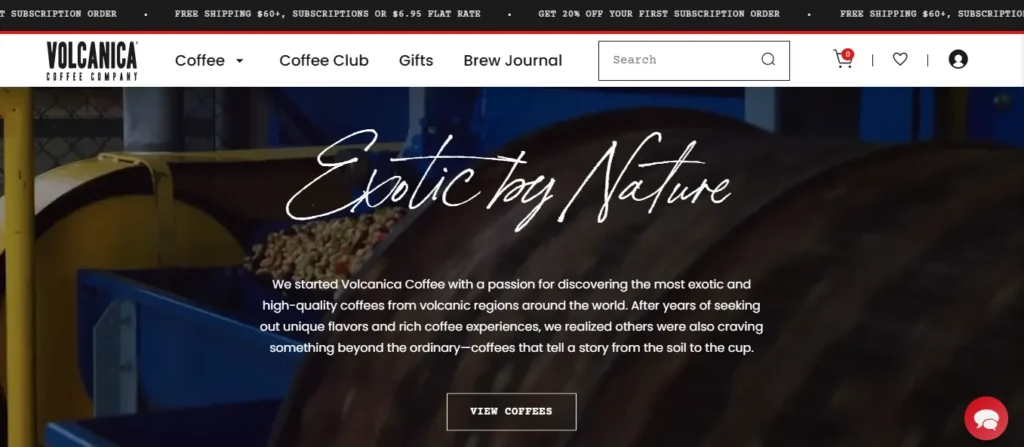
The company’s inspiration came from family trips to Costa Rica. Coffee farming also runs through the family. Its mother and grandfather reportedly helped harvest coffee in Costa Rica’s mountain regions.
That heritage explains the catalog.
Volcanica focuses heavily on coffees from established high-altitude regions, including:
It also sells Colombian Supremo, Panama Geisha, peaberry coffees, low-acid blends, decaf coffee, flavored beans, espresso roasts, and sample packs.
The catalog is broad without feeling completely random.
Many listings include the farm, altitude, processing method, roast level, certifications, and expected flavours. That gives shoppers more information than most mass-market coffee brands provide.
Is Volcanica Coffee Really Grown in Volcanic Soil?
Many Volcanica coffees come from volcanic growing regions. That part is legitimate.
Costa Rica’s Tarrazu region, Indonesia’s mountain zones, Hawaii’s Kona district, Guatemala, Kenya, and parts of Ethiopia all have volcanic geology somewhere in their agricultural story.
Still, “volcanic coffee” is not a formal quality grade.
There is no universal volcanic-coffee certification. A bag does not earn an automatic 90-point cup because the farm sits near an old crater.
Volcanic soil is an advantage… not a verdict.
Young volcanic soils can contain useful minerals and drain water efficiently. Coffee roots dislike sitting in waterlogged ground. Good drainage matters.
Higher elevations also bring cooler temperatures. Cherries usually mature more slowly there. That longer development can support denser seeds, clearer acidity, and more developed sugars.
But soil is one variable.
A poorly picked, badly fermented coffee grown on volcanic land will still taste poor. A skilled producer working non-volcanic soil can produce a superb lot.
Volcanica’s name works best as a sourcing philosophy. Treating it as scientific proof of flavour would be marketing nonsense.
What Does Volcanica Coffee Taste Like?
Volcanica does not have one house flavour.
Its best coffees taste distinct because the company lets region and processing lead. The medium roasts remain approachable, though they are rarely ultra-light Nordic-style roasts.
That makes the catalog friendly to regular drip-coffee drinkers.
You get more origin character than supermarket coffee. You generally get less sharp acidity than aggressively light specialty roasts.
Costa Rica Original Tarrazu
This is the safest starting point.
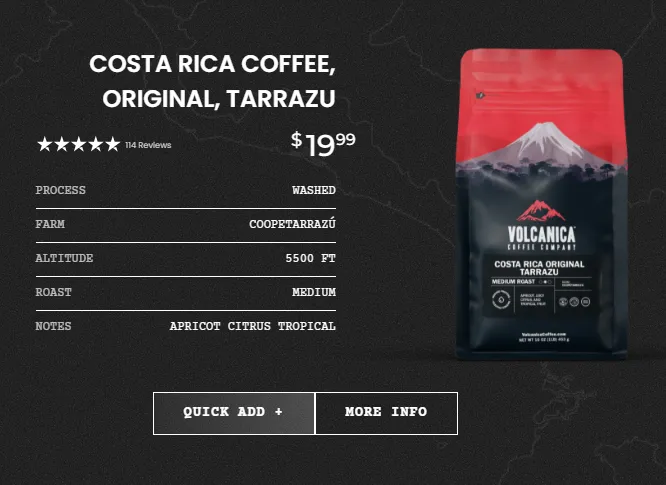
The Costa Rica Original Tarrazu is a washed, medium-roast coffee grown around 5,500 feet. Volcanica identifies Coopetarrazú as the producing cooperative.
The cup leans towards apricot, juicy orange, mild honey, and toasted almond. The acidity is bright enough to stay lively. It never turns sour.
Its sweetness becomes clearer as the coffee cools.
This is not a wild fermentation bomb. It is clean, structured, and extremely drinkable. The finish carries soft cocoa and citrus peel.
This one earns its price.
At $19.99 for 16 ounces, it competes well with smaller specialty bags costing the same amount.
Ethiopian Yirgacheffe
The USDA Organic Ethiopian Yirgacheffe is Volcanica’s best option for fruit-driven coffee.
It is washed, medium-light roasted, and sourced from Ethiopia’s Gedeo Zone. The listed growing altitude reaches roughly 7,500 feet.
Expect lemon, blackberry, blueberry skin, tea, and light florals.
The fruit is cleaner than a natural-process Ethiopian. You will not get the heavy strawberry-jam character found in fermented naturals. This is crisper. More controlled.
Its medium-light roast keeps the acidity present without making the cup painfully sharp.
People moving from dark roast may find it thin. Pour-over drinkers will understand it immediately.
Our guide to Ethiopian Yirgacheffe coffee explains why washed lots from this region often taste cleaner and more floral than natural-process versions.
Sumatra Mandheling
The Sumatra Mandheling goes in the opposite direction.
It is heavier, earthier, and lower in perceived acidity. The body feels syrupy. The cup tastes like toffee, dried fig, cocoa, cedar, and sweet herbs.
This is the coffee for French press, moka pot, or anyone who finds East African acidity exhausting.
There is one editorial problem.
Volcanica’s product page labels the coffee as washed in one section. The same page describes the beans as semi-washed or wet-hulled elsewhere. It also displays inconsistent pH figures.
Wet hulling is the explanation that fits the classic Mandheling character. The page needs tighter editing.
The flavour still makes sense. The technical listing does not.
Kenya AA
Volcanica’s Kenya AA comes from Nyeri Hill Estate and is grown around 6,000 feet.
This is the liveliest coffee in the regular lineup. It tastes like cranberry, raspberry, red currant, and black tea.
It is not soft.
The acidity arrives quickly and stays through the finish. Add milk and you lose much of what makes it interesting.
Brew it black. Let it cool for five minutes. The fruit becomes far easier to identify.
At $26.99 per 16-ounce bag, it is one of Volcanica’s more expensive core coffees. The price still looks reasonable beside many specialty Kenya offerings.
Costa Rica Peaberry
The Costa Rica Peaberry is sweeter and rounder than the Original Tarrazu.
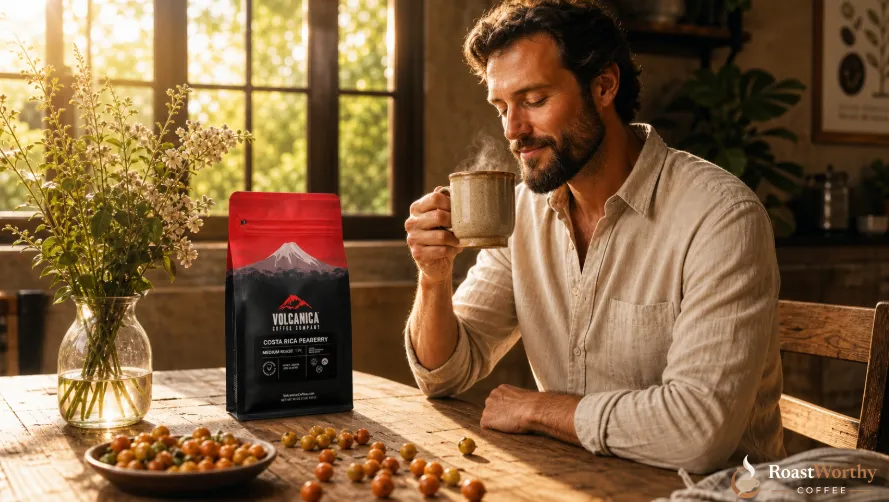
Volcanica sources it from Coopetarrazú and Finca La Candelilla. It is washed, medium roasted, and listed at 5,500 feet.
The cup tastes like lemon, almond brittle, honey, and mild baking spice.
Peaberry coffee is often marketed as stronger or naturally superior. That claim is oversold. A peaberry is simply a coffee cherry containing one rounded seed instead of two flat-sided seeds.
This lot is good because it is well sourced and sensibly roasted. Not because the bean is round.
Best Volcanica Coffee Beans Ranked
| Volcanica coffee | Roast | Main flavours | Best brew method | Price* | Score |
|---|---|---|---|---|---|
| Costa Rica Original Tarrazu | Medium | Apricot, citrus, honey | Drip or Chemex | $19.99 | 8.7/10 |
| Ethiopian Yirgacheffe | Medium-light | Lemon, blueberry, florals | V60 or AeroPress | $22.99 | 8.6/10 |
| Kenya AA | Medium-light | Raspberry, cranberry, tea | Pour-over | $26.99 | 8.5/10 |
| Costa Rica Peaberry | Medium | Honey, almond, lemon | Drip or AeroPress | $24.99 | 8.4/10 |
| Sumatra Mandheling | Medium | Toffee, dried fruit, herbs | French press | $21.99 | 8.1/10 |
| Colombian Supremo | Medium | Chocolate, orange, caramel | Drip or espresso | $19.99 | 8.0/10 |
*Prices shown for available 16-ounce whole-bean options during this review. Coffee prices can change.
Roast Freshness and Grind Options
Volcanica says it roasts each week according to expected demand.
Most orders ship within a few days of roasting. The company says it does not ship coffee carrying a roast date older than two weeks.
That is good. It is not the same as roasting every individual order after checkout.
Some tiny specialty roasters roast only after an order arrives. Volcanica runs a larger weekly production schedule. That approach offers faster fulfilment but creates a wider freshness window.
Expect fresh coffee… not necessarily coffee roasted yesterday.
Whole bean remains the right choice. Grind immediately before brewing.
Volcanica also offers:
Ground coffee orders may ship later because the company allows freshly roasted beans to release gas before grinding.
That delay makes technical sense. Grinding coffee immediately after roasting can produce excessive carbon dioxide and unstable extraction.
Volcanica Coffee Pricing: Is It Good Value?
Volcanica occupies the middle of the specialty coffee market.
Its regular 16-ounce bags commonly cost between $19.99 and $26.99. That works out to roughly $1.25 to $1.69 per ounce.
Many modern specialty roasters charge $20 to $25 for 10 or 12 ounces. Volcanica often gives you four to six extra ounces for comparable money.
That makes the Costa Rica Tarrazu, Colombian Supremo, Tanzania Peaberry, and espresso roast particularly good values.
The rare coffees are another story.
Jamaican Blue Mountain and Kona Peaberry options can cost well above $100 per bag. One Jamaican estate coffee has been listed near $160.
Those prices reflect scarce origins, protected names, labour costs, and luxury demand. They do not mean the coffee will taste eight times better than the $19.99 Tarrazu.
It will not.
Volcanica offers its best value below $30.
The Jamaican and Kona selections are gifts or curiosity purchases. They are not sensible daily coffees.
Is the Volcanica Coffee Subscription Worth It?
Volcanica has two subscription systems.
Subscribe & Save
This is the better option for repeat buyers.
You choose an individual coffee and set a delivery interval. Current benefits include:
There is no stated order minimum for Subscribe & Save.
The discount makes a $19.99 bag roughly $15.99 on the first shipment and $17.99 afterwards, before cashback. That is strong value for a 16-ounce specialty coffee.
Volcanica Coffee Club
The Coffee Club offers three or six 8-ounce coffees per box.
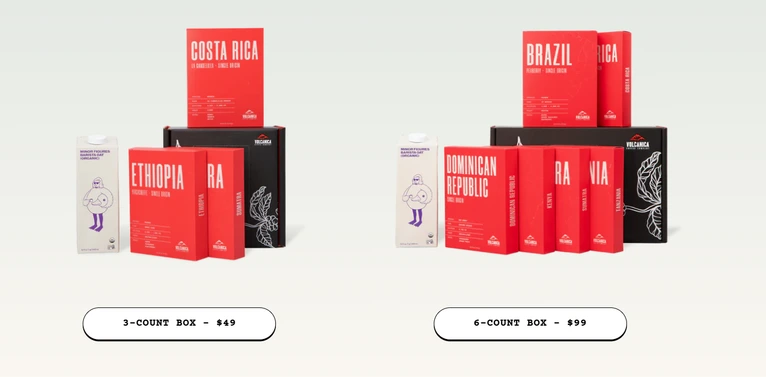
The three-coffee box costs $49. The six-coffee box costs $99. Shipping is included, and members receive oat milk as a recurring perk.
On coffee weight alone, both boxes cost around $33 per pound.
That is more expensive than buying most full-size Volcanica bags. The club makes sense for variety, gifting, and smaller portions. It is not the cheapest route.
Subscribe & Save wins on value. Coffee Club wins on exploration.
Mold Testing and Low-Acid Claims
Volcanica uses “mold-free” language in its Coffee Club marketing.
The company says imported coffees receive phytosanitary checks and laboratory testing for mycotoxins such as ochratoxin A.
That is more specific than the vague purity claims used by many wellness-coffee brands.
Still, “mold-free coffee” is not a unique roast style. It should not command a huge premium by itself.
Volcanica also sells designated low-acid coffees and gives pH figures for selected products. Sumatra Mandheling and darker roasts may feel gentler because they carry lower perceived acidity.
Low-acid coffee is not automatically safe for every sensitive stomach. Roast level, brew strength, portion size, and individual tolerance all matter.
👉 Read our best low-acid coffee guide before treating a pH number as a health promise.
Volcanica Coffee Pros and Cons
What Volcanica Gets Right:
What Could Be Better:
How to Brew Volcanica Coffee
1. For Ethiopian Yirgacheffe or Kenya AA
![The V60 Guide: Crafting the Perfect Pour-Over Coffee [2024 Guide]](https://roastworthy.coffee/wp-content/cache/flying-press/760d14c1ad2186ef181543bd0c16922b.jpg)
Use a V60 or similar cone brewer.
Pour slowly. Keep the water level consistent. These coffees become harsh when extraction runs too fast.
2. For Costa Rica Tarrazu
Use an automatic drip machine, flat-bottom brewer, or AeroPress.
This ratio keeps the citrus clean while giving the caramel sweetness enough weight.
3. For Sumatra Mandheling
Use a French press.
Pour gently. Leave the final centimetre in the press. That reduces sediment and keeps the woody finish under control. ☕
Who Should Buy Volcanica Coffee?
Volcanica suits drinkers who want recognizable origins without paying boutique-roaster prices for tiny bags.
Buy it when you:
Skip it when you:
Frequently Asked Questions
Is Volcanica Coffee a legitimate company?
Yes. Volcanica is a family-owned specialty coffee roaster operating near Atlanta, Georgia. It sells single-origin, organic, decaf, flavored, low-acid, and rare-origin coffees.
Is all Volcanica Coffee grown in volcanic soil?
The company focuses on beans sourced from volcanic growing regions. Volcanic geology varies by farm, and volcanic soil is not an official coffee-quality certification.
What is the best Volcanica Coffee?
Costa Rica Original Tarrazu is the best starting point. It offers clean citrus, apricot sweetness, moderate acidity, and strong value at $19.99 per 16-ounce bag.
Does Volcanica roast coffee to order?
Volcanica roasts weekly according to expected demand. It says most coffees ship within a few days of roasting and none ship with roast dates older than two weeks.
Is Volcanica Coffee low acid?
Volcanica sells dedicated low-acid coffees. Sumatra Mandheling and darker roasts also have lower perceived acidity than bright Ethiopian or Kenyan coffees.
Does Volcanica offer free shipping?
US orders of at least $60 generally qualify for free standard shipping. Subscribe & Save and Coffee Club orders also include free shipping in eligible areas.
Final Verdict: Is Volcanica Coffee Legit?
Yes. Volcanica Coffee is a legitimate specialty roaster with better sourcing depth than its dramatic name suggests.
The company’s regular single-origin range is the reason to shop here. Costa Rica Tarrazu, Ethiopian Yirgacheffe, Kenya AA, and Sumatra Mandheling offer clearly different cups.
The standard pricing is fair. Full-pound bags strengthen the value considerably.
The weaknesses are mostly editorial. Some listings contradict themselves. The volcanic wording occasionally stretches past what soil alone can prove.
None of that ruins the coffee.
Start with the Costa Rica Original Tarrazu. It is sweet, clean, forgiving, and fairly priced. Move to the Yirgacheffe when you want more fruit.
The flavour doesn’t lie.
More Recommendations from RoastWorthy Coffee