How to Make Pour Over Coffee: A Step-by-Step Beginner’s Guide

Pour over coffee is the cleanest cup you can make at home. No machine. No pods. Just hot water, ground coffee, and a filter doing exactly what you tell it to.
And here's the honest part… most people get it wrong on the first try. Bad grind. Cold water. A pour that floods the bed in ten seconds. The result tastes thin, sour, or weirdly bitter.
This pour over coffee guide fixes that. Real numbers. Real technique. The kind that actually ranks in the cup.
TL;DR — The 30-Second Version
What Pour Over Coffee Actually Is
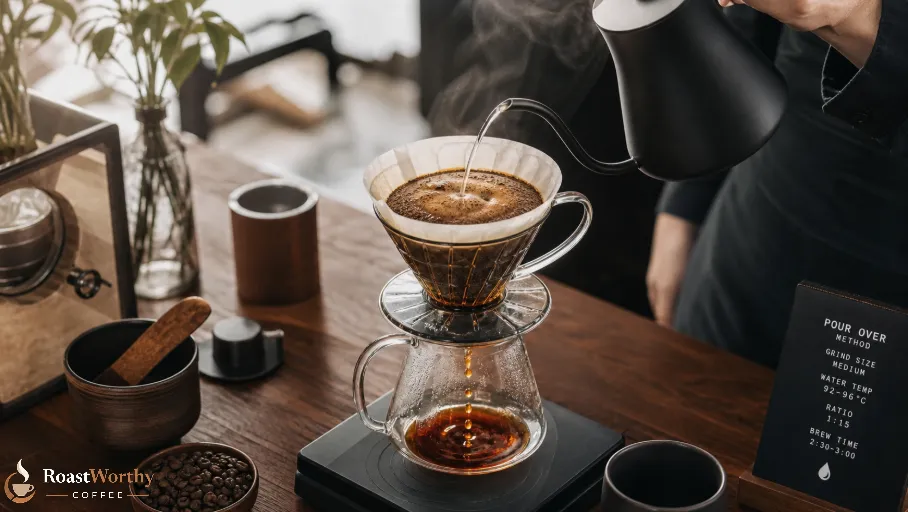
Pour over is a manual drip method. You pour hot water over coffee grounds sitting in a filter, and gravity pulls the brewed coffee into a cup or carafe below.
That's it. The genius is control.
You decide the water temperature, the speed of the pour, the grind, the timing. Espresso hides those variables behind a machine. Pour over puts them in your hands. ☕
The trade-off is simple. More control means more responsibility. Sloppy technique shows up instantly in the cup.
The Tools You Need
You don't need a $400 setup. You need five things that do their jobs well.
| Tool | Why it matters | Beginner pick |
|---|---|---|
| Dripper | Shapes flow and extraction | Hario V60 (size 02) |
| Gooseneck kettle | Controls pour rate precisely | Any gooseneck, electric ideal |
| Burr grinder | Even grind = even extraction | Hand grinder is fine to start |
| Digital scale | Coffee is measured, not eyeballed | 0.1g resolution |
| Paper filters | Cleaner cup, less sediment | Brand-matched to dripper |
Two of these are non-negotiable. The gooseneck kettle and the scale.
A gooseneck spout gives you a thin, controlled stream. You want roughly 2–4ml per second during the bloom and 4–6ml per second on the main pour. A regular kettle dumps water and ruins the bed. You cannot pour over without control.
The scale matters because guessing scoops is how people make inconsistent coffee for years. Weigh it. Every time.
The Pour Over Ratio (Get This Right First)
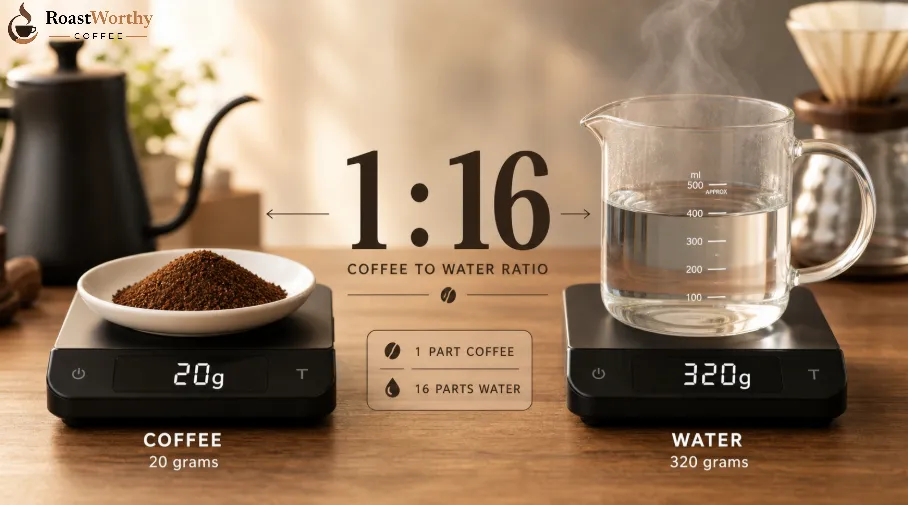
Start with 1:16. One gram of coffee for every 16 grams of water.
For a single large mug, that's 20g of coffee and 320g of water. Want it stronger? Move toward 1:15. Want it lighter and more tea-like? Try 1:17.
Don't overthink it on day one. Lock 1:16 in. Change one variable at a time later.
Here's the thing nobody tells beginners… water is also weighed in grams, not measured in milliliters by eye. 1 gram of water equals roughly 1ml. Your scale handles both. One tool, two jobs.
Grind Size and Drip Rate
Grind size controls how fast water moves through the bed. This is the variable beginners ignore. Don't.
For a V60, aim for a medium grind — think coarse table salt or fine sea salt. Too fine and water stalls, over-extracts, turns bitter. Too coarse and water rushes through, under-extracts, tastes sour and weak.
The drip rate is your feedback signal:
The clock doesn't lie. Use it to dial in your grind across a few brews.
Water Temperature
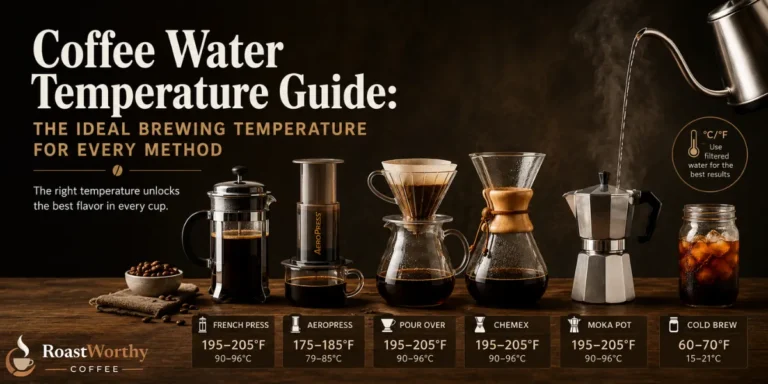
Use water between 92°C and 96°C (198–205°F). Off-boil is the sweet spot.
If you don't have a temperature-controlled kettle, boil the water and let it rest 30–45 seconds. That drop gets you in range.
One real-world note on gooseneck kettles: the long unheated spout cools water on the way out. Early pours can run 5–10°C cooler than the internal reading. Light roasts especially like it hot, so don't under-shoot the temperature.
The Bloom Technique
The bloom is the most important 45 seconds in pour over. Skip it and your coffee tastes flat.
Here's what's happening. Fresh coffee holds trapped carbon dioxide. When hot water hits it, the gas escapes and the grounds puff up and bubble — that's the bloom. Until that CO2 clears, water can't extract flavor evenly. ⚗️
The move:
- Pour 40–50g of water over the grounds. Roughly twice the weight of your coffee.
- Wet everything. No dry pockets.
- Wait 30–45 seconds. Watch it rise and settle.
Fresher beans bloom harder. If your coffee barely fizzes, the beans are stale. The bloom is also a freshness test.
How to Make Pour Over Coffee: Step-by-Step
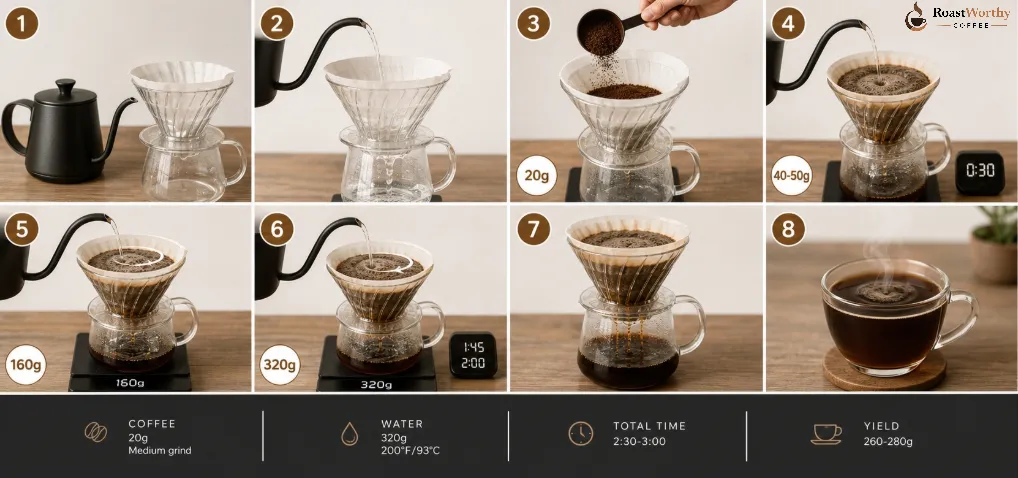
Here's the complete pour over brewing sequence. 20g coffee, 320g water, V60.
1. Boil and prep. Heat water to ~96°C. Place the paper filter in the dripper.
2. Rinse the filter. Pour hot water through the empty filter into your cup, then discard that water. This kills the papery taste and preheats everything. Don't skip it.
3. Grind and dose. Grind 20g of coffee at medium. Add it to the rinsed filter. Tap to level the bed flat.
4. Tare and bloom. Put the dripper on the scale, zero it. Pour 40–50g of water, saturating all grounds. Start your timer. Wait 30–45 seconds.
5. First main pour. Pour in slow, steady circles from the center outward. Bring the total to about 160g. Keep the stream thin and controlled.
6. Second pour. Let the water level drop slightly, then pour again up to your full 320g. Finish all pouring by around the 1:45–2:00 mark.
7. Let it draw down. Don't touch it. Water filters through the bed. Total brew time should land between 2:30 and 3:30.
8. Serve and assess. Swirl the cup gently. Taste it. Sour means under-extracted (grind finer). Bitter and hollow means over-extracted (grind coarser).
Taste it. Write it down. Brew it again.
V60 Pour Over Tutorial: Common Mistakes
Most bad pour overs come from the same handful of errors. Fix these and you jump levels fast.
Let's be honest. Nail the grind and the ratio, and you're already brewing better than most cafés serving drip.
Light vs Medium Roast: Quick Adjustments
Roast level changes how you brew. A light roast is denser and harder to extract.
| Variable | Light roast | Medium/dark roast |
|---|---|---|
| Water temp | 95–96°C | 90–93°C |
| Grind | Slightly finer | Slightly coarser |
| Ratio | 1:16 | 1:15–1:16 |
| Goal | Coax out brightness | Avoid over-extraction |
Light roasts reward heat and patience. Dark roasts give up flavor easily, so back off the temperature so it doesn't turn ashy.
Key Takeaways
Your first pour over will be imperfect. Make it anyway.
Frequently Asked Questions
What's the best coffee-to-water ratio for pour over?
Start at 1:16 — one gram of coffee per 16 grams of water. Adjust toward 1:15 for stronger coffee or 1:17 for a lighter cup.
Do I really need a gooseneck kettle?
Yes, if you want consistency. The narrow spout lets you control pour speed (2–6ml per second), which directly affects extraction. A regular kettle floods the coffee bed.
Why do you bloom pour over coffee?
Blooming releases trapped CO2 from fresh coffee. Until that gas escapes, water can't extract evenly. A 30–45 second bloom with 40–50g of water sets up the whole brew.
What grind size should I use for pour over?
Medium — similar to table salt. If your brew finishes under two minutes, grind finer. If it drags past four minutes, grind coarser.
How long should a pour over take?
Total brew time should land between 2:30 and 3:30 for a single cup. Faster usually means under-extracted (sour); slower means over-extracted (bitter).
What water temperature is best?
Between 92–96°C (198–205°F). No temperature kettle? Boil, then wait 30–45 seconds before pouring.
Disclosure: Roastworthy may earn a commission on gear purchased through our links. We only recommend tools we'd brew with ourselves.