Coffee Brewing Ratios: Grams Per Cup for Every Brew Method

Your coffee tastes weak. Or bitter. Or just… off.
Nine times out of ten, it's not your beans. It's your ratio.
Coffee brewing ratios are the single most controllable variable in your cup. Not your grinder. Not your kettle. The ratio. Get it wrong and nothing else saves you.
Here's what the numbers actually mean — and what to use for every method.
What Is a Coffee Brewing Ratio?
A brew ratio is the relationship between coffee and water. Usually expressed as 1:X — one part coffee to X parts water.
So a 1:15 ratio means 1g of coffee for every 15g of water. Simple math. Serious results.
Most people measure in tablespoons and cups. That works at the kitchen counter. But grams per cup is more precise — and precision is the difference between a repeatable cup and a lucky one.
The Specialty Coffee Association (SCA) sets the golden ratio coffee standard at 1:15 to 1:18 for most filter brewing. That's your starting point. Not your final answer.
Why Ratios Matter More Than You Think
TDS — Total Dissolved Solids — is what you're actually tasting. It measures how much coffee is extracted into your water.
Too low a ratio (say, 1:20 or weaker) and your TDS drops. The cup tastes thin. Sour. Under-extracted.
Too high a ratio (1:10 or stronger) and TDS climbs. You get bitterness. Astringency. Over-extracted tannins.
Coffee strength lives in the ratio. The extraction lives in your grind, temperature, and time. But ratio sets the ceiling and the floor.
The curve doesn't lie.
The Brew Ratio Guide: Every Method, Every Number
Pour-Over (V60, Chemex, Kalita Wave)
Ratio: 1:15 to 1:17
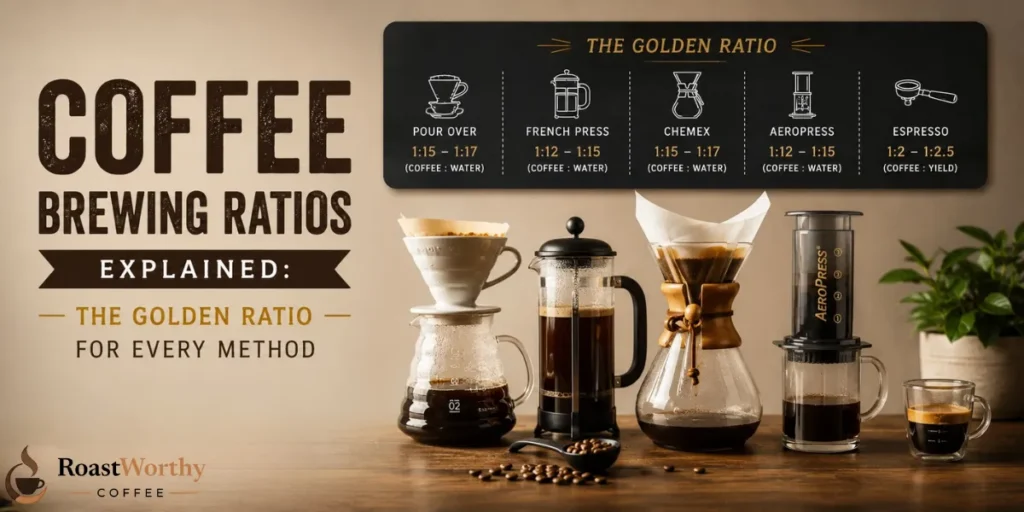
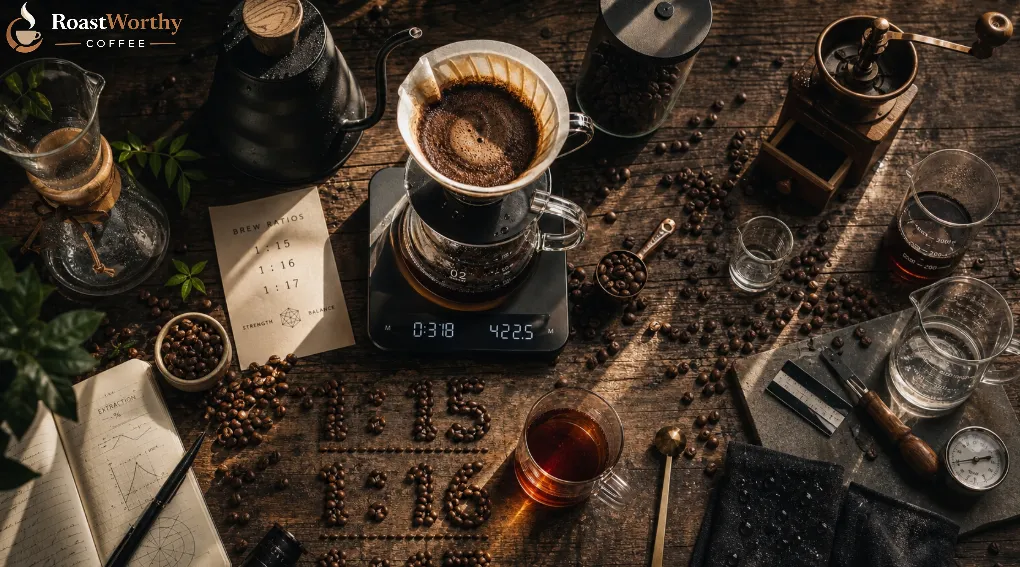
This is the sweet spot for filter drip brewing. A 1:15 ratio gives you a fuller, more intense cup. A 1:17 ratio opens it up — brighter, cleaner, more delicate.
For light roasts, go 1:15. The density of a light roast needs more contact time and a tighter ratio to extract properly.
For medium roasts, 1:16 is the workhorse number.
A practical example: 20g of coffee → 320ml of water (1:16). That's one solid 10oz cup. Write that down.
One tablespoon per cup gets you nowhere near this accuracy. Switch to a scale. A $10 kitchen scale changes your coffee permanently. ⚗️
French Press
Ratio: 1:12 to 1:15
French press is full immersion. The grounds sit in water the whole time. That changes the math.
A tighter ratio — 1:12 — produces the thick, heavy body French press is known for. Go to 1:15 and it starts tasting more like drip. Still good. Just different.
Standard starting point: 1:13. It's rich without being sludgy.
For a 350ml French press: 27g of coffee. Four-minute steep. Press slow.
If your French press always tastes muddy, your grind is too fine — not your ratio. Fix the grind first. Then adjust the ratio.
AeroPress
Ratio: 1:6 to 1:15
AeroPress is the wildcard. It's designed for flexibility.
Inverted method at 1:6 gives you a concentrate — closer to a pseudo-espresso. Add hot water to taste after pressing.
Standard upright method at 1:13 to 1:15 gives you a clean, filtered cup with less body than French press.
The AeroPress World Championship has been won with ratios across the full spectrum. There is no wrong answer here. Start at 1:12 and adjust from there. ☕
Espresso
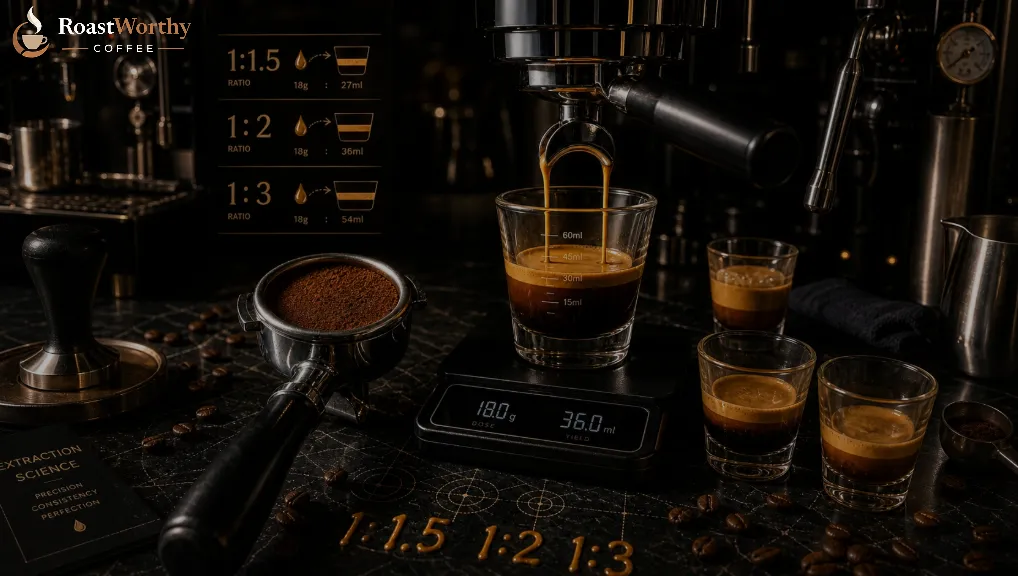
Ratio: 1:1.5 to 1:3
This is where the numbers shift dramatically.
A 1:2 brew ratio (18g in → 36g out) is the standard specialty espresso target. It's been the industry benchmark for years.
A ristretto pulls tight — 1:1 to 1:1.5. More concentrated. Sweeter. Less bitter.
A lungo stretches to 1:3 or beyond. More bitter. More caffeine extracted.
The 1:2 ratio is where most espresso tastes best. It's not a rule — it's a pattern backed by thousands of shots.
Your shot weight is your ratio. If you're pulling by time alone and ignoring the output weight, you're flying blind.
Cold Brew
Ratio: 1:4 to 1:8 (concentrate to cup)
Cold brew is brewed as a concentrate, then diluted.
A 1:4 ratio (steep ratio) gives you a strong concentrate. Dilute 1:1 with water or milk before drinking.
A 1:8 steep ratio produces something closer to ready-to-drink strength. No dilution needed.
Steep time matters here more than almost any other method — 12 to 24 hours at room temperature, or up to 48 hours cold. The ratio interacts with time. A tighter ratio needs less time.
Moka Pot
Ratio: 1:7 to 1:10
A Moka pot is not espresso. It can't build the 9 bars of pressure espresso needs. But it's strong, syrupy, and excellent if you respect the ratio.
Fill the basket level. Don't tamp. Fill the lower chamber to just below the pressure valve. That geometry is your ratio.
Typical output is about 1:7. Richer than drip. Thinner than espresso. Perfect for an Americano base.
Tablespoon Per Cup vs. Grams Per Cup
Let's settle this.
Two tablespoons per 6oz cup is the standard volumetric recommendation. It works. It's not precise.
Ground coffee is not uniform in density. A tablespoon of a coarsely-ground medium roast weighs about 5g. A tablespoon of a finely-ground dark roast can weigh 7g or more. That's a 40% difference.
Grams per cup wins. Always. Use 10–12g per 6oz cup as your baseline. Adjust from there.
If you only have a tablespoon and a measuring cup, use 2 tablespoons per 6oz. Just know your margin of error is real.
How to Adjust Your Ratio for Taste
This is the part nobody writes down.
| Tastes Like | Problem | Fix |
|---|---|---|
| Watery, sour | Under-extracted or too weak | Tighten ratio (less water) or grind finer |
| Bitter, harsh | Over-extracted or too strong | Loosen ratio (more water) or grind coarser |
| Flat, no sweetness | Under-extracted | Increase water temp + tighten ratio |
| Too intense | Over-strength | Loosen ratio first before adjusting grind |
Taste it. Write it down. Roast it again. (Or in this case — brew it again.)
Change one variable at a time. If you adjust ratio and grind simultaneously, you learn nothing.
The Golden Ratio: Does One Number Exist?
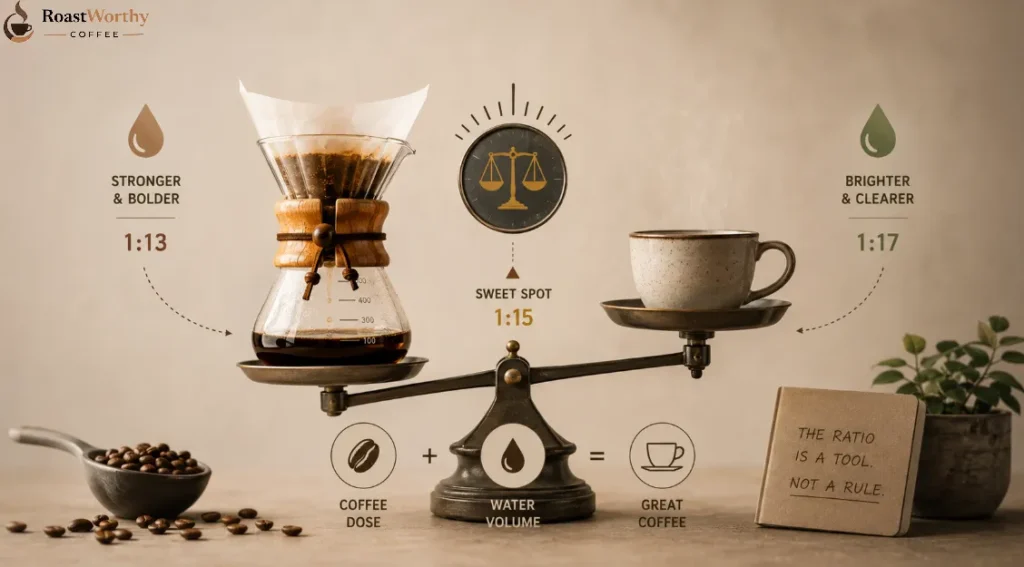
Honestly? No.
The “golden ratio coffee” idea — usually cited as 1:15 or 1:17 — is a useful starting point. The SCA's 55g per litre (roughly 1:18) is calibrated for American-style filter coffee. Specialty third-wave brewing tends to tighten that to 1:15.
But your palate is the final judge.
If you like strong coffee, live at 1:13 for pour-over. If you prefer brightness and clarity, go 1:17. Neither is wrong. Both are intentional.
The ratio is a tool. Not a rule.
FAQ: Coffee Brewing Ratios
What is the standard coffee to water ratio?
For most filter methods, 1:15 to 1:17 is the starting point. Espresso uses 1:2. Cold brew concentrate uses 1:4 to 1:6.
How many grams of coffee per cup?
For a standard 250ml cup using pour-over or drip, use 15–17g of coffee. Adjust by taste from there.
What does 1:15 ratio mean in coffee?
It means 1 gram of coffee for every 15 grams of water. For a 300ml brew, that's 20g of coffee.
Is the golden ratio coffee 1:15 or 1:17?
Both are cited as “golden ratio” depending on the source. The SCA standard is closer to 1:18 for drip coffee. Specialty cafés often use 1:15 to 1:16 for more intensity. Start at 1:15 and adjust.
Why does my coffee taste weak even with the right ratio?
Check grind size first. Too coarse a grind under-extracts regardless of ratio. Also check water temperature — below 90°C drops extraction fast.
How many tablespoons of coffee per cup?
Two tablespoons per 6oz cup is the general rule. For better accuracy, use a scale: 10–12g per 180ml is more reliable.
A scale. A ratio. A timer. That's the whole system. Everything else is refinement. 🔥
More Recommendations from RoastWorthy Coffee