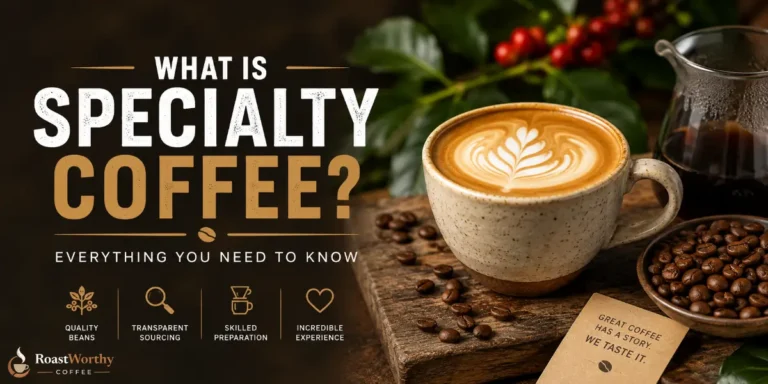
How Much Caffeine Is in a Cup of Coffee? The Complete Breakdown

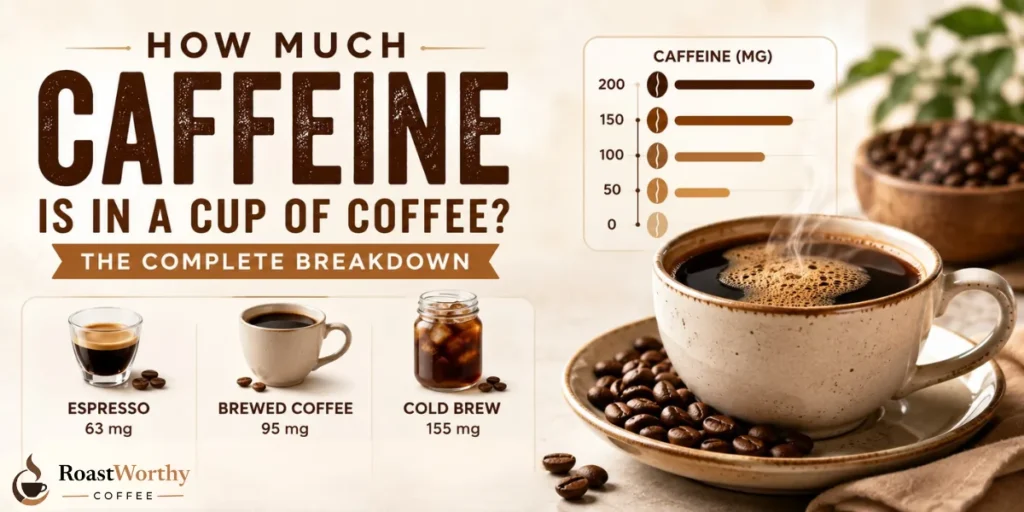
Here's the short answer: an 8-ounce cup of brewed coffee has about 95mg of caffeine.
But that number lies. Sort of.
Because your actual cup could hold 30mg. Or 200mg. The range is enormous… and almost nobody tells you why.
I've logged eight hundred roast profiles in my garage. The caffeine question comes up constantly. So let's settle it with real numbers — not vague guidance. ⚗️
TL;DR — Caffeine Content at a Glance
If you only read one box, read this one.
The average sits near 95mg. Your real number varies — a lot. Keep reading and you'll know exactly why.
What Actually Drives Caffeine Content in Coffee
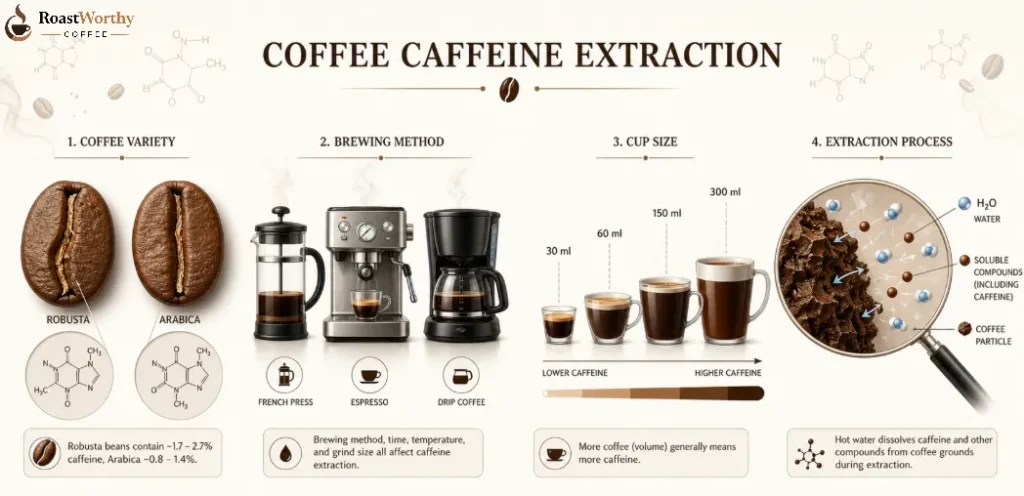
Four things decide your number. That's it.
- The bean species (Robusta or Arabica)
- The brew method
- The serving size
- The grind and contact time
Here's what's actually happening. Caffeine is water-soluble. The more water touches the grounds, and the longer it stays in contact, the more caffeine you pull out.
It's extraction. Same principle as steeping tea. Time plus surface area plus temperature equals more caffeine in the cup.
Roast level? Barely matters. We'll bust that myth in a minute.
Robusta vs Arabica Caffeine: The Bean Decides
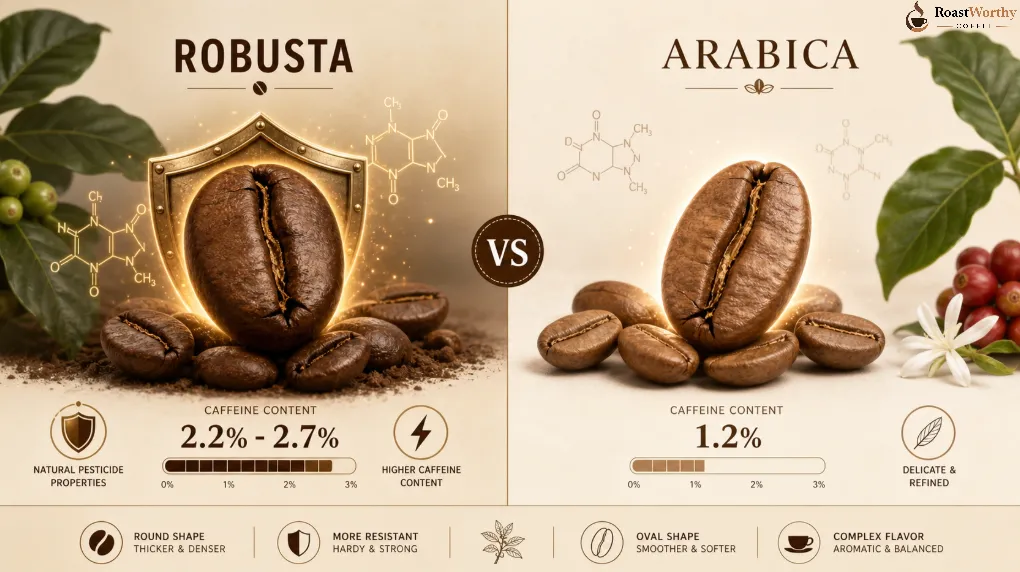
This is the biggest lever. And most people skip right past it.
Robusta beans contain roughly twice the caffeine of Arabica.
The raw numbers:
Arabica is what specialty coffee is built on. Sweeter, more complex, lower caffeine. Robusta is harsher, more bitter, and absolutely loaded with caffeine.
Why the gap? Caffeine is a natural pesticide. The plant makes it to defend itself. Robusta grows lower, hotter, and under more bug pressure — so it builds more chemical armour.
That cheap supermarket blend hitting you like a freight train? Probably heavy on Robusta.
Your single-origin Ethiopian pour-over? Pure Arabica. Less caffeine than you'd guess. Smoother, too.
So if caffeine sensitivity is your concern, the bean on the bag matters more than anything else you'll do.
Caffeine by Brew Method
The coffee vs espresso caffeine debate confuses everyone. Let me lay it out clean.
| Brew Method | Serving Size | Caffeine (mg) |
|---|---|---|
| Espresso | 1 oz (single shot) | 63 |
| Drip / filter coffee | 8 oz | 95 |
| French press | 8 oz | 80–100 |
| Pour-over | 8 oz | 90–115 |
| Cold brew | 8 oz | 100–200 |
| Instant coffee | 8 oz | 62 |
| Moka pot | 2 oz | 100–125 |
| Decaf | 8 oz | 2–5 |
Notice something? Espresso looks low at 63mg.
But that's per ounce of liquid. Espresso is the most concentrated coffee you can make. Ounce for ounce, it's the strongest thing in the cup.
You just drink far less of it.
A full mug of drip coffee carries more total caffeine than one espresso shot. That's the part people miss every single time.
The Espresso Myth, Settled
Espresso has more caffeine per ounce. Drip has more caffeine per cup.
Both statements are true. They're just measuring different things.
Run the math:
Close. But the drip usually wins on total volume.
So next time someone calls espresso “stronger,” ask them: stronger how? Per ounce, or per serving?
Per ounce, espresso wins easily. Per serving, the big mug of drip takes it. Language is doing the lying here, not the coffee. ⚗️
Does Roast Level Change Caffeine? (The Big Myth)
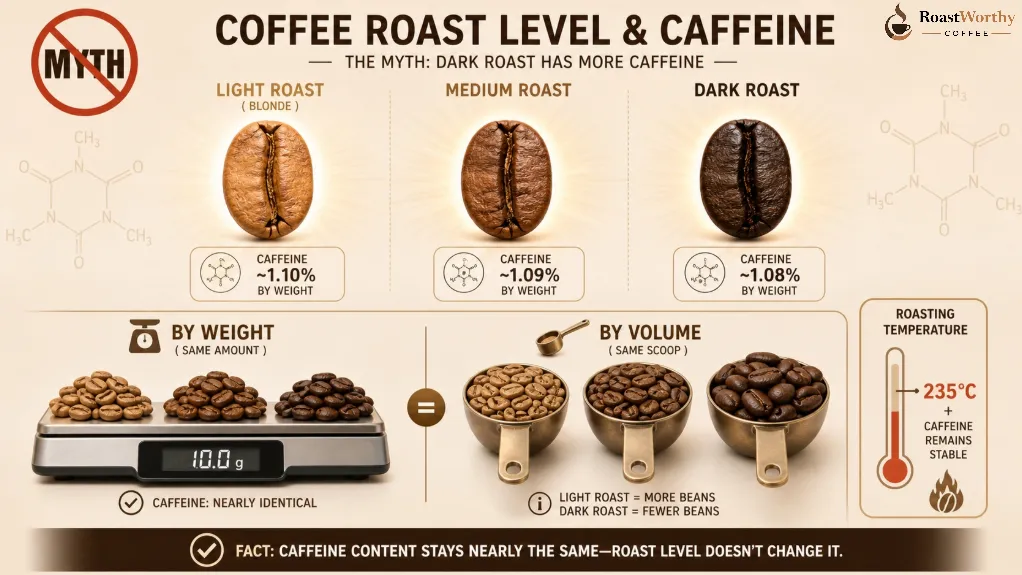
Here's what the heat is actually doing.
Roasting burns off almost no caffeine. Caffeine is remarkably stable — it stays intact up to about 235°C. Your roaster never holds that temperature long enough to matter.
So light and dark roasts carry nearly identical caffeine by weight.
The confusion comes from how you measure your dose.
Either way, the difference is tiny. Single digits of milligrams.
Stop stressing about roast level for caffeine. The bean species matters a hundred times more. So does how big your cup is.
The “dark roast is stronger” idea is about flavour intensity, not caffeine. Two completely different things.
Cold Brew: The Sneaky Heavyweight
Cold brew fools people. It tastes smooth. Low acid. Easy-drinking.
But it steeps for 12 to 24 hours. That long contact time pulls out serious caffeine.
A typical cold brew concentrate can hit 200mg+ per 8 oz before you dilute it. Even watered down, you're often above hot drip.
Smooth doesn't mean weak. Respect the cold brew — that gentle taste hides a real punch.
I've watched people slam two glasses on a hot afternoon and wonder why they can't sleep. The contact time is the answer.
How Caffeine Hits Your Body
Quick science, because it explains the rest.
Caffeine peaks in your blood about 30 to 60 minutes after you drink it. That's your window of alertness.
Its half-life is roughly 5 to 6 hours. So a 2pm coffee with 95mg means you've still got ~47mg in your system at 8pm. That's why afternoon coffee wrecks some people's sleep.
It works by blocking adenosine — the chemical that makes you feel tired. Caffeine sits in the receptor and locks fatigue out. Temporarily.
The crash later? That's the backed-up adenosine flooding in once the caffeine clears.
How Much Caffeine Is Too Much?
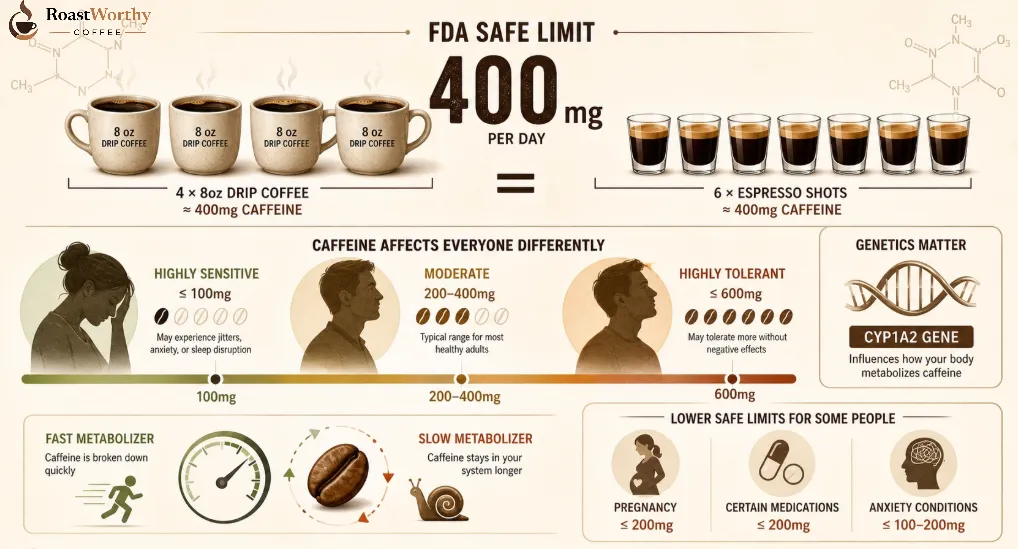
The FDA flags 400mg per day as a safe ceiling for healthy adults.
That's roughly four 8 oz cups of drip coffee. Or about six espresso shots.
Caffeine sensitivity is wildly personal, though. Some people fold at 100mg. Others run on 600mg and sleep like a baby.
The reason is genetic. A gene called CYP1A2 controls how fast your liver clears caffeine. Fast metabolizers barely feel it. Slow metabolizers feel one cup all afternoon.
Pregnancy, certain medications, and anxiety conditions lower your safe ceiling. When in doubt, track your own response — your body is the only data set that matters.
Signs You've Had Too Much
What About Caffeine Overdose?
Caffeine overdose is rare from coffee alone. You'd need somewhere around 10 grams to risk it — that's roughly 100 cups in a short window. Not happening by accident.
The real danger is caffeine pills and powders. Concentrated. Easy to misjudge. A teaspoon of pure caffeine powder can equal 28 cups of coffee. That's where overdose cases actually come from — not your morning brew.
Decaf Coffee: How Much Caffeine Is Really Left?
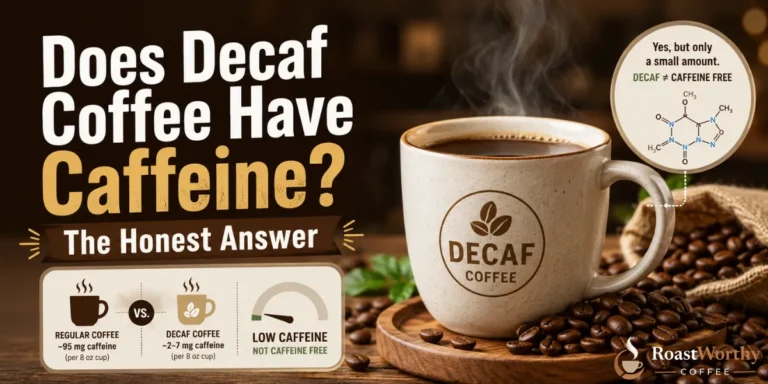
Decaf is not caffeine-free. Read that again.
A cup of decaf has about 2 to 5mg of caffeine.
Regulations require removing 97% of the caffeine. Not 100%. So a few milligrams always survive the process.
Drink five cups of decaf and you've had roughly a quarter of one regular cup. Worth knowing if you're genuinely caffeine-sensitive or cutting off late in the day.
The Swiss Water Process is my pick for decaf. No chemical solvents. Better flavour retention. Most quality roasters label it clearly — look for it.
A Quick Caffeine Reference for Common Orders
Real-world numbers for what people actually order:
The big chain drip coffee is the real surprise. Those large sizes stack caffeine fast — a 16 oz brewed coffee is double a standard cup before you've thought about it.
Add a second one mid-morning and you're already near the 400mg line.
How to Control Your Caffeine Intake
You have more control than you think. Here's how to dial it in.
Want less caffeine? Switch to Arabica. Drink espresso-based drinks in smaller volumes. Shorten your brew or steep time. Watch your cup size — that 16 oz mug is two servings, not one.
Want more? Choose a Robusta blend. Brew cold and long. Increase your coffee-to-water ratio. A typical ratio runs 1:16 (coffee to water) — push it toward 1:14 for a stronger, more caffeinated cup.
Want consistency? Weigh your beans. Same dose, same grind, same water every single time. The curve doesn't lie — and neither does your scale.
This is the engineer in me talking. If you measure it, you control it. Guesswork gives you guesswork. ⚗️
Frequently Asked Questions
How much caffeine is in a cup of coffee?
An 8 oz cup of brewed drip coffee has about 95mg of caffeine on average, though the real range runs from 30mg to over 200mg depending on the bean and brew method.
Does espresso have more caffeine than coffee?
Espresso has more caffeine per ounce (~63mg per shot), but a full cup of drip coffee usually carries more total caffeine because you drink a much larger volume.
Which has more caffeine, Robusta or Arabica?
Robusta has roughly twice the caffeine of Arabica — about 2.2–2.7% by weight versus 1.2%. Most specialty coffee uses Arabica, so it runs lower in caffeine.
Does dark roast have more caffeine than light roast?
Barely. Roasting doesn't destroy meaningful caffeine. By weight, dark roast has slightly more; by scoop, light roast does. The difference is negligible either way.
How much caffeine is too much in a day?
The FDA suggests up to 400mg daily for healthy adults — about four 8 oz cups of coffee. Sensitivity varies by genetics, so some people tolerate far less.
Does decaf coffee have any caffeine?
Yes. Decaf has about 2–5mg per cup because regulations only require removing 97% of the caffeine, not all of it.
How long does caffeine stay in your system?
Caffeine peaks 30–60 minutes after drinking and has a half-life of about 5–6 hours, which is why afternoon coffee can disrupt nighttime sleep.
The Bottom Line on Coffee Caffeine
So — how much caffeine is in a cup of coffee?
Call it 95mg for a standard 8 oz drip. But understand that's an average hiding a 30 to 200mg range.
The bean species is your biggest lever. Brew method is second. Serving size is third. Roast level barely registers at all.
Know your numbers. Track your own sensitivity. Brew accordingly. ☕
More Recommendations from RoastWorthy Coffee