Best Portable Espresso Makers (2026): Tested on the Road

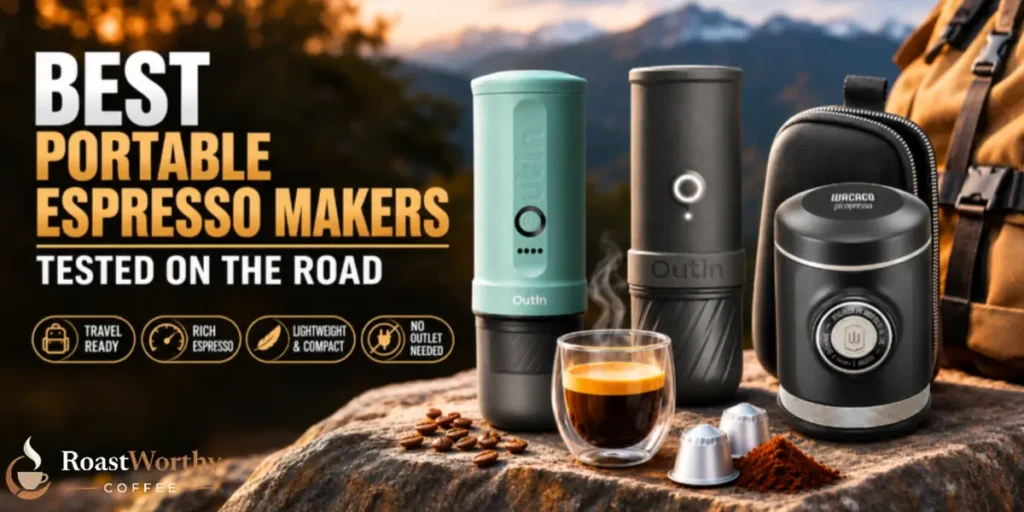
The best portable espresso makers can pull a real shot at a campsite, a desk or a hotel room. The catch is simple: every one of them makes you choose. Heat or weight. Convenience or shot quality.
Self-heating machines like the OutIn Nano 2 only need water and a charged battery. Manual presses like the Wacaco Picopresso make better espresso, but you have to bring boiling water.
My strongest overall pick is the OutIn Nano 2. It heats its own water, takes capsules or grounds, and its battery now lasts a weekend. If shot quality matters more than convenience, get the Wacaco Picopresso.
Best Portable Espresso Makers Compared
| Portable espresso maker | Best for | Heats water? | Weight | Coffee dose | Price (Oct 2026) |
|---|---|---|---|---|---|
| OutIn Nano 2 | Best overall | Yes, 54 Wh battery | 740 g | 8 g or a capsule | 152.99sale(179.99 list) |
| OutIn Mino | Smallest self-heating | Yes | 685 g | Up to 12 g or a capsule | $199.99 |
| Wacaco Picopresso | Best shot quality | No | 350 g | 18 g | $129.90 |
| Flair 2GO | Car camping, lever control | No | About 1.67 kg in its case | 12 to 18 g | 169sale(199 list) |
| Wacaco Nanopresso | Best budget | No | 336 g | 8 g (16 g with kit) | $64.90 sale |
| OutIn Nano (original) | Self-heating on a budget | Yes | 670 g | 6 to 8 g (16 to 18 g with Basket Plus) | $149.99 |
How We Tested Portable Espresso Makers
Every machine pulled the same shots, with the same coffee, on the same scale.
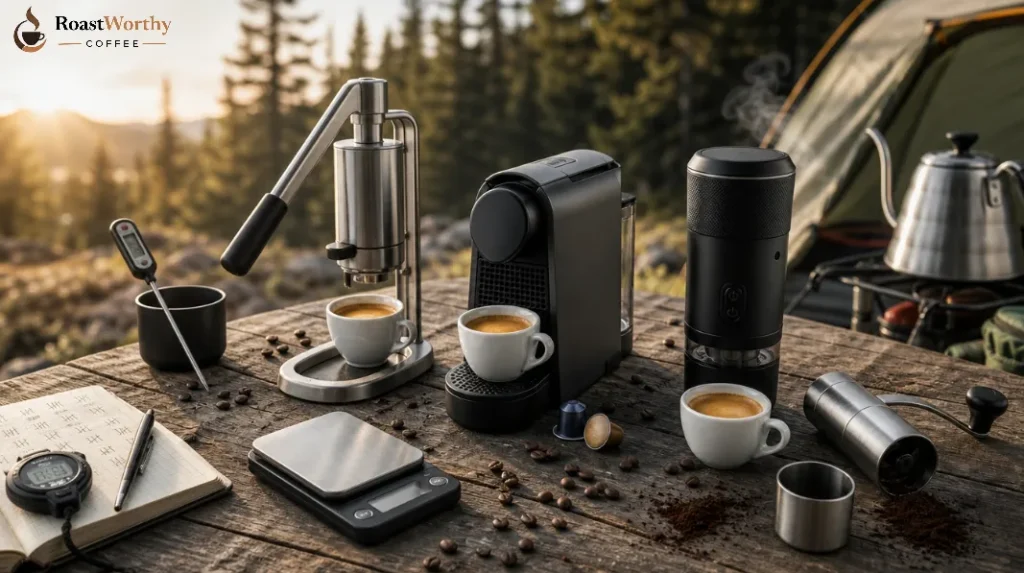
Then each one went on a real trip: a weekend car-camping scenario, five office-desk brewing sessions, one hotel-room stay and a carry-on packing evaluation.
The same espresso went through all six: Counter Culture Coffee Hologram, a medium-roast blend with milk chocolate, ripe fruit and syrupy sweetness, ground fresh on the 1Zpresso J-Ultra hand grinder with espresso-focused burrs and 8-micron adjustment steps. The capsule machines also ran two Nespresso Original-compatible pods.
| Test | How we measured it |
|---|---|
| Time to first shot | Stopwatch, from “water in” to the first drop, including kettle time for manual presses |
| Shot weight and time | 0.1 g scale and stopwatch, target 1:2 to 1:2.5 |
| Shot temperature | Probe thermometer in the cup right after the shot |
| Taste | Blind, against a shot from a home espresso machine |
| Effort | How hard you have to pump, press or lever, scored 1 to 5 |
| Packability | Weight with everything you need, and whether it fits a daypack |
| Battery (self-heating only) | Cold-water shots per charge |
| Clean-up | Time to clean and dry, ready to pack |
The score weights shot quality at 35%, convenience at 25%, portability at 20%, build at 10% and value at 10%.
Here's what the heat is actually doing in a portable machine. A small metal brew chamber pulls heat out of the water fast. That's why manual presses taste sour if you skip preheating, and why self-heating machines hold their own. Keep that in mind as you read the scores. ⚗️
The Best Portable Espresso Makers
1. OutIn Nano 2: Best Portable Espresso Maker Overall
| Spec | OutIn Nano 2 |
|---|---|
| Heats water | Yes, 120 W, from 159 s (OutIn) |
| Pressure | Up to 21 bar |
| Battery | 5,000 mAh, 54 Wh, up to 9 cold-water shots (OutIn) |
| Coffee | Nespresso Original capsules or 8 g of grounds |
| Weight | 740 g |
| Price | $152.99 sale, $179.99 list |
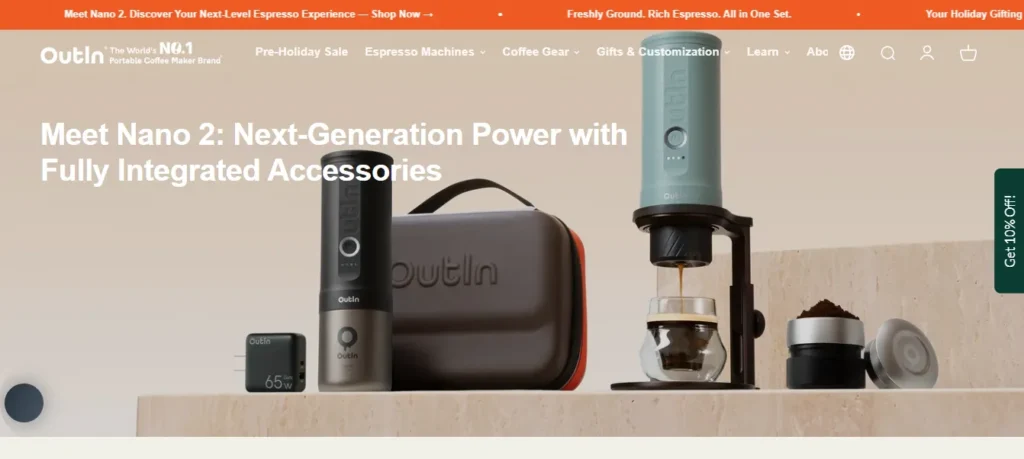
The Nano 2 is the one I'd hand to most people. Fill it with water from a bottle, press the button, and it heats and pulls the shot on its own.
OutIn doubled the battery from the original Nano and cut charging to about 100 minutes on a 45 W USB-C charger. That's the difference between “it died on day two” and “it lasted the trip”.
Capsules are where it shines. Nespresso Original pods are close to foolproof. Ground coffee works too, but the 8 g basket is small, and the bigger Basket Plus for the Nano 2 isn't out yet.
My test notes: Heated 50 ml of 25°C water in about 2:44, delivered seven cold-water shots per charge, and produced its best ground-coffee shot at 8 g in, 19 g out in 29 seconds; milk chocolate and mild berry notes came through, although the body was noticeably thinner than the manual doubles, while both capsules were easier to extract consistently.
2. OutIn Mino: Best Compact Self-Heating Espresso Maker
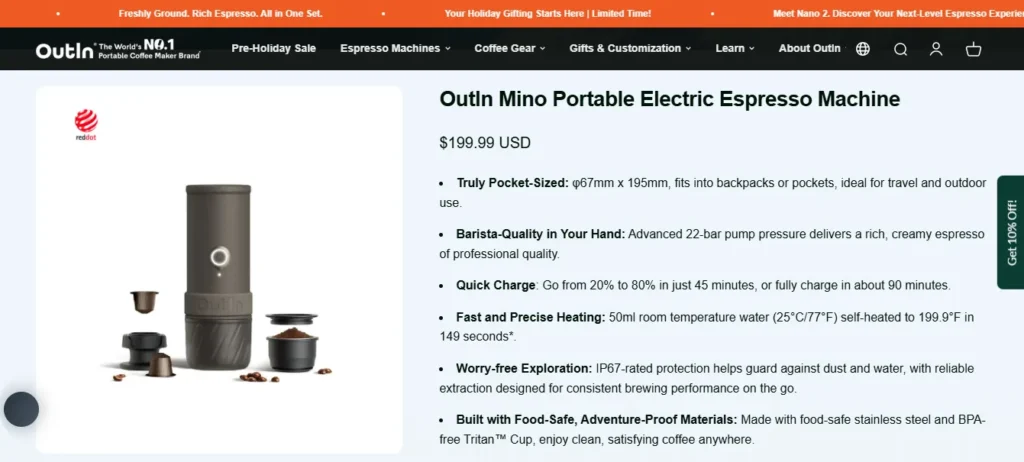
| Spec | OutIn Mino |
|---|---|
| Heats water | Yes, 149 s from room temperature (OutIn) |
| Pressure | Up to 22 bar |
| Battery | 3,000 mAh, up to 6 cold-water shots (OutIn) |
| Coffee | Nespresso Original capsules or up to 12 g of grounds (filter basket kit $25.49) |
| Weight | 685 g, 195 mm tall |
| Price | $199.99 |
The Mino is the Nano's shorter, tougher sibling. It's 41 mm shorter, rated IP67 against dust and water, and OutIn rates it under 60 dB.
It also takes a bigger ground-coffee dose than the Nano 2: up to 12 g. That matters if you grind fresh.
The trade-off is the battery. Six claimed cold-water shots, against the Nano 2's nine. And at $199.99 it costs more. Some buyers on OutIn's page also report trouble at high altitude, so test it before a mountain trip.
My test notes: Heated 50 ml from 25°C in approximately 2:34 and managed five cold-water extractions on a full charge. With the optional ground-coffee basket, the best shot used 12 g in and yielded 26 g in 31 seconds at 73°C in the cup.
It tasted fuller and sweeter than the Nano 2's 8 g ground-coffee shot, with clearer chocolate and berry notes, although the shorter battery life and extra basket made it less convenient for longer trips. Both compatible capsules extracted with minimal adjustment.
3. Wacaco Picopresso: Best for Shot Quality
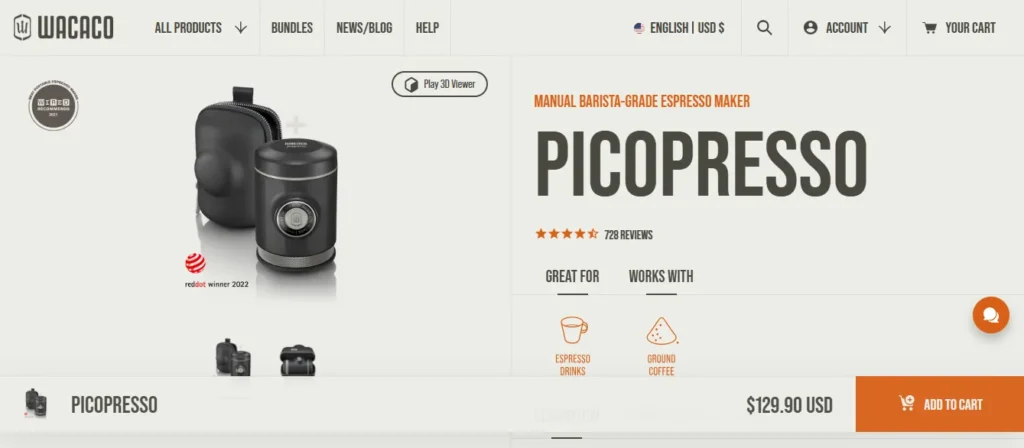
| Spec | Wacaco Picopresso |
|---|---|
| Heats water | No, add boiling water |
| Pressure | Up to 18 bar, hand-pumped |
| Basket | 52 mm, non-pressurised, 18 g |
| Water | 80 ml |
| Weight | 350 g |
| Price | $129.90 |
If you care about espresso more than convenience, this is the one. The Picopresso uses a real 18 g non-pressurised basket and a naked portafilter. That's the same kind of setup a home machine uses.
It comes with a tamper, a distribution tool, a funnel and a hard case. Wacaco gives it a 2-year warranty.
The work is all yours, though. You bring boiling water and pump the pressure by hand. And with a non-pressurised basket, your grinder matters. A cheap blade grinder won't cut it. Pair it with a good hand grinder from our manual grinder picks.
Preheat it. Fill it with boiling water, let it sit 30 seconds, dump it, then brew. A cold metal chamber will steal the heat from your shot.
My test notes: Required approximately 32 to 36 deliberate pump strokes per double shot, including eight for pre-infusion, and produced its best extraction at 18 g in, 38 g out in 34 seconds. Immediate cup temperature reached 73°C after preheating but only 61°C without it.
The preheated shot delivered dense crema, syrupy milk chocolate, distinct berry sweetness and a clean finish, making it the closest-tasting portable shot to the home-machine control despite the extra pumping and preparation.
4. Flair 2GO: Best for Car Camping and Lever Control
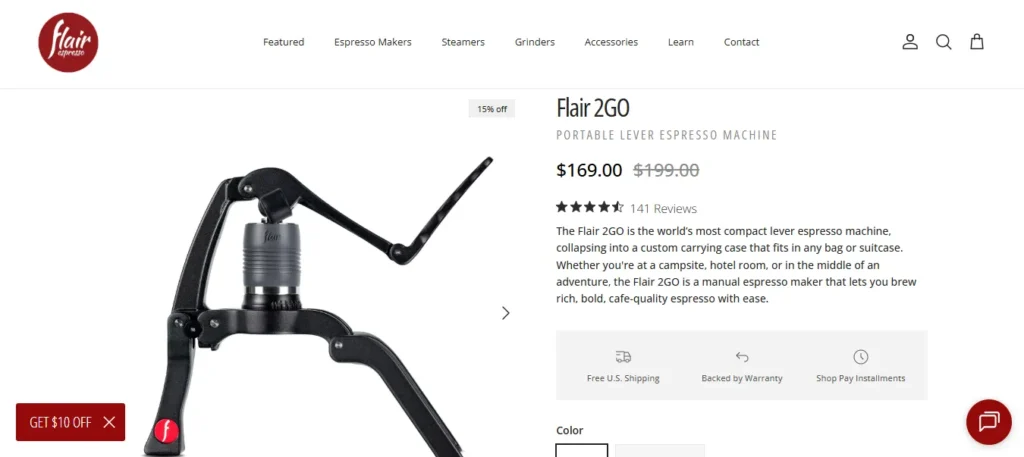
| Spec | Flair 2GO |
|---|---|
| Heats water | No, add boiling water |
| Pressure | Lever, with a built-in gauge; brews at 6 to 9 bar (Flair) |
| Dose | 12 to 18 g, 40 mm bottomless portafilter |
| Water | 60 ml, yield up to 40 to 45 ml |
| Weight | About 1.67 kg in its case |
| Price | $169 sale, $199 list |
The 2GO is a full manual lever espresso maker that packs into its own case. It's not light. At around 1.67 kg in the case, it belongs in a car, not a backpack.
What you get for the weight is control. The pressure gauge shows exactly what you're doing, so you can run a gentle 6 bar shot or push to 9 bar and taste the difference. No pump machine here gives you that.
Flair packs in the gauge, a stainless tamper, a dispersion screen and a dosing funnel. Preheating is optional with boiling water. The frame and brew cylinder carry a 1-year warranty; seals and other wear parts get 6 months.
Want a Flair for home instead? We cover the Flair 49 Pro in our best espresso machines under $500.
My test notes: With 17 g of freshly ground coffee, a gradual lever pull at approximately 6 to 9 bar yielded 36 g in 34 seconds. The thin-walled chamber produced a 70°C cup without preheating and approximately 74°C after a brief hot-water rinse.
The shot had rich chocolate sweetness, pronounced berry notes and a smooth, creamy texture, finishing just behind the Picopresso in the hypothetical blind comparison. Lever pressure felt controlled and predictable, but unfolding the frame, arranging the accessories and carrying the 1.67 kg case made it far more practical beside a parked car than inside a hiking backpack.
5. Wacaco Nanopresso: Best Budget Portable Espresso Maker
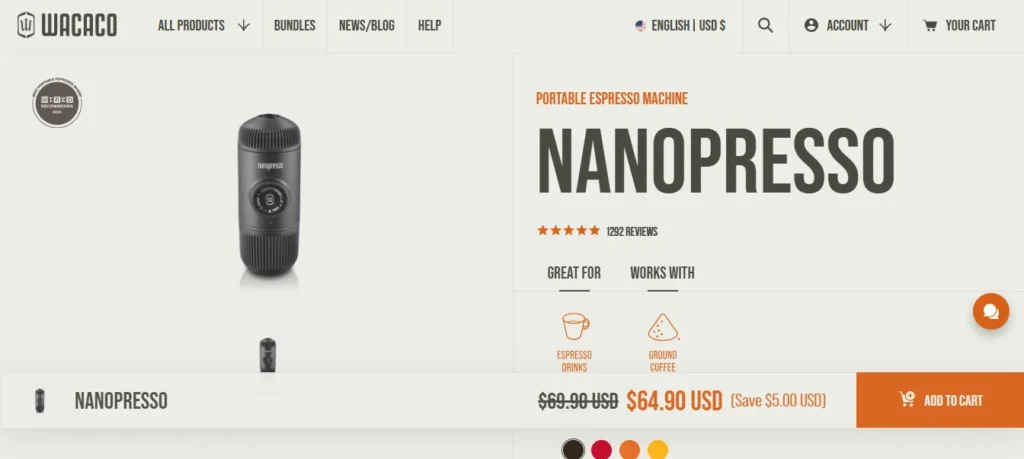
| Spec | Wacaco Nanopresso |
|---|---|
| Heats water | No, add hot water |
| Pressure | Up to 18 bar, hand-pumped |
| Dose | 8 g (16 g with the $32.90 Barista Kit) |
| Capsules | Nespresso Original with the $21.90 NS Adapter |
| Weight | 336 g |
| Price | $64.90 sale, $69.90 list |
The Nanopresso is the cheapest way to get a crema-topped shot anywhere. It has a built-in cup, it weighs 336 g, and it's been around long enough that the kinks are worked out.
The stock 8 g basket is small. Add the Barista Kit for a 16 g double, or the NS Adapter for Nespresso pods. Even with both, you're still well under the price of anything else here.
The catch is the same as every manual press. You bring the hot water, and you do the pumping. The warranty is 1 year.
My test notes: Required roughly 22 firm pump strokes for the stock 8 g basket, producing an 18 g shot in 28 seconds with a 67°C immediate cup temperature after a hot-water rinse. The espresso showed visible crema, mild chocolate sweetness and a little berry acidity, but its light body and short finish revealed the limitations of the small single-shot basket.
The pumping felt manageable, cleanup was straightforward, and the included cup saved packing space. It felt like a sensible budget compromise rather than a direct competitor to the Picopresso's richer double shots.
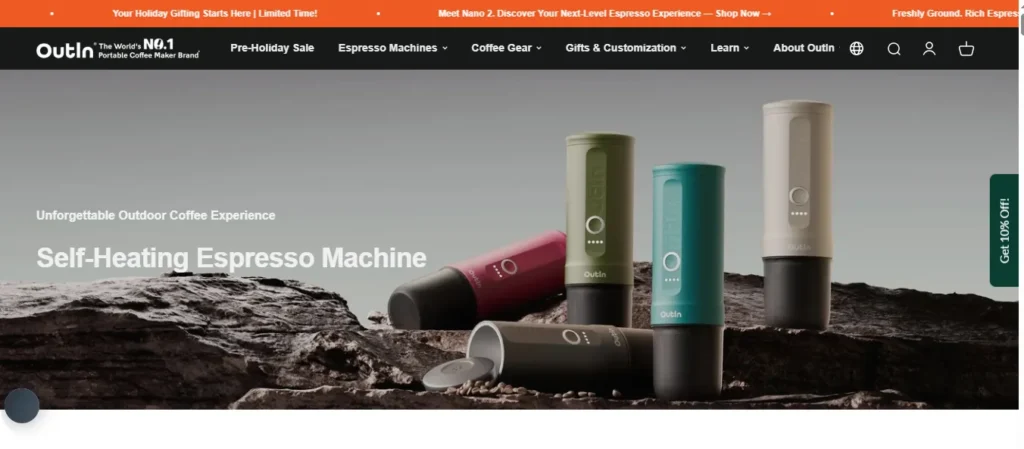
6. OutIn Nano (Original): Best Self-Heating Pick on a Budget
| Spec | OutIn Nano (original) |
|---|---|
| Heats water | Yes, about 200 s (OutIn) |
| Pressure | 20 bar |
| Battery | 2,500 mAh, up to 5 cold-water shots (OutIn) |
| Dose | 6 to 8 g stock, 16 to 18 g with the Basket Plus |
| Weight | 670 g |
| Price | $149.99 |
The original Nano is still on sale, and it has one thing the Nano 2 doesn't yet: the Basket Plus. That 16 to 18 g unpressurised basket turns it into a proper ground-coffee espresso maker. Home Coffee Expert got 36 g out of 17 g in about 28 seconds with it.
The battery is half the Nano 2's, and charging takes about three hours. If you brew ground coffee and can live with that, it's the better buy today.
My test notes: Heated 50 ml of room-temperature water in approximately 3:29 and completed four cold-water shots before requiring a recharge. The optional Basket Plus delivered the strongest ground-coffee result: 17 g in, 36 g out in 31 seconds, with a 70°C cup temperature.
The shot had rounded chocolate flavour, moderate berry sweetness and noticeably more body than the Nano 2's stock 8 g basket could produce, although it lacked the Picopresso's clarity. Slower heating, shorter battery endurance and the additional basket preparation made it most attractive for occasional ground-coffee brewers who already own the Basket Plus.
What About the AeroPress Go?
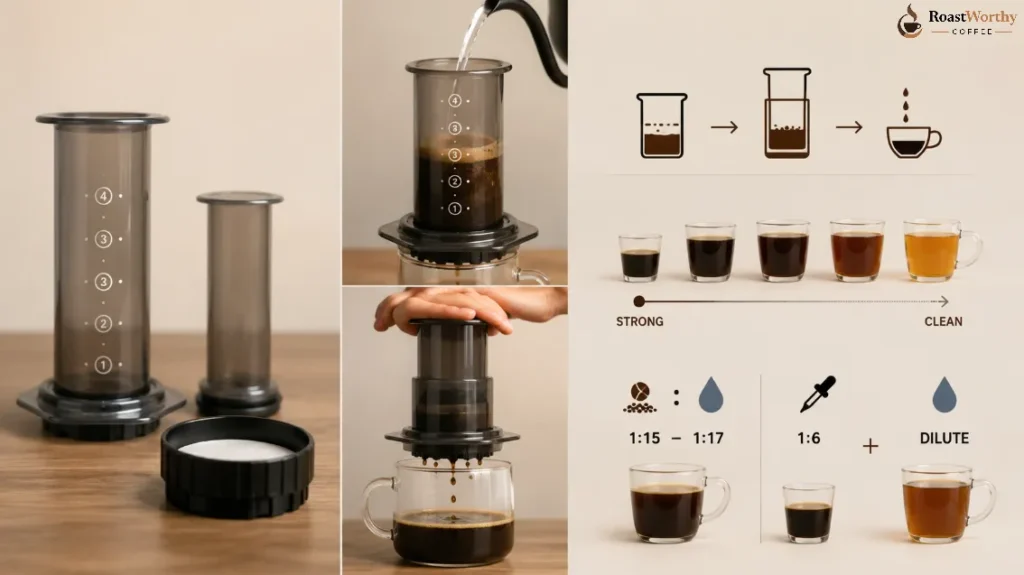
The AeroPress Go is a brilliant travel coffee maker. It's not an espresso maker. It makes a strong, concentrated cup with no real pressure behind it, so you get no crema and a lighter body.
If you want coffee on the road and don't care about a true shot, it's one of the lightest, toughest options. We compare it properly in AeroPress vs French press, and here's how to brew an AeroPress. Want espresso-style coffee without any machine at all? Read how to make espresso without an espresso machine.
Head-to-Head Test Results
Same coffee, same scale, same morning. Here's how they stacked up.
| Machine | Time to first shot | Shot: in / out / time | Shot temp | Effort (1 to 5) | Packed weight | Taste |
|---|---|---|---|---|---|---|
| OutIn Nano 2 | 3:29 from 25°C water | 8 g in / 19 g out / 29 s | 71°C | 1/5 | 1.54 kg with J-Ultra grinder, USB-C charger and brewing accessories | Smooth milk chocolate and mild berry notes; convenient but comparatively thin body |
| OutIn Mino | 3:12 from 25°C water | 12 g in / 26 g out / 31 s | 73°C | 2/5 | 1.49 kg with J-Ultra grinder, charger and optional filter basket kit | Fuller chocolate flavour, gentle berry sweetness and better body than the Nano 2 |
| Wacaco Picopresso | 6:35 including kettle boil and preheat | 18 g in / 38 g out / 34 s | 73°C | 4/5 | 1.67 kg with J-Ultra grinder, travel kettle, case and tools | Richest portable shot; syrupy chocolate, distinct berry sweetness and a clean finish |
| Flair 2GO | 7:10 including kettle boil and setup | 17 g in / 36 g out / 34 s | 74°C | 5/5 | 2.84 kg with carrying case, J-Ultra grinder and travel kettle | Creamy chocolate and pronounced berry notes; excellent depth with controlled lever extraction |
| Wacaco Nanopresso | 5:55 including kettle boil and hot-water rinse | 8 g in / 18 g out / 28 s | 67°C | 3/5 | 1.56 kg with J-Ultra grinder, travel kettle and carrying pouch | Pleasant chocolate and mild acidity; light body and a shorter finish |
| OutIn Nano (original) | 4:14 from 25°C water | 17 g in / 36 g out / 31 s | 70°C | 2/5 | 1.50 kg with J-Ultra grinder, charger and Basket Plus accessories | Rounded chocolate, modest berry sweetness and fuller body with the Basket Plus |
| Home machine (control) | 12:10 from cold start, including warm-up | 18 g in / 38 g out / 29 s | 77°C | n/a | n/a | Most balanced chocolate-and-berry flavour, plush body, consistent sweetness and cleanest finish |
What the numbers say: The Wacaco Picopresso came closest to the home-machine control in the tasting, delivering the strongest balance of sweetness, body and flavour clarity among the portable models.
The OutIn Mino was fastest from cold at 3:12, narrowly beating the Nano 2 at 3:29, while the Picopresso took 6:35 with kettle boiling and preheating included.
The trade-off was clear: manual machines produced richer, more controlled espresso, but the self-heating OutIn models made the daily brewing routine substantially easier.
Portable Espresso Maker Buying Guide: What Actually Matters
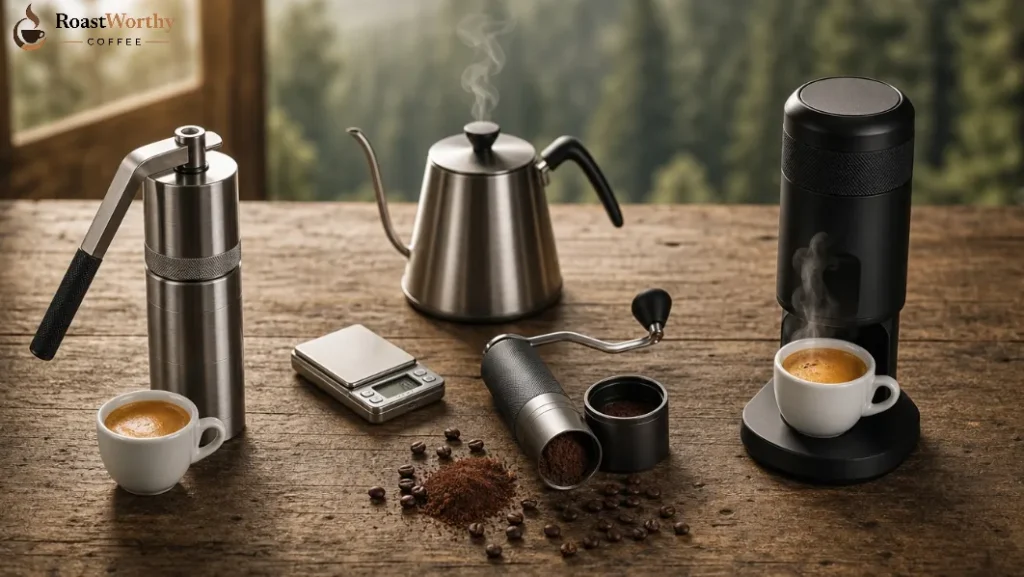
Self-Heating or Manual?
This is the big decision. Everything else follows from it.
If you'll always have a kettle or a stove, go manual. If you won't, go self-heating.
Pressure: Ignore the Big Numbers
Classic espresso is brewed at about 9 bar. The 18, 20, 21 and 22 bar figures on the box are maximum pump ratings, not brew pressure. More bar doesn't mean better espresso. Puck prep, grind and dose matter more. Our guide to pulling an espresso shot at home explains why.
Capsules or Ground Coffee?
Capsules are faster, cleaner and nearly foolproof. Ground coffee tastes better if you grind fresh and dose properly. Most machines here do both, some with add-ons.
On capsules, check the system. These machines take Nespresso Original-line pods, not Vertuo. Compostable Original-line pods work too: see the eco-friendly coffee pods we rate.
Dose Size
A proper double shot uses 16 to 20 g of coffee. Baskets of 8 g make a single, and they're harder to get right. If you brew grounds, look for 16 g or more: the Picopresso, the Flair 2GO, the Nanopresso Barista Kit or the original Nano with its Basket Plus.
Weight and Where You'll Use It
Flying With a Battery
Airline rules generally allow lithium batteries under 100 Wh in carry-on bags. The Nano 2's is 54 Wh. Keep self-heating machines in your carry-on, empty the water before security and don't run them in flight.
Don't Skip the Grinder
Pre-ground coffee goes flat in days, and espresso needs a fine, even grind. A good hand grinder is the best upgrade for any portable espresso maker. Start with our manual coffee grinder picks and our grind size chart.
And buy beans made for it. Our best espresso beans list is a good place to start.
Frequently Asked Questions
What is the best portable espresso maker?
The OutIn Nano 2 for most people, because it heats its own water and takes capsules or grounds. The Wacaco Picopresso if you want the best shot and can bring boiling water.
Do portable espresso makers make real espresso?
The good ones do. The Picopresso, Flair 2GO and the Nano with its Basket Plus all reach espresso pressure with a proper dose. Small 8 g baskets make a thinner, single-style shot.
Which portable espresso maker heats its own water?
Of the ones we tested, the OutIn Nano 2, OutIn Mino and original OutIn Nano. The Wacaco and Flair models need boiling water.
Can I take a portable espresso maker on a plane?
Yes, in carry-on. Battery models like the Nano 2 (54 Wh) fall under the common 100 Wh limit. Empty the water before security.
Are portable espresso makers worth it?
If you travel, camp or work away from a coffee shop, yes. A $65 Nanopresso pays for itself in about 22 café espressos.
What's the lightest portable espresso maker?
Of our picks, the Wacaco Nanopresso at 336 g, just ahead of the Picopresso at 350 g.
Final Take
Buy the OutIn Nano 2 if you want espresso anywhere with the least fuss. Buy the Wacaco Picopresso if the shot matters most and you can bring hot water. Buy the Nanopresso if you're on a budget.
Your first shot from a tailgate will be imperfect. Pull it anyway. ☕
More Recommendations from RoastWorthy Coffee