
Latte vs Cappuccino vs Flat White: What’s the Real Difference?


Three drinks. Same espresso. Wildly different cups.
Let's be honest. Most cafés get at least one of these wrong. They'll hand you a “flat white” that's just a small latte. Or a cappuccino drowning in dry foam like a bubble bath.
The difference between latte and cappuccino — and the flat white sitting between them — comes down to one thing: the milk. Same espresso base in all three. What changes is how much milk, and what texture that milk has.
That's the whole game. Here's how it actually breaks down.
Latte vs Cappuccino vs Flat White: The Full Comparison
Here's the whole thing in one view.
| Feature | Cappuccino | Flat White | Latte |
|---|---|---|---|
| Espresso base | 1 shot (30ml) | 2 shots (60ml) | 1–2 shots |
| Espresso-to-milk ratio | 1:1 + foam | 1:2–1:3 | 1:4–1:5 |
| Foam | Thick, dry (~1cm) | Thin microfoam (~0.3cm) | Thin, wet (~0.5cm) |
| Total size | 150–180ml | 150–160ml | 240ml+ |
| Coffee strength | Strong | Strongest | Mildest |
| Texture | Airy, frothy | Silky, dense | Creamy, light |
| Best for | Espresso lovers | The middle ground | Milk lovers |
The pattern is clear. The flat white is the boldest of the three thanks to a double shot in less milk — followed by the cappuccino, then the latte. Milk volume runs the opposite direction.
The One Thing That Separates Them: Milk Ratio
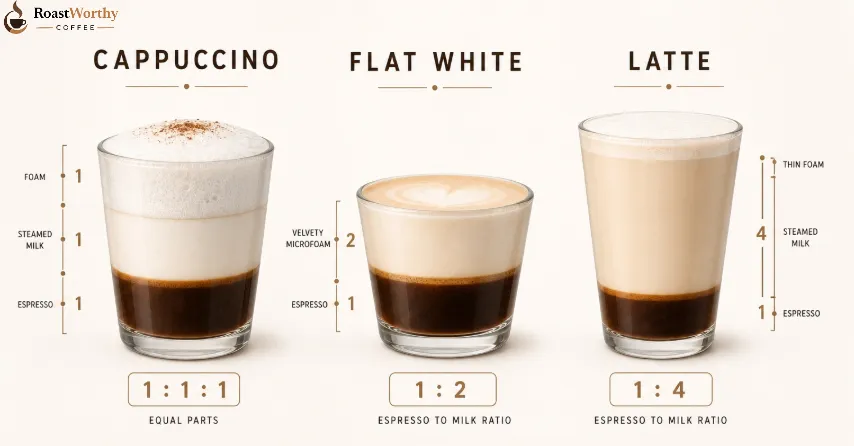
Every one of these starts identical. A shot of espresso. Usually 30ml, sometimes a double at 60ml.
Then milk enters. And that's where they split.
The espresso doesn't move. The milk does the talking. ☕
The milk-to-espresso ratio is the single most useful thing to understand here. Get that, and you understand all three drinks. Everything else — foam, texture, size — flows from it.
A Quick Bit of History (It Explains the Cups)
The cappuccino is old. Italian. The name traces back to the Capuchin monks, whose brown robes matched the colour of coffee with milk. It became the classic morning drink of Italy — and Italians, famously, won't touch one after 11am.
The latte is the cappuccino's milkier American cousin. “Caffè latte” just means “milk coffee.” Bigger, gentler, built for sipping.
The flat white is the newcomer. Born in Australia and New Zealand in the 1980s. Both countries still argue over who invented it. Honestly, doesn't matter — they nailed it either way.
Cappuccino: The Foam-Forward Classic
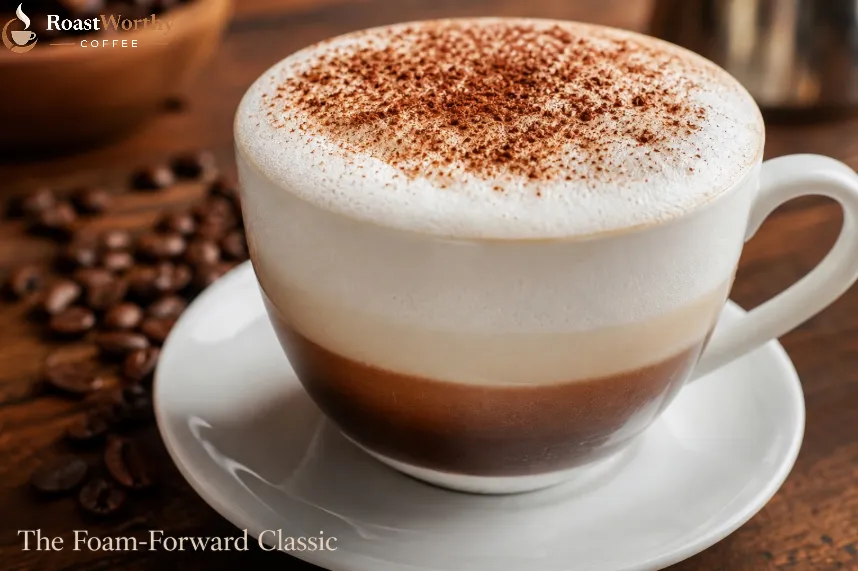
A proper cappuccino is the driest of the three. More air. More foam.
Traditional Italian cappuccino runs about 150–180ml total. One shot of espresso, one-third steamed milk, one-third foam. That foam should be thick enough to hold a dusting of cocoa without sinking.
The Specialty Coffee Association is specific about it. A cappuccino should carry at least 1cm — about 0.4 inches — of foam on top. That's roughly twice the foam of a latte.
The flavour? Espresso comes through hard. The foam softens it but doesn't bury it.
This is the drink for people who want to taste the coffee. Not the milk.
What a cappuccino actually tastes like
Bolder. More bitter edge. The foam adds a light, almost airy sweetness on top, then the espresso hits underneath.
The mouthfeel is the giveaway. Frothy. Pillowy. Almost dry on the first sip before the milk comes through.
If your café serves a cappuccino that tastes milky and flat… they made you a bad latte. Full stop.
Flat White: The Tightest Cup of the Three

This is where things get interesting. And where most cafés fumble.
A flat white runs smaller. Usually 150–160ml, served in a 6–8oz cup. It's espresso with steamed milk and a thin, glossy layer of microfoam — paper-thin, no dry froth.
Here's the kicker most people miss: a flat white is often pulled with a double shot of espresso in that small cup. Less milk, more coffee, tighter ratio.
That microfoam is the whole point. Tiny bubbles. Silky. It folds into the milk instead of sitting on top.
Flat white vs latte: the part people get wrong
Same idea, different intensity. A flat white uses less milk than a latte. That means a higher coffee-to-milk ratio.
Translation: the flat white tastes stronger. More espresso per sip. The latte is gentler, milkier, longer.
A flat white also skips the thick foam cap of a cappuccino and the loose foam of a latte. It's flat — hence the name. The texture is dense and velvety all the way down.
If you want espresso flavour but smoother than a cappuccino… this is your cup. ✒️
Latte: The Mildest, Milkiest Option

The latte is the crowd-pleaser. The gateway drink. And there's nothing wrong with that.
Most milk. Most volume. Usually 240ml or more — lattes start around 6oz and climb to 8oz and beyond. A single or double shot of espresso, a flood of steamed milk, and a thin foam layer maybe 0.5cm thick.
The result is mellow. Creamy. The espresso is present but quiet. It's the background, not the headline.
This is why latte art shows up here so often. All that steamed milk and thin foam gives the canvas. The flat white competes, but the latte is the easel.
When the latte wins
You want comfort. You want something long and warm to sip for twenty minutes. You don't want a coffee punch to the face.
The latte delivers. No notes. (And that's rare for me to say about the mild option.)
Foam vs Microfoam: Why Texture Decides Everything
This is the detail most guides skip. And it's the one that actually matters.
Foam and microfoam aren't the same thing.
Foam is what you get on a cappuccino — bigger bubbles, more air, dryer in the mouth. It sits on top and holds shape.
Microfoam is what makes a flat white sing. The bubbles are so small you barely see them. It's glossy. It pours like wet paint. It tastes sweeter because the milk's natural sugars get drawn out without the dry froth getting in the way.
A latte sits in between — wetter than cappuccino foam, looser than flat white microfoam.
Get the texture wrong and the whole drink falls apart. The flavour doesn't lie.
Which Has the Most Caffeine?

Common question. The answer surprises people.
Caffeine comes from espresso, not milk. So the drink with more shots wins — regardless of cup size.
A flat white is usually pulled with two shots. A traditional cappuccino with one. A latte with one or two. So a standard flat white often carries the most caffeine of the three, even though it's the smallest cup.
The latte just tastes weakest, because all that milk dilutes the coffee. Don't confuse mild flavour with low caffeine. They're not the same thing.
Frequently Asked Questions
Is a flat white stronger than a latte?
Yes. A flat white uses less milk and often two shots of espresso, so the coffee-to-milk ratio is higher. Same base, less dilution, stronger taste.
What's the main difference between a latte and a cappuccino?
Milk and foam. A cappuccino has equal parts espresso, steamed milk, and thick foam. A latte has far more steamed milk and only a thin foam layer, making it milder and creamier.
Does a flat white have less milk than a cappuccino?
Similar total volume, but the texture differs. A cappuccino has thick, airy foam. A flat white has velvety microfoam and more liquid steamed milk, so it drinks denser and smoother.
Which has the most caffeine?
Usually the flat white, because it's commonly made with two shots. Caffeine tracks espresso shots, not milk volume, so the latte only tastes weaker.
What is microfoam?
Microfoam is steamed milk with tiny, almost invisible bubbles. Silky and glossy — the signature of a flat white. It tastes sweeter than the dry, airy foam on a cappuccino.
Can I make these at home?
Yes. You need an espresso machine and a milk steamer. The only real skill is steaming milk to the right texture — microfoam for flat whites, dryer foam for cappuccinos.
So Which One Should You Order?
Depends on what you're after. Quick guide.
There's no “best” here. Only what fits your morning.
That said — if I had to pick one to judge a café by? The flat white. It's the hardest to fake. Bad microfoam exposes a lazy barista instantly. ☕
Key Takeaways
More Recommendations from RoastWorthy Coffee