
How Water Affects Coffee Flavor: Hardness, Minerals, and pH Explained

TL;DR — Key Takeaway
Why Water Controls Your Cup ☕
Your coffee is 98% water. That sounds obvious. But most people still blame the beans when the cup tastes flat.
Here's what's actually happening. When hot water hits ground coffee, it dissolves soluble compounds — acids, sugars, lipids, melanoidins. The water's mineral content determines which compounds dissolve and how fast. That's not opinion. That's chemistry.

If your water is too hard, calcium and magnesium saturate it before the coffee can release its full flavour. If your water is too soft (or distilled), there's nothing to pull the compounds out. The cup tastes hollow.
Water quality for coffee isn't a niche obsession. It's the single biggest variable after the beans themselves.
Water Hardness and Coffee Brewing: The Core Number
Water hardness measures dissolved calcium and magnesium in your water. It's expressed as mg/L of calcium carbonate (CaCO₃).
Here's the breakdown:
| Hardness Level | mg/L as CaCO₃ | Effect on Coffee |
|---|---|---|
| Soft | 0–17 | Under-extracts. Thin, sour cup |
| Slightly Hard | 17–60 | Can work for light roasts |
| Moderately Hard | 60–120 | Close to SCA ideal range |
| Hard | 120–180 | Over-extracts. Bitter, chalky |
| Very Hard | 180+ | Dulls flavour, scales equipment |
The SCA water standards put the sweet spot at 68 mg/L calcium hardness. That's enough mineral content to extract evenly without overwhelming the coffee.
Too hard? Your water saturates early. You get bitterness and a chalky film on the palate.
Too soft? There's nothing in the water to bond with the coffee compounds. The extraction is incomplete. Your Ethiopian Yirgacheffe that should taste like jasmine and lemon zest tastes like… nothing.
If you do one thing after reading this, test your tap water's hardness. That number alone will explain a lot about your brews.
The Minerals That Matter: Calcium and Magnesium ⚗️
Not all minerals affect coffee the same way. Two carry most of the weight: calcium and magnesium.
Magnesium: The Flavour Extractor
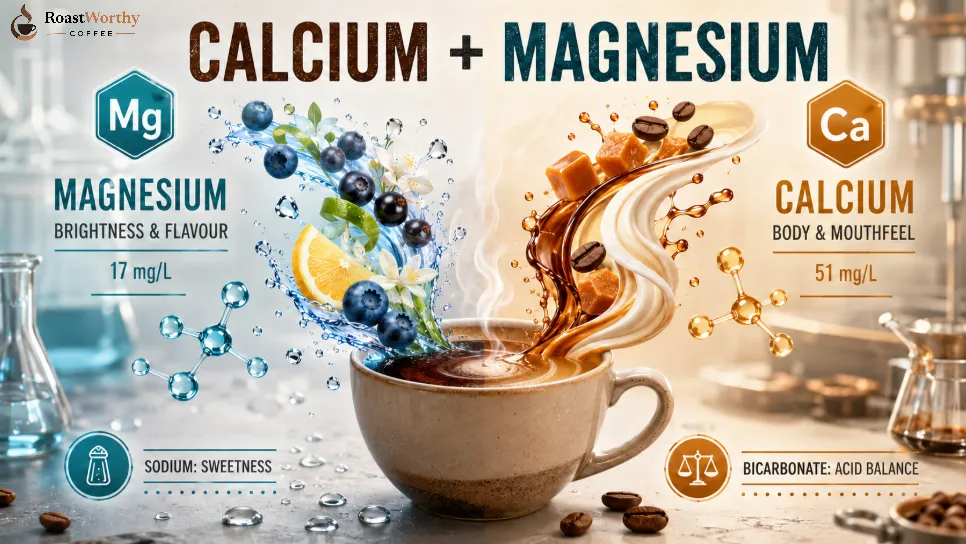
Magnesium binds to organic acids in coffee. That means it pulls out the bright, fruity, and floral compounds — the stuff that makes a natural Ethiopian taste like blueberry, or a washed Kenyan taste like blackcurrant.
More magnesium in your water = more flavour extraction from acids and esters.
But there's a catch. Too much magnesium and the cup turns sharp, almost metallic. The SCA target is roughly 17 mg/L magnesium.
Calcium: The Body Builder
Calcium does something different. It extracts heavier compounds — the ones responsible for body, mouthfeel, and that creamy texture in a good espresso.
Calcium also contributes to scaling. When calcium bicarbonate heats up, it forms calcium carbonate — the white chalky buildup on your kettle element and espresso machine boiler.
The SCA target is 51 mg/L calcium.
Here's the balance: you want both minerals, but in moderation. Magnesium without calcium gives you a bright but thin cup. Calcium without magnesium gives you body with no acidity. Together, at the right levels, they extract the full spectrum.
Other Minerals: Sodium and Bicarbonate
Sodium at low levels (under 10 mg/L) can actually enhance sweetness perception. Above that, it makes coffee taste flat or salty.
Bicarbonate (alkalinity) is the buffer. It neutralises acids in your coffee. The SCA targets 40 mg/L. Too much bicarbonate and your coffee tastes dull — the acids that should give you brightness get neutralised. Too little and the cup tastes aggressively sour.
TDS: The Number That Tells You Everything
TDS stands for Total Dissolved Solids. It measures everything dissolved in your water — minerals, salts, metals, organic matter.
The SCA water standards specify:
| Parameter | Target | Acceptable Range |
|---|---|---|
| TDS | 150 mg/L | 75–250 mg/L |
| Calcium Hardness | 68 mg/L | 17–85 mg/L |
| Total Alkalinity | 40 mg/L | At or near 40 mg/L |
| pH | 7.0 | 6.5–7.5 |
| Sodium | 10 mg/L | At or near 10 mg/L |
150 mg/L TDS is the target. Below 75, your water is too pure — it can't extract enough. Above 250, and the mineral content starts competing with the coffee for dominance.
You can measure TDS with a cheap digital meter. They cost $15–20. If you brew coffee daily, this is the best $20 you'll spend.
Taste it. Write it down. Brew it again. The number tells you why.
pH and Coffee: Why Neutrality Wins
Coffee itself sits at pH 4.5–6.0 — mildly acidic. But your brewing water's pH changes how that acidity plays out.
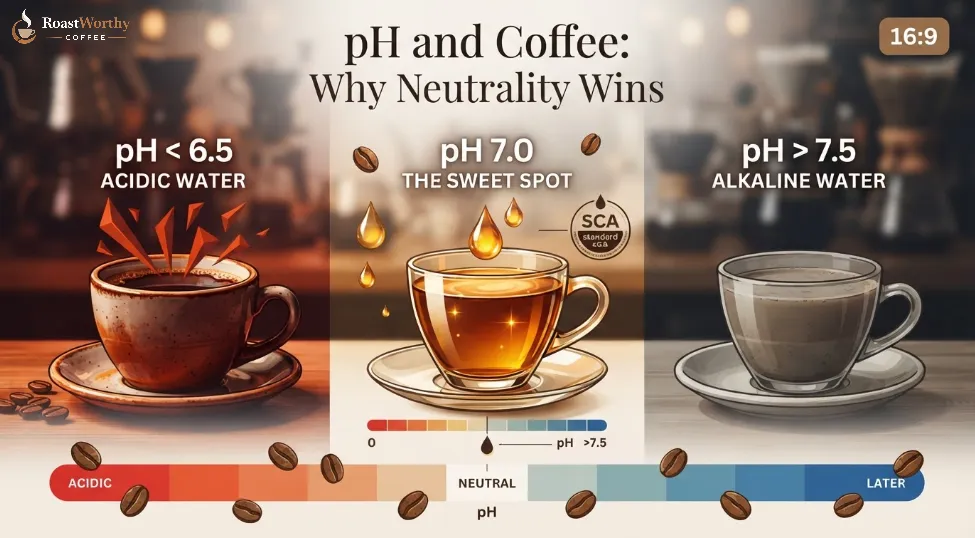
The SCA standard is pH 7.0, with an acceptable range of 6.5–7.5.
If your tap water is alkaline (common in areas with limestone aquifers), your coffee will taste duller than it should. This is why filtered water for coffee isn't just about removing chlorine — it's about bringing pH into range.
Filtered Water for Coffee: What Actually Works
Let's be practical. You don't need a lab setup. Here are the options that make a real difference, ranked by effectiveness.
1. Brita Filter for Coffee
A Brita filter uses activated carbon and ion-exchange resin. It reduces chlorine, some hardness, and a few heavy metals.
What it does well: Removes chlorine taste and smell. Reduces moderate hardness.
What it doesn't do: It won't bring very hard water into the SCA range. The mineral reduction is inconsistent — it varies depending on how fast you pour and how old the cartridge is.
Brita filter coffee is a genuine upgrade over unfiltered tap water in most cities. If your water is moderately hard (60–120 mg/L), a Brita will get you close.
Cost: $25–35 for the jug. Replacement filters every 2 months at ~$8 each.
2. Reverse Osmosis with Remineralisation
RO strips everything from your water — minerals, chlorine, fluoride, everything. That's too pure for coffee. You need to add minerals back.
An RO system with a remineralisation stage gives you total control. You can target SCA numbers precisely.
What it does well: Produces consistent, known water chemistry. Ideal for espresso machines (prevents scale buildup).
What it doesn't do: It's not cheap. And you need to manage the remineralisation stage — too many minerals and you're back to hard water.
RO systems range from $150 (under-sink units) to $500+ (commercial-grade). For serious home brewers, this is the gold standard.
3. Bottled Water (If You Must)
Some bottled waters work for coffee. Look for:
Mountain Valley Spring Water comes close to SCA specs. Volvic works well for lighter roasts. Avoid distilled water completely — it produces flat, lifeless coffee.
Bottled water is expensive over time and environmentally wasteful. Use it as a benchmark to compare against your filtered setup, not as a long-term solution.
Hard Water vs Soft Water for Coffee: Quick Comparison
| Factor | Hard Water | Soft Water |
|---|---|---|
| Calcium/Magnesium | High (>120 mg/L) | Low (<60 mg/L) |
| Extraction | Over-extracts bitter compounds | Under-extracts |
| Taste | Chalky, bitter, dull | Thin, sour, hollow |
| Body | Heavy, coating | Light, watery |
| Equipment Impact | Scaling, clogged pipes | No scaling |
| Fix | Filter or RO | Remineralise |
Neither extreme is good. Moderately hard water — the SCA range — is where coffee performs best.
How to Build Your Own Coffee Water
If you want full control, you can build your brewing water from scratch. This is what competition baristas do.
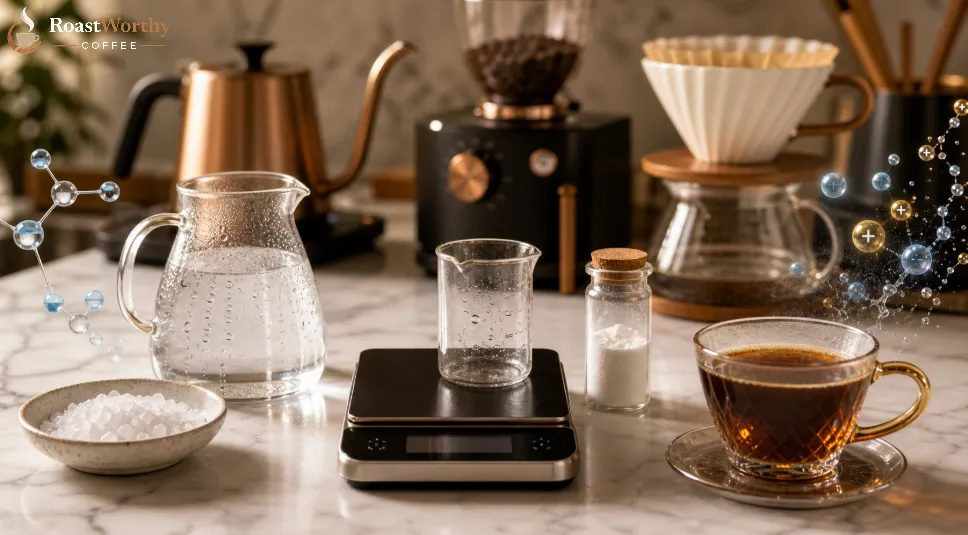
What you need:
The SCA-mimicking recipe (per 1 litre):
This gets you close to the SCA ideal. It's not perfect — it uses magnesium instead of calcium, and sodium instead of potassium — but it extracts cleanly and consistently.
Your first batch will be imperfect. Make it anyway. ☕
Taste it next to your tap water brew. The difference will be immediate. The curve doesn't lie.
Common Water Mistakes That Ruin Your Coffee
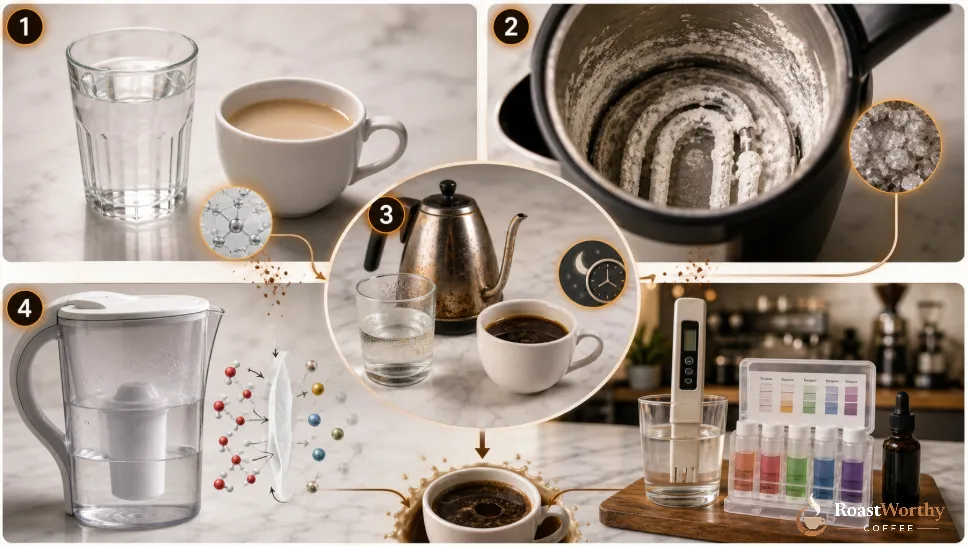
SCA Water Standards: The Reference
Here's the full SCA water standard for specialty coffee brewing, in one place.
| Characteristic | SCA Target | Acceptable Range |
|---|---|---|
| Odour | Clean, fresh | Odour-free |
| Colour | Clear | Clear |
| Total Chlorine | 0 mg/L | 0 mg/L |
| TDS | 150 mg/L | 75–250 mg/L |
| Calcium Hardness | 68 mg/L (4 grains) | 17–85 mg/L (1–5 grains) |
| Total Alkalinity | 40 mg/L | At or near 40 mg/L |
| pH | 7.0 | 6.5–7.5 |
| Sodium | 10 mg/L | At or near 10 mg/L |
These numbers aren't arbitrary. They're drawn from decades of cupping data and sensory research. The goal: water that extracts evenly without imposing its own character on the cup.
What This Means for Your Daily Brew
You don't need to hit every SCA number to make good coffee. But you do need to be in the ballpark.
If your water is very hard, get a filter — Brita at minimum, RO if you can. If your water is very soft, remineralise. If you don't know what you have, test it.
The difference between tap water and properly mineralised water is bigger than the difference between a $15 grinder and a $300 grinder. I'm not exaggerating.
Water is the variable most brewers ignore and the one that matters most. Fix it, and your coffee improves overnight. ☕
Frequently Asked Questions
What is the best water for brewing coffee?
Filtered water with a TDS between 75–250 mg/L, calcium hardness around 68 mg/L, and pH near 7.0. The SCA water standard provides these targets based on decades of sensory research. A Brita filter works for moderately hard tap water. Reverse osmosis with remineralisation offers the most control.
Does water hardness affect coffee taste?
Yes. Hard water (above 120 mg/L) over-extracts bitter compounds and leaves a chalky residue. Soft water (below 60 mg/L) under-extracts, producing a thin, sour cup. The ideal range is 17–85 mg/L calcium hardness, with 68 mg/L as the SCA target.
Is distilled water good for coffee?
No. Distilled water has zero dissolved minerals, which means it cannot extract flavour compounds from coffee grounds effectively. The resulting cup tastes flat and hollow. Always use water with moderate mineral content.
What pH is best for coffee brewing?
pH 7.0 (neutral) is the SCA target, with an acceptable range of 6.5–7.5. Water below pH 6.5 over-extracts bitterness. Water above pH 7.5 neutralises coffee acids and dulls flavour.
Does a Brita filter improve coffee?
A Brita filter removes chlorine, reduces moderate hardness, and improves taste compared to unfiltered tap water. It works well in areas with moderately hard water (60–120 mg/L). For very hard water, a reverse osmosis system is more effective.
What minerals should be in coffee water?
Calcium and magnesium are the two most important. Magnesium extracts bright, fruity, and floral compounds. Calcium extracts heavier compounds responsible for body and mouthfeel. The SCA targets roughly 51 mg/L calcium and 17 mg/L magnesium. Bicarbonate (40 mg/L) acts as an acid buffer.
More Recommendations from RoastWorthy Coffee