Cold Brew vs Iced Coffee: What’s the Actual Difference?


Most people use these two terms like they mean the same thing. They don't.
The cold brew vs iced coffee question comes down to one variable: heat. Cold brew never sees it. Iced coffee is built on it. That single difference changes the caffeine, the acidity, the steep time, and the taste in your cup.
Here's what the heat is actually doing. ⚗️
TL;DR: Iced coffee = brewed hot, served cold. Cold brew = brewed cold, slow, 12–24 hours. Cold brew is lower acid and often higher caffeine per serving. Iced coffee is faster, brighter, and cheaper to make.
Cold Brew vs Iced Coffee: The One-Line Difference
Iced coffee is hot-brewed coffee poured over ice. Cold brew is coffee steeped in cold water for 12 to 24 hours, then strained.
Same bean. Completely different extraction.
That's the whole story in two sentences. Everything below is just the why — the brewing temperature, the steep time, and the caffeine concentration that actually separate them.
How Each One Is Actually Made
Iced Coffee
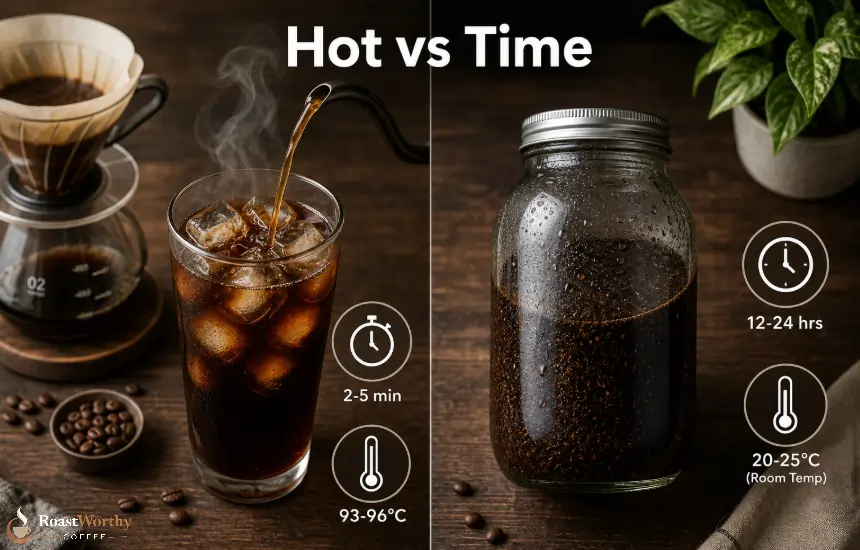
You brew it hot. Drip, pour-over, espresso — doesn't matter. The water hits the grounds at around 93°C93°C93°C to 96°C96°C96°C. Then you cool it down, usually over ice.
Extraction happens in 2 to 5 minutes. Hot water is aggressive. It pulls acids, oils, and caffeine out fast.
The catch: ice melts. Pour hot coffee over ice and you dilute it. Smart move is to brew it double-strength, or use the Japanese flash-chill method — brew directly onto ice so it cools instantly without watering down.
Cold Brew
No heat. None. You combine coarse grounds with cold or room-temp water and let it sit.
Steep time is the whole game here. 12 to 24 hours is the standard range. Shorter than 12 and it's weak. Past 24 and it turns muddy and over-extracted.
Then you strain it. What you get is a concentrate — usually cut with water or milk before drinking. That's a key point most people miss: cold brew isn't a finished drink off the strainer. It's a base.
Your first batch will be imperfect. Make it anyway.
Brewing Temperature: Why It Changes Everything
This is the core of the whole comparison. Temperature controls what dissolves out of the bean.
Hot water at 93°C93°C93°C+ extracts almost everything — including the acidic compounds and bitter oils. That's why iced coffee tastes brighter and sharper.
Cold water at room temp or below is selective. It leaves a lot of those acidic and bitter compounds behind. That's why cold brew tastes smooth and mellow.
The curve doesn't lie. Lower temperature, slower extraction, softer cup. It's the same principle that governs roasting — heat decides which compounds you get and which you leave behind.
Steep Time and Extraction
Here's the trade-off in plain numbers:
Cold brew uses a much higher coffee-to-water ratio to compensate for the cold. A typical concentrate runs 1:4 to 1:8 (coffee to water). Iced coffee sits around the standard hot-brew ratio of 1:161:161:16.
That ratio difference is exactly why cold brew is a concentrate and iced coffee isn't. The cold water extracts less per gram, so you throw more grounds at it and give it more time.
Time replaces heat. That's the trade. You can't rush an extraction without one or the other.
Cold Brew vs Iced Coffee Caffeine: Which Is Stronger?
This is the question everyone asks. Is cold brew stronger than iced coffee?
It depends on how you measure it.
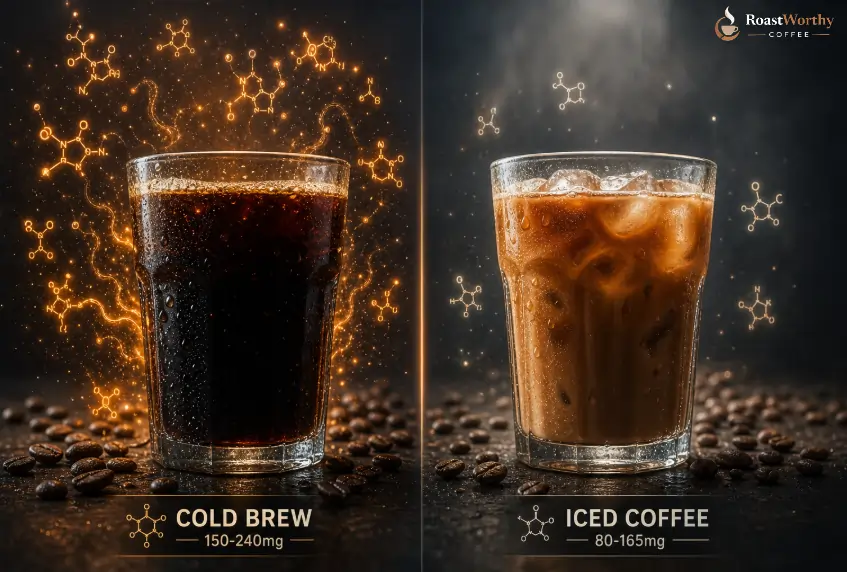
Cold brew concentrate, undiluted, is significantly stronger. That high coffee-to-water ratio plus the long steep time pulls out a lot of caffeine. A 16 oz cold brew can land anywhere from 150150150 to 240240240 mg of caffeine.
A 16 oz iced coffee usually sits around 808080 to 165165165 mg.
But — and this matters — once you dilute cold brew concentrate with water or milk, the gap shrinks fast. The caffeine concentration in your actual glass depends entirely on the dilution.
So the honest answer: cold brew is usually stronger per serving, but not always. Dilution decides it. A heavily cut cold brew can land below a strong iced coffee.
| Factor | Cold Brew | Iced Coffee |
|---|---|---|
| Brewing temperature | Cold / room temp | Hot (93–96°C93–96°C93–96°C) |
| Steep time | 12–24 hours | 2–5 minutes |
| Coffee-to-water ratio | 1:4 to 1:8 (concentrate) | ~1:16 |
| Caffeine (16 oz) | 150–240 mg | 80–165 mg |
| Acidity | Low | Higher |
| Taste | Smooth, chocolatey, sweet | Bright, sharp, more acidic |
| Prep speed | Slow (overnight) | Fast (minutes) |
| Shelf life | 7–10 days (concentrate) | 1–2 days |
| Best roast | Medium to dark | Light to medium |
Acidity: The Real Taste Difference
This is where the two split hardest.
Cold brew is roughly 60–70% lower in acidity than hot-brewed coffee. Cold water doesn't extract the same volume of acidic compounds — chlorogenic acids, mostly.
That's why cold brew tastes smooth and slightly sweet. Less bite. Chocolatey, nutty, easy on a sensitive stomach.
Iced coffee keeps that acidity because it was brewed hot. You get more brightness, more fruit, more snap. Some people love it. Some find it sour over ice.
Neither is better. They're built for different palates. If your stomach hates acid, cold brew wins. If you chase fruit and brightness, iced coffee delivers.
Dilution: The Step People Get Wrong
Iced coffee dies on bad dilution. Pour hot coffee straight over ice, walk away, come back to brown water.
Two fixes:
Cold brew has the opposite problem. The concentrate is too strong to drink straight. Cut it 1:1 with water or milk to start, then adjust to taste.
Taste it. Write it down. Make it again. That's how you find your ratio — not by guessing.
Flavor and Roast Pairing
Bean choice matters as much as method. The two methods reward different roasts.
Cold brew loves medium-to-dark roasts. The low-acid extraction pulls out chocolate, caramel, and nutty depth. Dark roasts that taste harsh hot turn smooth cold.
Iced coffee shines with light-to-medium roasts. The brightness shows off fruit and floral notes. A light Ethiopian over ice tastes like cold fruit tea. In a good way.
Here's the home-roaster angle: cold brew is forgiving. It smooths over minor roast inconsistencies. Iced coffee exposes them — the brightness shows every flaw. ☕
Which One Should You Make?
Depends on what you want and how much patience you've got.
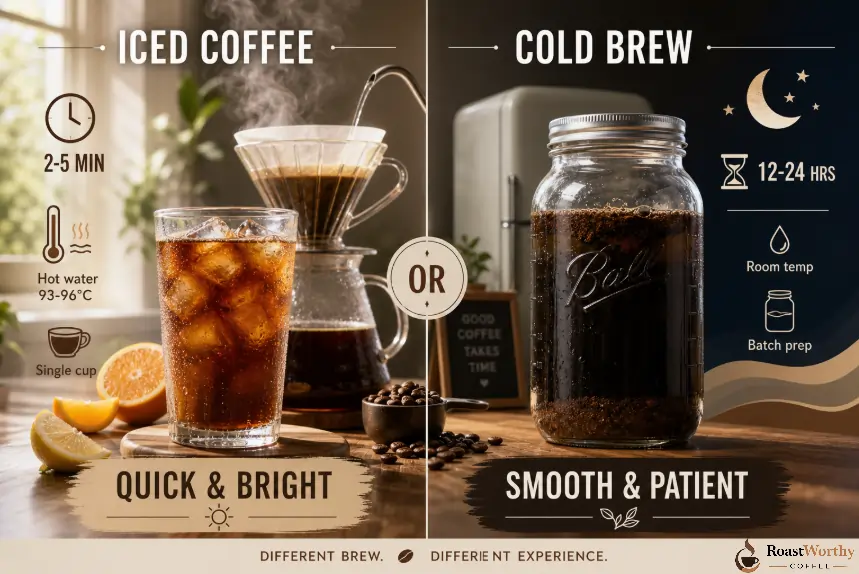
👉 Make iced coffee if: you want it now, you like a brighter cup, and you don't want to plan ahead. It's faster and cheaper per cup. One mug, a few minutes, done.
👉 Make cold brew if: you want smooth, low-acid coffee, you like batch-prepping, and you don't mind waiting overnight. The concentrate keeps in the fridge for 7–10 days.
For home setups, cold brew is genuinely low-effort once you nail the ratio. No special gear. A jar, coarse grounds, water, and a filter. That's it.
Quick Recipes for Both
Flash-Chilled Iced Coffee
Cold Brew Concentrate
Want a dialed-in recipe? Check our step‑by‑step Home Cold Brew Guide for exact ratios, steep times, and grind settings that actually work.
Both scale up easily. The ratios are what matter, not the volume. Log your steep time and dilution every batch. The numbers are how you get repeatable cups.
FAQ
Is cold brew stronger than iced coffee?
Usually, yes — by caffeine per serving. Cold brew runs 150–240 mg per 16 oz versus 80–165 mg for iced coffee. But dilution changes everything. A heavily diluted cold brew can be weaker than a strong iced coffee.
What's the main difference between cold brew and iced coffee?
Brewing temperature. Cold brew steeps in cold water for 12–24 hours. Iced coffee is brewed hot, then chilled. That changes acidity, caffeine concentration, and taste.
Why is cold brew less acidic?
Cold water doesn't extract acidic compounds the way hot water does. Cold brew runs roughly 60–70% lower in acidity, which is why it tastes smoother and is gentler on the stomach.
Does iced coffee get watered down?
Yes, if you pour hot coffee straight over ice. Fix it by brewing double-strength or using the flash-chill method — brewing hot coffee directly onto ice.
How long does cold brew last?
Cold brew concentrate keeps 7–10 days in the fridge. Iced coffee is best within 1–2 days before it goes flat and dull.
Can I use the same beans for both?
Yes. The method matters more than the bean. Cold brew favors medium-to-dark roasts for chocolatey depth. Iced coffee shines with lighter roasts and their brighter, fruitier notes.
Bottom line: it's not just hot vs cold. It's two different extractions that give you two different cups. Pick the one that fits your taste — and your schedule. ⚗️☕
More Recommendations from RoastWorthy Coffee