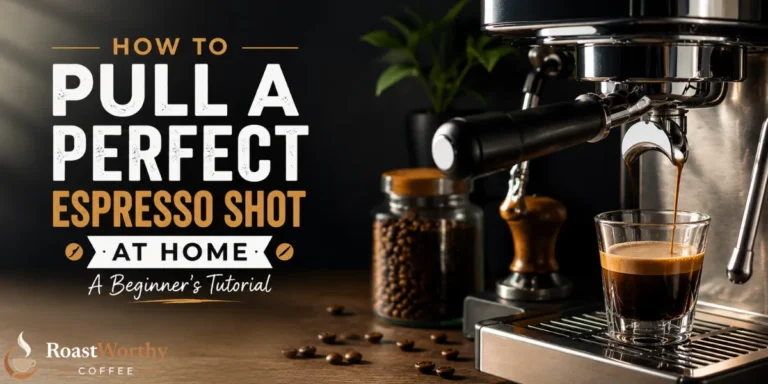
French Press vs Pour Over: Which Brewing Method Is Right for You?

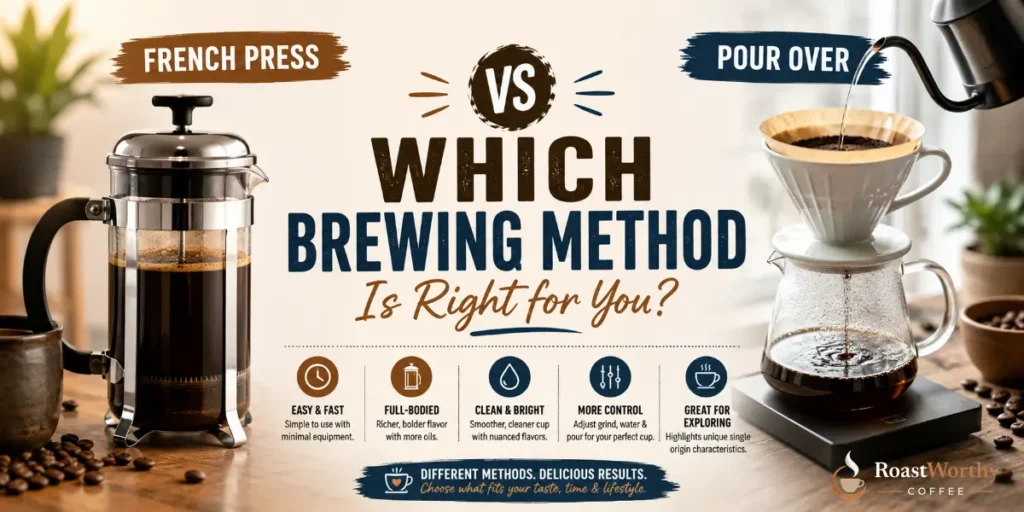
If you're comparing French press vs pour over, you're really choosing between two extraction styles: immersion and percolation. They produce completely different results in the cup.
French press gives you a full body, heavier texture, and more oils. Pour over delivers a cleaner cup with higher clarity and brighter acidity.
The better method isn’t universal. It depends on your grind size, brew time, and what you actually want to taste.
French Press vs Pour Over: Head-to-Head
| Category | French Press | Pour Over |
|---|---|---|
| Extraction method | Immersion | Percolation |
| Body | Full, heavy, oily | Light to medium, clean |
| Clarity | Low | High |
| Best roast level | Medium–Dark | Light–Medium |
| Brew time | 4 min (hands-off) | 3–5 min (hands-on) |
| Ease of use | Beginner-friendly | Moderate learning curve |
| Sediment | Yes | No (paper-filtered) |
| Equipment cost | Low–Medium | Low–Medium (+kettle) |
| Grind requirement | Coarse | Medium-fine |
The Core Difference: How Extraction Actually Works
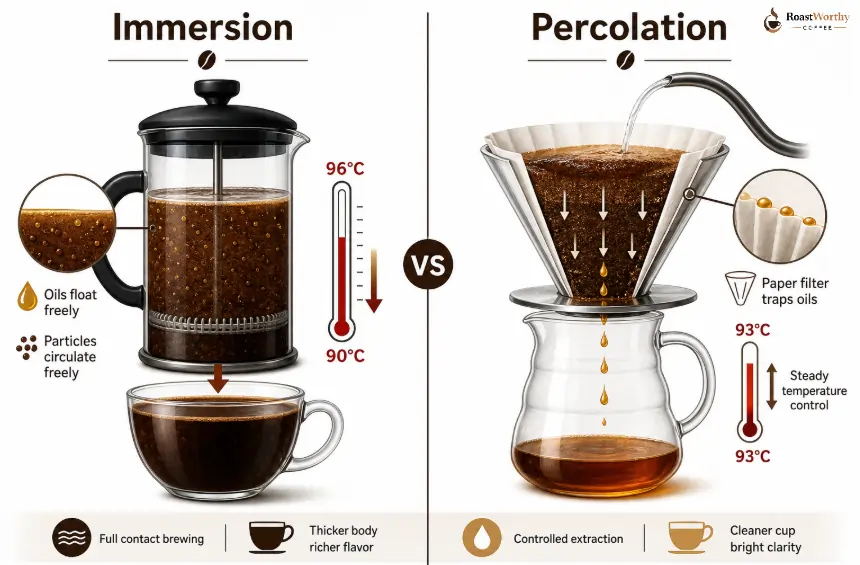
This is where most comparisons get lazy. They say “French press is bold, pour over is clean.” That's true — but not why.
French press is immersion brewing. The grounds sit in water for the entire extraction. Every particle is in constant contact with the water from start to finish. The result: a heavier body, more oils, a thicker texture in the cup.
Pour over is percolation. Water moves through a bed of grounds and a filter. Contact time per particle is shorter and more controlled. The paper filter traps coffee oils and fine particles. What gets through is a cleaner, brighter extraction.
Here's what the heat is actually doing — in French press, thermal mass drops as you brew. You start at 93–96°C and lose roughly 4–6°C over a 4-minute steep. That temperature curve affects extraction rate in ways most people never account for.
In pour over, you control temperature actively. Every pour is a decision. 93°C throughout, if you're paying attention.
Flavor Comparison: What Actually Hits the Cup
French Press: Body First
Expect a heavy, textured cup. You'll taste the oil in the bean — which means a medium or dark roast from Brazil or Sumatra absolutely shines here. The mouthfeel is almost chewy on a good extraction.
What you also get: sediment. Fine particles pass through the metal mesh filter. Some people love the texture. Some find it gritty. That's a real variable.
If you're brewing a light-roasted Ethiopian or a delicate Kenyan, immersion can muddy the clarity. The brightness gets buried in body.
Pour Over: Clarity and Acidity
Pour over rewards light and medium roasts. The paper filter strips the oils, which lets the acidity and origin character lead. A washed Colombian through a V60 tastes like what the farmer intended. You get stone fruit, citrus, florals — not just “coffee.”
The tradeoff: thinner body. Not watery — but lean. If you want that thick, satisfying mouthfeel, pour over won't deliver it.
Brew a natural-processed Yirgacheffe through a Chemex and you'll taste blueberry and honey clearly. Brew the same bean in a French press and the texture takes over. Different cups. Neither wrong. One just tells the origin's story better.
New to pour over? Our complete pour over brewing guide covers grind size, ratios, and technique — start there.
Brew Time: Which Is Faster?
| Method | Grind Size | Brew Time | Hands-On? |
|---|---|---|---|
| French Press | Coarse | 4 minutes | Minimal |
| Pour Over (V60) | Medium-Fine | 3–4 minutes | High |
| Pour Over (Chemex) | Medium-Coarse | 4–5 minutes | High |
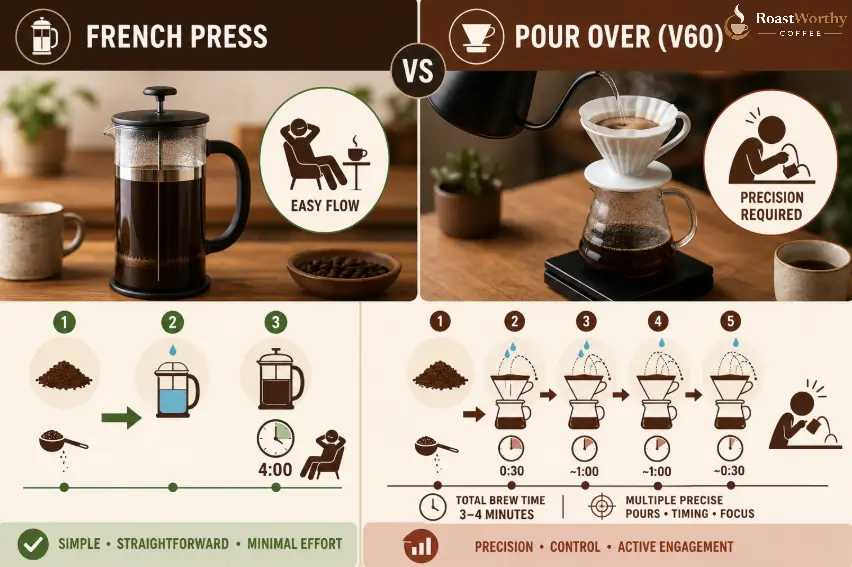
French press wins on ease. Grind coarse, pour at 93°C, start a 4-minute timer, press, pour. That's it.
Pour over demands attention. You're doing a 30–45 second bloom pour, then 2–4 controlled pours in intervals. If your pour rate is inconsistent, your extraction is inconsistent.
For morning autopilot, French press is faster and more forgiving.
For a focused weekend brew where you want to taste the bean properly — pour over pays back the effort.
Ease of Use: The Honest Assessment
French press is genuinely beginner-friendly. There's one variable that matters most: grind size. Go too fine and you're under-pressing and over-extracting. Go coarse (think chunky sea salt) and you're in the right zone.
Pour over has a real learning curve. Grind size, pour rate, water temperature, total brew time — all four interact. A beginner can pull a decent cup quickly. A great cup takes repetition and logging. Taste it. Write it down. Roast it again. ⚗️
One practical note: pour over equipment is more fragile. A glass V60 or Chemex breaks. A stainless French press doesn't.
Equipment Cost Breakdown
You don't need to spend much for either method — but the floor and ceiling differ.
French Press:
Pour Over:
The real cost difference is the kettle. Pour over benefits from a gooseneck kettle with temperature control. Budget $30–80 for a decent one (Hario Buono or Fellow Stagg EKG if you want precision).
If you're starting from zero, French press is the cheaper setup. Dripper + gooseneck kettle + decent grinder puts pour over at $80–150 to do it properly.
Which Roast Level Works Best for Each?
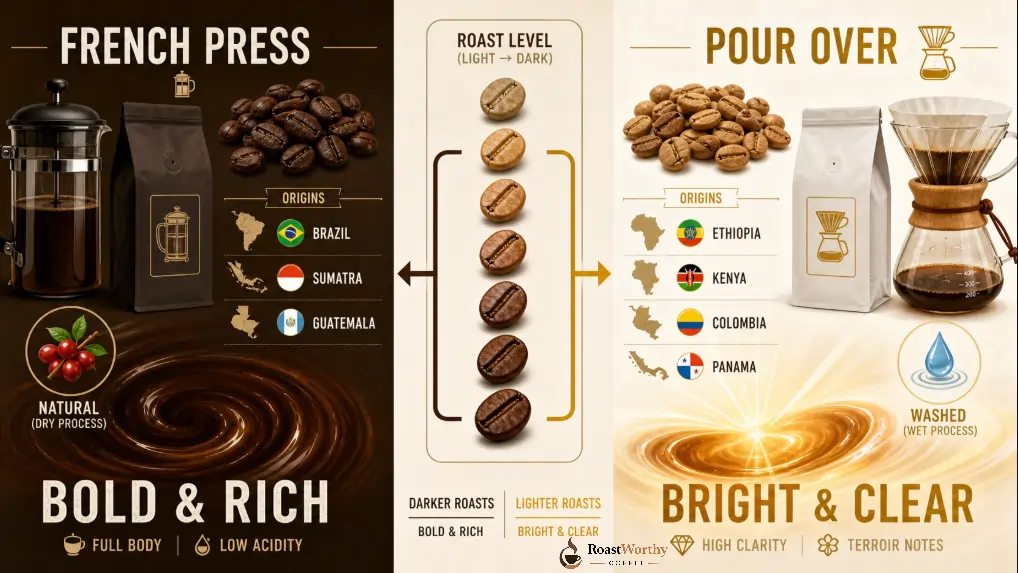
This is the question most guides skip. And it matters more than the equipment itself.
French press performs best with:
Pour over performs best with:
If someone hands you a bag of a Guatemalan dark roast, brew it in a French press. If it's a light-roasted Kenyan AA, use a V60. Match the method to the bean — not the other way around.
FAQ
Is pour over coffee stronger than French press?
Not necessarily. French press tends to have a heavier, oilier body — which reads as “strong” to most people. Pour over is typically cleaner and brighter, but total caffeine depends on your coffee-to-water ratio, not the brewing method.
What grind size should I use for French press?
Coarse. Think chunky sea salt or rough breadcrumbs. Fine grounds clog the mesh filter and produce an over-extracted, bitter cup.
Does French press have more caffeine than pour over?
Marginally, yes. Longer immersion time and no paper filter means slightly more dissolved solids — including caffeine. The difference is small. Ratio matters far more than method.
Is pour over better for specialty coffee?
For light-roasted, single-origin specialty coffee, yes. Pour over preserves origin clarity and acidity better than French press. If the bean has something to say, pour over lets it speak.
Which is easier to clean — French press or pour over?
Pour over is simpler: remove the filter, rinse the dripper. French press requires disassembling the plunger and rinsing out wet grounds. Not difficult, but more steps.
Can I use the same coffee for both methods?
You can, but results vary. A medium roast works in both. For best results, match the bean to the method — light roasts for pour over, medium-to-dark for French press.
More Recommendations from RoastWorthy Coffee

So Which One Should You Use?
If you want one honest answer: start with a French press.
It's forgiving. It's fast. It produces a consistently satisfying cup once you dial in grind size and steep time. And it costs less to set up properly.
If you want to actually explore what coffee can taste like — the origin character, the processing notes, the brightness that a washed Ethiopian delivers — move to pour over. It rewards the work. Significantly.
The best setup? Own both. Use French press for weekday mornings. Pull out the V60 on Saturdays when you have 10 extra minutes and a bag worth paying attention to.
The curve doesn't lie. Neither does the cup.