Coffee Extraction Explained: What TDS, Yield, and Solubles Mean

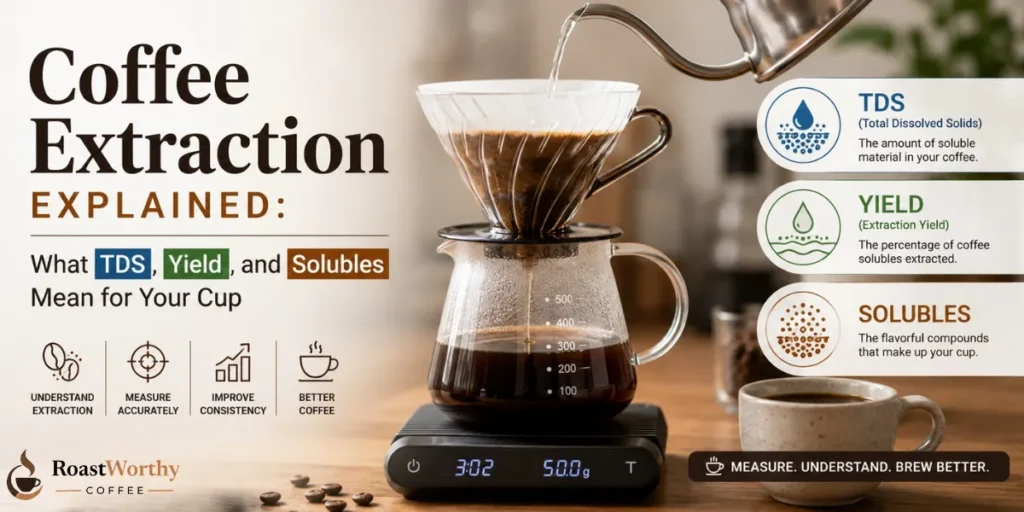
🔬 Most brewing problems aren't grind problems. They're extraction problems you haven't measured yet.
Coffee extraction is the process of pulling soluble compounds out of ground coffee using hot water. Simple concept. Wildly misunderstood in practice.
If your cup tastes sour, hollow, or weirdly sharp — that's under-extraction. If it's bitter, drying, or just harsh — that's over-extraction. Both have the same fix: understand what you're actually measuring.
Here's what the heat is actually doing, and what the numbers mean.
What Coffee Extraction Actually Means
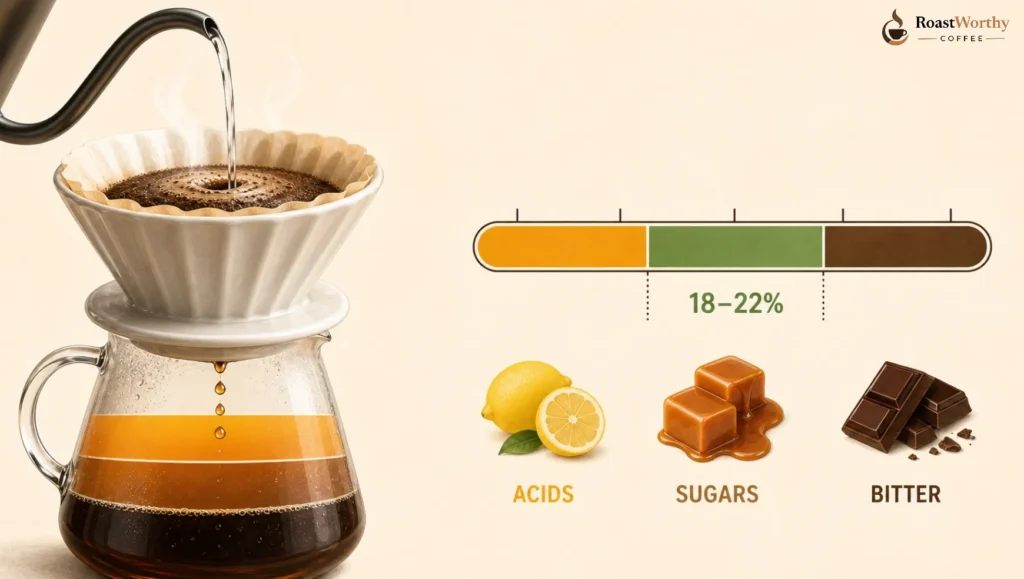
When hot water hits ground coffee, it dissolves compounds in a specific sequence. Acids and fruity compounds extract first. Sugars and sweetness come next. Bitter, woody compounds pull last.
This is why extraction percentage matters so much. Pull too early — you get sour and thin. Pull too late — you get bitter and dry.
Extraction percentage is the percentage of coffee mass that dissolved into your brew water.
The SCA (Specialty Coffee Association) brewing standards put the sweet spot at 18–22% extraction. Most home brewers sit somewhere between 16% and 24%, often without knowing it.
TDS: The Number Most Brewers Ignore ⚗️
TDS stands for total dissolved solids. It measures the concentration of extracted coffee in your final cup — expressed as a percentage.
A brewed coffee at 1.4% TDS means 1.4% of that liquid is dissolved coffee solids. The rest is water.
The SCA's target brewing range sits between 1.15% and 1.45% TDS for filter coffee. Espresso runs much higher — typically 8–12%.
You measure TDS with a refractometer. A basic one costs around $30–$50. It pays for itself the first week you use it because you stop guessing.
Here's the critical distinction most people miss: TDS tells you concentration, not quality. You can have a high-TDS cup that's over-extracted and tastes terrible. TDS and extraction percentage are related — but they're not the same number.
Extraction Percentage vs. TDS: How They're Connected
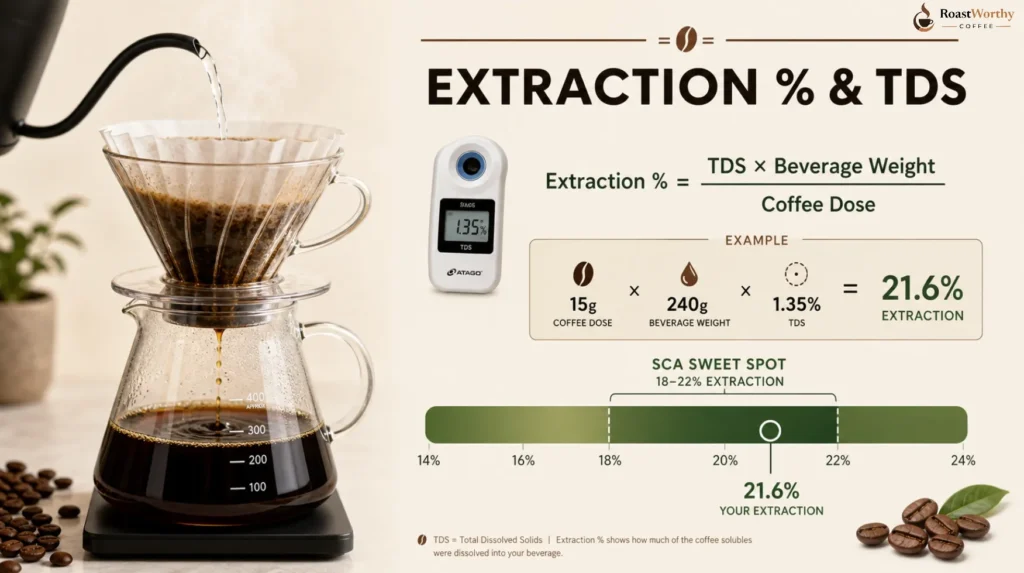
The relationship between TDS and extraction percentage depends on your brew ratio.
The formula:
Extraction %=TDS×Beverage WeightCoffee Dose\text{Extraction \%} = \frac{\text{TDS} \times \text{Beverage Weight}}{\text{Coffee Dose}}Extraction %=Coffee DoseTDS×Beverage WeightReal example: You brew 15g of coffee and end up with 240g of liquid. Your refractometer reads 1.35% TDS.
Extraction %=1.35×24015=21.6%\text{Extraction \%} = \frac{1.35 \times 240}{15} = 21.6\%Extraction %=151.35×240=21.6%
That's a well-extracted cup — sitting right in the SCA sweet spot.
Change your dose or your yield, and the extraction percentage shifts even if
stays the same. This is why brew ratio is not optional information. It's the anchor for every other measurement.
Brew Ratio: The Foundation of Repeatable Coffee
Brew ratio is the weight of coffee to the weight of water used.
Standard pour-over range: 1:15 to 1:17 (1g coffee per 15–17g water).
If you're brewing by volume — tablespoons, scoops — stop. Weight is the only way to repeat a result. Grind density changes between bags, between roast levels, and across time as coffee degasses.
Use a scale. Every time.
The ratio controls strength. The grind and contact time control extraction. You can have a 1:15 brew that's under-extracted if the grind is too coarse or the pour is too fast. You can have a 1:17 brew that's over-extracted if the grind is too fine.
These are separate levers. Treat them separately.
Under-Extraction vs. Over-Extraction: What They Actually Taste Like ☕
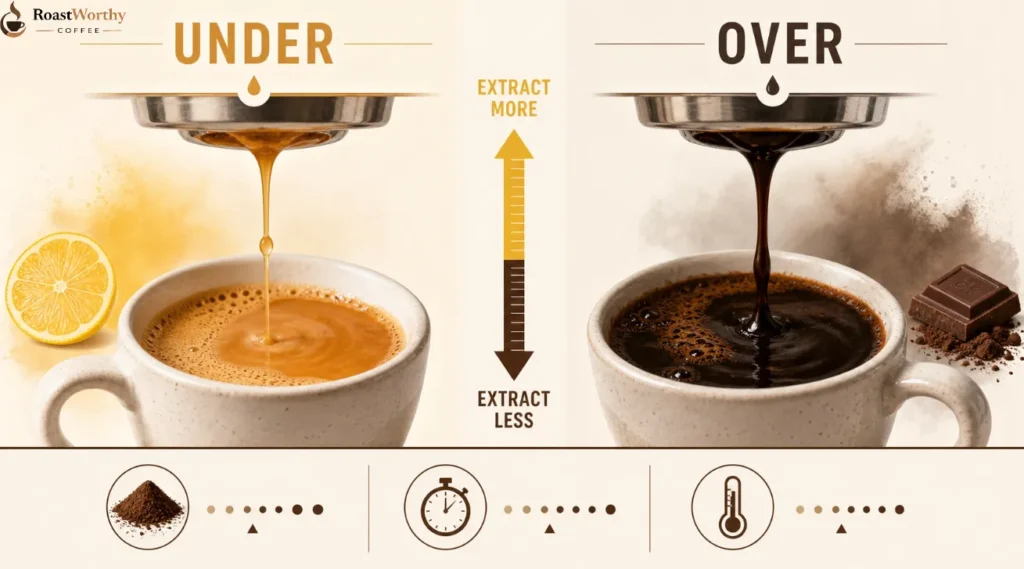
Under-extracted coffee tastes:
Over-extracted coffee tastes:
The sour-vs-bitter diagnostic is your fastest fix tool. Sour = extract more (finer grind, longer brew time, hotter water, or all three). Bitter = extract less.
Most first-time brewers under-extract. They're trying to avoid bitterness and end up with thin, sour cups instead.
Taste it. Write it down. Roast it again.
How Roast Level Affects Extraction
Light roasts extract differently than dark roasts. This is not an opinion — it's physics.
Darker roasts are physically more porous. Cell walls have broken down. Solubles release faster and more easily.
Light roasts are denser. They need more coaxing. Higher brew temperature (93–96°C vs. 88–91°C for dark), finer grind, or extended bloom time.
If you're brewing a light roast the same way you brew a dark roast, you're probably under-extracting it. Sour, thin, underwhelming — and you blame the coffee. The coffee is fine. Your parameters are off.
A light Ethiopian natural processed through the wrong recipe tastes nothing like what it should. Same bean. Wrong variables. Adjust for the roast. Always.
SCA Brewing Standards: What the Numbers Say
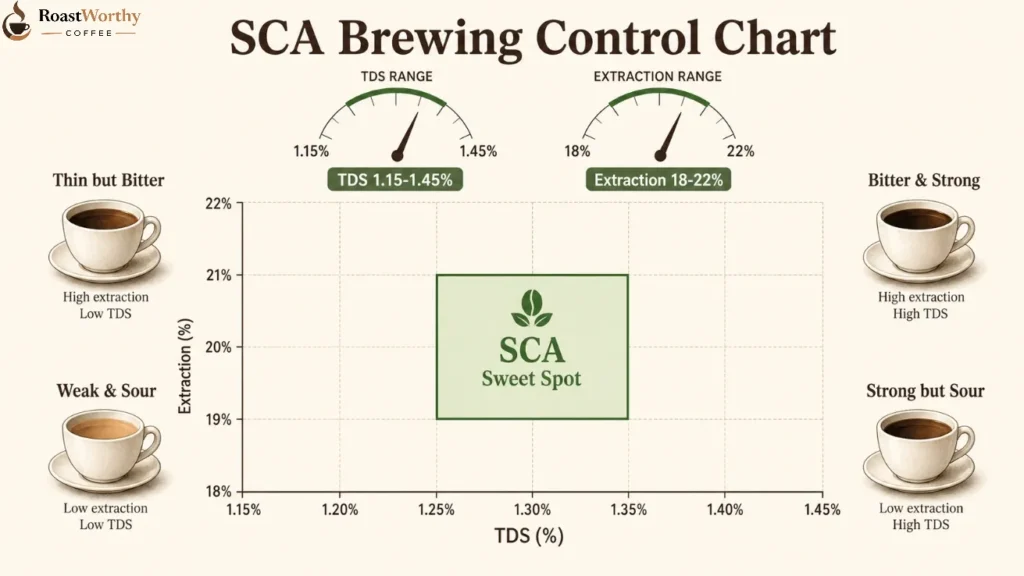
The SCA Coffee Brewing Control Chart maps TDS against extraction percentage to define the ideal brewing zone.
The target zone:
Hit both? You're in the zone.
High TDS + high extraction = bitter and strong. High TDS + low extraction = strong but sour. Low TDS + high extraction = thin but bitter. Low TDS + low extraction = weak and sour.
These standards were developed for filter coffee — primarily drip and pour-over. Espresso, immersion brewing, and cold brew all operate outside these ranges by design.
The chart is a calibration tool, not a rulebook. But if you're consistently off — especially on the low end — it tells you exactly which direction to move. ⚗️
Brew Method Extraction Ranges at a Glance
Each method extracts differently because contact time, pressure, and grind interact differently. Don't chase one set of numbers across every brew method.
| Brew Method | Target TDS | Extraction % | Water Temp |
|---|---|---|---|
| Pour-Over | 1.25–1.45% | 18–22% | 90–96°C |
| French Press | 1.2–1.4% | 18–22% | 92–96°C |
| Espresso | 8–12% | 18–22% | 90–94°C |
| Cold Brew | 1.3–1.5% | 12–18% | Cold/Room Temp |
| AeroPress | 1.3–1.6% | 18–23% | 80–96°C |
Espresso hits the same extraction percentage target as pour-over — just at a wildly different TDS because the brew ratio is so compressed. That's the same science, different parameters.
Solubles Yield: What's Actually in the Cup
Solubles yield is another way of saying: how much of the dry coffee mass ended up dissolved in your final beverage?
Coffee is not 100% soluble. Approximately 28–32% of dry coffee mass is extractable under any brewing conditions. The rest — cellulose, fibres, oils locked in the grounds — stays in the filter.
Your target is to extract 18–22% of that total dry mass. That means you're pulling roughly 60–70% of what's theoretically available.
This matters when troubleshooting because it sets a ceiling. You cannot extract 35% from coffee no matter how fine you grind or how long you brew. At some point, you're scorching compounds that were never meant to dissolve.
More brew time past a certain point doesn't equal better extraction — it equals degraded extraction.
Why Water Chemistry Gets Overlooked
Most brewers obsess over grind. Almost none think about their water.
Water hardness and mineral content directly affect how efficiently solubles are released. Magnesium ions are especially active at bonding with aromatic compounds. Soft water (under 75 ppm total hardness) produces flat, under-extracted cups even with a perfect recipe.
If you're in a soft-water city and your extraction feels stubbornly low — that's probably why.
The fix is simple: Third Wave Water mineral packets, or a basic filtered water setup with a remineralisation cartridge. Aim for 75–150 ppm total hardness. Calcium and magnesium balanced. No chlorine.
Your recipe didn't change. The water did. That's often all it takes.
How to Start Measuring Extraction at Home
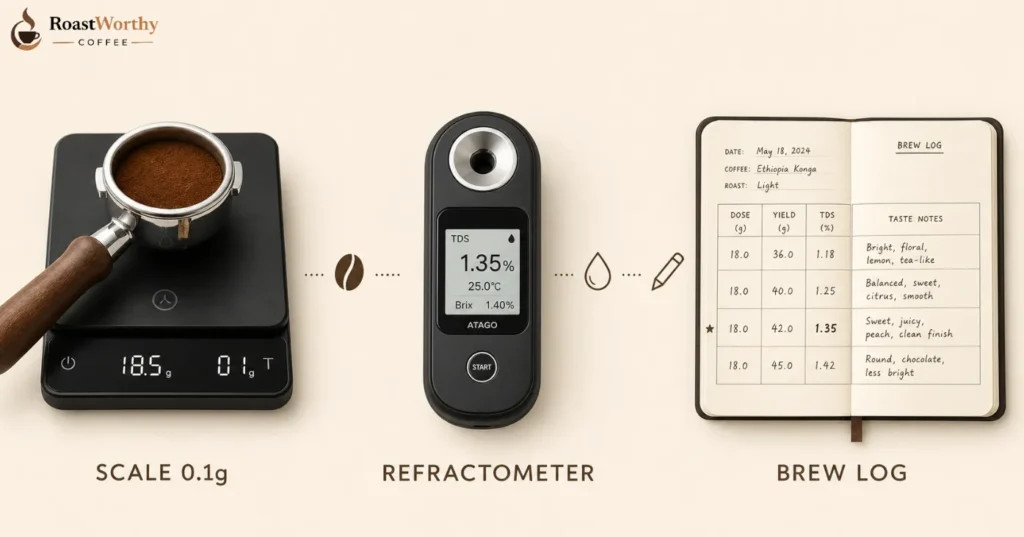
You don't need a lab setup. Here's the practical minimum:
Start with a 1:16 ratio. Aim for 1.35% TDS. Calculate your extraction percentage. Taste the cup.
If it's sour and low, grind finer or slow your pour. If it's bitter and high, grind coarser or reduce brew time.
Adjust one variable per brew. Not two. If you change grind and pour speed simultaneously, you can't identify which variable fixed or broke the cup.
This is basic experimental method. Same thing I used when I was burning popcorn-popper batches in 2017. The principle doesn't change.
The Variables That Control Extraction
Every brewing parameter affects extraction. Here's how each one moves the needle:
Pull any one of these in the wrong direction and the extraction shifts. Most troubleshooting failures happen because someone changed the wrong variable — or changed two at once and lost the thread.
The curve doesn't lie.
FAQ: Coffee Extraction, TDS, and Solubles
What is coffee extraction in simple terms?
Hot water dissolves soluble compounds out of ground coffee. Extraction percentage measures how much of the dry coffee mass ended up in your cup.
What is a good TDS for coffee?
For filter coffee, the SCA target is 1.15–1.45% TDS. Espresso typically runs 8–12%. Neither number is meaningful without the matching extraction percentage.
What does under-extracted coffee taste like?
Sour, thin, sharp, sometimes salty. The fruity acids extracted but the sugars and sweetness didn't follow.
What does over-extracted coffee taste like?
Bitter, dry, astringent. Occasionally woody or like straw. The late-stage bitter compounds dominated.
Do I need a refractometer to brew good coffee?
No — but it accelerates your learning significantly. Tasting alone can get you to good extraction. A refractometer gets you there faster and tells you exactly what to adjust.
What is the SCA brewing standard extraction range?
18–22% extraction percentage at 1.15–1.45% TDS for filter coffee. These targets apply to drip and pour-over at standard brew ratios.
What brew ratio should I start with?
Start at 1:16 — 1g of coffee per 16g of water. It's the most forgiving ratio for pour-over and a solid calibration point before you dial in further.
More Recommendations from RoastWorthy Coffee