Atlas vs Blue Bottle 2026: Which Coffee Subscription Wins?

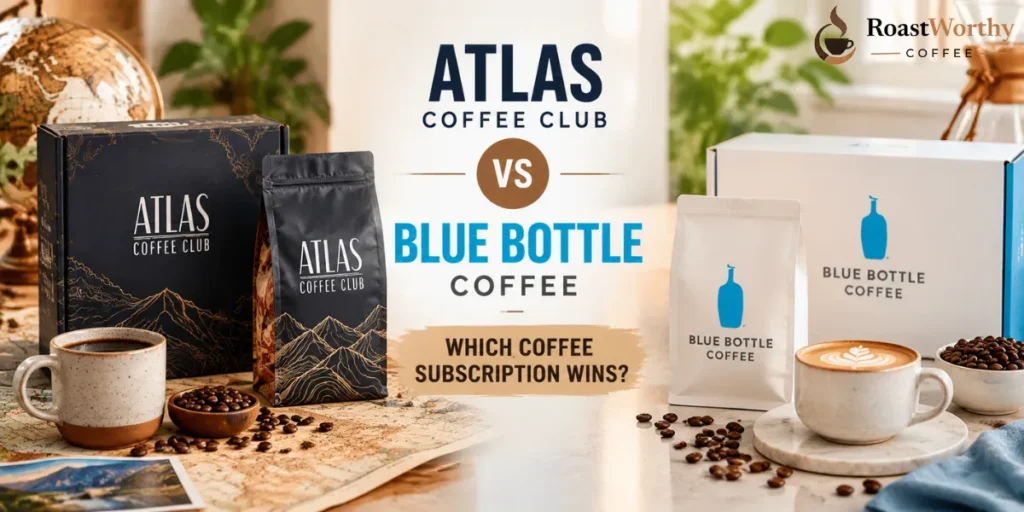
Atlas sells discovery. Blue Bottle sells control.
That difference shapes this entire Atlas vs Blue Bottle comparison. Atlas sends single-origin coffee from a different country, complete with tasting information and origin storytelling. Blue Bottle gives you a larger menu of roast styles, blends, espresso coffees, and rotating assortments.
Both ship freshly roasted premium coffee. Both include free shipping on subscriptions. Only one offers the stronger balance of variety, flexibility, and price.
Quick Verdict
Atlas Coffee Club wins for most coffee drinkers.
A 12-ounce Atlas shipment costs $20, compared with $22 for most Blue Bottle assortments and $27 for Blue Bottle’s Single Origin Assortment. Atlas also offers pre-ground coffee, multiple bag sizes, origin postcards, and a 30-day money-back guarantee.
Blue Bottle remains the better choice for experienced brewers who own a grinder and know exactly what roast style they enjoy.
Atlas vs Blue Bottle at a Glance
| Feature | Atlas Coffee Club | Blue Bottle |
|---|---|---|
| Best for | Exploring global coffee origins | Choosing a defined roast style |
| Standard 12-ounce price | $20 | $22 for most assortments |
| Premium single-origin price | Included in standard plan | $27 |
| Coffee format | Whole bean or ground | Whole bean only |
| Coffee selection | New country each month | Rotating assortments or fixed blends |
| Roast customization | Choose a roast preference | Choose an assortment by flavour style |
| Shipment sizes | 6, 12, 24 ounces and larger | 12, 24 or 36 ounces |
| Delivery schedule | Adjustable | Every one to four weeks |
| Free shipping | Yes | Yes |
| Freshness promise | Roasted the day it ships | Roasted daily in small batches |
| Gift subscription | Strong | Limited flexibility |
| Money-back guarantee | 30 days | Standard return rules |
| Winner | Yes | Close second |
Atlas charges $13 for 6 ounces, $20 for 12 ounces, and $34 for 24 ounces. Blue Bottle’s rotating Blend, Bright, Balanced, Espresso, Comforting, and Cold Brew assortments generally begin at $22. Its Single Origin Assortment costs $27.
The Main Difference Between Atlas and Blue Bottle
Atlas is a coffee-of-the-month club in the literal sense.
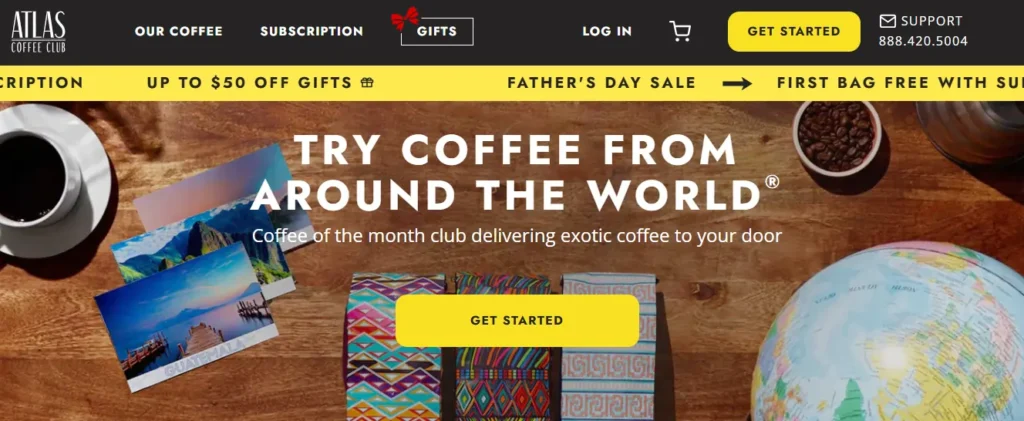
Members receive coffee from one featured country at a time. The box includes a postcard, tasting information, and background on the region. You cannot select the country, but that is part of the point.
Blue Bottle takes a different route.
You select a flavour category or a specific evergreen coffee. The company then sends coffee that stays within those boundaries. Its Origins Assortment rotates single-origin beans, while the Balanced, Bright, Comforting, Blend, Espresso, and Cold Brew plans focus on particular roast or brewing preferences.
Atlas asks you to surrender control. Blue Bottle asks you to define your taste.
Neither approach is wrong. Atlas simply creates more anticipation when the box arrives.
Coffee Quality and Roast Style
Both companies operate well above supermarket coffee.
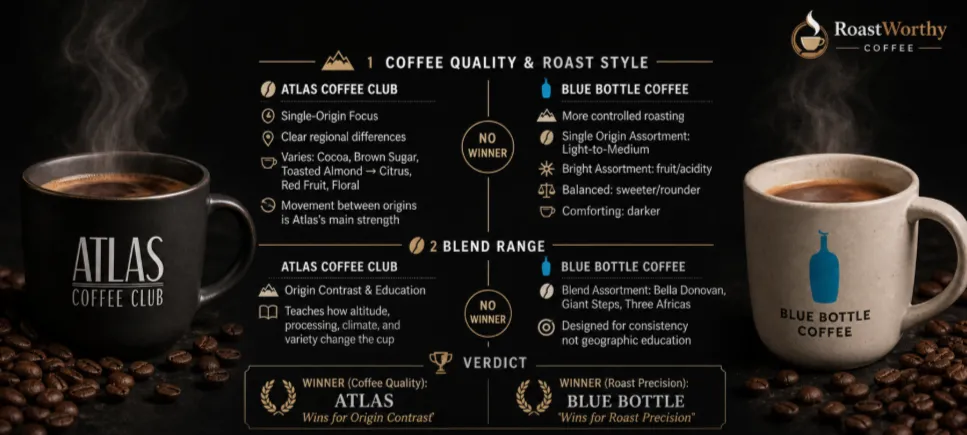
Atlas concentrates on accessible single-origin coffee. Expect clear regional differences rather than competition-level micro-lots roasted at the palest possible level.
One shipment may lean towards cocoa, brown sugar, and toasted almond. Another may taste brighter, with citrus, red fruit, or floral edges.
That movement between origins is Atlas’s main strength. It teaches you how altitude, processing, climate, and variety change the cup.
Blue Bottle is more controlled.
Its Single Origin Assortment usually sits around the light-to-medium range. The Bright Assortment pushes towards fruit and acidity. Balanced stays sweeter and rounder. Comforting moves darker.
The Blend Assortment rotates recognisable Blue Bottle coffees such as Bella Donovan, Giant Steps, and Three Africas. These are designed for consistency rather than geographic education.
Blue Bottle wins for roast precision. Atlas wins for origin contrast.
Blue Bottle is also stronger for espresso. Its dedicated Espresso Assortment moves between chocolate-heavy blends, brighter espresso profiles, and selected single-origin coffees.
Atlas lets you choose an espresso grind, but its core identity remains filter-friendly global discovery.
Freshness: Which Coffee Arrives Faster?
Atlas has the sharper roast-to-ship promise.
Its whole-bean and ground coffee is roasted on the same day it ships, sometimes only hours before dispatch. That is excellent handling for a subscription at this price.
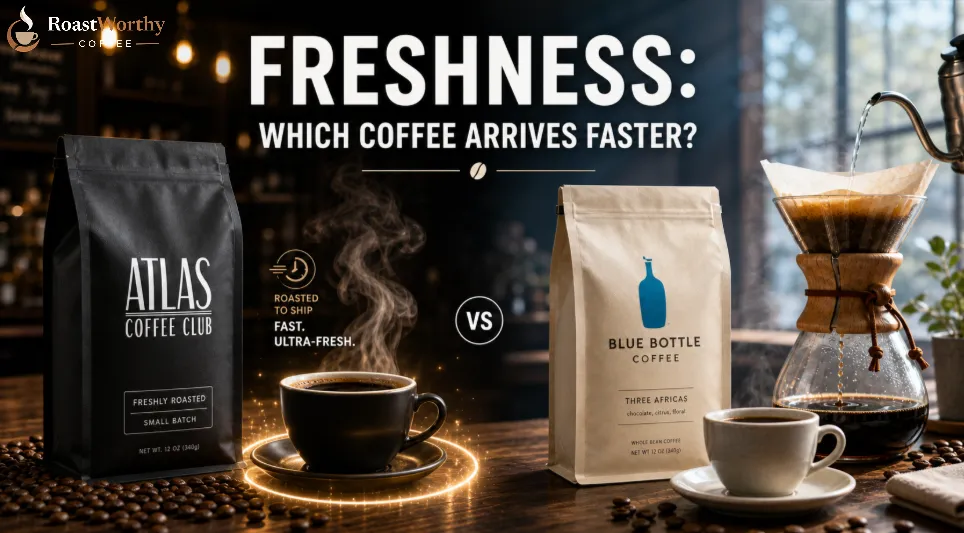
Blue Bottle roasts coffee daily in batches of no more than 70 kilograms. Orders usually enter packing and carrier handoff within one to three business days. The company estimates five to ten business days from order processing to delivery.
Blue Bottle’s packaging is built for a longer unopened life. The company says sealed bags can remain vibrant for up to 100 days after roasting. Once opened, it recommends using the coffee within 14 days.
Here is what the heat is actually doing… freshly roasted coffee continues releasing carbon dioxide after roasting. Brewing too early can create unstable extraction. Waiting roughly four to seven days often improves light and medium roasts.
Atlas wins the freshness claim on paper. Blue Bottle’s packaging and roasting controls still make this close.
Coffee Variety and Discovery
Atlas sends coffee from a new country each month.
That could mean familiar producers in Colombia or Ethiopia. It could also mean coffee from less common subscription origins such as India, Papua New Guinea, Burundi, or the Dominican Republic.
The experience feels guided. You receive the coffee, read the origin card, brew it, and place another country in your mental flavour map.
Start with the origin, not the branding. There is a whole story in this cup.
Blue Bottle offers more products but less geographic theatre.
Its rotating subscriptions change regularly, yet the member first chooses a flavour lane. Someone subscribing to Balanced will not suddenly receive an aggressively floral coffee that tastes like jasmine tea and lemon peel.
That predictability is useful. It is also less exciting.
Atlas offers greater geographic variety. Blue Bottle offers greater subscription variety.
For a fuller look at Atlas’s country rotation, our Atlas Coffee Club Review explains how its origin-first format works. Our Blue Bottle Subscription Review covers each roast assortment separately.
Whole Bean Delivery and Grind Options
This category is not close.
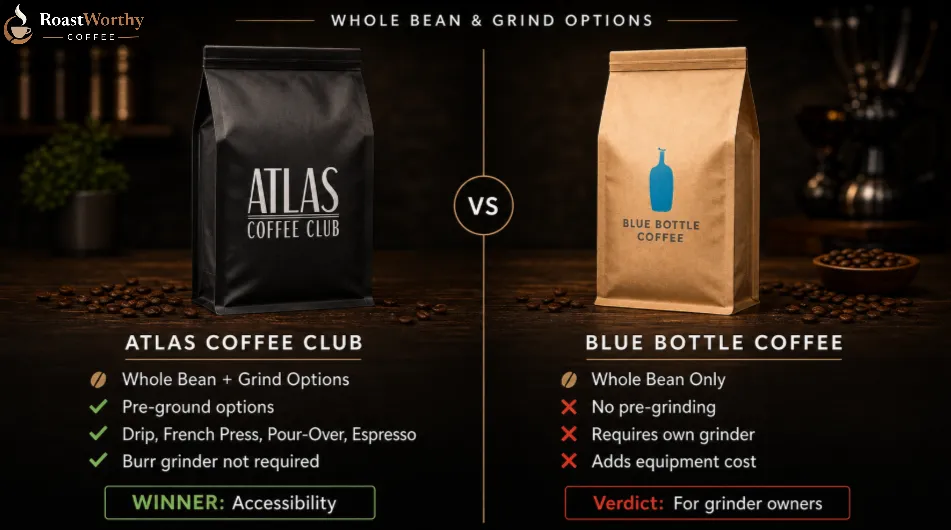
Atlas offers whole beans plus grind settings for different brewing methods. Options include common formats for drip machines, French presses, pour-over brewers, and espresso.
Blue Bottle ships all conventional coffee as whole bean. It does not grind coffee before shipping.
I normally prefer whole bean delivery. Grinding immediately before brewing preserves aroma and gives you control over extraction.
Still, plenty of people do not own a burr grinder. Atlas serves them properly. Blue Bottle effectively requires another piece of equipment.
A decent grinder also changes the real price of the subscription. Buying Blue Bottle without one makes little sense.
Atlas wins for accessibility. Blue Bottle is built for grinder owners.
Atlas vs Blue Bottle Coffee Pricing and Overall Value
Atlas is cheaper at every comparable entry point.
Its 12-ounce plan costs $20 with free shipping. The 24-ounce option costs $34, reducing the price to $17 per bag. A smaller 6-ounce plan costs $13 for lighter drinkers.
Blue Bottle charges $22 for most 12-ounce assortment subscriptions. The Single Origin Assortment costs $27. Individual blends commonly sit around $23 per shipment.
That makes Atlas $2 cheaper than Blue Bottle’s standard assortments and $7 cheaper than its premium single-origin plan.
The gap matters over a year.
At one 12-ounce shipment every four weeks, Atlas costs roughly $260 across 13 deliveries. A $22 Blue Bottle assortment costs about $286. Blue Bottle Single Origin reaches roughly $351.
Promotional prices can change these totals. The normal recurring prices provide the cleaner comparison.
Atlas also includes:
Blue Bottle includes free shipping, subscriber savings, early access to selected coffees, and the option to pause, skip, change, or cancel recurring orders.
Atlas offers better value. Blue Bottle earns its premium through tighter roast selection and brand consistency.
Pricing disclaimer: Atlas currently offers 50% off the first shipment on eligible subscription sizes. Future deliveries renew at the applicable recurring subscription price and ongoing savings shown at checkout.
Shipping Frequency and Subscription Flexibility
Blue Bottle gives you clear frequency controls.
Coffee can ship every one, two, three, or four weeks. Members can select 12, 24, or 36 ounces per shipment, though every bag in one shipment contains the same coffee.
Atlas lets members adjust shipment frequency through the customer portal. Its available quantities run from a 6-ounce bag to four 12-ounce bags per delivery. Larger orders can be arranged through customer support.
Both recurring subscriptions can be paused or cancelled.
Blue Bottle has the cleaner scheduling system. Atlas provides more quantity choices, including the useful 6-ounce option.
Call this one level.
Which Gift Subscription Is Better?
Atlas wins the gift subscription category comfortably.
It offers prepaid three, six, and twelve-month gifts. Buyers can select caffeinated or decaf coffee, choose delivery details, include a note, and send the gift by mail or email.
Its quarterly option groups three coffees from three countries into each delivery. That reduces packaging and gives the recipient more variety at once.
Blue Bottle gift subscriptions are far more rigid.
The first shipment processes immediately. Once started, the subscription cannot be paused, cancelled, or changed. The frequency, coffee type, and bag size stay fixed until all prepaid shipments finish.
Blue Bottle gift subscriptions are also unavailable for Canadian delivery.
Blue Bottle still makes an attractive premium gift. Atlas provides the better gifting system.
Which Coffee Subscription Fits You Best?
Your brewing equipment and taste preferences should decide this comparison.
Choose Atlas Coffee Club if you want discovery
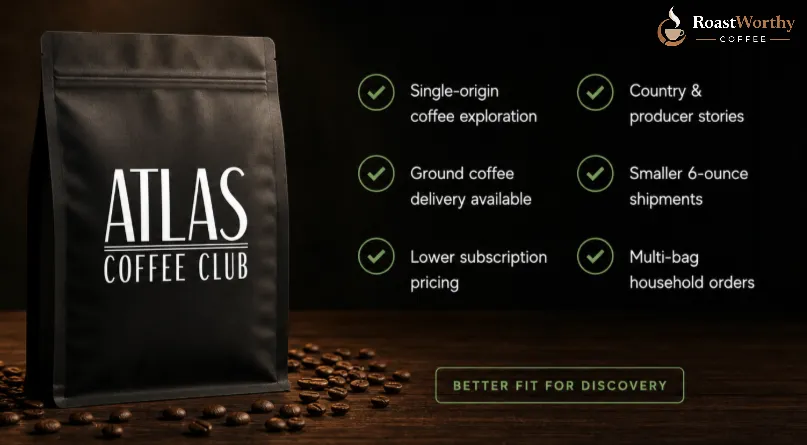
Atlas works best for drinkers who want to taste coffee from different countries without choosing every bag themselves.
It is also the easier option for people without a grinder. You can order whole beans or select a grind suited to drip machines, pour-over brewers, French presses, or espresso equipment.
Atlas is the better fit for:
For drip coffee, start with 30 grams of coffee and 480 grams of water. That gives you a reliable 1:16 ratio.
For pour-over, use 20 grams of coffee with 320 grams of water. Brew medium roasts near 200°F and darker roasts closer to 195°F.
Choose Blue Bottle if you prefer control
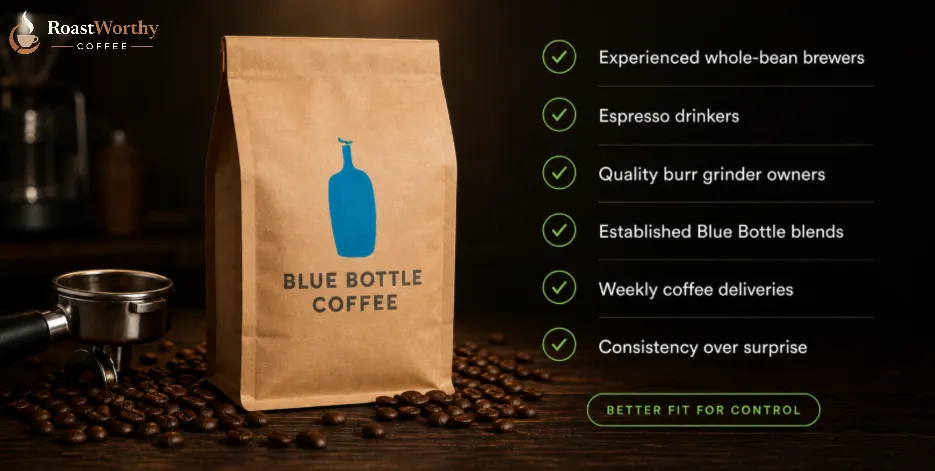
Blue Bottle suits drinkers who already know the roast style they enjoy.
Its Bright, Balanced, Comforting, Blend, and Espresso assortments let you stay within a familiar flavour range. The coffee changes, but the overall cup remains predictable.
Blue Bottle is the better fit for:
For espresso, begin with an 18-gram dose and aim for 36 grams in the cup within 27 to 32 seconds.
A bitter, dry shot usually ran too slowly. A sharp, thin shot probably ran too quickly. Adjust the grind before changing the dose.
Atlas is better for exploration and accessibility. Blue Bottle is better for roast control and espresso.
Frequently Asked Questions
Is Atlas better than Blue Bottle?
Atlas is better for most people because it costs less, supports ground coffee, and sends single-origin beans from a new country each month. Blue Bottle is better for defined roast preferences and espresso.
Is Atlas Coffee Club freshly roasted?
Yes. Atlas says its whole-bean and ground coffee is roasted on the same day it ships, often within several hours of dispatch.
Does Blue Bottle grind subscription coffee?
No. Blue Bottle ships its conventional coffee whole bean and does not offer pre-shipment grinding.
Which subscription has more coffee variety?
Atlas has more geographic variety. Blue Bottle has more subscription categories, including single origin, blends, espresso, bright, balanced, comforting, and cold brew.
Is Atlas or Blue Bottle cheaper?
Atlas is cheaper. A standard 12-ounce Atlas shipment costs $20. Most Blue Bottle assortments cost $22, while its Single Origin Assortment costs $27.
Which coffee subscription is better as a gift?
Atlas has the better gift subscription. It offers more duration, delivery, caffeine, and scheduling choices. Blue Bottle prepaid gifts cannot be paused or modified after starting.
Final Verdict: Atlas Beats Blue Bottle by a Small Margin
Atlas wins because it makes specialty coffee approachable without flattening what makes it interesting.
The price is lower. The coffee is roasted on its shipping day. Whole-bean and ground options are available. Every shipment connects the cup to a country, processing method, and coffee culture.
Blue Bottle is the more polished roaster. Its subscription menu is deeper, and its roast categories are better defined. Espresso drinkers may prefer it.
For the wider audience, Atlas offers more discovery per dollar.
More Recommendations from RoastWorthy Coffee