How Roast Level Affects Espresso vs Drip: The Real Difference


Espresso concentrates everything – acidity, sweetness, bitterness – so roast level matters more here than anywhere else. Light roasts in espresso demand higher temperatures and longer ratios. Dark roasts in drip need lower temps and coarser grinds. The same bean, the same roast, brewed two ways can taste like completely different coffees. That is not a problem. That is the point.
There is a Yirgacheffe I tasted last year at a small producer cooperative in Gedeo Zone, Ethiopia – grown at 1,900 metres, fully washed, dried on raised beds for 21 days. As a drip, it tasted like bergamot and white peach. Someone at the table pulled it as espresso. Sharp, electric acidity. A completely different drink from the same bag.
Roast level is one part of what happened there. Brew method is the other. You cannot separate them.
Understanding how roast level affects espresso vs drip brewing is not just academic. It changes what you buy, how you dial in, and whether the cup in front of you actually represents the bean.
🔥 How Roast Level Affects Espresso vs Drip Extraction
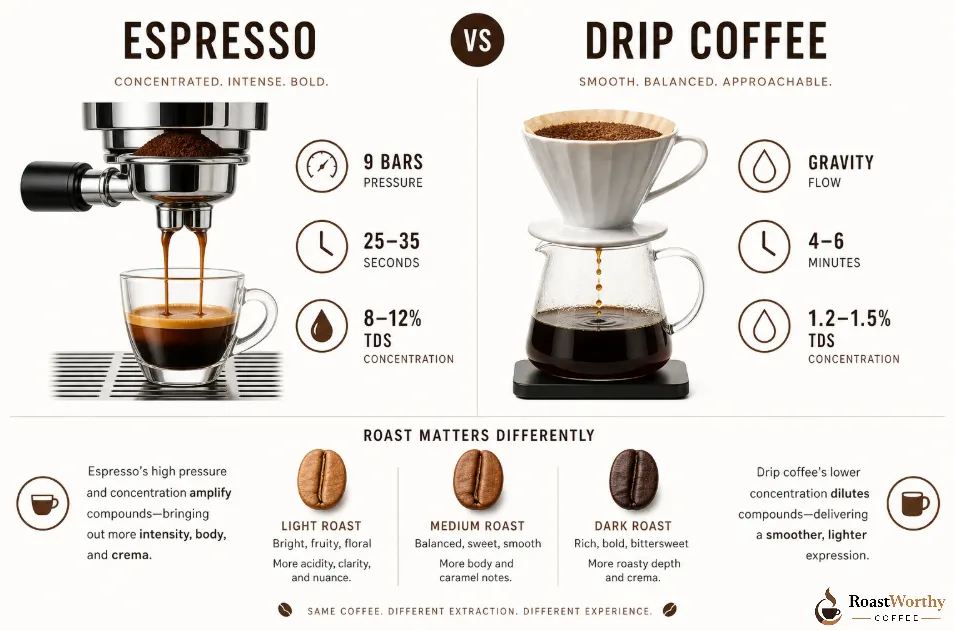
Espresso forces 9 bars of pressure through 18 to 20 grams of finely ground coffee in 25 to 35 seconds. Drip coffee uses gravity, a medium grind, and 4 to 6 minutes of contact time.
The physics are completely different. So the chemistry is too.
Espresso extracts fast and concentrates everything – organic acids, bitter compounds, sweet melanoidins, lipids. The result is a small, intense liquid with total dissolved solids (TDS) typically between 8 and 12 percent. A well-pulled drip produces TDS closer to 1.2 to 1.5 percent.
That concentration means every roast-level variable gets amplified in espresso. Acidity from a light roast that tastes pleasant in a V60 becomes sharp and aggressive in a 30ml shot. Bitterness that hides in a French press becomes central in espresso.
Roast level does not change between brew methods. But its effects do.
✨ Light Roast in Espresso vs Drip
Light roast is where origin lives. The floral compounds, stone fruit esters, and bright organic acids are products of terroir and processing – not roasting chemistry. A washed Colombian from Huila. A natural Ethiopian from Guji. The roast preserves them. The brew method either honours or destroys them.
Light Roast Espresso
This is the hardest combination to get right. And the most rewarding when you do.
Light roasts are dense and poorly soluble. Espresso short contact time under-extracts them at standard temperatures. The result is a sour, thin, unfinished shot that tastes like the bean had nothing to say.
It had plenty to say. You just did not extract it.
To pull a clean light roast espresso:
The extended ratio and higher temperature work together to draw out the sweetness and fruit that dense light roast beans hold back. Expect something bright. Tangy. Maybe a little wild. That is the origin speaking in concentrated form.
Light roast espresso does not make good milk drinks. Lattes and flat whites need a roast with body and bittersweet backbone. Light roast disappears into milk. Save it for a straight shot or a long black.
Light Roast Drip
This is where light roast belongs.
Pour-over gives you time, control, and a clean extraction window. A washed Ethiopian or Colombian at a medium-fine grind, brewed at 94 to 96 C, with a 40 to 45 second bloom at 1:15 – that is how you get bergamot, apricot, jasmine. That is what people mean when they say specialty coffee changed how they think about coffee.
The longer contact time of 3 to 4 minutes gently pulls aromatics from dense light roast beans without concentrating acidity into something unpleasant.
Drip is patient. Light roast rewards patience.
⚡ Medium Roast in Espresso vs Drip
Medium roast sits at the intersection of origin and roast character. Caramel sweetness has developed. Brightness has softened. Body is fuller. It is the most versatile roast level – and that is exactly why most specialty cafes use it as their espresso house blend base.
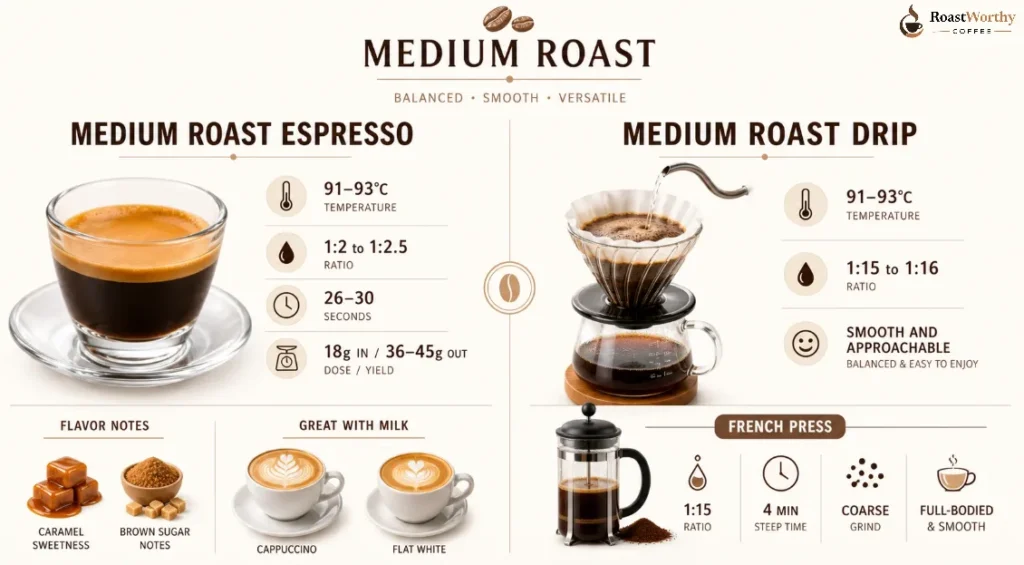
Medium Roast Espresso
Medium roast is the natural home of espresso. The balance between acidity, sweetness, and bitterness is already built in. You are not fighting the bean. You are refining the extraction.
Standard recipe:
At these parameters, a medium roast pulls with a thick, golden crema and layers of caramel, brown sugar, and light fruit in the finish. This is the shot that works under milk. Cappuccino. Flat white. Cortado. The roast sweetness integrates cleanly without disappearing.
Medium roast espresso is also the most forgiving. Minor grind adjustments produce predictable changes. A single-click coarser shortens the shot; a single-click finer extends it. For home baristas dialling in without a flow profiler, this matters.
Medium Roast Drip
Medium roast drip is what most of the world drinks every morning. Familiar, sweet, full. It works across all filter methods – drip machine, Chemex, V60, AeroPress, Moka pot.
At 91 to 93 C with a 1:15 to 1:16 ratio, medium roast produces a smooth, caramel-forward cup. The acidity is low enough to be approachable. The body is full enough to carry milk or drink black.
French press is particularly good with medium roast. The immersion method preserves oils that paper filters strip. The result is round, heavy in the cup, and stays interesting as it cools. Use a coarse grind, 1:15 ratio, 4-minute steep. Do not rush the plunge.
☕ Dark Roast in Espresso vs Drip
Let us be honest: most dark roasts sold in supermarkets are dark for reasons that have nothing to do with flavour intent. Over-roasting hides defects. It creates consistency on a large scale. None of that matters here.
A well-sourced, intentionally roasted dark bean – think Brazilian Cerrado taken to a full city+ or a Sumatran Mandheling developed to Vienna – has real depth. Bittersweet dark chocolate. Dried fig. Toasted cedar. These are legitimate flavours.
But dark roasts extract fast. That changes everything.
Dark Roast Espresso
Dark roasts are porous. The cellular structure has broken down during extended roasting. Water moves through them quickly, dissolving bitter and roasty compounds fast.
If you pull dark roast espresso at the same parameters as a medium roast, you over-extract. You get ash, harsh bitterness, and a flat, thin finish.
The fix is specific:
Lower temperature slows extraction enough to prevent bitterness from dominating. A shorter shot time reduces overall extraction yield. The result, when dialled in, is bittersweet chocolate and molasses, smooth on the finish, with crema that runs golden-brown and thick.
Dark roast espresso is also the best base for milk drinks if you want strong coffee character to hold up in a latte. Medium roast sweetens under milk. Dark roast stays present.
Dark Roast Drip
Dark roast drip is simple but punishing if you get the temperature wrong.
Do not brew dark roasts at 96 C. High heat extracts bitter and roasty compounds from porous dark beans in seconds. The cup tastes burnt. Ashy. Flat.
Drop to 88 to 92 C. Use a 1:15 ratio. Grind one step coarser than you would for medium roast at the same brew method. Contact time should stay between 3.5 and 4 minutes for immersion methods.
French press at 91 C, 4-minute steep, coarse grind: this is where dark roast drip is most comfortable. Full body. Bittersweet. Heavy.
Drip machines that cannot control temperature are actually well-suited to dark roasts because most run at 88 to 90 C by default. The temperature limitation that handicaps light roast performance works in dark roast favour.
🆚 Roast and Brew Method Reference: Espresso vs Drip
| Roast | Brew Method | Water Temp | Brew Ratio | Time | What to Expect |
|---|---|---|---|---|---|
| Light | Espresso | 93-96 C | 1:2.5-1:3 | 28-35s | Bright, tangy, fruit-forward, electric acidity |
| Light | Pour-Over / V60 | 94-96 C | 1:15 | 3-4 min | Floral, stone fruit, bergamot, delicate body |
| Light | AeroPress | 92-94 C | 1:15 | 90-120s | Clean, fruit-forward, lighter body |
| Medium | Espresso | 91-93 C | 1:2-1:2.5 | 26-30s | Caramel, balanced acidity, thick crema |
| Medium | Drip / French Press | 91-93 C | 1:15-1:16 | 4-6 min | Brown sugar, smooth, full body |
| Dark | Espresso | 88-91 C | 1:2-1:2.2 | 20-26s | Bittersweet chocolate, molasses, heavy crema |
| Dark | French Press / Drip | 88-92 C | 1:15 | 3.5-4 min | Toasted, chocolate, low acidity, full body |
📈 The Grind Variable Nobody Adjusts Enough
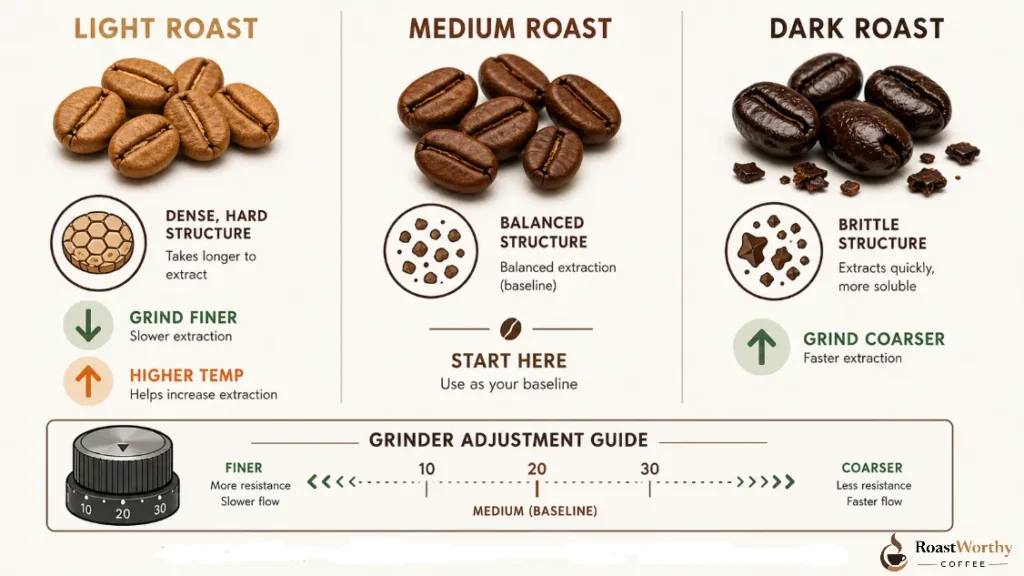
Roast level changes bean density. Bean density changes how the grinder cuts.
Light roasts are hard and dense. They produce slightly uneven particle distribution at a given grind setting. To hit optimal extraction in espresso, go finer than you think and brew at a higher temperature. The two variables compensate for each other.
Dark roasts are brittle. They shatter rather than cut cleanly. At the same grind setting as a medium roast, dark roasts produce more fines – tiny fragments that extract faster and turn bitter. Always go one or two clicks coarser when switching from medium to dark on the same espresso recipe.
This applies to drip too. Same method, same grind dial position, different roast level – you will get different extraction every time. Adjust the grind first. Then adjust temperature. Then adjust ratio.
Most home brewers adjust ratio when a cup tastes off. Grind is usually the real problem.
🧭 Rest Time Matters More for Espresso
Green coffee off the roaster off-gasses CO2 for days. Freshly roasted coffee in espresso produces uneven extraction, channelling, and a hollow, sour shot.
The rest period differs by roast level:
Drip coffee is more forgiving. 3 to 5 days post-roast for light and medium, 2 to 4 days for dark.
If your espresso is channelling despite a good grind and correct temperature, rest time is the first thing to check. There is a whole story in a bag that has been sitting for only 48 hours after roasting. Most of it is CO2. Not flavour.
🎯 Roast and Brew FAQs
What roast level is best for espresso?
Medium to medium-dark. Medium roast gives balanced sweetness and solid crema. It works in milk drinks and straight shots. Dark roast produces heavier, bittersweet shots that hold up under milk.
Can you use a light roast for espresso?
Yes, but it demands precise dialling. Use 93 to 96 C water, a 1:2.5 to 1:3 ratio, and pull for 28 to 35 seconds. Under-extraction is the common failure.
Why does the same roast taste different as espresso vs drip?
Espresso concentrates everything at 8 to 12 percent TDS. Drip extracts at 1.2 to 1.5 percent TDS. The concentration difference amplifies every flavour the roast carries.
Should you grind differently for espresso vs drip with the same roast?
Yes. Espresso needs fine grind for pressure extraction in 25 to 35 seconds. Drip needs medium grind for gravity extraction in 4 to 6 minutes. Roast level also affects how the bean grinds.
How do I stop dark roast espresso from tasting bitter?
Drop water temperature to 88 to 91 C, go one click coarser on grind, and shorten shot time to 20 to 26 seconds. Dark roasts extract fast.
Does rest time after roasting affect espresso more than drip?
Yes. Espresso is sensitive to CO2 off-gassing. Light roast espresso needs 10 to 14 days rest. Dark roast espresso needs 5 to 7 days. Drip is more forgiving.