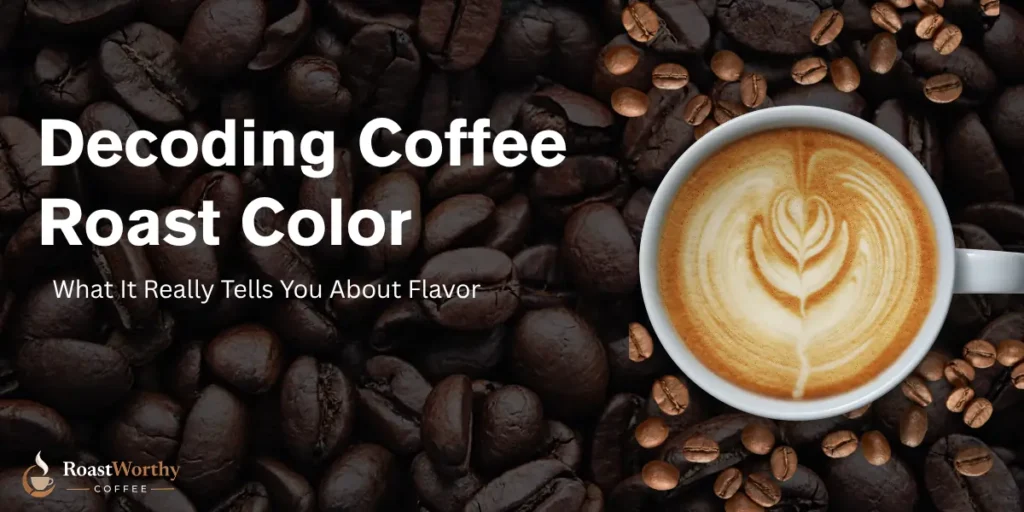
Decoding Coffee Roast Color: What It Really Tells You About Flavor

Coffee roast color tells you something. But not everything. A light brown bean is usually bright and acidic. A dark, oily one is usually bittersweet and heavy. That much is reliable.
What the colour cannot tell you is how the bean was sourced, developed, or whether it was any good to begin with. Use roast colour as a starting point. Never as a final verdict.
What Coffee Roast Color Actually Signals
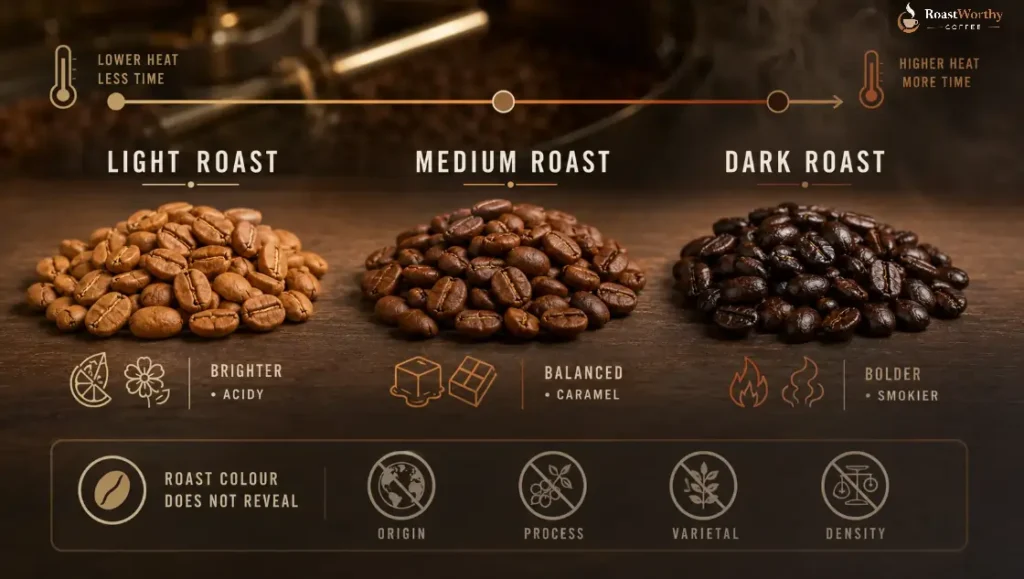
Let's be honest. Most people buy coffee by looking at the bag and the bean. That's fair. Roast colour is the fastest visual cue you have — and it does carry real flavour information.
Darker beans have spent more time in the roaster, at higher temperatures. They've lost more moisture. Their sugars have caramelised further. Their cellular structure has broken down more. That changes how they taste, brew, and extract.
Roast colour is a proxy for time and temperature inside the drum. Nothing more, nothing less.
What you cannot see from colour: origin, process, varietal, bean density, roast curve shape, or development time. Two beans with identical colour can taste completely different if those variables differ. The flavour doesn't lie — but colour alone won't predict it.
The Five Roast Color Bands
Coffee roasters don't agree on one naming system. That's part of what makes this confusing. Here's the scale that actually matters:
Light Roast (Cinnamon to City)
Colour: Pale to medium cinnamon brown. Surface is dry and matte. No visible oils.
This is where origin character survives. Floral aromatics, bright organic acids, stone fruit sweetness. The bean came off the roaster shortly after first crack — around 196–205°C internal temperature.
What it tastes like in the cup: bright, tangy, sometimes almost tea-like. Think Kenyan SL28 with blackcurrant and tomato. Ethiopian Yirgacheffe with jasmine and bergamot. Panamanian Geisha with peach and honeysuckle.
Light roasts are dense. They need higher water temperatures and longer extraction times to brew properly. Get that wrong and they taste sour. That's not the bean's fault. ☕
Light-Medium (City+)
Colour: Medium brown. Still dry. Maybe the faintest sheen if you hold it to light.
This is the sweet spot for a lot of specialty roasters. The bean has developed enough past first crack to soften the sharpest acidity, but origin still comes through clearly. It's where filter coffee peaks.
Flavour: balanced brightness, brown sugar sweetness, some fruit. A Colombian Huila at City+ tastes like red apple and caramel. A washed Ethiopian tastes like peach and black tea.
Medium Roast (Full City)
Colour: Medium-dark brown. Dry to slightly glossy surface.
The bean has pushed further into development. Sugars have caramelised more. Acidity has dropped. Body has filled out. This is the natural home for espresso and the default for most drip machines.
Flavour: caramel, milk chocolate, toasted almond, brown sugar. Origin character is still present but softened. A Brazilian Cerrado at full city tastes like peanut brittle and cocoa. A Guatemalan Huehuetenango tastes like dark chocolate and dried cherry.
Medium-Dark (Full City+ to Vienna)
Colour: Dark brown with visible oil patches on the surface.
The bean is approaching second crack. Sugars are now on the edge of burning rather than sweetening. Origin character has largely disappeared. What you're tasting is mostly roast.
Flavour: dark chocolate, molasses, toasted bread, hints of smoke. Body is heavy. Bitterness is climbing. A Sumatran Mandheling at Vienna tastes like earth, cedar, and dark cocoa.
This roast level works well under milk. It does not work well in a V60. Choose accordingly.
Dark Roast (French to Italian)
Colour: Very dark brown to near-black. Glossy, oily surface.
The bean has moved into second crack territory. Most origin character is gone. The oil you see on the surface is a sign of broken cellular structure.
Flavour: bittersweet chocolate at best. Burnt, ashy, rubbery at worst. A well-done dark roast can still taste good. A badly-done one tastes like carbon.
Here's the uncomfortable truth: a lot of dark roasts are dark because the bean wasn't worth roasting lighter. Over-roasting hides defects — stale green, low grade, uneven moisture. That's not a style choice. That's damage control.
Coffee Roast Color by Temperature and Stage
| Roast Level | Internal Temp | Stage | Surface | Origin Clarity |
|---|---|---|---|---|
| Light | 196–205°C | End of 1st crack | Dry, matte | High |
| Light-Medium (City+) | 205–215°C | Between cracks | Dry | Medium-high |
| Medium (Full City) | 215–225°C | Before 2nd crack | Dry to slight sheen | Medium |
| Medium-Dark (Vienna) | 225–232°C | Start of 2nd crack | Oil patches | Low |
| Dark (French/Italian) | 232–245°C | Deep into 2nd crack | Fully oily | Near zero |
What Roast Color Cannot Tell You
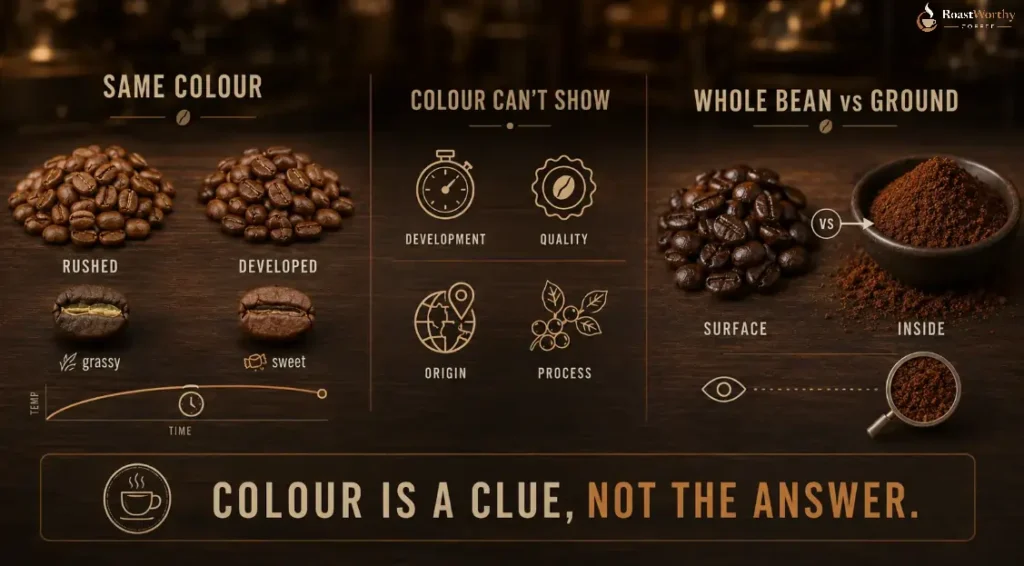
This is where most buying guides stop being useful. They treat colour as the answer. It isn't.
Colour Doesn't Show Development Time
Two beans can land at the same final colour through completely different roast curves. One might have been rushed — scorched on the outside, underdeveloped on the inside. The other might have been developed slowly and evenly. They look identical. They don't taste identical.
The rushed one tastes grassy or green. The developed one tastes sweet and clean. Colour won't tell you which is which. Only tasting it will.
Colour Doesn't Show Quality
A bad bean roasted perfectly still tastes bad. A good bean roasted badly still tastes bad. Roast colour is blind to what was in the green. The flavour doesn't lie — but the colour can mislead you into thinking a pretty medium roast is automatically a good one.
Colour Looks Different in Whole Bean vs Ground
Whole bean colour is surface colour. Ground colour is interior colour. Those can be different — especially in rushed roasts where the exterior is darker than the core.
Cupping professionals grind a bean before judging roast colour. That's the honest read. Whole bean tells you marketing. Ground tells you the truth.
How to Actually Use Roast Color When Buying Coffee
Use colour as a first filter. Not a verdict.
Then check what actually matters:
Colour is the bag's handshake. The rest is the conversation. ✒️
Roast Color and Caffeine: The Myth
Let's kill this one. Dark roast does not have less caffeine than light roast. By weight, the difference is negligible. By volume — because dark roast beans are less dense — scoops of dark roast weigh less, so you get slightly less caffeine per scoop.
Measure by grams. Scoops lie. Scoops lie differently depending on the roast.
This myth has circulated for decades. It's wrong in both directions. If anything, the practical difference for a standard 18g dose is less than 5%.
Roast Color and Brewing: What It Means for You
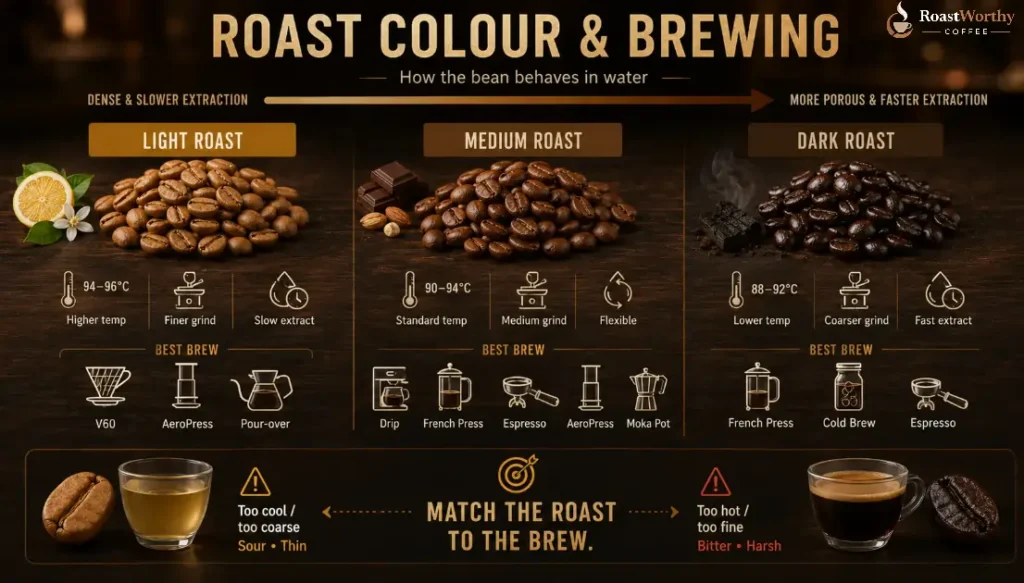
Colour signals how the bean will behave in water.
Brew a light roast like a dark roast and you'll get sour, thin coffee. Brew a dark roast like a light roast and you'll get bitter, burnt coffee. The colour is telling you how to set your parameters. Listen.
Coffee Roast Color FAQs
Does darker roast mean stronger coffee?
No. Strength is about brew ratio and extraction, not roast level. Dark roast tastes bolder because of roast-driven bitterness, but it isn't inherently stronger than light roast.
Is oily dark roast coffee bad?
Not automatically. Some intentionally dark roasts have surface oil and taste great. But oily beans go stale faster — the oil oxidises. If the bag is more than 3 weeks old and the beans are oily, expect dull flavour.
Can you tell coffee quality from roast color alone?
No. Roast colour tells you how long the bean was roasted — nothing about the green coffee quality, origin, or processing. A badly sourced medium roast will taste worse than a well-sourced dark roast.
What roast color has the most flavor?
Light to medium roasts preserve the most origin character — fruit, floral, and acidity. Dark roasts have more roast-driven flavours like chocolate and smoke. “Most flavour” depends on what kind of flavour you want.
Why do some light roasts taste sour?
Usually under-extraction. Light roasts need higher water temperatures and longer contact times. If your cup is sour, raise the temperature or go finer on the grind before blaming the roast.
How do I know if a coffee is over-roasted?
Very dark, almost black beans with heavy surface oil. The aroma smells scorched or ashy. In the cup it tastes bitter and metallic with no sweetness. Over-roasted coffee is cover-up, not craft.