How Roast Color and Development Time Shape Coffee Sweetness

Roast colour is the single best predictor of how sweet and heavy a coffee will taste. Development time fine-tunes it. Darker colour means more body and less sweetness past a certain point.
Longer development time past first crack generally drops sweetness too — it doesn't build it. Anyone who has told you otherwise has not been paying attention to the cup.
What Roast Color and Development Time Actually Control
Let's be honest. Most buying guides treat roast colour as aesthetics. It isn't. Using roast colour and development time to predict coffee sweetness and body is how professional roasters dial in flavour before a single cup is brewed.
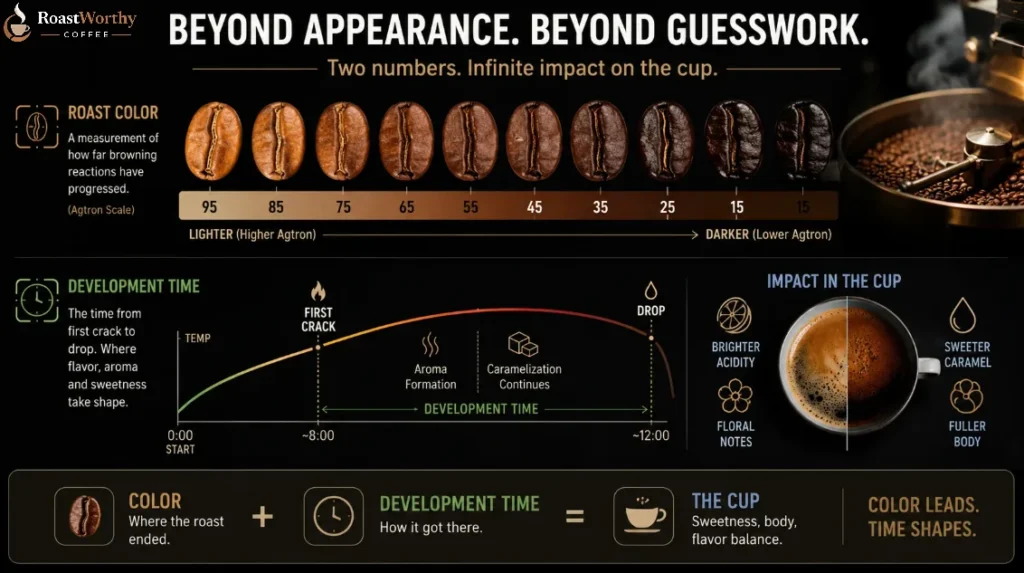
Roast colour is a scale measurement — usually Agtron — of how far chemical browning reactions have progressed inside the bean. Lower Agtron numbers mean darker roasts. Higher numbers mean lighter roasts.
Development time is the period between first crack and the moment the roaster dumps the batch. It's the phase where aroma compounds form and sugars caramelise further.
Colour tells you where the roast ended. Development time tells you how it got there. Both shape the cup. Colour does the heavier lifting.
How Roast Color Predicts Sweetness
There's a myth in specialty coffee that darker roasts are sweeter because of caramelisation. Half-true. There is a sweet spot — and it's not where most people think.
Sweetness peaks somewhere in the medium band. Agtron 65–75 range. That's where sugar caramelisation has advanced enough to build caramel, brown sugar, and honey notes, but not so far that those sugars have burnt into bitter compounds.
Go lighter than Agtron 80 and the bean retains bright organic acids and lower perceived sweetness — the sweetness is there chemically, but acidity dominates the palate. Go darker than Agtron 55 and sweetness drops as burnt and smoky compounds take over. ☕
The cup confirms this every time. A well-developed medium roast from Colombia or Brazil tastes like toffee. A dark French roast of the same green tastes like cocoa-dust and carbon. Same bean. Different sweetness.
Quick Sweetness by Roast Color Guide
| Roast Color | Agtron Range | Perceived Sweetness | Taste Character |
|---|---|---|---|
| Light | 85–95 | Moderate (fruit sweetness) | Bright, acidic, stone fruit |
| Light-Medium | 75–85 | Medium-high | Balanced, caramel-leaning |
| Medium | 65–75 | Peak sweetness | Caramel, brown sugar, honey |
| Medium-Dark | 55–65 | Declining | Bittersweet chocolate, molasses |
| Dark | 40–55 | Low | Burnt sugar, smoke, carbon |
How Roast Color Predicts Body
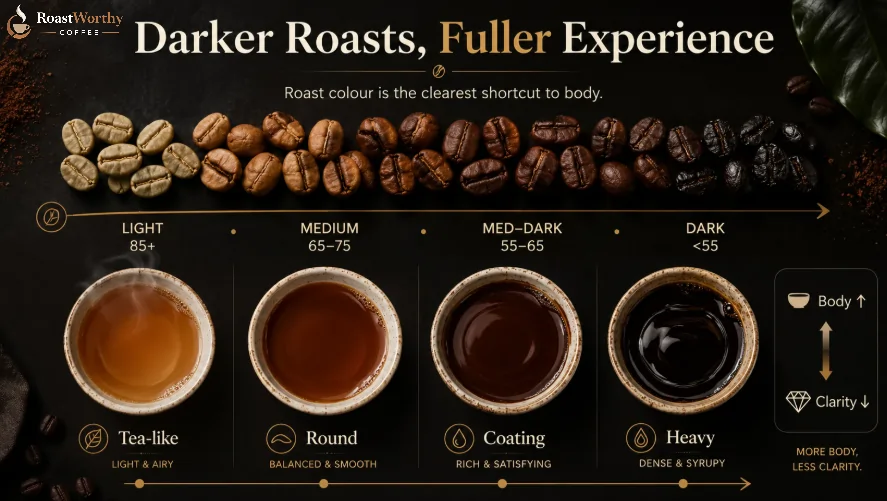
Body is easier to predict than sweetness.
The darker the roast, the heavier the body. That's reliable. Extended roasting breaks down cell walls, releases more oils onto the bean surface, and increases the concentration of soluble solids in the cup. All three factors push mouthfeel toward heavier, fuller, coating.
A light roast brewed as pour-over is almost tea-like in weight. A medium-dark roast brewed the same way feels like it coats the tongue. A dark roast in a French press pulls heavy enough to feel syrupy.
There's a trade-off. You gain body but lose clarity. At Agtron 50 and below, origin character is mostly gone. What you're tasting is roast. Heavy, bittersweet, and in the cup, honestly, a little one-note.
Body by Roast Color Reference
How Development Time Changes the Cup
This is where most home roasters — and a lot of commercial ones — get the story wrong.
Development time is often marketed as the sweetness dial. It isn't, exactly. Recent sensory research shows that longer development time past first crack correlates with lower sweetness, not higher. What it actually builds is body, texture, and weight.
The number that matters is Development Time Ratio (DTR) — the percentage of total roast time spent after first crack. Not the raw minutes. The ratio.
Recommended DTR by Intended Use
Go past 30% DTR and you're baking the coffee. That's not development. That's over-extension of heat where sugars stop caramelising cleanly and start degrading. The result tastes dull. Flat. Tired.
Color vs Development Time: Which Matters More?
Both matter. But they don't weigh the same.
Colour is the stronger predictor of flavour balance — sweetness, acidity, bitterness, body. Development time modulates what colour delivers. You can pull the same final Agtron reading through two different DTR paths and get different cups.
A coffee roasted to Agtron 70 with 22% DTR tastes sweet, balanced, medium-bodied. The same coffee roasted to Agtron 70 with 13% DTR tastes under-developed — green, grassy, hollow — even though the colour matches.
Hit the colour, but earn it. That's the rule.
A roaster who ends on the right colour through a rushed curve gets a bean that looks correct and tastes wrong. A roaster who ends on the same colour through a well-paced Maillard phase and clean development phase gets a bean that matches what the colour promised.
The Maillard Phase and Sweetness
Here is what most guides skip entirely. The Maillard phase — before first crack, starting around 150°C — is where sweetness is actually built.
Sugars react with amino acids during Maillard. Browning happens. Flavour compounds form. This is where caramel, brown sugar, and honey character emerges.
Development time does not build sweetness. Maillard builds sweetness. Development time locks it in and adds body.
A long Maillard phase followed by a clean, moderate development window produces the sweetest cup. A rushed Maillard phase followed by extended development produces a dull, bitter cup regardless of final colour.
If you're cupping a coffee that looks medium brown but tastes flat — not bitter, not sweet, just flat — the problem is Maillard, not colour. The roaster rushed the middle of the curve.
Using Roast Color and Development Time as a Buyer
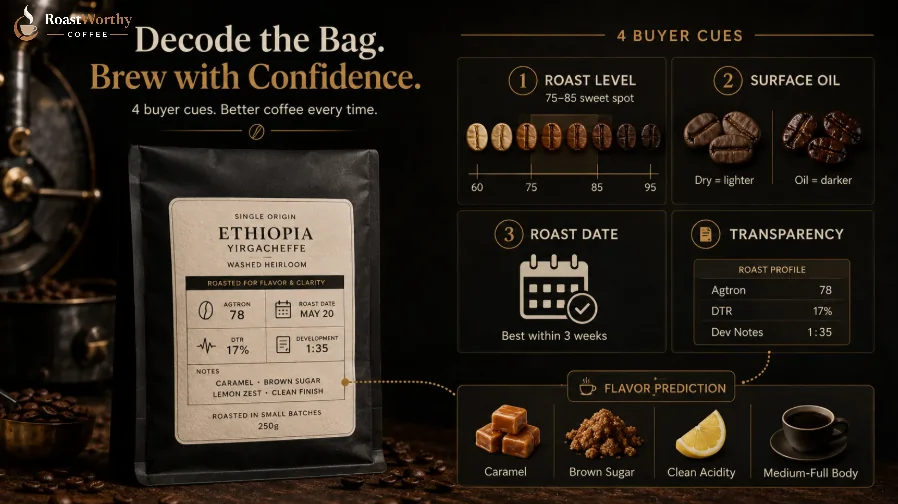
You don't run a roaster. You read labels. Here's what to actually look for.
A roaster that lists Agtron 73 with 20% DTR is telling you: expect caramel, brown sugar, medium-full body, clean acidity. That's a sentence most buying guides can't deliver. The flavour doesn't lie. ✒️
Predicting Cup Flavor From Color + DTR
Here's the table to keep bookmarked. Use it as your fastest read on any bean you pick up.
| Agtron | DTR | Expected Sweetness | Expected Body | Cup Character |
|---|---|---|---|---|
| 90–95 | 15–18% | Low-moderate (fruit-driven) | Light | Bright, tea-like, acidic, floral |
| 80–90 | 18–22% | Medium (origin + caramel) | Medium-light | Balanced, fruit + caramel |
| 70–80 | 20–24% | High — peak sweetness | Medium-full | Caramel, honey, brown sugar |
| 60–70 | 22–26% | Medium — declining | Full | Bittersweet chocolate, molasses |
| 50–60 | 25–30% | Low | Very full | Dark cocoa, toasted, smoky |
| Below 50 | 28–32% | Minimal | Heavy, oily | Burnt sugar, carbon, one-note |
Where Most Roasters Get It Wrong
Two common failures show up in retail bags.
1. Over-developed light roasts. The roaster hits a light Agtron reading but pushes DTR to 23–25%. The result looks like a light roast and tastes like a baked one. Flat. Hollow. Dusty. You paid for brightness. You got tiredness.
2. Under-developed mediums. The roaster drops the batch too fast after first crack to land at a medium Agtron with a low DTR — 12–14%. The cup looks medium brown but tastes grassy, green, or sour. The bean didn't get enough time to finish developing.
Both failures produce coffee that is technically at the right colour. Colour, by itself, lied. That's why development time exists as a separate metric.
Roast Color and Development Time FAQs
What Agtron reading has the most sweetness?
Agtron 65–75 generally produces the sweetest cups. This is the medium roast band where Maillard sugars are fully caramelised but not yet burnt into bitter compounds.
Does longer development time always increase sweetness?
No. Longer development time past 25% DTR typically reduces sweetness and increases bitterness. Sweetness is built in the Maillard phase before first crack, not during development.
Can you predict body from roast color alone?
Mostly yes. Darker roasts consistently produce heavier body because extended heat breaks down cellular structure and increases soluble solids. Development time influences body to a smaller degree than colour.
What is a good DTR for filter coffee?
16–21% is the standard range for filter coffee. This window preserves acidity and clarity while giving enough development for clean sweetness and moderate body.
Why does my medium roast taste flat despite the right colour?
Most likely, development time was too short or the Maillard phase was rushed. The bean hit the colour target without completing the chemical reactions that build flavour. The cup reads dull, grassy, or hollow even at correct colour.
Is Agtron the only way to measure roast colour?
No, but it is the specialty industry standard. Other scales exist — Colorette, Probat colour charts — but Agtron Gourmet is what most professional roasters cite and what most research uses.
How do I know if a coffee is over-developed?
Very dark, oily beans with flat, burnt, or cardboard-like flavour in the cup. Over-development also produces a harsh, lingering bitterness that doesn't clear.