Flavor Profile Decisioning: Choose Coffee by Body & Acidity


Pick up any bag of specialty coffee and you'll see tasting notes. Jasmine. Blackberry. Brown sugar. Cool. But none of that tells you what the coffee will actually feel like in your mouth.
That's where Flavor Profile Decisioning, built on coffee body and acidity balance, becomes the real decision tool. Body is weight. Acidity is brightness. The ratio between them is what you actually taste first, before any fruit note registers.
Master that ratio and you stop buying coffees you don't enjoy. 🔥
Quick Takeaway
Flavor Profile Decisioning says body + acidity balance is the fastest way to predict whether you'll love a coffee.
☕ What Body Actually Means in Coffee
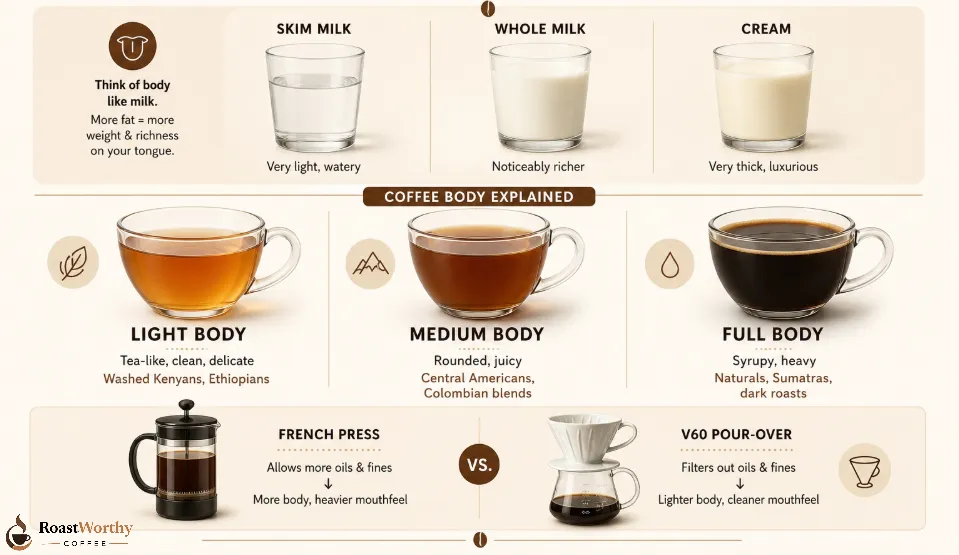
Body is the physical weight of the coffee on your tongue. Not flavor. Weight.
Think skim milk vs whole milk vs cream. Same liquid category. Very different mouthfeel. Coffee works the same way.
It comes from dissolved solids, oils, and suspended fine particles. A natural-process Brazilian has body. A washed Ethiopian usually doesn't.
The Three Body Levels
Brew method shifts this too. A French press drinks heavier than a V60. Same bean. Different filter. Different body.
🔥 What Acidity Actually Means in Coffee
Acidity in coffee has nothing to do with stomach discomfort. It's brightness. The sparkle. The thing that makes a Kenyan taste like a ripe tomato and a Sumatran taste like wet earth.
Chemically, it's chlorogenic, citric, malic, and phosphoric acids surviving the roast. ⚗️
Higher altitude, washed process, and lighter roast = more acidity. Lower altitude, natural process, and darker roast = less acidity.
The Three Acidity Levels
Here's what the heat is actually doing. First crack burns off acidity fast. Every 15 seconds past first crack = noticeably less brightness. The curve doesn't lie. 🔥
👀 Why Body-Acidity Balance Is the Real Metric
Most drinkers who say “I don't like this coffee” are actually reacting to an imbalance they can't name.
A coffee with high acidity and no body tastes thin and sour. A coffee with full body and no acidity tastes flat and muddy. Neither is the bean's fault. It's a mismatch between what's in the cup and what the drinker expects.
Flavor notes are garnish. Balance is the plate. Get the plate right first.
✨The Four Balance Archetypes
This is the framework I use before buying any green bean or picking a roast on my Bullet R1V2. Four quadrants. Pick yours.
| Balance Type | Body | Acidity | Tastes Like | Classic Examples |
|---|---|---|---|---|
| Bright & Light | Low | High | Tea, lemonade, white wine | Kenya AA, Yirgacheffe washed, Panama Geisha |
| Bright & Full | Full | High | Jammy, fermented fruit, red wine | Ethiopian naturals, Burundi naturals, Gesha naturals |
| Smooth & Light | Low | Low | Clean, nutty, mellow | Washed Brazils, low-grown Hondurans |
| Smooth & Full | Full | Low | Chocolate, earth, dark cocoa | Sumatra Mandheling, Sulawesi, Monsooned Malabar |
Most drinkers live in one quadrant and don't know it. Once you identify yours, your buying decisions get faster and your cupboard stops filling up with bags you won't finish.
❓ How to Figure Out Your Balance Preference
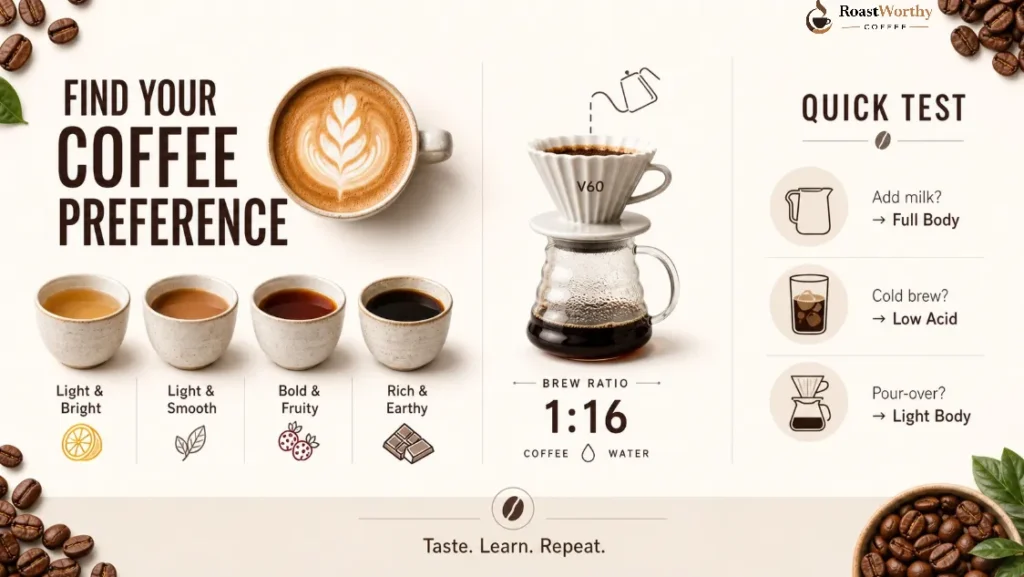
Buy four coffees. One from each quadrant above. Brew them identically. Same grind, same ratio, same method.
I recommend 1:16 ratio, medium grind, V60. Keep it boring on purpose.
Taste them side by side. Write down one word per cup. Which one did you reach for second? That's your quadrant.
Taste it. Write it down. Roast it again. ☕
The Three-Question Self-Test
Not perfect. But 80% accurate for most drinkers.
⚡ How Origin Predicts Balance
Geography does most of the work before the roaster ever touches the beans.
Africa
Ethiopian and Kenyan coffees dominate the high-acidity quadrants. Washed = bright and light. Natural = bright and full. The altitude and varietals (heirloom, SL28) drive the acidity.
Central America
Guatemala, Costa Rica, Honduras — the balance zone. Medium body, medium acidity. This is where beginners should start. Hard to hate.
South America
Colombia spans the middle. Brazil sits in smooth-and-full. Brazilian naturals are the espresso backbone of Italy for a reason — low acidity, heavy body, chocolate finish.
Indonesia
Sumatra, Sulawesi, Java. Low acidity, heavy body, earthy. Wet-hulled processing kills brightness and builds mouthfeel. If you hate sour coffee, start here.
📈 How Roast Level Shifts the Balance
Roast changes everything. A light-roast Sumatra and a dark-roast Sumatra are basically different coffees.
DTR is the number that matters. Development time ratio of 20–25% keeps origin character. Push past 28% and you're drinking the roast, not the bean. ⚗️
🙌 How Brew Method Shifts the Balance
Same bean. Different brewer. Different balance.
If you love a bean but it's too bright, switch from V60 to French press before blaming the coffee.
✨ Matching Coffees to Personal Balance Preferences
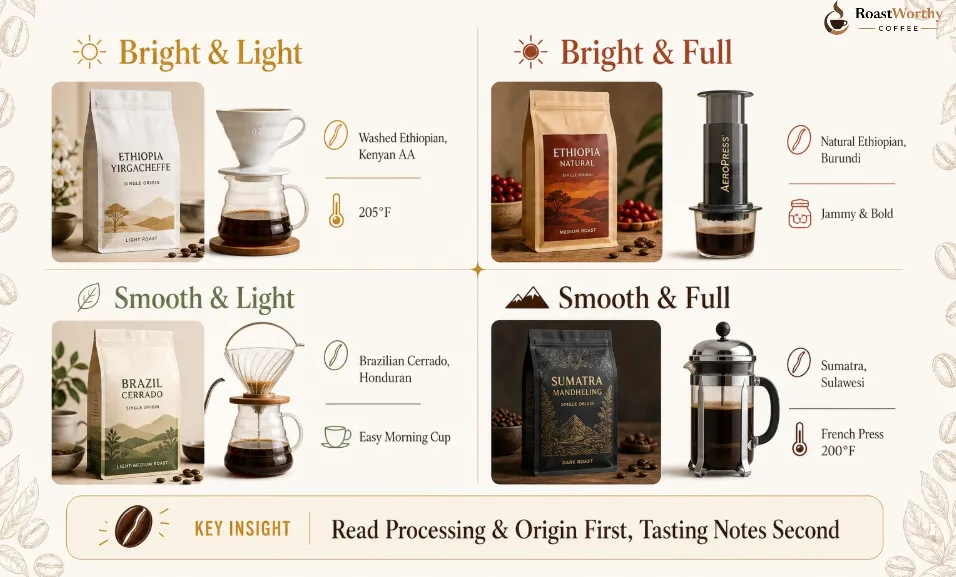
Here's the practical part. Use this as a buying filter.
If You Want Bright & Light
Buy washed Ethiopian Yirgacheffe, washed Kenyan AA, or washed Colombian Huila. Brew V60, 1:16, 205°F. Drink black.
If You Want Bright & Full
Buy Ethiopian naturals (Guji, Sidamo) or Burundi naturals. Brew Kalita or AeroPress. These are the jammy, fermented, polarizing coffees. I love them. Some won't.
If You Want Smooth & Light
Buy washed Brazilian Cerrado or low-grown Honduran. Brew V60 or AeroPress. Good for morning cups that don't fight you.
If You Want Smooth & Full
Buy Sumatra Mandheling, Sulawesi Toraja, or dark-roast Brazilian naturals. Brew French press, 1:15, 200°F. Add milk if you want. This is the cappuccino lane.
The Mistake Most Drinkers Make
They buy on tasting notes. Blueberry. Jasmine. Honey. Sounds great on the bag. Tastes confusing in the cup if the balance is wrong for them.
A bright-and-light drinker buying a Sumatra because the bag says “chocolate” will be disappointed. Not because the coffee is bad. Because the balance doesn't match.
Read the processing method and the origin first. Tasting notes second. Your cupboard will thank you.
🌐 Building Your Personal Flavor Map
Keep a notebook. Or a note on your phone. Every coffee you buy, write down:
After ten bags, patterns emerge. Your coffee flavor wheel starts drawing itself. You stop guessing.
Your first map will be imperfect. Make it anyway. 🔥
🎯 FAQs Related to Coffee Flavor Profile Decisioning
What does body mean in coffee?
Body is the physical weight and mouthfeel of coffee on your tongue. It ranges from tea-like (light) to syrupy (full) and comes from oils and dissolved solids.
What causes acidity in coffee?
Acidity comes from natural acids — citric, malic, chlorogenic, phosphoric — that survive roasting. Higher altitude, washed processing, and lighter roasts preserve more acidity.
Is high-acidity coffee bad for your stomach?
No. Perceived acidity (brightness) is different from pH. Most specialty coffees have a pH between 4.8 and 5.2 regardless of tasting acidity. Cold brew is lowest if you're sensitive.
Which coffee has the best body-acidity balance for beginners?
Washed Central Americans — Guatemala, Costa Rica, Honduras. Medium body, medium acidity. The safest starting quadrant.
How does brew method change body and acidity?
Paper filters reduce body and amplify acidity. Metal filters retain oils and increase body. Immersion brewers (French press, AeroPress) generally produce heavier-bodied cups than pour-over.
Can I change a coffee's balance at home?
Yes. Switch brew method, adjust grind size, or change roast level. Finer grind and longer contact time build body. Coarser grind and paper filters enhance acidity.