Light Roast vs Dark Roast Coffee: Taste, Caffeine & More

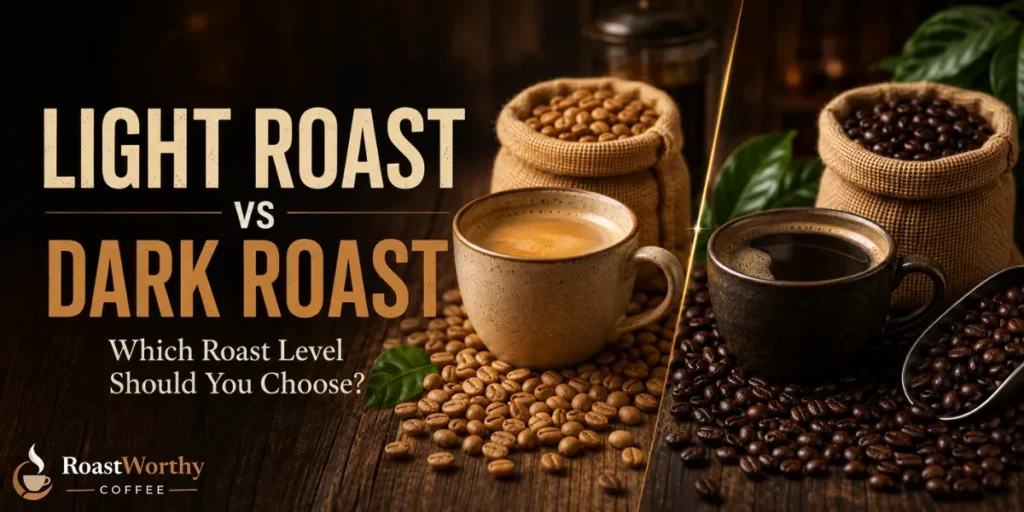
Here's what the heat is actually doing inside that bean: it's rewriting the chemistry, not just the color. 🔥
Most guides will tell you dark is “stronger” and light is “weaker.” That's wrong. It's not about strength at all. It's about what temperature and time do to the sugars, acids, and oils locked inside a green coffee seed.
I've logged over 800 roast profiles on my Bullet R1V2. No single question comes up more than this one. So let's answer it properly — with real numbers, not vibes.
TL;DR — Key Takeaway
What “Roast Level” Actually Means
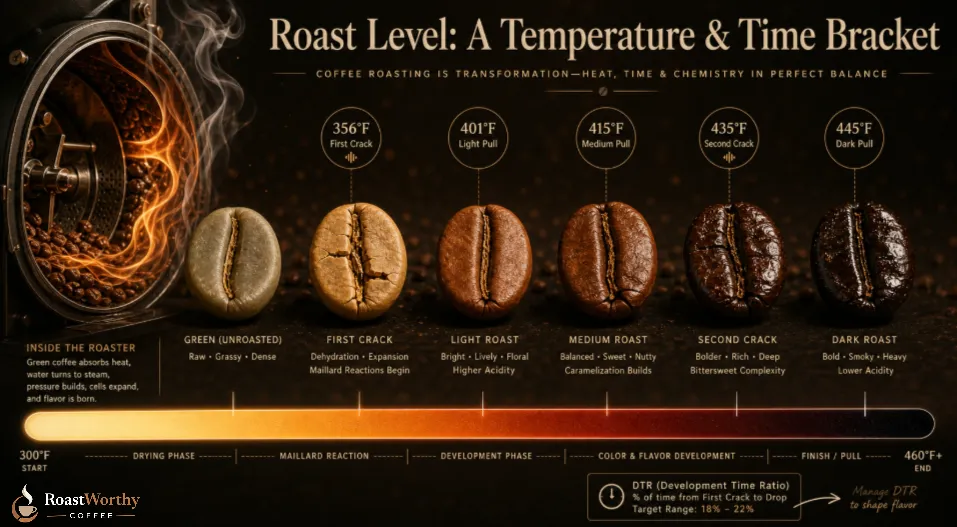
Roast level isn't a flavor category. It's a temperature-and-time bracket.
Green coffee goes into the roaster and starts absorbing heat. Around 356°F, you hit first crack — the bean physically pops as trapped moisture flashes to steam and escapes. This is where light roast begins.
Keep heating. Somewhere around 435–445°F you hit second crack — a quieter, higher-pitched pop as the bean's cell walls break down and oils push to the surface. Past this line, you're in dark roast territory.
DTR is the number that matters. Development Time Ratio is the percentage of total roast spent after first crack. A light roast might sit at 15–18% DTR. A dark roast can run 30%+, sometimes pushing well past second crack. ⚗️
| Roast Stage | Internal Bean Temp | What's Happening |
|---|---|---|
| First Crack | 356–401°F | Moisture escapes, sugars begin caramelizing |
| Light Pull | 401–410°F | Maillard reaction dominant, acids preserved |
| Medium Pull | 410–430°F | Balance point — sugars and acids trade off |
| Second Crack | 435–445°F | Cell breakdown, oils surface |
| Dark Pull | 445–465°F | Carbonization begins, origin flavor fades |
The Maillard Reaction, Briefly
The Maillard reaction is the browning chemistry between amino acids and sugars — the same reaction that browns bread crust and seared steak. In coffee, it builds hundreds of aromatic compounds.
Light roasts capture the early, complex end of that reaction. Dark roasts run it long enough to tip into caramelization, then carbonization. That single difference explains most of what you taste.
Light Roast vs Dark Roast Coffee: The Direct Comparison
This is the part everyone actually wants. Here's the difference broken down by the variables that hit your cup.
| Variable | Light Roast | Dark Roast |
|---|---|---|
| Color | Light brown, cinnamon-toned | Dark brown to near-black |
| Surface oil | Dry, matte | Glossy, visible sheen |
| Acidity | High — citrus, bright, malic | Low — acids roasted out |
| Body | Tea-like to medium | Syrupy, full-bodied |
| Origin flavor | Preserved, varietal-specific | Roasted out, replaced by char |
| Sweetness | Delicate, fruit-driven | Caramelized, bittersweet |
| Caffeine (by weight) | Slightly higher | Slightly lower |
| Best for | Pour-over, drip, AeroPress | Espresso, French press, moka |
The Caffeine Myth — Let's Kill This One
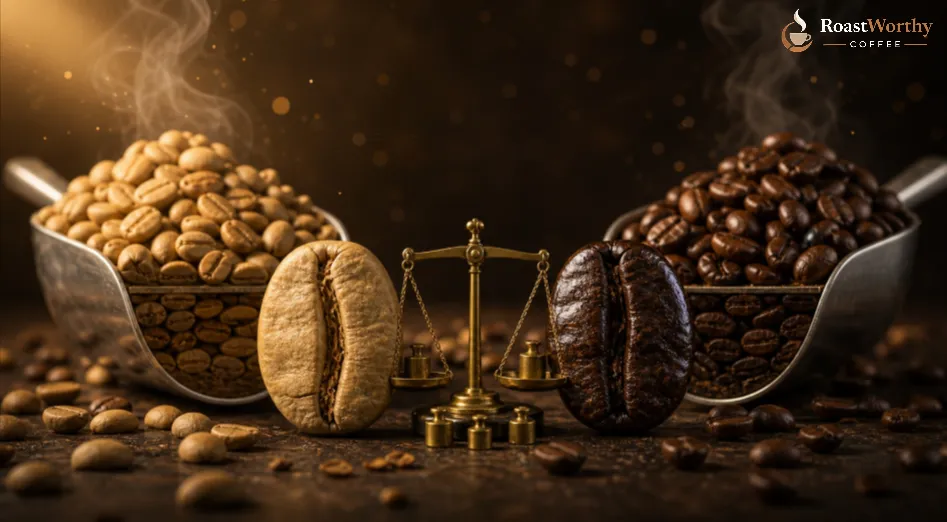
This is the single most-misunderstood question in the whole debate: which roast has more caffeine?
Caffeine is remarkably heat-stable, but it does degrade slightly over a long roast. So by weight, light roast beans retain marginally more caffeine — think 5–10%, not the huge gap people assume.
Here's where it flips. Dark roast beans lose more moisture and physically expand, so they're less dense. Scoop by volume — like most people do — and a scoop of dark roast holds fewer actual beans than the same scoop of light.
So by volume, light usually edges ahead. By weight, the gap is small either way. If caffeine is your deciding factor, weigh your dose instead of scooping. Every serious home roaster does this anyway.
Flavor: Where the Real Difference Lives
This isn't “mild vs strong.” It's two completely different chemical stories happening in the same bean.
Light Roast Flavor
Light roast stops the clock before caramelization takes over, so the bean's own character survives. That's why light roasts taste like:
Origin matters here. A washed Yirgacheffe roasted light tastes nothing like a natural Sumatra roasted light. That distinction is the whole point of buying good beans.
Dark Roast Flavor
Push past second crack and you're tasting the roast more than the bean. Sugars caramelize hard, then start to carbonize. Expect:
Taste it. Write it down. Roast it again. If you're roasting at home, that loop is the only way to find where your palate sits between these two poles. ☕
Acidity and Bitterness — The Chemistry
Acidity comes mostly from chlorogenic, citric, and malic acids in the green bean. Heat degrades them progressively.
Light roasts stop early, so more acid survives — that's your bright, sparkly cup. Dark roasts run long enough that most of those acids break down, which is why dark tastes rounder and flatter, never sharp.
Bitterness runs the opposite way. It's driven by chlorogenic acid lactones and, at the extreme end, actual carbonization of plant fiber.
Push too far past second crack and you're no longer tasting coffee — you're tasting burnt plant matter. That's the line between “bold dark roast” and genuinely over-roasted.
A good dark roast should taste rich, not ashy. If your dark roast tastes like an ashtray, that's a roasting flaw — not the roast level.
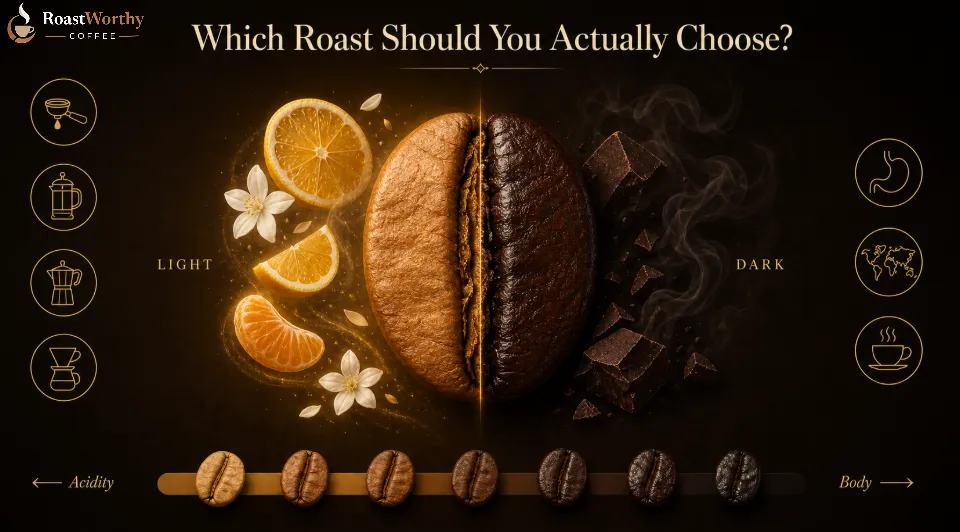
Which Roast Should You Actually Choose?
Forget “which is better.” Ask these instead.
Do you brew espresso, French press, or moka pot?
Dark roast's heavier body and lower acidity hold up under pressure and full immersion. Espresso from a light roast can taste sour and thin unless your grind and machine are dialed in perfectly.
Do you brew pour-over or drip?
Light roast shines. Slower extraction lets bright, origin-specific flavors come through without the roast dominating. This pairing is worth getting right — matching roast level to brew method changes the cup more than most gear upgrades.
Sensitive to acid reflux or stomach issues?
Dark roast is generally gentler. Lower acid content means less irritation for sensitive drinkers.
Do you care where the coffee is from?
Go light. Dark roast erases most terroir and varietal character. If you want Ethiopia, Colombia, and Guatemala to taste like three different places, light roast is non-negotiable.
Want that bold, familiar coffee-shop taste?
Dark roast delivers the smoky-sweet profile most people grew up drinking. There's no shame in that — it's a genuine preference, not a lesser one.
Home Roasting Both Levels: What to Watch
If you're roasting your own, here's the practical breakdown by heat point.
- Light roast target: Pull at 401–410°F, right at or just past first crack. DTR around 15–18%.
- Medium roast target: Pull at 415–425°F. Sugars get more development time without losing all acidity.
- Dark roast target: Pull at 445–460°F, into second crack. Watch your Rate of Rise (RoR) closely — it's easy to overshoot into ashy territory.
The curve doesn't lie. If your RoR spikes late in the roast, you'll scorch the outside while the inside stays underdeveloped. This happens more on dark roasts because people push heat hard to blow past second crack.
Your first roast will be imperfect. Make it anyway. And here's the counterintuitive part: light roasts are harder to nail than dark ones for beginners. There's less margin, and underdeveloped light roast tastes grassy and sour — not “delicate.”
A Note on Freshness
Roast level interacts with freshness differently. Dark roasts, with oil on the surface, go stale and rancid faster than dry light roasts.
If you buy dark roast, buy small and drink it fast. Light roast holds its quality longer in the bag — another reason home roasting light pays off.
Quick Reference
| If you want… | Choose |
|---|---|
| Maximum origin flavor | Light roast |
| Bold, familiar coffee-shop taste | Dark roast |
| Best pour-over / drip results | Light roast |
| Best espresso / French press results | Dark roast |
| Slightly more caffeine per scoop | Light roast |
| Lower acidity, gentler on stomach | Dark roast |
| Most forgiving roast to start with | Medium-to-dark |
Frequently Asked Questions
Does dark roast have less caffeine than light roast?
By weight, yes — slightly, due to longer heat exposure. By volume (standard scooping), the difference often favors light roast because dark beans are less dense and you fit fewer per scoop.
Is dark roast coffee more bitter than light roast?
Generally yes, but a well-roasted dark should read as bold and rich, not burnt. Harsh bitterness usually means the roast went too far past second crack.
Which roast is better for espresso?
Dark and medium-dark roasts are traditionally preferred. Their lower acidity and heavier body hold up better under pressure extraction.
Does roast level affect coffee's health benefits?
Light roasts retain slightly more chlorogenic acids and antioxidants, since less is degraded by heat. The difference is measurable but small for everyday drinking.
Can I turn dark roast beans into light roast at home?
No. Roast level is locked the moment beans leave the roaster. You can't un-roast a bean — one reason roasting green beans yourself gives far more control.
Which roast level should beginners start with?
Medium. It's the most forgiving to both brew and roast — balanced acidity and body without demanding the precise timing that light or very dark roasts require.
So, Which One Wins?
Neither. And anyone who tells you otherwise is selling something.
Light roast is for people who want to taste the coffee. Dark roast is for people who want to taste coffee. Both are legitimate. The trick is matching the roast to your palate and your brewer, then dialing it in.
Start with a medium if you're unsure. Then drift light or dark from there once you know what your cup is missing.
More Recommendations from RoastWorthy Coffee