
What Is Turkish Coffee and How Do You Make It Authentically?

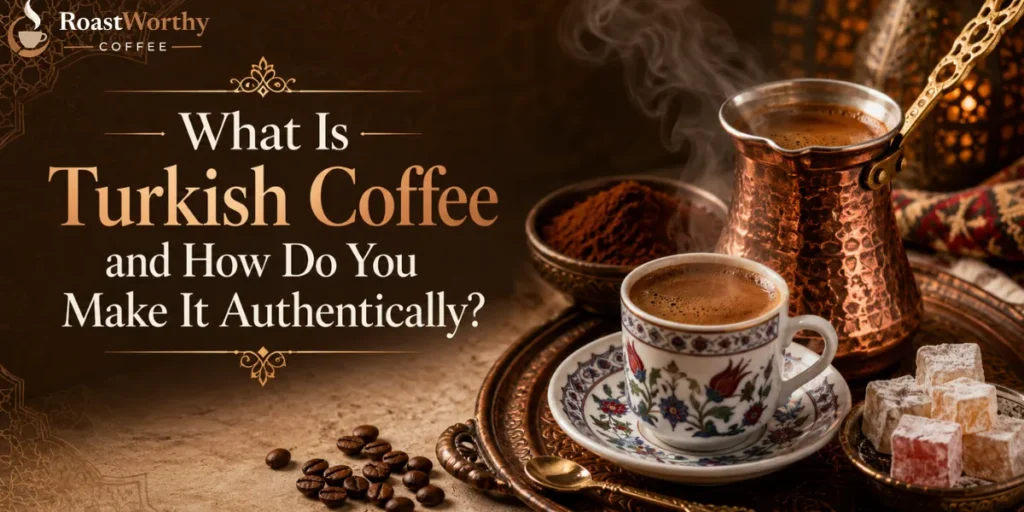
Turkish coffee has been brewed the same way for over five hundred years. No filter. No pressure. No machine. Just water, finely ground coffee, heat — and patience.
That's not simplicity. That's a five-century-old standard nobody has improved on.
Most people encounter Turkish coffee once and think it's just “strong coffee.” It isn't. The texture is different. The ritual is different. The grounds settling at the bottom of the cup — that's a feature, not a flaw. There's a whole story in this cup, and it starts long before the cezve hits the flame.
What Makes Turkish Coffee Different
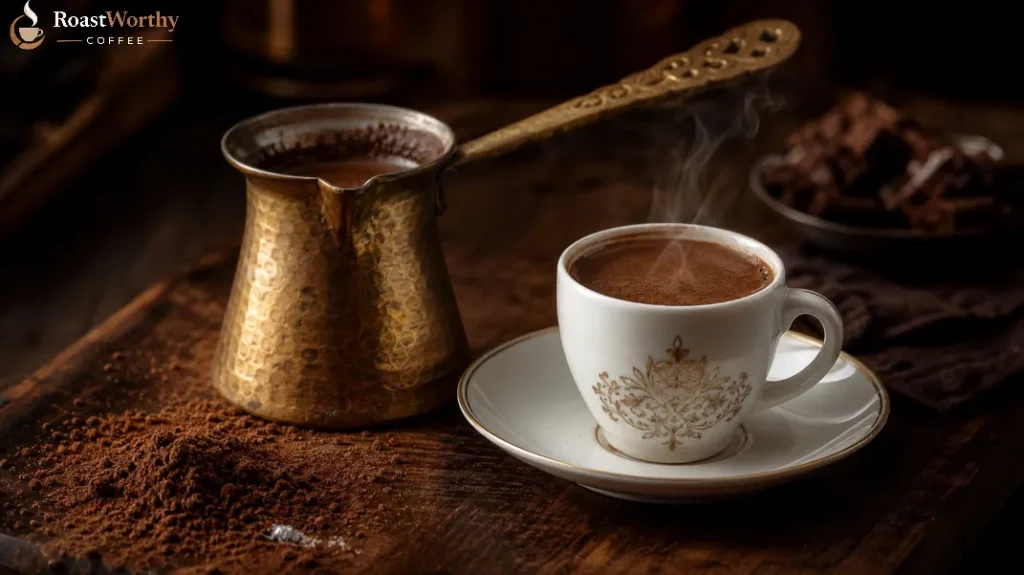
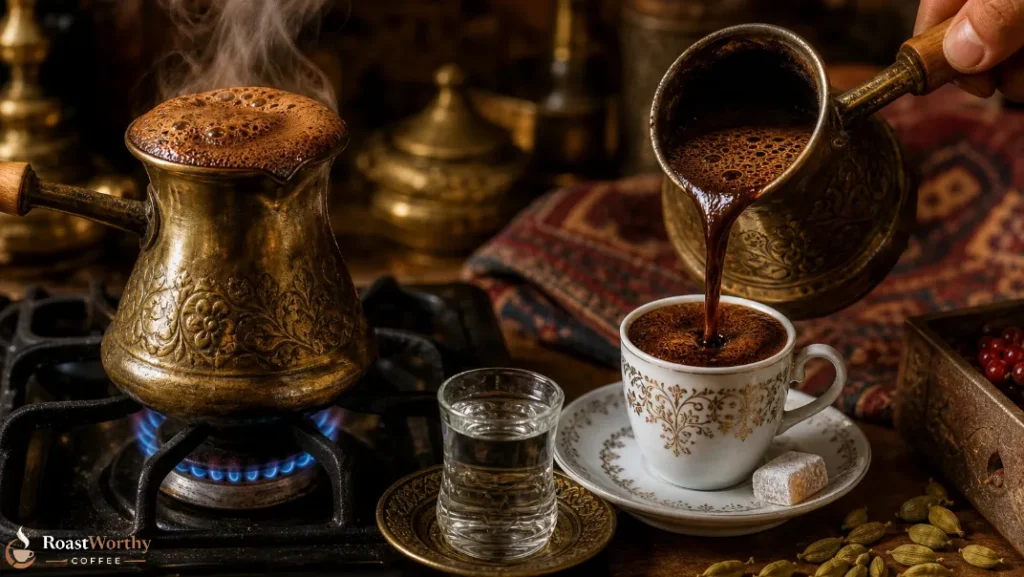
Turkish coffee is unfiltered coffee brewed in a small, long-handled pot called a cezve — also called an ibrik in some regions. The coffee is ground to a powder. Not fine like espresso. Finer. Closer to flour or powdered cocoa in texture.
The grounds are never filtered out. They go in, they brew, they settle.
That's the cup. Dense. Thick. A thin layer of dark foam on top if you've done it right. Grounds layered at the bottom that you leave in the cup. The drink ends when the grounds start.
This is what separates Turkish coffee from every other brew method — no filtration, no pressure, no paper. Just coffee and water, managed entirely by heat and time.
Turkish Coffee vs Espresso
People conflate these two constantly. They're not the same drink.
| Feature | Turkish Coffee | Espresso |
|---|---|---|
| Grind size | Extra fine (powder) | Fine |
| Brewing method | Simmered in cezve | Pressurized extraction (9 bar) |
| Filter | None — grounds settle | Yes (portafilter + puck) |
| Foam | Natural, protein-based kaimaki | Crema (CO₂-based) |
| Serving size | 60–90ml | 25–30ml |
| Brew time | 4–5 minutes | 25–30 seconds |
| Caffeine | Moderate (grounds don't fully extract) | Higher per ml |
Espresso is extraction science under pressure. Turkish coffee is immersion brewing managed entirely by temperature. Both produce intensity. They arrive there completely differently.
🌍 The History Behind the Cup
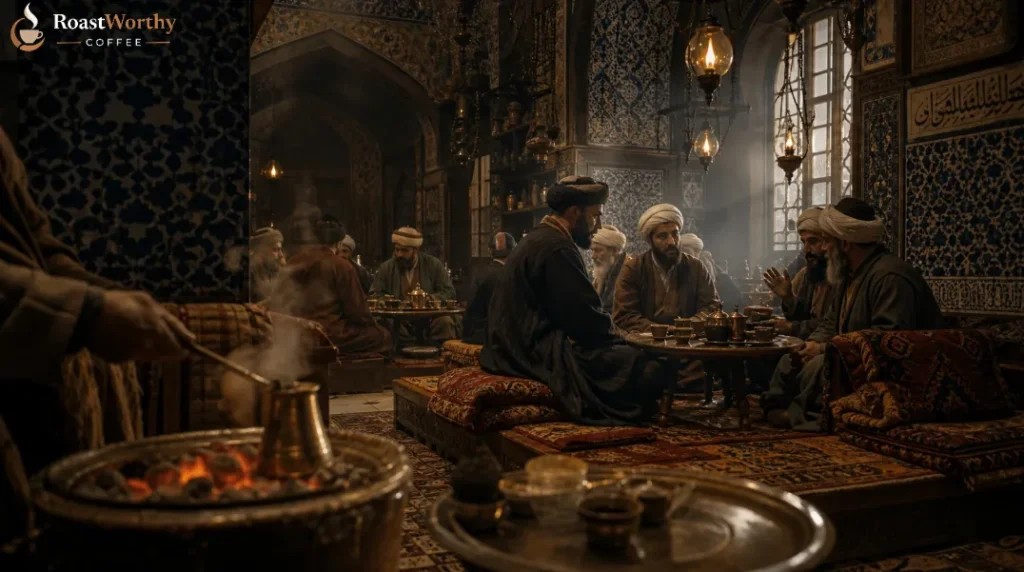
The story of Turkish coffee starts in Yemen, 15th century. Sufi monks brewed it to stay awake through late-night prayer. The practice moved north fast — by the mid-1500s, coffeehouses called qahveh khaneh had opened across the Ottoman Empire. Constantinople. Cairo. Damascus. Aleppo.
These weren't just places to get caffeine. They were political gathering spaces. Debate halls. The kind of places where news spread before newspapers existed.
The first European coffeehouse opened in Oxford in 1650. It was modelled on what travellers had seen in Istanbul. Turkish coffee didn't just influence coffee culture globally — in many ways, it created it.
UNESCO recognised Turkish coffee as an Intangible Cultural Heritage of Humanity in 2013. That's not marketing. That recognition came from the ritual around the cup — the serving ceremony, the social context, the fortune-telling tradition — not just the drink itself.
The terroir is doing something here that nowhere else can replicate. Not in the bean. In the culture built around it.
Equipment You Actually Need
The equipment list is short. That's part of the point.
No scale is strictly required. But 7 grams of coffee per 60ml of water is the ratio that works. Memorize it.
Which Coffee Beans to Use
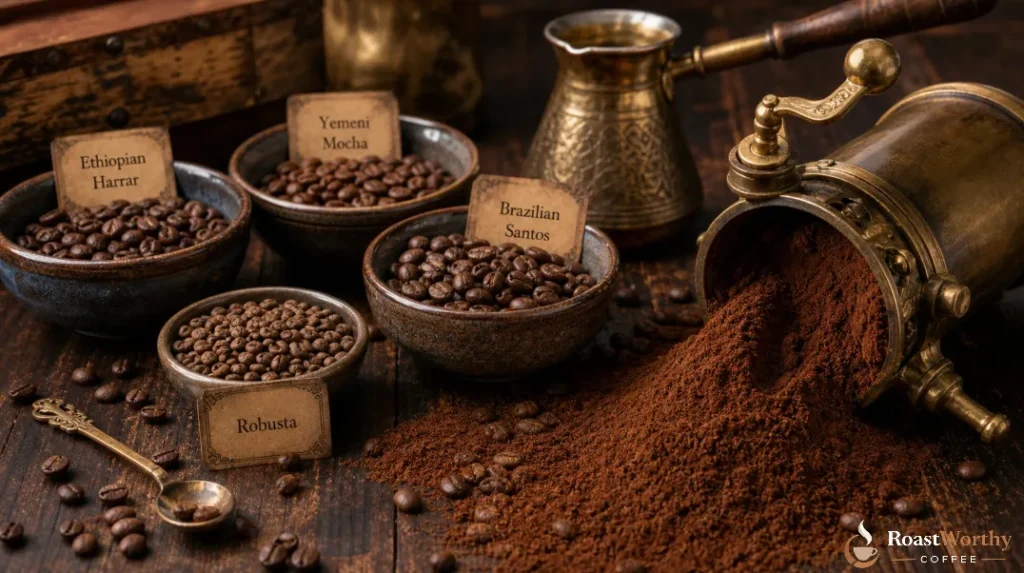
The grind matters more than the bean here. But origin shapes the final flavour significantly.
Traditionally, medium-roast Arabica from Yemen or Ethiopia forms the base. Some Turkish commercial blends add 10–15% Robusta for extra body and a thicker, more stable foam layer.
Dark roasts are the popular association — that deep, smoky density. But medium roasts give you more flavour clarity. The earthiness comes through. You taste the origin, not just the roast.
Good choices for grinding at home:
Grind fresh. Grind fine. Buy pre-ground if your grinder can't hit Turkish setting — a coarser grind will not settle correctly and the cup will be gritty throughout. ☕
How to Make Turkish Coffee Authentically — Step by Step
Serves: 1 | Brew time: 5–7 minutes | Ratio: 7g coffee : 60ml cold water
What You Need
The Sugar Decision
In Turkey, you declare your sugar preference before the coffee is made. The sugar is brewed in — it's not added at the table.
| Turkish Term | Meaning |
|---|---|
| Sade | No sugar |
| Az şekerli | A little sugar (½ tsp) |
| Orta | Medium sweet (1 tsp) |
| Çok şekerli | Very sweet (2 tsp) |
Add sugar to the cold water before the coffee goes in. Never stir in sugar after brewing.
Step-by-Step Method
Step 1 — Cold water first.
Pour exactly 60ml of cold water into your cezve. Cold start is not optional. It allows the slow heat build-up that develops the foam and gives the grounds time to extract without burning.
Step 2 — Add coffee. Don't stir yet.
Measure 7g of finely ground Turkish coffee. Add it on top of the water. If you're adding cardamom, crush 2–3 pods and add them now.
Step 3 — One stir. Then stop.
A single gentle stir to combine. After that, don't touch it again until it's in the cup.
Step 4 — Low heat. Slow build.
Place the cezve on your lowest flame setting. You are not boiling this coffee. Boiling kills the foam and drives bitterness through the roof. This is the most common mistake beginners make.
Step 5 — Watch for the foam rise.
After 3–4 minutes, a dark foam (kaimaki) will begin to form at the edges and move inward. Watch this closely. The moment the foam rises to the rim of the cezve — pull it off heat immediately.
Step 6 — The double-pour (optional but traditional).
For thicker foam: pour half the coffee into your prewarmed fincan. Return the cezve to heat. Let the foam rise again. Pour the remaining coffee to top up. This double-pour technique produces a denser foam layer. It's worth doing.
Step 7 — Pour slowly.
Tip the cezve gently. Don't rush. The grounds are in suspension for about 30 seconds before they begin to settle.
Step 8 — Wait 2 minutes.
This step is non-negotiable. Let the grounds settle fully before drinking. Two minutes. Use them to appreciate what you made.
Step 9 — Serve with water.
Always. A small glass of cold water served alongside cleanses the palate before the first sip. This is tradition, not decoration.
The Cardamom Question
Cardamom in Turkish coffee is not universal. It appears more consistently in Gulf and Levantine preparations — qahwa style — than in traditional Turkish homes.
But it belongs. Cardamom adds a floral, slightly cooling edge that cuts through the density of the brew. With a dark roast, it rounds out bitterness. With a medium roast, it lifts the natural sweetness.
Use it if you want it. Leave it out if you want the coffee to speak alone. The authentic version is whatever the person making it was taught by someone who made it before them. That's how oral traditions work.
Reading the Grounds: Kahve Falı
After finishing, flip your cup upside down onto the saucer. Let it cool for five minutes. Lift the cup and read the dried ground patterns — this is tasseography, or kahve falı in Turkish.
It's not magic. It's a five-hundred-year-old social ritual that extends the experience of the cup long after the coffee is gone.
The ritual is the point. Turkish coffee was never just about caffeine delivery. It was always about the time spent around it.
Common Mistakes — And Why They Matter
Regional Variations Worth Knowing
The cezve method is shared across a wide geographic band — each culture runs a slightly different variation:
Same technique across the board. Different cultural fingerprints on the same ancient method.
Frequently Asked Questions
What is Turkish coffee?
Turkish coffee is an unfiltered brew method using extra-finely ground coffee simmered in a small pot called a cezve. The grounds settle at the bottom of the cup and are not consumed.
How finely should Turkish coffee be ground?
Finer than espresso — close to powdered cocoa or flour in texture. Most standard home grinders cannot reach this setting. A dedicated burr grinder with a Turkish setting or pre-ground Turkish coffee is recommended.
Is Turkish coffee stronger than espresso?
Not necessarily. Espresso delivers more caffeine per ml. Turkish coffee produces a larger serving volume but the grounds don't fully extract — so overall caffeine per cup is moderate, not extreme.
Can I make Turkish coffee without a cezve?
A small saucepan works as a substitute, but a cezve's tapered shape concentrates the foam and controls heat distribution. The result is noticeably better with the right tool.
Does authentic Turkish coffee include cardamom?
Not always. Cardamom is standard in Gulf and Levantine qahwa styles but is optional in traditional Turkish preparation. Add it based on personal preference.
Why do you always start with cold water?
Cold water creates a longer, slower heat ramp that develops the foam (kaimaki) properly and extracts the coffee gently without bitterness. Starting hot skips this critical phase.
What does the foam on Turkish coffee mean?
The foam — called kaimaki — is a sign of a well-made cup. In Turkish culture, a thick, unbroken foam layer is considered a mark of skill and care. Boiling the coffee destroys it.
More Recommendations from RoastWorthy Coffee