What Is Nitro Cold Brew Coffee? How It’s Made and Where to Get It


Nitro cold brew coffee is cold brew steeped for 12 to 24 hours, then infused with nitrogen gas under 30 to 45 PSI of pressure, and poured through a stout faucet with a restrictor plate that creates microbubbles — giving you a creamy, cascading cup with zero milk, zero cream, and zero added sugar.
I burned my first three roasts trying to understand heat transfer back in 2017. The same stubbornness that taught me roasting is what made me obsessive about nitro. Because the physics here are genuinely interesting. The gas isn't decoration. It's doing something real. ⚗️
Your first nitro pour at home will be imperfect. Make it anyway.
TL;DR — Key Takeaways
What Is Nitro Cold Brew Coffee, Exactly?
Start with the origin, not the roaster. Nitro cold brew begins life as regular cold brew — coarsely ground coffee steeped in cold or room-temperature water for 12 to 24 hours.
No heat at any point. Cold water extraction pulls fewer acidic compounds from the grounds, which is why cold brew tastes smoother and less bitter than hot-brewed coffee.
But it pulls caffeine efficiently because of the long steep time and higher coffee-to-water ratio — typically 1:4 to 1:8 for concentrate, compared to 1:15 to 1:18 for hot drip.
Then the cold brew goes into a pressurized keg. Food-grade nitrogen gets forced in at 30 to 45 PSI. The keg sits, chilled, for several hours to overnight, letting the nitrogen interact with the liquid.
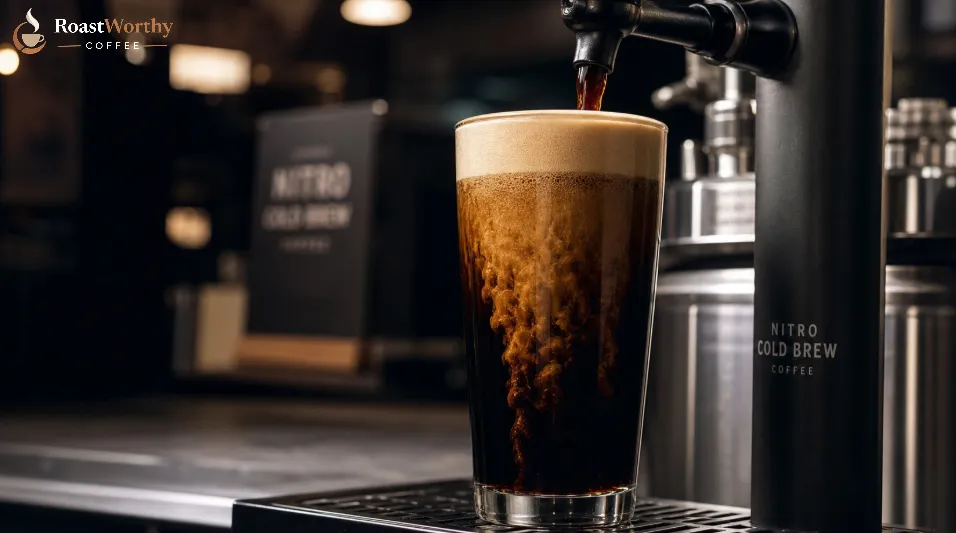
When it's tapped, the liquid passes through a stout faucet — the same type used for Guinness. Inside that faucet is a restrictor plate: a disc with tiny holes, roughly 0.5 mm or smaller.
Forcing nitrogen-infused liquid through those holes at pressure shears the nitrogen into microbubbles instead of the large, fizzy bubbles you'd get from CO2. The result is a dense, cascading pour that settles into a thick, creamy head.
No milk. No cream. No shaking. The texture is built entirely by physics.
Why Nitrogen? Why Not CO2?
Here's what the gas is actually doing. ⚗️
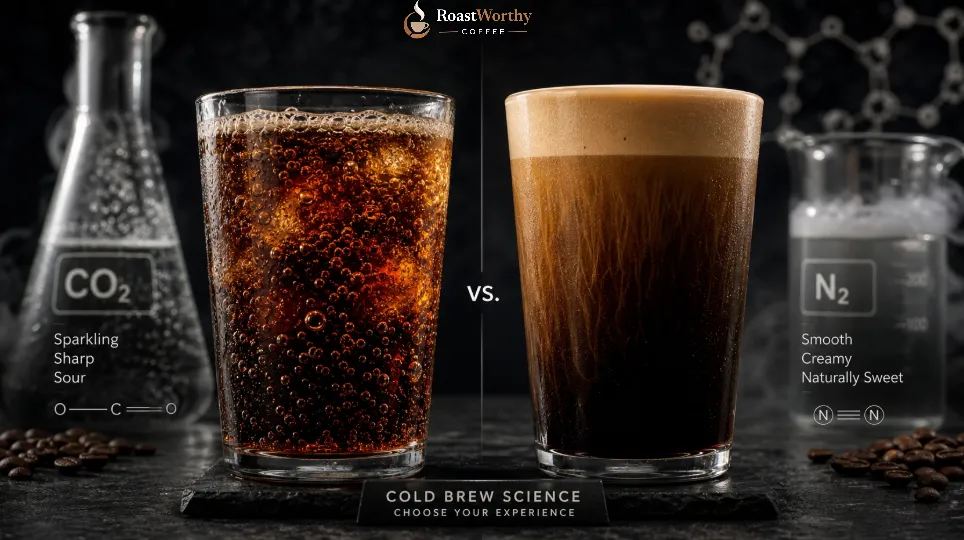
Someone tried carbonated coffee first. It tasted awful. When CO2 dissolves in water, it forms carbonic acid — which is sour. Coffee already has acidity. Adding carbonic acid on top made early carbonated coffee taste sharp, sour, and genuinely unpleasant.
Nitrogen solves two problems at once:
There's a third benefit: nitrogen displaces oxygen. Oxygen oxidizes coffee and makes it stale. Pressurized nitrogen pushes oxygen out of solution — a process called degassing — which extends shelf life of cold brew in the keg.
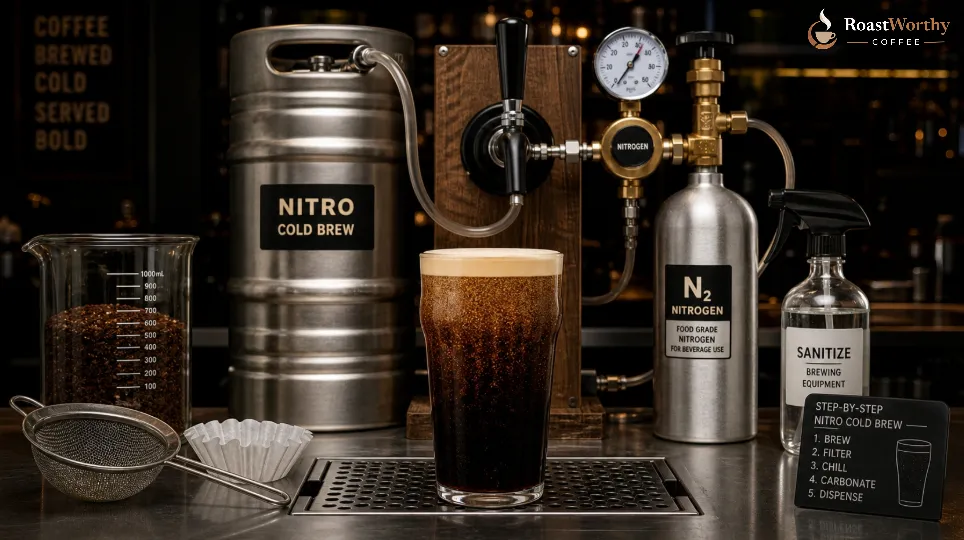
How Nitro Cold Brew Is Made — Step By Step
I like specificity. Vague guidance doesn't help anyone. Here's the actual process with real numbers.
Step 1: Brew The Cold Brew Base
Use a 1:4 coffee-to-water ratio for concentrate. Coarse grind — think French press consistency, maybe slightly coarser. Steep in cold or room-temperature water for 16 to 24 hours. Longer steep = more extraction, more body, more caffeine.
I aim for 18 hours at room temp (around 22°C / 72°F). Balanced concentrate without over-extracting tannins.
Step 2: Filter Thoroughly
Filter the concentrate through a fine mesh strainer, then through a paper filter or a nylon nut-milk bag. Any fine sediment left in the cold brew will clog the restrictor plate in your stout faucet or dispensing nozzle.
Filter twice if you're unsure. The cleaner the liquid, the better the nitrogen cascade.
Step 3: Load Into A Keg
Pour the filtered cold brew into a stainless steel corny keg or a dedicated cold brew keg. Sanitize everything first — PBW (Powdered Brewery Wash) for cleaning, Star San for sanitizing. Don't skip this. Spoiled cold brew in a keg is a waste of good coffee.
Step 4: Charge With Nitrogen
Connect a food-grade nitrogen tank to the keg through a nitrogen-specific regulator. CO2 regulators don't work with nitrogen — different thread sizes, different pressure ranges.
Set the pressure to 30 to 45 PSI. Let the keg sit, refrigerated, for at least 2 hours. Overnight is better. The nitrogen needs time to interact with the liquid under pressure.
Some setups use a quick cascade lid — a lid with a stone diffuser that forces nitrogen directly into the liquid as fine bubbles. This cuts infusion time dramatically, sometimes to 15 to 30 minutes.
Step 5: Pour Through A Stout Faucet
Tap the keg through a stout faucet with a restrictor plate. The plate's tiny holes shear the nitrogen into microbubbles as the liquid exits under pressure. That's what creates the cascading pour and the creamy head.
Pour at a 45-degree angle for the first half, then straighten the glass for the second half. Same technique as pouring a nitro stout beer.
Nitro Cold Brew vs. Regular Cold Brew vs. Iced Coffee
People conflate these three constantly. They are not the same drink.
| Feature | Iced Coffee | Cold Brew | Nitro Cold Brew |
|---|---|---|---|
| Brew method | Hot-brewed, then chilled | Steeped cold, 12 to 24 hrs | Cold brew + nitrogen infusion |
| Coffee-to-water ratio | 1:15 to 1:18 | 1:4 to 1:8 (concentrate) | Same as cold brew base |
| Acidity | Higher | Lower | Lower |
| Texture | Thin, watery | Smooth, flat | Creamy, velvety, cascading |
| Served with ice | Yes | Usually | Rarely — nitrogen chills it |
| Caffeine (16 oz, Starbucks) | ~360 mg (hot, varies) | 205 mg | 280 mg |
| Dairy added | Often | Sometimes | Never (by design) |
| Shelf life in keg | N/A | 1 to 2 weeks | 1 to 2 weeks under N2 |
The key distinction: iced coffee is hot coffee that's been cooled. Cold brew is never heated. Nitro cold brew is cold brew that's been pressurized with nitrogen. Each step changes the chemistry and the texture.
Does Nitro Cold Brew Have More Caffeine?
Yes — but not because of the nitrogen. The nitrogen adds zero caffeine. It's higher because of how the base cold brew is made.
Cold brew uses a higher coffee-to-water ratio than drip coffee — roughly 2 to 2.5 times more coffee per unit of water. The long steep time (12 to 24 hours) extracts caffeine efficiently even at low temperatures.
Then there's the serving difference. Regular cold brew is often served over ice, which dilutes it. Nitro cold brew is served straight — no ice, no dilution. More coffee per cup means more caffeine per cup.
Starbucks as the reference point: Their 12 oz nitro cold brew has 215 mg of caffeine. Their 12 oz regular cold brew has 155 mg. The 16 oz nitro has 280 mg versus 205 mg for regular cold brew. That's a 30 to 40% difference at the same volume.
The FDA recommends adults stay under 400 mg of caffeine per day. One 16 oz nitro cold brew gets you most of the way there.
Where To Get Nitro Cold Brew Coffee
At Major Chains
At Specialty Coffee Shops
Independent specialty cafés often make better nitro than chains. They typically use higher-quality beans for the cold brew base, roast lighter, and steep longer.
The difference shows up in the cup — more clarity, more origin character, less of the heavy roasted bitterness you get from chain cold brew.
Look for cafés that roast their own beans and have a visible nitro tap. If they're pouring nitro from a keg they filled themselves, the coffee is usually no more than a few days old. That freshness matters.
Canned And Bottled Options
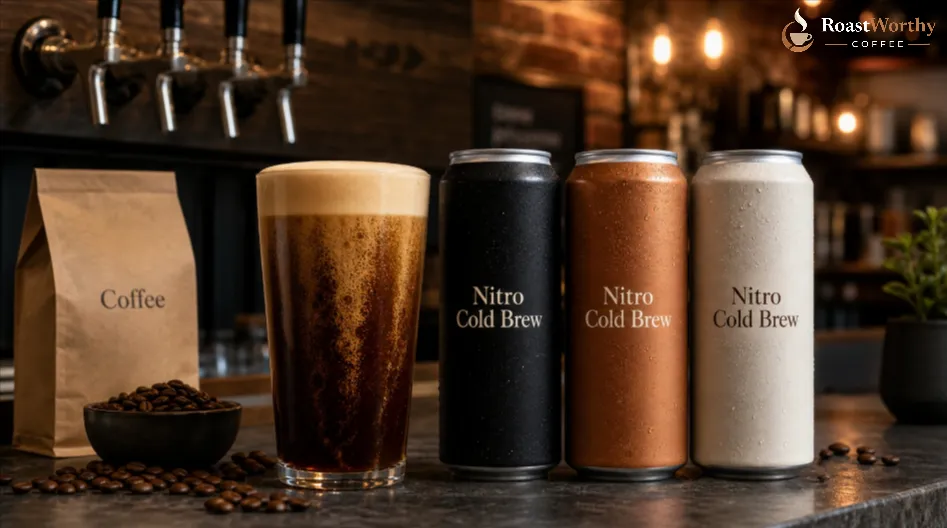
Several brands now sell canned nitro cold brew with internal nitrogen widgets:
Canned nitro will never match the texture of a fresh tap pour. The widget gets you maybe 60% of the cascade. But for convenience, they're solid.
Can You Make Nitro Cold Brew At Home?
Yes. And it's more accessible than people think.
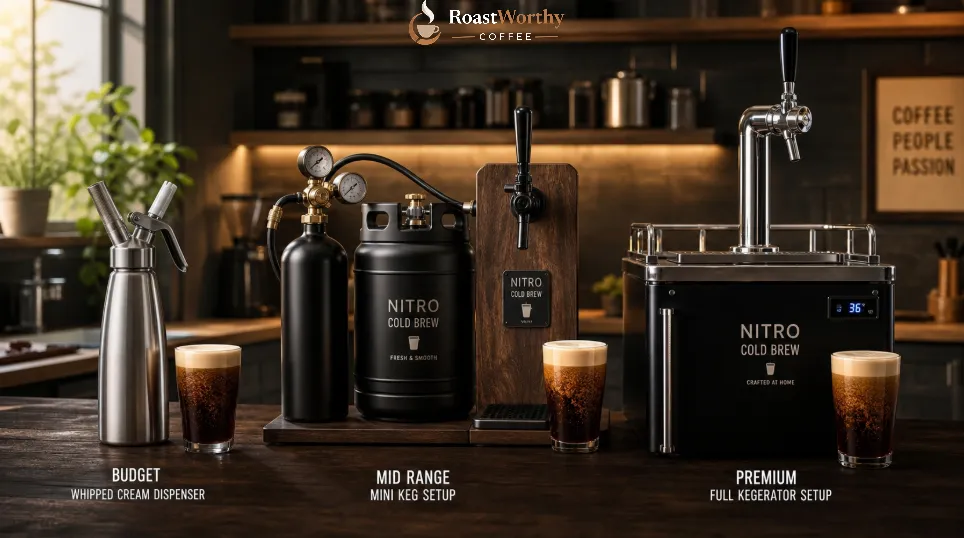
Option 1: Whipped Cream Dispenser (Budget — $80 to $120)
Get a nitrogen-compatible whipped cream dispenser (not N2O — those are for whipped cream). Brands like iSi make nitrogen-specific models. You'll also need N2 (nitrogen) chargers, not nitrous oxide.
Fill the dispenser with cold brew (diluted to drinking strength if using concentrate). Charge with one N2 cartridge. Shake gently for 10 to 15 seconds. Refrigerate for at least 30 minutes — longer is better. Dispense through the narrow nozzle.
You won't get the full cascade of a stout tap. But you'll get the creamy texture and the thick head. About 80% of the experience for a fraction of the cost.
Option 2: Mini Keg System (Mid-Range — $150 to $300)
A 1 to 2.5 gallon mini keg with a nitrogen regulator and a stout faucet. This is the setup that gets you closest to café-quality nitro at home.
Load filtered cold brew into the keg. Connect the nitrogen tank. Set pressure to 30 to 45 PSI. Let it sit, refrigerated, for 2 to 24 hours. Pour through the stout faucet.
The restrictor plate in the faucet creates the cascade and the creamy head. This is the real deal.
Option 3: Full Kegerator Setup (Pro — $500 to $1,000+)
A dedicated kegerator with a nitrogen tank, stout faucet, and corny keg. This is for people who drink nitro cold brew daily and want café quality at home.
Overkill for most. But if you're already home-roasting and brewing in volume, it's a logical next step. I run a 2.5 gallon corny keg with a single stout faucet in my garage next to the Bullet roaster. It's glorious. 🔥
Common Mistakes With Nitro Cold Brew
Health Considerations
Nitro cold brew is lower in acidity than hot coffee, which makes it gentler on the stomach for some people. The smooth mouthfeel also tricks your palate into perceiving sweetness — many people drink it without added sugar and don't miss it.
The catch is caffeine. At 280 mg per 16 oz, it's easy to overconsume. If you're sensitive to caffeine, treat a nitro cold brew like you'd treat a double espresso — sip slowly.
And for the record: there's zero evidence that nitrogen gas has any negative health effect. It's inert. It makes up 78% of the air you're breathing right now.
FAQ
Is nitro cold brew stronger than regular coffee?
Yes, in caffeine terms. Cold brew concentrate uses more coffee per ounce of water, and nitro is served undiluted. A 16 oz Starbucks nitro has 280 mg of caffeine versus about 188 mg for a 16 oz drip coffee.
Does nitro cold brew have dairy in it?
No. The creamy texture comes entirely from nitrogen microbubbles. It's naturally dairy-free and vegan unless you add milk yourself.
Why does nitro cold brew taste sweet without sugar?
The nitrogen microbubbles change the physical texture of the liquid on your tongue, softening bitterness and amplifying the coffee's natural sweetness. No sugar is added.
Can I make nitro cold brew without a keg?
Yes. A nitrogen-compatible whipped cream dispenser with N2 chargers gets you most of the texture at home. iSi makes nitrogen-specific models that work well.
Is Starbucks nitro cold brew the same as craft nitro?
Same process — cold brew plus nitrogen through a stout tap. But craft versions usually use better beans, lighter roasts, and longer steeps. The flavor difference is noticeable.
How long does nitro cold brew stay fresh in a keg?
Typically 1 to 2 weeks refrigerated under nitrogen pressure. The nitrogen displaces oxygen, which slows oxidation. But flavor peaks within the first 3 to 5 days.
What does nitro cold brew taste like?
Smooth, creamy, and naturally sweet with low bitterness. The cold brew base tastes like dark chocolate or cocoa, sometimes with molasses or caramel notes depending on the beans. The nitrogen adds body without adding flavor.
Why is nitro cold brew not served over ice?
Ice dilutes the carefully engineered texture. The nitrogen infusion already chills the coffee and creates the mouthfeel. Adding ice would thin it out and disrupt the cascade.
Taste it. Write it down. Adjust your nitrogen dwell time next round. ⚗️☕
More Recommendations from RoastWorthy Coffee