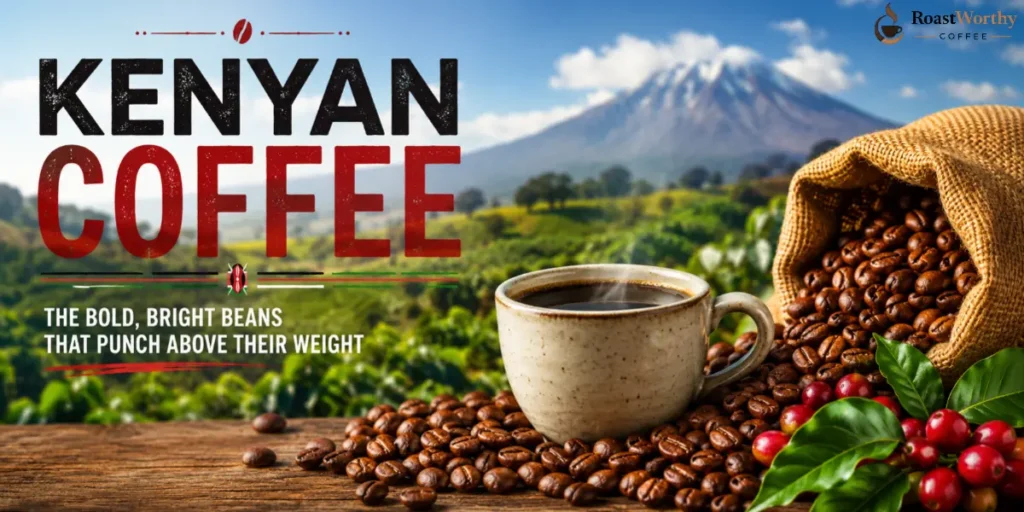
Kenyan Coffee: Bold Beans That Punch Above Their Weight

Kenya doesn't whisper. It announces itself.
One sip of a well-sourced Kenyan coffee and you know exactly where you are. That sharp, citric brightness. The blackcurrant finish that lingers longer than it has any right to. A savory tomato-skin edge that makes you pause mid-sip.
No other origin does this. Not like Kenya does.
What Makes Kenyan Coffee So Distinctive
The terroir is doing something here.
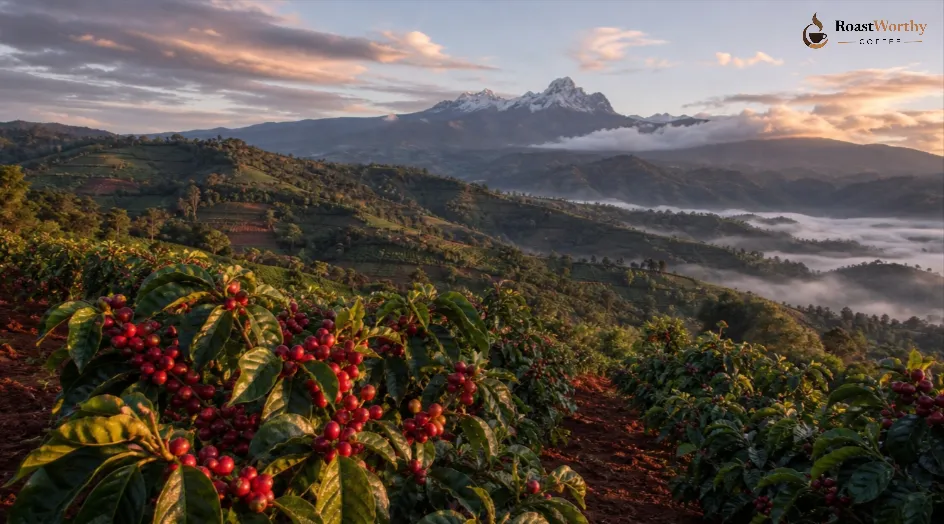
Kenya sits on the equator, but the coffee grows at altitude — between 1,400 and 2,100 metres on the slopes of Mount Kenya and the Aberdare Range. Thin air. Volcanic red soil. Warm days, cold nights. That temperature swing slows the cherry's development. Slower development means more sugars. More sugars mean more complexity in the cup.
It's not magic. It's geography.
The two dominant varietals — SL28 and SL34 — were developed in the 1930s by Scott Agricultural Laboratories. Both were selected for drought resistance. Neither was selected to taste this good. That was accidental. Or maybe just Kenyan.
SL28 is the one most specialty buyers want. It's sensitive, disease-prone, and difficult to grow. Farmers grow it anyway because the cup quality is worth the trouble. SL34 is broader, slightly more forgiving. Still exceptional. Slightly less singular.
Start with the origin, not the roaster. The varietal here is half the story. 🌱
The Washed Process: Why Kenya's Preparation Is Part of the Flavour
Kenya is almost entirely washed process. That's not incidental.
Washed coffee means the fruit is stripped from the seed before drying. What you taste in the cup comes almost entirely from the bean itself — not from fermentation, not from fruit contact.
That's why Kenyan coffee tastes clean and bright at the same time. High clarity. High acidity. Nothing muddy.
But Kenya's washed process has a specific wrinkle: double fermentation. After pulping, the beans soak in water for 12–72 hours. Then they're washed, soaked again in clean water, and dried on raised beds.
That second soak — often called the “Kenya method” — strips mucilage more thoroughly and is widely credited for the intensity of Kenya's cup.
The terroir is doing something here. But so are the farmers.
The Kenyan Auction System: Why It Matters to Your Cup 🗺️
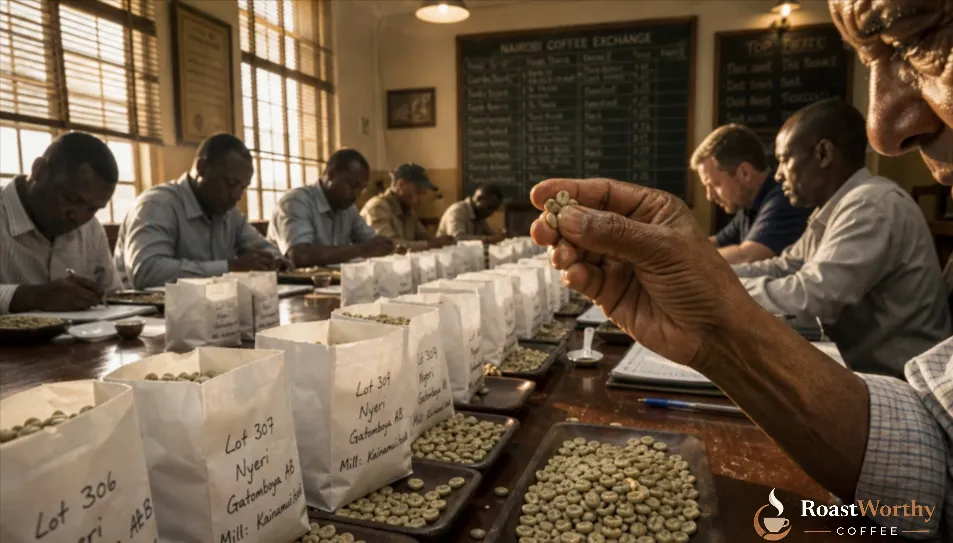
Kenya runs one of the most structured coffee auction systems in the world.
Farmers bring cherry to washing stations (cooperatives). Washing stations process the lot and deliver it to dry mills. Dry mills present finished parchment to the Nairobi Coffee Exchange. Buyers — including international specialty importers — bid there.
This system creates price transparency and quality incentives that most coffee origins lack. A high-quality Nyeri lot gets a premium. Farmers know it. So they invest in better cherry selection.
There's a whole story in this cup. And part of that story is a 60-year-old cooperative washing station and a farmer who hand-sorted cherry at 5am.
The tradeoff: the auction system also adds layers between farmer and buyer. Direct trade relationships exist in Kenya, but they're harder to build than in, say, Colombia. When you see “direct trade Kenyan coffee” on a roaster's bag, that actually means something — because it's genuinely harder to achieve.
Kenya's Top Coffee Regions
Not all Kenyan coffee is equal. The region on the bag matters.
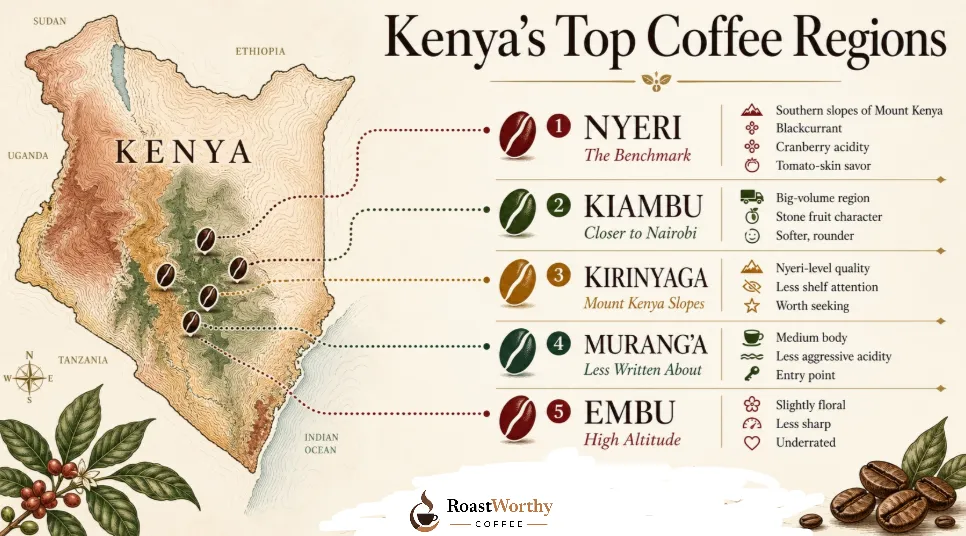
Nyeri
The benchmark. Nyeri sits on the southern slopes of Mount Kenya and produces what most specialty buyers consider Kenya's finest lots. Expect intense blackcurrant, cranberry acidity, and that tomato-skin savory note that's become a Kenyan signature.
Kiambu
Closer to Nairobi. Historically a big-volume region. Quality has fluctuated, but Kiambu lots from strong cooperatives can be excellent — softer than Nyeri, rounder, with stone fruit character. Less electric. Still very good.
Kirinyaga
Also on the Mount Kenya slopes. Often grouped with Nyeri in quality terms. Kirinyaga lots punch at Nyeri's level without always getting the same shelf attention. Worth seeking out when you find them.
Murang'a
Less written about. Produces more accessible, medium-body Kenyan cups. Less aggressive acidity. A good entry point if you find Kenya's brightness overwhelming.
Embu
High altitude. The character is similar to Kirinyaga. Slightly more floral, slightly less sharp. Underrated by most roasters.
Kenya AA: What the Grade Actually Means
You'll see “Kenya AA” everywhere. Here's what it means — and what it doesn't.
AA is a screen size grade. Kenya AA refers to beans that pass through a screen with holes 18/64 inches in diameter. Larger beans, theoretically, more developed fruit. Better cup.
It's the highest commercial grade. Below it: AB (screen 15/16), PB (peaberry), C (smaller), and others.
But here's the honest part: AA is a starting point, not a guarantee. A Kenya AA from a poorly managed cooperative at 1,400 metres is not the same cup as a Kenya AA from a top Nyeri washing station at 1,900 metres.
Grade tells you size. Region, varietal, and washing station tell you quality.
When buying best Kenyan coffee for home use, look past the grade. Look for the region, the washing station name if listed, and the altitude. That's where the real information lives.
How to Roast Kenyan Coffee at Home 🔥
Kenya's density and acidity make it a roaster's origin. Roast it well and it sings. Push it too dark and you bury everything that makes it special.
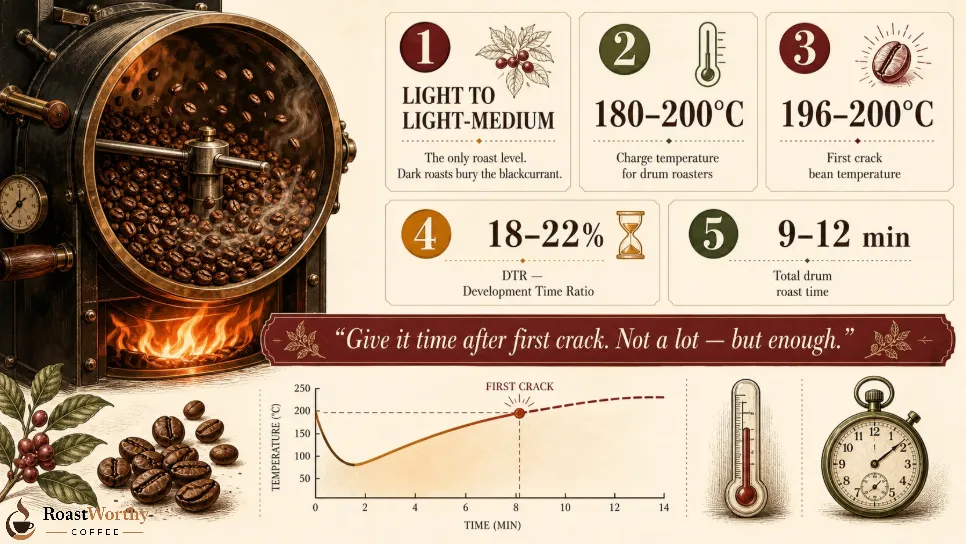
Roast level: Light to light-medium. Full stop.
Dark-roasting a Kenya AA is like painting over a Hockney. The blackcurrant disappears. The brightness collapses. What's left is just bitter and generic.
For home roasting, here are the numbers that matter:
The acidity in Kenya can spike harsh if you rush development. Give it time after first crack. Not a lot — but enough.
Taste it. Write it down. Roast it again.
Brewing Kenya: Get the Method Right ☕
Kenya is a pour-over origin. That's not a rule — it's just where it performs best.
Pour-over (V60, Kalita Wave): Use a 1:15 ratio. Water at 94°C. Grind medium-fine. Bloom for 45 seconds with 2x the coffee weight in water. Pour slowly. Total brew time: 2:30–3:00 minutes. The clarity of the washed process comes through beautifully.
Aeropress: Also excellent for Kenya. Shorter brew time, slightly fuller body. Try inverted method with a 1:12 ratio and 92°C water. 1:30 steep, slow press.
Espresso: Kenya as espresso is a strong opinion. It can be extraordinary — that blackcurrant and tomato intensity compressed into 30ml is genuinely interesting. But it needs a skilled pull and lower extraction. Dial in carefully. It goes sour fast if under-extracted.
French press: Skip it. Kenya's brightness becomes muddy and flat. The flavour doesn't lie — and in a French press, Kenya lies.
FAQ: Kenyan Coffee
What does Kenyan coffee taste like?
Expect blackcurrant, cranberry, tomato-skin, and a winey brightness. It's high-acid, intensely fruity, and clean — the washed process means nothing muddies the cup.
What is Kenya AA coffee?
AA is a screen-size grading standard — beans large enough to pass screen size 18. It's the top commercial grade by size. Larger beans often mean more even development, but grade alone doesn't guarantee cup quality. Region and washing station matter more.
What varietals grow in Kenya?
SL28 and SL34 are the most celebrated. Both were developed by Scott Agricultural Laboratories in the 1930s. SL28 is considered the higher-quality varietal but is more delicate to grow. Ruiru 11 and Batian are also common, developed for disease resistance.
What roast level is best for Kenyan coffee?
Light to light-medium. Dark roasts destroy Kenya's acidity and fruit character. The brightness is the point — don't roast it out.
Why is Kenyan coffee expensive?
The auction system, the altitude, the hand-sorting at washing stations, and the limited yield from high-quality varietals like SL28 all contribute. You're paying for real traceability and real quality control. It's worth it.
What's the best brewing method for Kenya coffee beans?
Pour-over — V60 or Kalita Wave. The clarity of the washed process shines in filter brewing. Aeropress works well too. French press is not the move.
Where to Buy Kenyan Coffee: What to Look For
The specialty market for Kenya coffee beans is well-developed. Most serious roasters carry at least one Kenyan lot.
When shopping:
Reputable sources for green beans: Sweet Maria's, Genuine Origin, Bodhi Leaf Trading. All carry Kenyan lots in season. All provide washing station-level detail.
The people who grew this deserve credit. Their names are on these lots if you know where to look.
More Recommendations from RoastWorthy Coffee