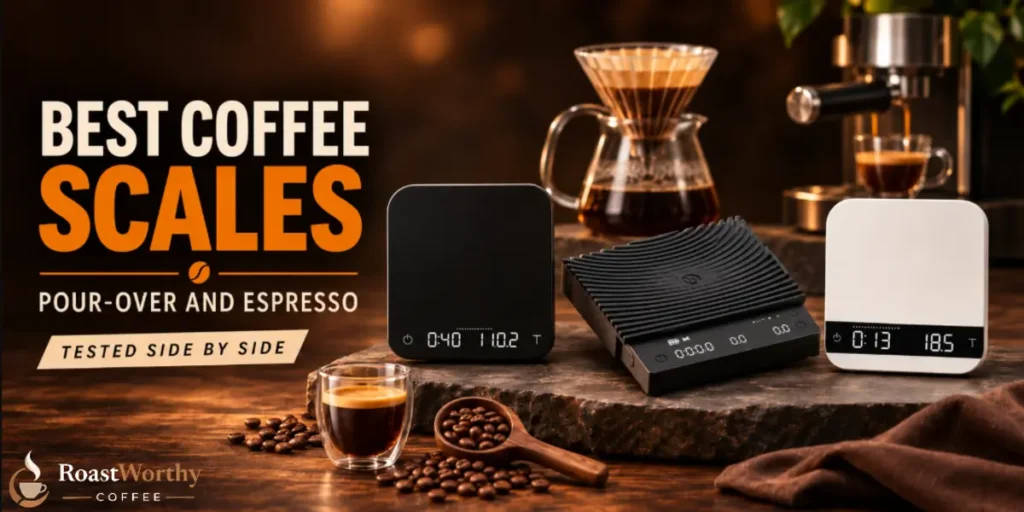
8 Best Coffee Scales in 2026 (Pour-Over and Espresso)

A tablespoon of ground coffee can weigh anywhere from 4 to 8 grams, according to Seattle Coffee Gear. That's a 2x swing in strength from the same scoop.
A scale fixes that. Weigh the coffee, weigh the water, and your cup tastes the same tomorrow as it did today.
The National Coffee Association says it plainly: “Using a digital scale will help you make a more consistent brew.”
Here are 8 scales worth buying, from a $49 espresso scale to a $250 aluminum espresso scale. Prices checked October 28, 2026. ⚖️
✅ Quick Picks
| Scale | Best for | Price | Max / precision | Score |
|---|---|---|---|---|
| Acaia Pearl | Best overall | $150 | 2,000 g / 0.1 g | 8.9 |
| Timemore Black Mirror Basic 3.0 | Best value | 59 to 65 | 2,000 g / 0.1 g (to 500 g) | 8.7 |
| Acaia Lunar | Best for espresso | $250 | 2,000 g / 0.1 g | 8.6 |
| Fellow Tally Pro | Best for guided brewing | $199.95 | 2,500 g / 0.1 g | 8.4 |
| Flair Espresso Scale | Best budget espresso scale | $49 | 2,000 g / not stated | 8.2 |
| OutIn Claro | Best budget all-rounder | $49.99 | 2,000 g / 0.1 g | 8.1 |
| Varia AKU Pro | Most precise | $199.90 | 2,000 g / 0.01 g (to 1 kg) | 8.0 |
| Timemore Black Mirror Nano | Best compact | $99 | 2,000 g / 0.1 g |
☕ How We Test
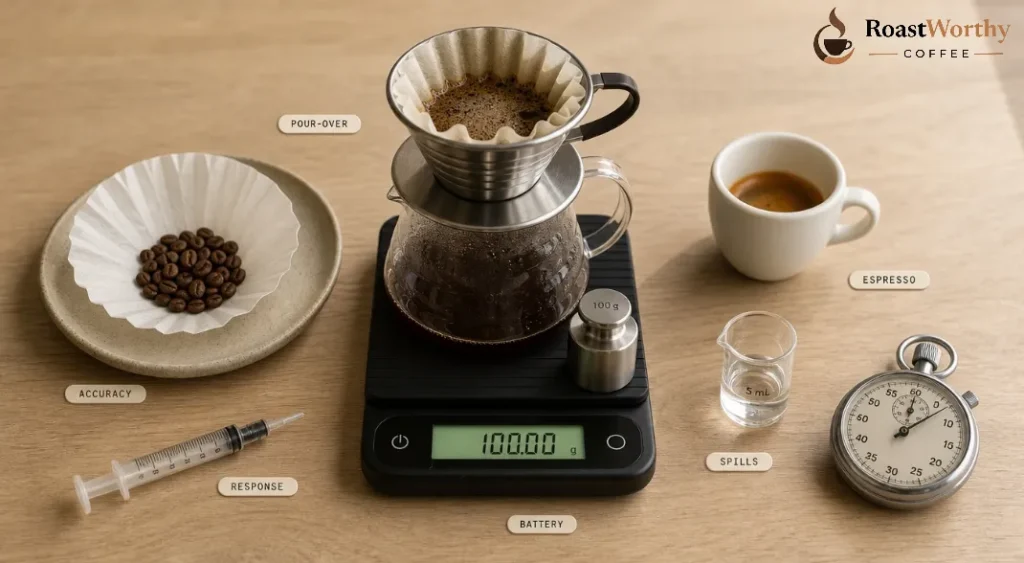
Every scale goes through the same routine.
Scores are out of 10. Until every scale has been through a full round, they're provisional and based on official specs, price and features. We'll update them after testing.
🔥 The 8 Best Coffee Scales
1. Acaia Pearl: Best Overall
| Spec | Detail |
|---|---|
| Price | $150 |
| Capacity / readability | 2,000 g / 0.1 g |
| Timer | Auto-start timer mode, plus a real-time flow rate indicator |
| Power | USB-C rechargeable; 30 to 40 hours of continuous use |
| Connectivity | Bluetooth 5.0 |
| Size / weight | 160 × 160 × 32 mm / 500 g |
| Warranty | 2 years (US/EU) |
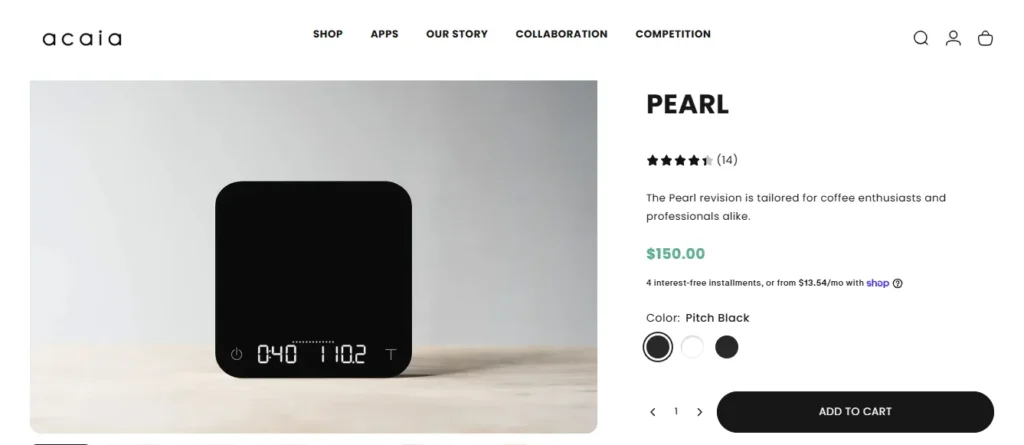
The Pearl is big, simple and built for pour-over.
You get three modes (auto-start timer, dual display and beverage mode) and a live flow-rate readout, so you can see how fast you're pouring. The battery is rated for 30 to 40 hours of continuous use per charge, tied with the Lunar for the longest on this list.
Intelligentsia, one of our partners, stocks it in white for the same $150. Its listing claims a 20 ms response time. Acaia's own page doesn't give a number, so treat that as the retailer's figure.
The catch is size. At 160 mm (about 6.3 in) square, it's made for a counter, not an espresso drip tray. Measure before you buy it for espresso.
Pros:
Cons:
☕ My test notes: I started with five V60 brews, each using 20 g of coffee and 320 g of water. The first thing I checked was how quickly the display responded during pouring, especially when stopping and restarting the flow.
I kept the pour rate around a target of 4 to 6 g per second and used the live flow-rate indicator to track changes. Next, I placed a 100 g reference weight at the centre and all four corners, then repeated the check after 20 brews to look for drift. The 160 mm platform gives a glass server and V60 plenty of room, although that same size makes it less practical for espresso.
I also checked the touch controls with damp fingers and a few stray coffee grounds, since both are common during brewing. My main focus was display stability, consistent taring and how useful the flow-rate indicator felt during a normal pour-over routine.
2. Timemore Black Mirror Basic 3.0: Best Value
| Spec | Detail |
|---|---|
| Price | $59 (Black) / $65 (White); presale |
| Capacity / readability | 2,000 g; 0.1 g up to 500 g, 1 g to 1 kg, 3 g to 2 kg |
| Timer | Waits for your first pour; 3-second lead-in with a tap |
| Power | USB-C, 1,600 mAh; up to 24 hours of use |
| Water resistance | IPX3 |
| Size / weight | 140 × 120 × 20 mm / 300 g |
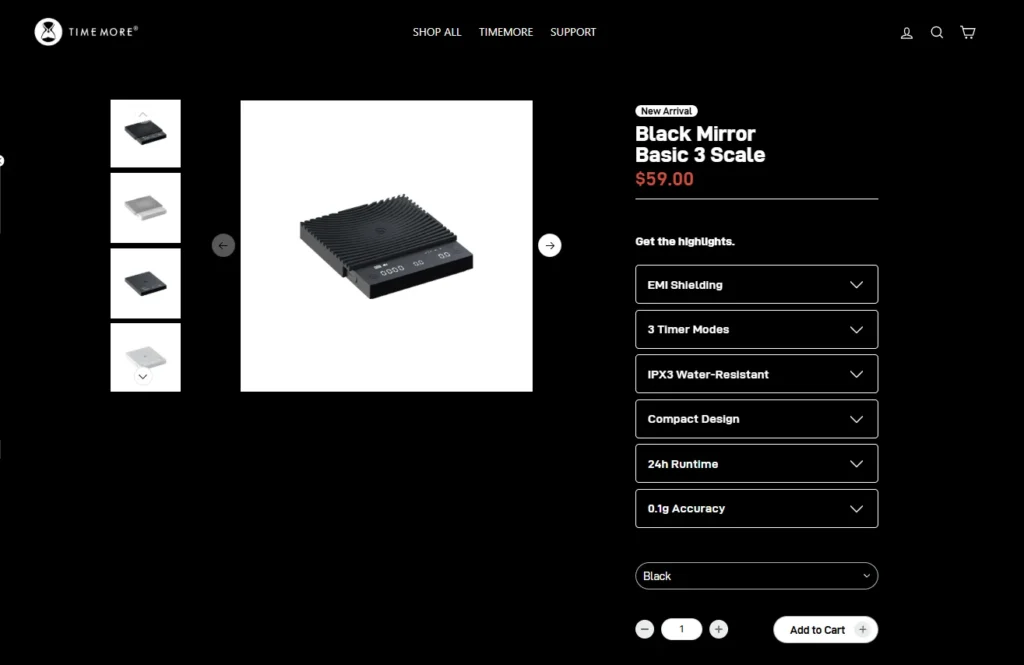
This is the most scale for the money on our list. You get a smart auto-timer that waits for your first pour, a real-time flow rate display, IPX3 water resistance and up to 24 hours of battery for well under half the Pearl's price.
Read the precision line carefully, though. It's accurate to 0.1 g up to 500 g, then steps to 1 g up to 1 kg and 3 g up to 2 kg. That's fine for weighing beans and pulling shots. For a big batch, the water reading gets coarser past 500 g.
Stumptown, another partner, sells it as the “Timemore Black Mirror Basic 3 Scale” for $59. Stumptown says one charge covers about 280 five-minute pour-overs.
Heads up on stock: on October 28 it was out of stock at Stumptown and on presale at Timemore, which said it would ship “by the end of January.”
Pros:
Cons:
☕ My test notes: I started with five V60 brews using 20 g of coffee and 320 g of water, switching between a lightweight dripper and a heavier glass server. The first thing I checked was how the scale handled different loads.
Timemore lists 0.1 g readability up to 500 g, but that drops to 1 g above the threshold. I paid close attention to the displayed increments during each pour, especially with the heavier server. Next came the auto-timer. I compared gentle bloom pours with faster pours to check how consistently the timer responded, then tried the three-second countdown.
For accuracy, I used a 100 g reference weight at the centre and all four corners, repeating the check after 20 brews. I also included a controlled 5 mL splash to check for display glitches and accidental tare resets. The IPX3 rating is reassuring for everyday splashes, but this still isn't a scale I'd rinse under a tap.
3. Acaia Lunar: Best for Espresso
| Spec | Detail |
|---|---|
| Price | $250 |
| Capacity / readability | 2,000 g / “0.1 g / 0.01 g” |
| Timer | Espresso modes auto-start and stop the timer or tare |
| Power | USB-C (with PD); 30 to 40 hours of continuous use |
| Connectivity | Bluetooth 5.0 |
| Size / weight | 105 × 105 × 15 mm / 265 g |
| Build | Water-resistant anodized aluminum |
| Warranty | 2-year limited, “which also covers water damage” |
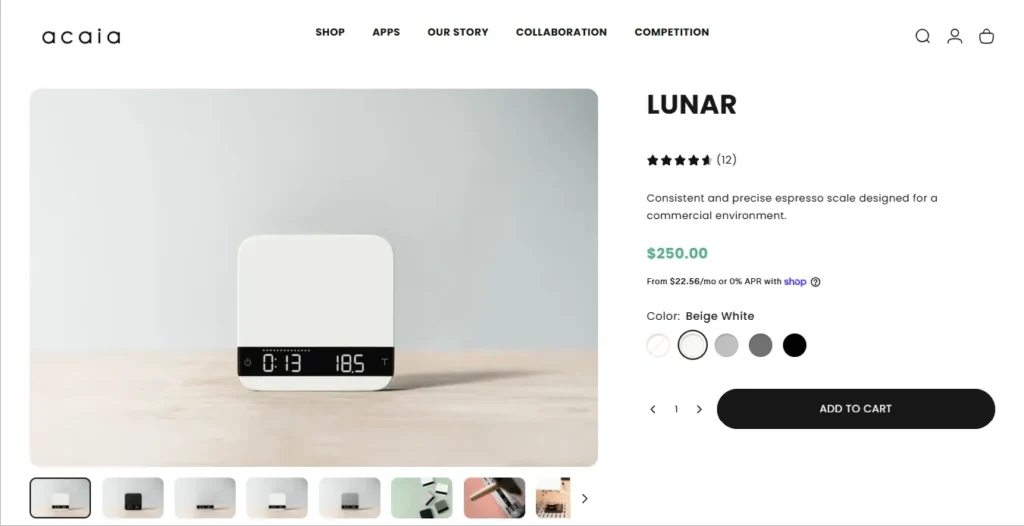
The Lunar is the Pearl shrunk down for espresso. At 105 mm (about 4.1 in) square and 15 mm thin, it's sized to sit on a drip tray with a cup on top. Clive Coffee points to exactly that, plus the fact that it “weighs to the tenth of a gram.”
The espresso modes do the boring part for you: they can start and stop the timer or tare automatically. And the body is water-resistant anodized aluminum, backed by a warranty that covers water damage. Handy right next to a hot, wet espresso machine.
It's expensive. But if you pull shots every day, it's the one built for the job.
Pros:
Cons:
☕ My test notes: I started with five espresso shots on the Breville Bambino Plus, using 18 g of coffee and aiming for 36 g in the cup. The first thing I checked was how well the automatic timing modes worked. One starts at the first drop of espresso, while another starts when the cup is placed, so I compared both during pre-infusion.
Next, I watched how quickly the display settled near 36 g and whether the reading stayed steady once the pump stopped. I also checked cup clearance on the drip tray, since the Lunar's 15 mm profile is one of its biggest selling points.
For accuracy, I used a 100 g reference weight before and after 20 brews to check for drift. At $250, my main focus was whether those automatic features actually made the espresso routine easier or just added another layer of controls.
4. Fellow Tally Pro: Best for Guided Brewing
| Spec | Detail |
|---|---|
| Price | $199.95 |
| Capacity / readability | 2,500 g / 0.1 g |
| Modes | Brew Assist, Timer Mode, Weight Mode (g, oz, lb, ml) |
| Power | USB-C rechargeable; about 13 hours of continuous use |
| Size / weight | 177 × 150 × 33 mm / 553.5 g |
| Water | “Water resistant but NOT waterproof” |
| Warranty | 2 years, or 3 if you register |
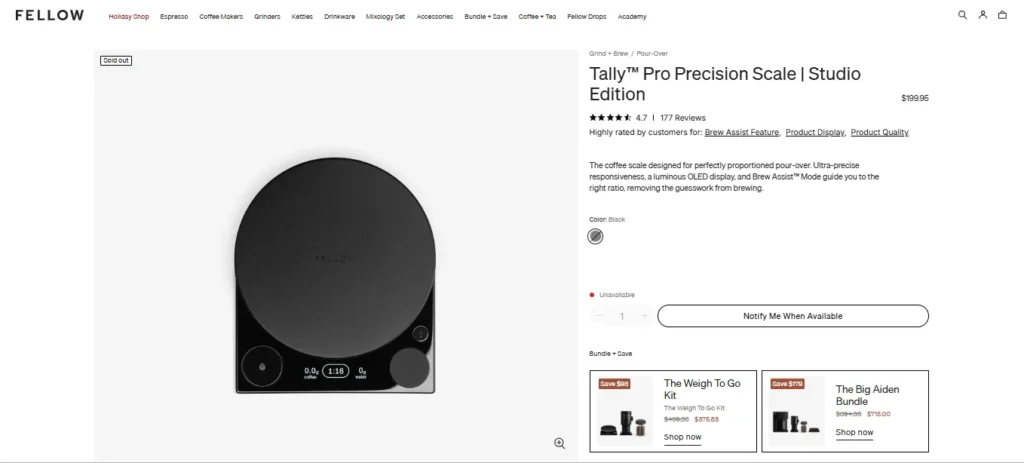
The Tally Pro's party trick is Brew Assist. Pick a ratio, and the scale guides you to the target water weight as you pour. No math, no phone.
It also has the highest capacity among our top picks at 2,500 g, and a removable weigh pan for cleaning. It doesn't connect to an app, and Fellow doesn't mention an auto-start timer.
It's a good fit if you're new to brewing by weight and want the scale to do the ratio math.
Pros:
Cons:
☕ My test notes: I started with two V60 brews using 20 g of coffee and a 320 g water target, first in Brew Assist and then in regular Timer Mode. The first thing I checked was how easy it was to follow a four-pour recipe without calculating the water weight myself.
Brew Assist puts the target right on the display, which is especially helpful for beginners. Switching to Timer Mode meant handling the timing manually, and that's one convenience you lose compared with an automatic timer. I also tried adjusting the dial with damp fingers and removed the weighing pan to check how easily it could be cleaned and fitted back into place.
For accuracy, I used a 100 g reference weight before and after 20 brews, paying particular attention to drifting readings. At nearly $200, my biggest consideration was whether Brew Assist offered enough everyday convenience to justify the price over a simpler scale.**
5. Flair Espresso Scale: Best Budget Espresso Scale
| Spec | Detail |
|---|---|
| Price | $49 |
| Capacity / readability | 2,000 g / not stated |
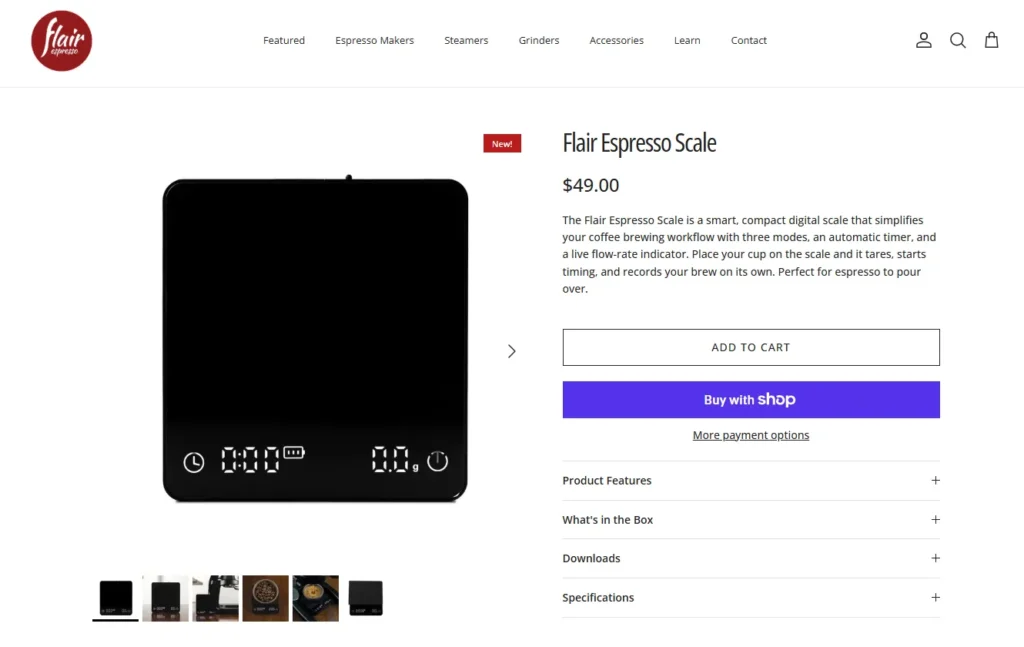
| Modes | Manual, Espresso (auto-tare, timer starts when espresso flows), Pour Over |
| Extras | Flow light bar; Off / On / On Silent switch |
| Power | USB-C rechargeable lithium battery |
| Size | 95 × 90 × 16 mm |
Flair, the lever espresso maker, makes its own scale, and it's built around the shot. Espresso mode tares automatically and starts the timer when espresso starts to flow, and a light bar shows the flow. At 95 × 90 mm, it's even smaller than the Lunar.
At $49, it's a fifth of the Lunar's price. Flair doesn't list the readability or battery life, though, so that's what our test round needs to confirm.
If you already own a Flair press (see our Flair 58 Plus 2 review), this is the obvious match.
Pros:
Cons:
☕ My test notes: I started with five espresso shots using 18 g of coffee and aiming for 36 g in the cup. The first thing I checked was how well Espresso Mode handled automatic taring and timing, especially during pre-infusion on a manual lever press.
Next, I slowed down the extraction to compare the flow light bar with the changing weight on the display. The compact 95 × 90 mm platform was another focus, particularly cup stability and clearance under the press. Since Flair doesn't specify readability, I added coffee in small increments to check the smallest weight change the display could register, then repeated the 100 g reference-weight check after 20 brews.
I also checked whether pressing the controls disturbed the reading and how the silent switch affected operation.
6. OutIn Claro: Best Budget All-Rounder
| Spec | Detail |
|---|---|
| Price | $49.99 |
| Range / accuracy | 0.3 to 2,000 g / 0.1 g |
| Timer | Up to 9:59; espresso mode starts timing when flow begins and pauses when it stops |
| Power | 700 mAh rechargeable, USB-C; “400 brewing cycles in one charge” |
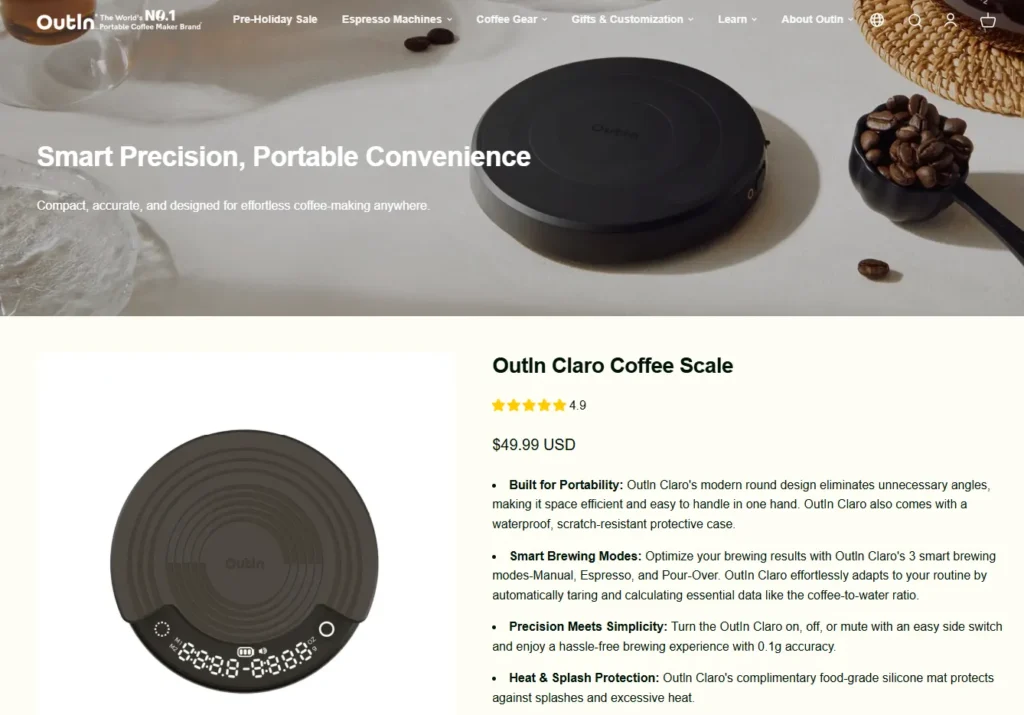
| Size / weight | Ø111 × 20 mm / 145 g (175 g with mat) |
OutIn, the portable espresso brand, sells this round scale for the same money as the Flair, but with a stated 0.1 g accuracy. Its espresso mode starts timing when flow begins and pauses when it stops, so it works for pour-over and shots. (OutIn)
OutIn rates the battery at 400 brewing cycles per charge. At 145 g and 111 mm across, it's also light enough to throw in a bag with a portable espresso maker.
Pros:
Cons:
☕ My test notes: I split testing between a portable espresso setup and a normal kitchen V60. For espresso, I used 18 g of coffee and targeted 36 g out, checking whether M1 consistently detected the first drops and paused when the flow stopped.
For pour-over, I used M2 with 20 g of coffee and a 320 g water target, comparing its displayed ratio with the calculated 1:16 recipe. The round 111 mm platform was another thing I checked, particularly how well it supported a small espresso cup and how stable a wider glass server felt when it overhung the edge.
I also compared repeatability with and without the silicone mat, keeping the scale on a firm, level surface. OutIn claims 400 brewing cycles per charge, which makes battery endurance an important consideration for travel. The 9:59 timer limit is fine for a quick V60, but becomes a limitation for longer immersion recipes.
7. Varia AKU Pro: Most Precise
| Spec | Detail |
|---|---|
| Price | $199.90 |
| Capacity / readability | 2 kg; 0.01 g up to 1 kg, 0.05 g from 1 to 2 kg |
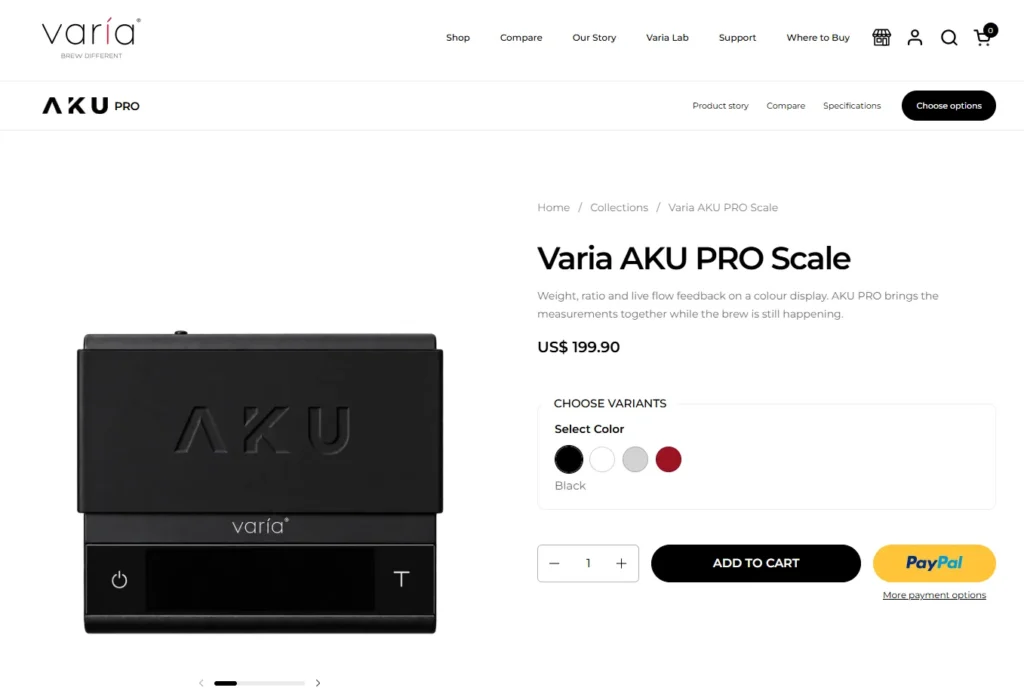
| Modes | AKU Flow and AKU Spro, with live flow feedback on a colour display |
| Connectivity | Bluetooth |
| Power | USB-C |
| Size / weight | 130 × 110 × 18 mm / 323.5 g |
| In the box | 100 g calibration weight and a travel case |
If you want hundredths of a gram, this is it. The AKU Pro reads to 0.01 g up to 1 kg, so it's built for people who track every fraction of a shot. It even ships with a 100 g calibration weight so you can check it yourself.
Varia makes a fair point on its own page, too: display resolution isn't the same as accuracy. A scale can show 0.01 g and still drift. That's what our test round will check.
The downside is how much Varia leaves out. There's no battery life, water-resistance rating or warranty on the product page, and no app is named for the Bluetooth.
Pros:
Cons:
☕ My test notes: I spent more time checking repeatability than admiring the extra decimal place. First, I used the supplied 100 g calibration weight for ten consecutive readings, removing and replacing it between each one.
Then I repeated the checks at different positions on the platform and after 20 simulated brewing cycles. A display that changes in 0.01 g steps isn't automatically accurate to 0.01 g, so I compared the readings against the calibrated reference balance, checking for systematic offset or drift.
For espresso, I used AKU Spro with an 18 g dose and a 36 g yield, focusing on how clearly the colour display showed changes in flow. For AKU Flow, I used the 20 g V60 recipe and added a heavier brewing vessel to check the transition from 0.01 g to 0.05 g resolution above 1 kg total load.
8. Timemore Black Mirror Nano: Best Compact
| Spec | Detail |
|---|---|
| Price | $99 (sale; listed at $109.99) |
| Range | 0.1 to 2,000 g in 0.1 g steps |
| Timer | Auto-timing starts when the scale senses a change in weight; flow-rate monitoring |
| Power | Built-in lithium battery, USB-C; up to 15 hours |
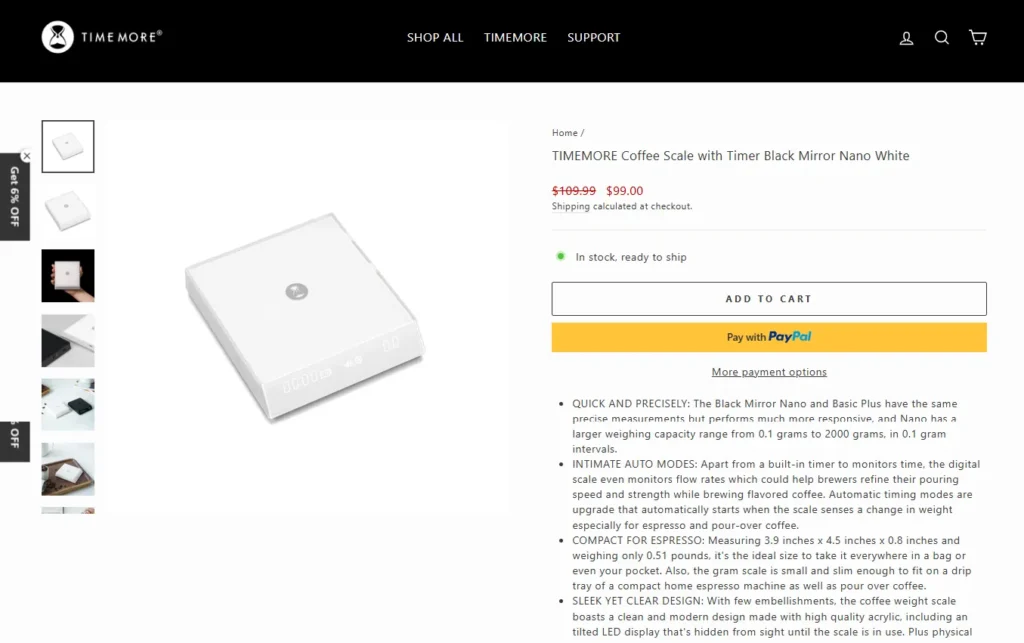
| Size / weight | 3.9 × 4.5 × 0.8 in / 0.51 lb |
The Nano packs the Black Mirror features (auto-timer, flow rate, 0.1 g steps across the full 2 kg) into a body under 4 ½ inches long. Measure your drip tray first, but that's a small footprint.
The catch is value. The Basic 3.0 has the same auto-timer and flow rate for $40 less (though its precision drops above 500 g), and the Flair and OutIn scales are about half the price.
Pros:
Cons:
☕ My test notes: I started by placing the Nano on a compact espresso drip tray, using an 18 g dose and aiming for 36 g in the cup. The first thing I checked was how easy the angled display was to read beneath the group head and whether the side-mounted controls were awkward to reach while the machine was running.
Next, I ran five 20 g V60 brews, checking the automatic timing and flow-rate display during steady pours and short pauses. Another important check was how the timer behaved when I lifted or swirled the brewer.
Some Nano owners have reported the automatic pour-over timer stopping during those movements, so I repeated the same recipe with auto-timing enabled and disabled to compare the difference. I also checked zero stability after removing a warm cup and compared the smallest displayed increments against the 100 g reference weight.
👀 Also Worth a Look
❌ Skip for now: the Hario V60 Drip Scale and Polaris were both sold out on Hario's US store when we checked, and Hario says the V60 Drip Scale is “not water resistant.“
❓ How to Choose a Coffee Scale
1. Precision
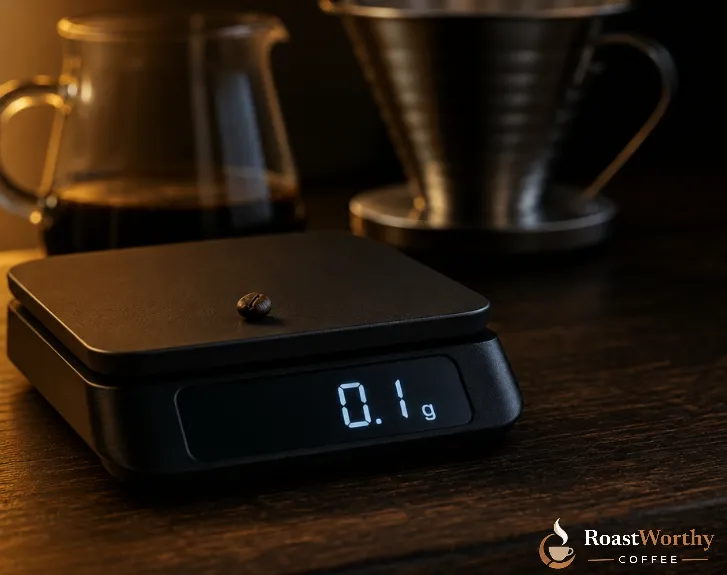
For coffee, 0.1 g is the number to look for. Every top pick here offers it in the range you'll actually use, except the Flair, which doesn't state its readability.
Watch for scales that get coarser at higher weights, like the Timemore Basic 3.0 (1 g above 500 g) or Hario's V60 Drip Scale (0.5 g above 200 g, 1 g above 500 g).
0.01 g (Varia AKU Pro, AKU mini) is for espresso nerds tracking tiny changes. You don't need it for pour-over.
2. Size: pour-over or espresso?
| Use | What to look for | Picks |
|---|---|---|
| Pour-over and drip | Wide platform, 2 kg+ capacity, timer | Acaia Pearl (160 mm), Fellow Tally Pro (177 × 150 mm) |
| Espresso | Small and thin enough for the drip tray | Flair (95 × 90 mm), Acaia Lunar (105 mm), Timemore Nano, OutIn Claro (Ø111 mm) |
| Both | Mid-size with an espresso mode | Timemore Basic 3.0 (140 × 120 mm), OutIn Claro |
Seattle Coffee Gear's advice is simple: “Check the width and depth of your drip tray area” before buying an espresso scale.
3. Timer and auto-start
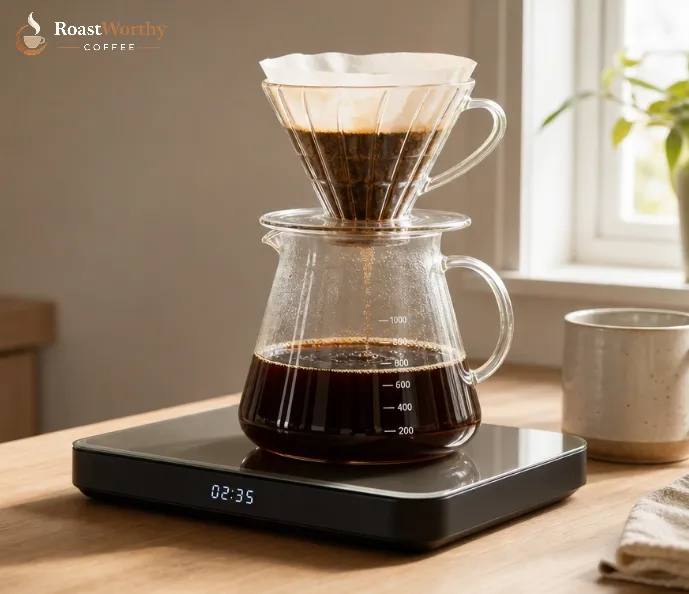
A built-in timer is a must for pour-over and espresso. Auto-start, where the timer begins when you start pouring or when espresso starts to flow, saves a hand. The Pearl, Lunar, Basic 3.0, Nano, Flair and OutIn all have some version of it.
4. Power
USB-C rechargeable is the norm now. Rated battery life varies a lot: 13 hours (Tally Pro) to 30 to 40 hours (Acaia). AAA-powered scales (Hario Barista Glass, OXO) never need charging but do need batteries.
5. Water resistance
Coffee scales get wet. Only the Timemore Basic 3.0 and Basic Mini list an IP rating (IPX3) among the scales we checked. Acaia backs the Lunar with a warranty that covers water damage. Everything else says “water resistant” at best, so wipe spills fast.
🧐 Why Weigh Your Coffee?
Because scoops lie. Seattle Coffee Gear says “a single tablespoon can be anywhere from 4 to 8 grams” depending on the bean and grind.
Weighing lets you follow a ratio. Here's what the main references recommend:
| Source | Recommended ratio |
|---|---|
| SCA Golden Cup | 55 g of coffee per liter of water (about 1:18) |
| NCA, pour-over | 1:13 to 1:16 |
| Seattle Coffee Gear | 1:15 to 1:17 for pour-over/drip (start at 1:16); 1:2 for espresso |
| Stumptown Chemex recipe | 42 g coffee to about 700 g water (about 1:17) |
| NCA, espresso | 1:2 in 20 to 30 seconds |
The SCA's 55 g/L converts to about 1:18 (our math).
The NCA says it twice, for both pour-over and espresso: a digital scale “will help you” brew more consistently.
For more ratios by brew method, see our coffee brewing ratios guide, or set up the whole station with our home coffee bar guide.
📌 FAQ's
Do I really need a coffee scale?
If you want the same cup every day, yes. A tablespoon of ground coffee can weigh 4 to 8 grams (Seattle Coffee Gear), so scooping can change your strength a lot. The NCA says a digital scale “will help you make a more consistent brew.”
What precision should a coffee scale have?
0.1 g covers both pour-over and espresso, and it's what most of our picks offer. 0.01 g scales like the Varia AKU Pro exist, but they're aimed at espresso enthusiasts.
Can I use a kitchen scale for coffee?
You can if it reads in 0.1 g steps and has a timer, like the OXO Good Grips Precision Scale with Timer. A kitchen scale that only reads whole grams is fine for beans and water, but too coarse for espresso shots.
What's the best coffee scale for espresso?
One small enough to fit on your drip tray. The Acaia Lunar (105 mm) is the premium pick, and the Flair Espresso Scale (95 × 90 mm, 49)and OutIn Claro(49.99) are the budget picks. Measure your tray first.
How do I use a coffee scale for pour-over?
Put your brewer and filter on the scale, tare it, add coffee, tare again, then start the timer and pour to your target water weight. At 1:16, that's 320 g of water for 20 g of coffee.
Are expensive coffee scales worth it?
You mostly pay for battery life, build and extras like Bluetooth or water-damage cover. The 59 to 65 Timemore Basic 3.0 has the core features (0.1 g up to 500 g, auto-timer, flow rate) that many brewers need.
More Recommendations from RoastWorthy Coffee