How to Set Up a Home Coffee Bar: Everything You Need to Get Started

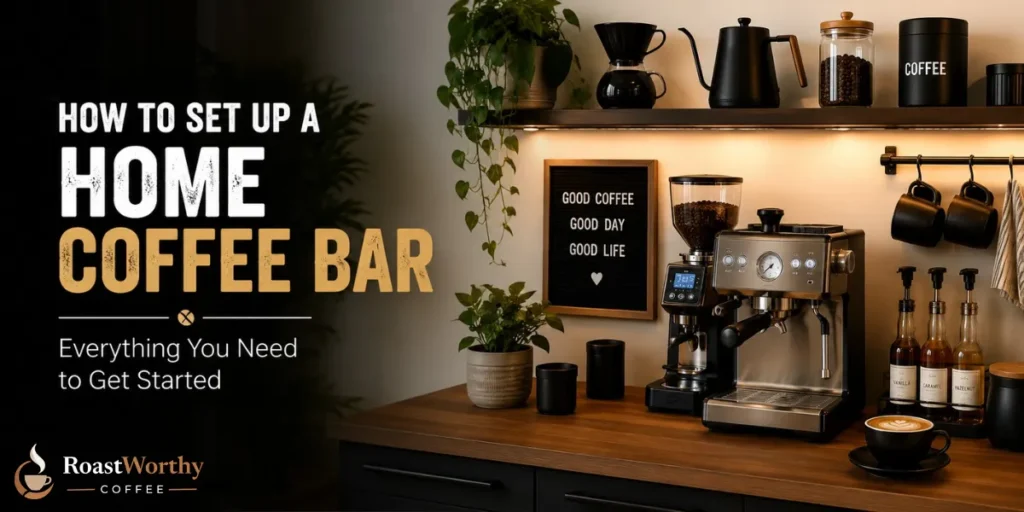
A Home Coffee Bar is the single best upgrade you can make to your daily caffeine routine. It turns one corner of your kitchen into a café you actually own.
No more $6 lattes. No more disappointing drip. Just repeatable, great coffee… on demand.
This guide covers exactly how to set up a home coffee bar from scratch — the gear, the sequence, the layout, and the budget. We’ll go tool by tool: espresso machine, grinder, scale, kettle, storage, tamper, knock box, and drip tray.
The big idea: a Home Coffee Bar isn’t décor. It’s a workflow. Build it like a system and your worst home cup beats most café cups.
Your first shot will be imperfect. Make it anyway.
TL;DR: Home Coffee Bar Setup at a Glance
Why a Home Coffee Bar Is Worth It
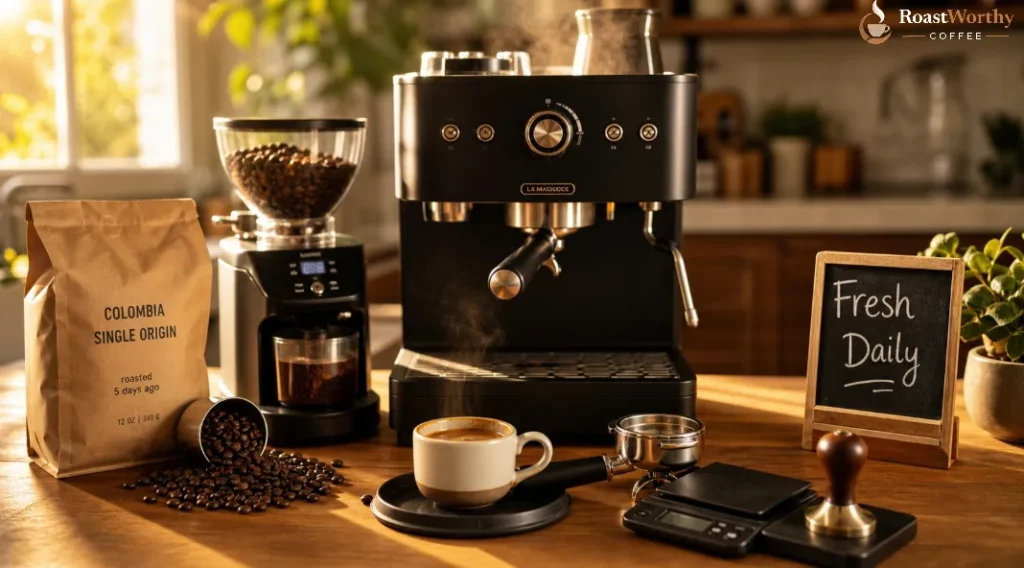
A good Home Coffee Bar makes your best coffee the default, not the weekend exception.
The math is simple. Two café drinks a day is roughly $300+ a month. A solid home coffee bar setup often pays for itself in 3–6 months.
But it’s not just money. It’s control: your beans, your roast, your grind, your ratio.
Freshness is the real win. Beans peak 4–14 days off roast. A home coffee station lets you brew them in their prime — something no café drive‑thru can guarantee.
Step 1: Choose the Right Space
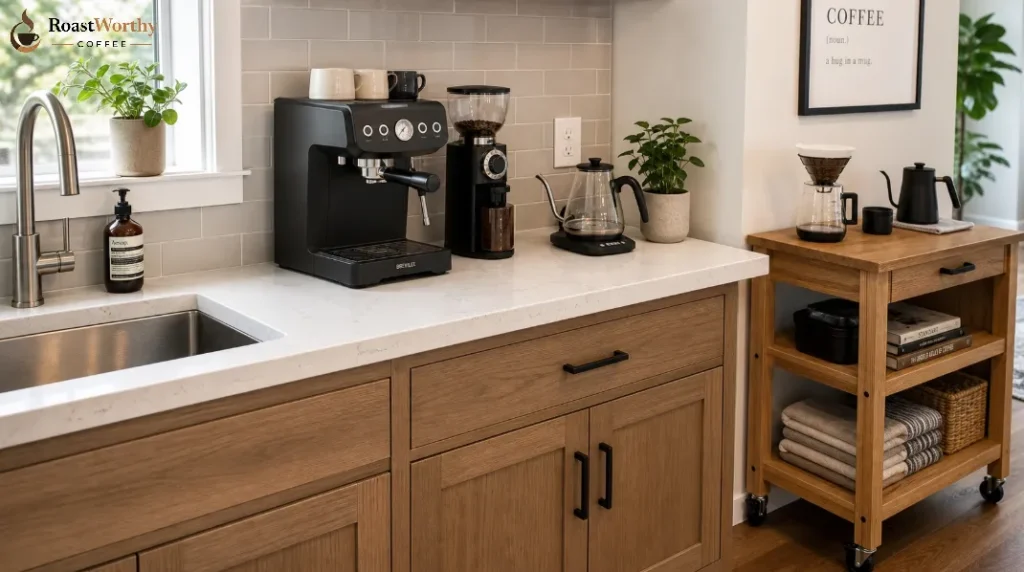
You don’t start with gear. You start with location.
For a practical home coffee bar setup, you need three things:
A 60–90 cm stretch of countertop is enough for a serious home barista setup.
Short on space? A sturdy rolling cart becomes a mobile home coffee station that tucks against the wall and rolls out when needed.
Step 2: Espresso Machine — The Heart of Your Home Coffee Bar
The espresso machine defines your ceiling. The grinder defines your floor.
When planning how to set up a home coffee bar, match the machine to how you drink:
What to look for:
Entry‑level machines absolutely belong in a serious Home Coffee Bar. The difference is pairing them with a real grinder and a repeatable routine — not the price tag.
Step 3: Grinder — The Non‑Negotiable Upgrade
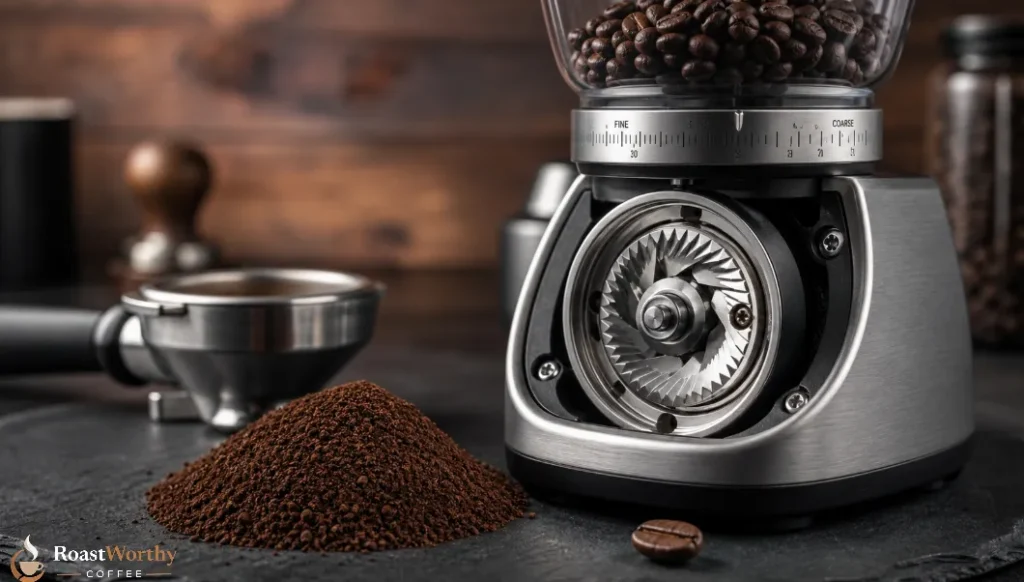
Let’s be honest. A weak grinder ruins more home barista setups than any other single mistake.
If you care about espresso, you need fine, even particles and tiny, controlled adjustments.
Core features for a home coffee station grinder:
Flip the old advice. Forget “machine first, grinder later.” For a Home Coffee Bar that tastes like a café, grinder quality comes first.
The curve doesn’t lie: a good grind gives stable flow, predictable shot times, repeatable flavour.
Step 4: Scale — Your Quiet MVP
A scale turns guessing into data.
If you’ve ever pulled an “okay” shot you couldn’t repeat, it’s because you didn’t weigh anything.
What your scale must do:
The starter espresso recipe for any Home Coffee Bar: 18 g in, 36 g out, in 25–30 seconds.
That’s a reliable 1:2 ratio. Taste it. Write it down. Pull it again.
Step 5: Kettle — For More Than Tea
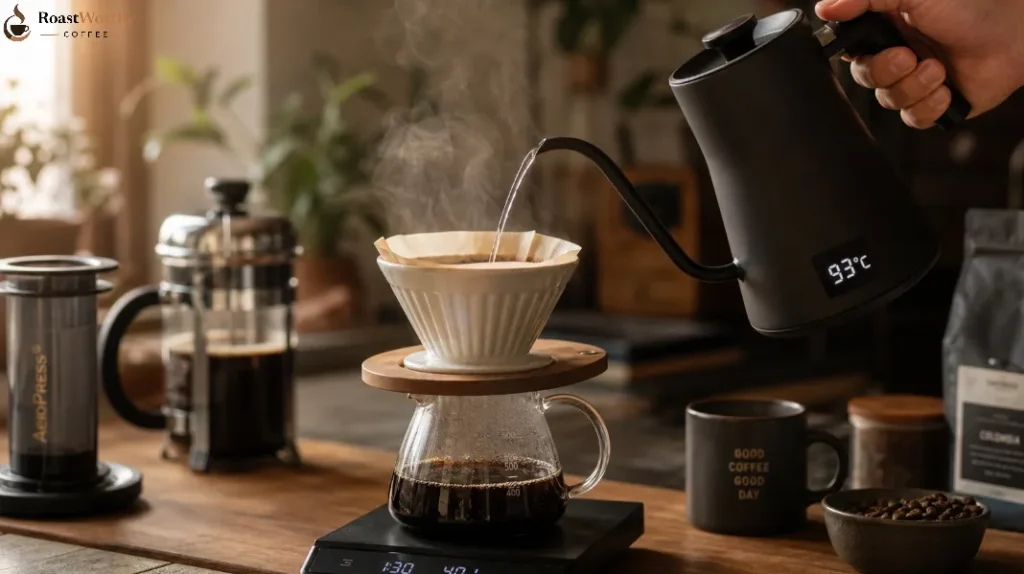
Even with hot water on your machine, a kettle belongs in your home coffee station.
Why? Because most Home Coffee Bars do more than espresso — pour‑over, AeroPress, French press, and quick cleaning.
Good kettle features:
Here’s what the heat is actually doing: lighter roasts brew best at 92–95°C for sweetness and acidity; darker roasts often shine closer to 90–92°C. Your kettle is how you control that.
Step 6: Storage — Beans, Tools, and Space
A clean Home Coffee Bar looks good. A well‑organized one makes better coffee.
Think in two layers: bean storage and tool storage.
Bean Storage
Start with the origin, not the roaster. Match beans to your brew: lighter roasts for pour‑over, medium for balanced espresso, darker for heavier shots.
Tool Storage
Keep within reach: tamper, distribution tool, cleaning brush, and extra filters.
Drawers under the bar are gold. No drawers? A small caddy keeps your home barista setup tidy but ready.
Step 7: Tamper — Small Tool, Big Impact
A tamper looks simple. It isn’t.
Uneven tamping is one of the fastest ways to ruin espresso in a home coffee station.
Tamper rules:
You’re building a Home Coffee Bar where muscle memory creates repeatability. Tamp the same way every single time and your shots stabilize fast.
Step 8: Knock Box — The Cleanup Engine
A knock box solves two problems at once: fast removal of spent pucks, and a cleaner workflow around your espresso machine.
Place it directly next to or under the machine. You want a short loop: unlock portafilter → knock → quick wipe → relock.
No walking around the kitchen dripping coffee grounds. A knock box is cheap, and it’s the difference between a tidy Home Coffee Bar and a daily mess.
Step 9: Drip Tray — More Than a Catch Basin
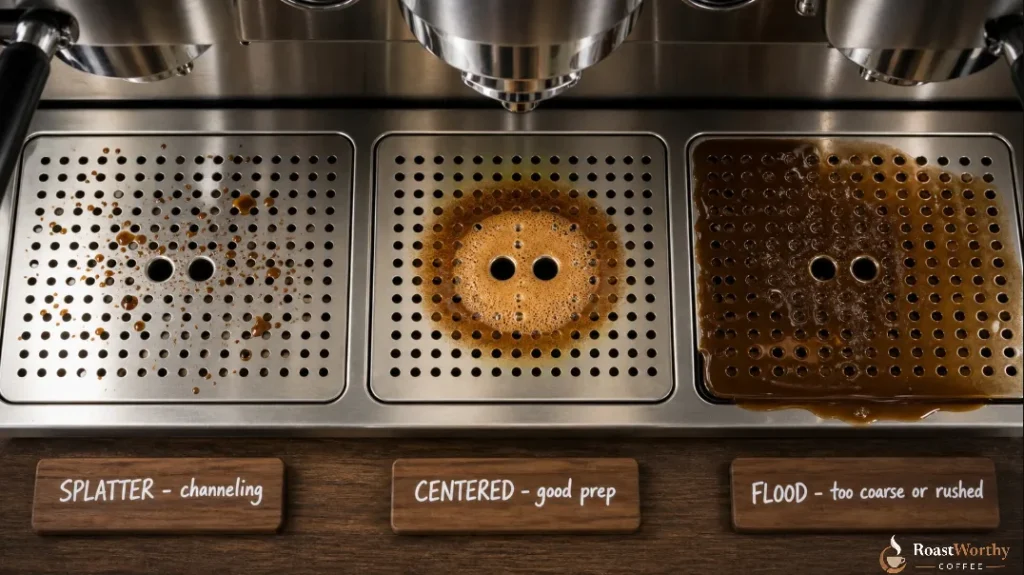
Every home coffee station needs a controlled mess zone. That’s the drip tray.
It’s not just there to catch spills. It’s a calibration tool.
Read the tray like a diagnostic:
Less mess over time means better technique. The flavour doesn’t lie — and neither does the tray.
Home Coffee Bar Gear Sequence & Budget
Here’s the full build order, what each tool does, and rough starter priority.
| Order | Tool | Job | Starter Priority |
|---|---|---|---|
| 1 | Espresso machine | Sets your quality ceiling | High |
| 2 | Grinder | Sets your quality floor — buy well | Highest |
| 3 | Scale | Repeatable dose & yield | High |
| 4 | Kettle | Pour‑over, temp control | Medium |
| 5 | Storage | Keeps beans fresh | Medium |
| 6 | Tamper | Even, level extraction | High |
| 7 | Knock box | Fast, clean puck disposal | Low |
| 8 | Drip tray | Mess control + calibration | Comes with machine |
If money is tight, spend it on the grinder and scale first. A modest machine with a great grinder beats a great machine with a bad grinder.
Layout: Turning Gear Into a Real Home Coffee Station
You have the sequence. Now you need flow.
Left → right (for right‑handed baristas):
- Grinder at the far left.
- Tamping space directly right of the grinder.
- Espresso machine + drip tray in the center.
- Knock box just right of the machine.
- Kettle and pour‑over setup further right or on a second tier.
- Storage above or below: beans and tools.
This gives your Home Coffee Bar a natural rhythm: grind → prep → brew → clean → switch brews. You’re building a system, not a Pinterest board.
Sample Daily Workflow in Your Home Coffee Bar
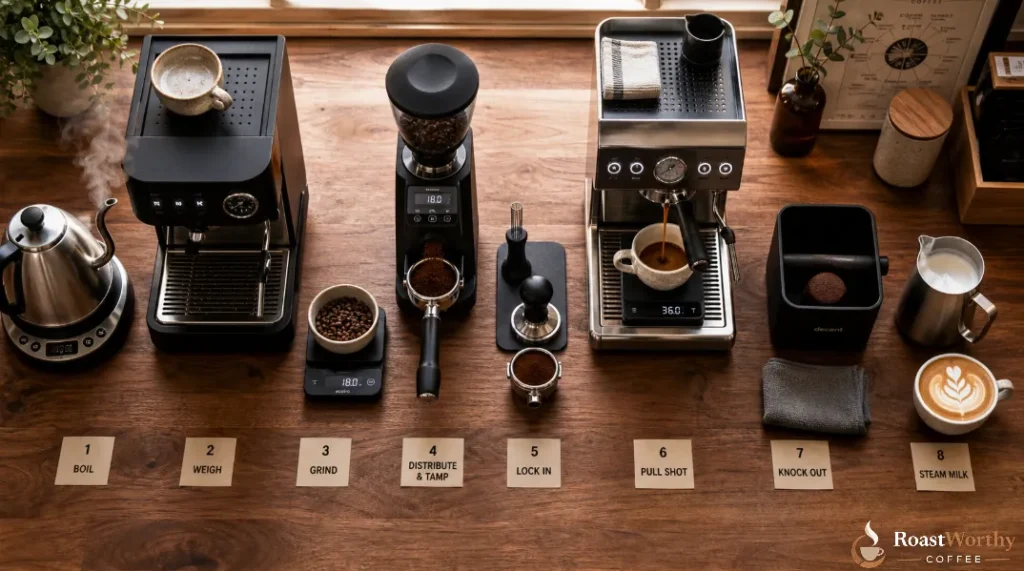
Here’s how to set up a Home Coffee Bar so it feels like a ritual, not a chore.
- Turn on the espresso machine and kettle.
- Pull beans from storage; weigh the dose on the scale.
- Grind into the portafilter.
- Distribute and tamp level.
- Lock in; place cup + scale on the drip tray.
- Pull the shot to target weight and time.
- Knock out the puck; quick wipe.
- Steam milk or make an americano.
Run this 30–40 times and the routine becomes muscle memory. Taste it. Write it down. Brew it again.
Common Home Coffee Bar Mistakes to Avoid
Fix the grinder and the scale first, and most flavour problems disappear.
FAQ: Home Coffee Bar Setup
What do I need to start a Home Coffee Bar?
An espresso machine, grinder, scale, kettle, storage containers, tamper, knock box, and drip tray, plus a stable counter with power and nearby water.
Is the grinder more important than the espresso machine?
Yes. A consistent grinder is critical for any home coffee bar setup, because poor grind quality ruins extraction even on expensive machines.
How much space do I need for a home coffee station?
Most people can build a practical home coffee bar in 60–90 cm of countertop, or on a compact rolling cart with stable power access.
Can I build a Home Coffee Bar without an espresso machine?
Yes. Focus on pour‑over, AeroPress, or French press with a good grinder, kettle, scale, and bean storage, then add espresso later.
How much does a starter Home Coffee Bar cost?
A functional home barista setup is achievable on a modest budget if you prioritize the grinder and scale and choose an entry‑level machine.
How do I keep my Home Coffee Bar clean?
Use proper bean and tool storage, keep the knock box beside the machine, wipe the drip tray daily, and brush down the grinder after each session.
More Recommendations from Roastworthy Coffee