How Roast Level Influences Coffee Sweetness and Perceived Body

Roast level influences coffee sweetness in one clear pattern: it peaks at medium roast (210–220°C / 410–428°F), then retreats. Body builds progressively as roast darkens. Neither is random — both are direct outputs of roast chemistry.
Understanding the Maillard reaction, caramelization, and development time ratio (DTR) tells you exactly what to expect before you brew a single gram.
Sweetness. Body. Bitterness. These are outputs of temperature, time, and roast flavor chemistry — and once you understand the reactions, you stop guessing and start choosing.
☕ What Roasting Actually Does to Your Coffee
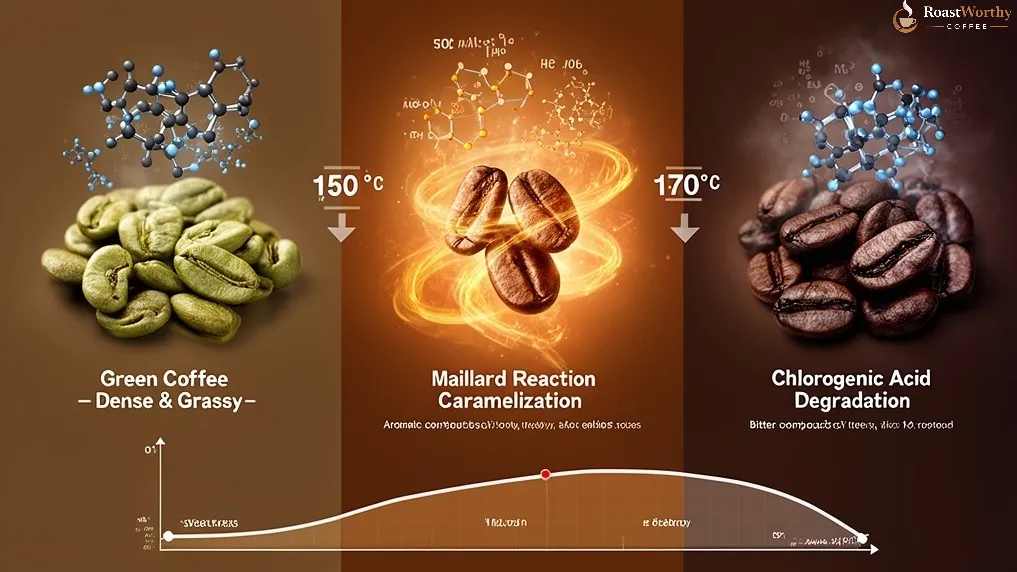
Green coffee is dense, grassy, and practically undrinkable. Roasting transforms it.
Two reactions drive most of what you taste:
The Maillard Reaction kicks off around 150°C (302°F). Amino acids and reducing sugars combine under heat. The result: hundreds of new aromatic compounds — toasty, nutty, caramel-adjacent. This is also where brown color develops.
Caramelization starts around 170°C (338°F). Sucrose breaks down. Simple sugars restructure into caramel-like compounds. Sweetness builds… and then, past a certain threshold, it starts degrading into bitterness. ⚗️
There's also chlorogenic acid degradation. Green beans are loaded with chlorogenic acids — they taste sharp and astringent. Heat breaks them down. Less acid means sweetness becomes more perceptible. Over-roast and those same acids produce bitter, harsh by-products.
The curve doesn't lie. What you taste is roast degree effects playing out in real time.
✨ How Sweetness Shifts Across Roast Levels
Sweetness in coffee is not added. It's released, transformed, or destroyed — depending on how far you push the roast.
Light Roast: Natural Sugars, Preserved
At light roast (roughly 195–205°C / 383–401°F, before or just at first crack), most of the bean's original sucrose survives intact. The Maillard reaction is active but not aggressive.
The sweetness here is subtle and fruit-forward. Think: dried mango, tamarind, hibiscus. It reads more like brightness than sweetness to most palates. Chlorogenic acids are still high, which means the sweetness competes with acidity.
Ethiopian naturals and Kenyan washed lots shine at this roast. The origin characteristics are preserved. The sweetness is real — but you have to taste for it.
What Causes Sweetness to Peak at Medium Roast?
Medium roast sits around 210–220°C (410–428°F). First crack has finished. Development is underway. Sucrose is actively caramelizing.
This is where sweetness peaks. Brown sugar. Caramel. Milk chocolate. The Maillard compounds and caramelized sugars layer on top of each other. Acidity softens as chlorogenic acids break down further. The result is a more accessible, round sweetness most people recognize immediately.
Colombian Huila lots, Guatemalan honey-processed beans — at medium roast, these taste like brown sugar and stone fruit. That's not poetic license. That's caramelization doing its job.
Reference the coffee flavor wheel here and you'll find medium roast lands squarely in the nutty-sweet and caramel quadrant. There's a reason for that.
Dark Roast: Sweetness Retreats
Push past 225°C (437°F) into dark roast territory and the caramelization that built all that sweetness starts working against you.
Sugars don't just caramelize — they pyrolyze. They char. Pleasant caramel notes convert into bitter, smoky, acrid compounds. Chlorogenic acid by-products increase bitterness further.
Sweetness doesn't disappear entirely. But it gets buried under roast character. Dark chocolate. Tobacco. Ash.
Some people love this. No judgment. But if you're chasing sweetness, dark roast is working against the chemistry.
🔥 How Body Changes as Roast Darkens
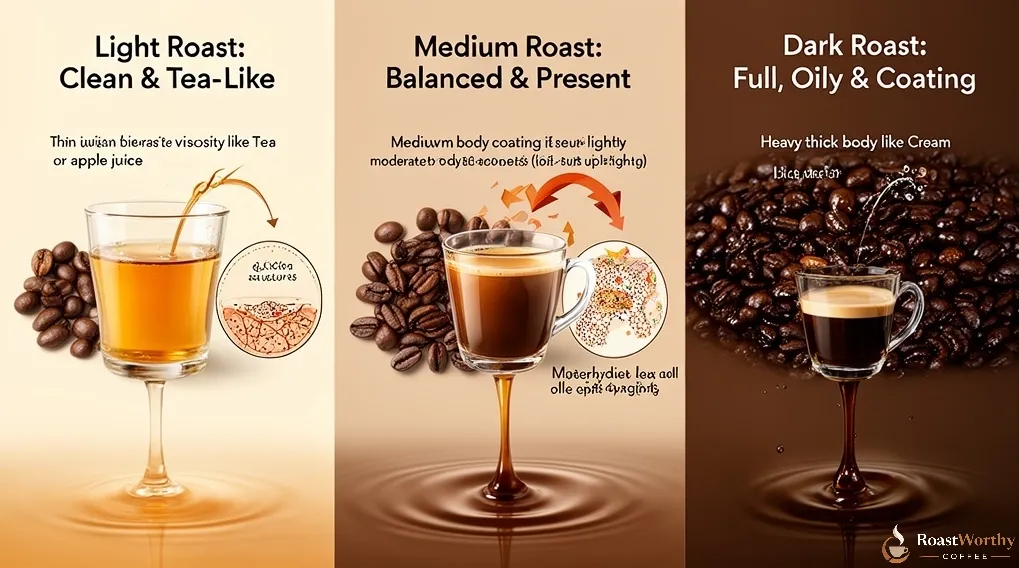
“Body” is mouthfeel — the weight and texture of coffee on your tongue. Thin like tea. Full like whole milk. Heavy and coating like cream. Coffee mouthfeel changes significantly across roast degrees, and two mechanisms drive it: oil migration and fiber breakdown.
Light Roast Body: Clean and Tea-Like
At light roast, coffee oils are sealed inside the bean's cellular structure. The bean hasn't expanded enough to push oils to the surface.
Brew a light roast pour-over. The cup is clean. Bright. Almost delicate. The body is low — some would say juicy. Like a high-quality white tea or a crisp apple juice. That's not a flaw. For origin-forward coffees, that clean body is a feature.
Medium Roast Body: Balanced and Present ☕
As roast development progresses, bean structure opens up. Oils start migrating. The breakdown of polysaccharides — long-chain carbohydrates in the bean — creates heavier dissolved solids in the brew.
Medium roast delivers the most balanced body. Not thin, not heavy. It coats the mouth lightly. You feel weight without grease. This is why medium roast works for both pour-over and espresso — it's versatile.
Dark Roast Body: Full, Oily, Coating
Dark roast pushes oils completely to the surface of the bean. You can see them — shiny, wet-looking beans. Those oils end up in the cup.
The result is a heavy, full body. Thick. Sometimes slick. Espresso pulled from a dark roast has viscosity. It clings.
This is why dark roast cuts through milk in lattes. The body holds up. An oat milk cortado made with a dark roast Sumatra hits differently than the same drink made with a light Ethiopian. Both are valid. They're just doing different things.
⚡ How Roast Level Influences Coffee Sweetness, Body & Flavor — Full Chart
Complete coffee sensory analysis across all three roast degrees:
| Dimension | Light Roast | Medium Roast | Dark Roast |
|---|---|---|---|
| Sweetness | Delicate, fruit-forward | Caramel, brown sugar (peak) | Low; bitter-forward |
| Body | Light, tea-like | Medium, balanced | Full, oily, coating |
| Acidity | High, bright | Moderate | Low, flat |
| Bitterness | Low | Moderate | High |
| Origin Clarity | High | Moderate | Low |
| Roast Temp | 195–205°C / 383–401°F | 210–220°C / 410–428°F | 225–245°C / 437–473°F |
| Best Brew | Pour-over, filter, cold brew | Drip, espresso, AeroPress | French press, moka, milk drinks |
✅ How to Choose a Roast Level Based on What You Want
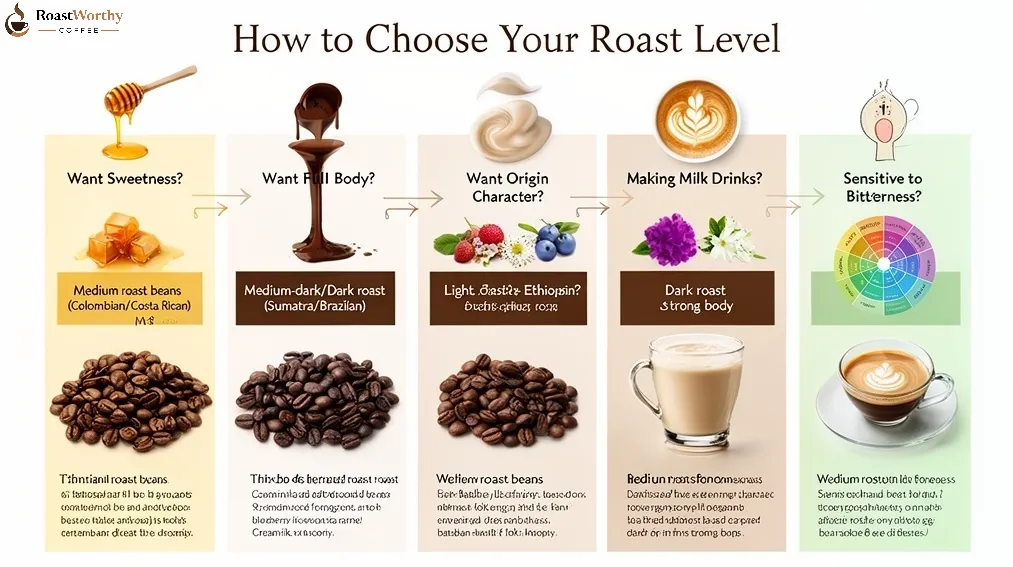
Stop picking roast level by bag color or marketing language. Pick by what you want in the cup. This is applied roast impact on body and flavor — practical, not theoretical.
You want sweetness:
Go medium roast. A washed Colombian or honey-processed Costa Rican at medium will give you the cleanest caramel sweetness. Avoid dark — it burns away what you're looking for.
You want full body:
Medium-dark or dark roast. A Sumatra wet-hulled or a Brazilian natural taken darker will have the thickness and coating body you're after. Pull it as espresso for maximum effect.
You want origin character — floral, fruity, terroir-driven:
Light roast, every time. A natural-processed Ethiopian Yirgacheffe at light roast tastes like blueberry jam. Take it dark and you get… dark roast. The origin disappears.
You're making milk drinks:
Dark or medium-dark. The body and roast intensity survive dairy. Light roast gets lost in a latte. It just disappears.
You're sensitive to bitterness:
Medium roast is your range. The bitterness of dark roast isn't just a preference thing — it's a chemistry thing. Over-roasted chlorogenic acid by-products are genuinely harsh. Medium avoids that entirely.
⏳ Home Roasting Tip: Watch Your Development Time
If you're roasting at home, this matters practically.
DTR is the number that matters. Development Time Ratio — the percentage of total roast time spent after first crack. Most home roasters keep it too short. The result: underdeveloped sweetness. The Maillard reaction didn't finish its work.
Shoot for 20–22% DTR for medium roast. That's where the caramelization lands in the sweet spot. Too short and the cup tastes baked. Too long and you're trending dark whether you want to or not.
Taste it. Write it down. Roast it again. 🔥
🎯 FAQ: Roast Level, Sweetness & Body
Does darker roast always mean more bitter coffee?
Yes, chemically. Extended heat converts caramelized sugars into bitter pyrolysis compounds. Dark roast bitterness increases with roast degree — it's not perception, it's roast flavor chemistry.
Why does my light roast taste sour, not sweet?
Underdevelopment. If the roast ended too early — before sufficient Maillard reaction and caramelization — you get raw acidity without sweetness to balance it. Increase your DTR to 20–22%.
What roast level has the most body?
Dark roast. Extended heat migrates oils to the bean surface and breaks down cell walls, producing the heaviest, most coating mouthfeel. This is the most significant roast impact on body.
Does roast level affect caffeine content?
Marginally. Light roast retains slightly more caffeine by mass. But the difference in a brewed cup is small — brewing method matters more than roast level for caffeine yield.
Can origin affect body regardless of roast level?
Yes. Bean density, processing method, and varietal all influence body independently of roast degree. A natural-processed Ethiopian can have surprising body even at light roast. Roast level amplifies what's already there.
Why does espresso from dark roast taste sweeter than filter?
Pressure extraction pulls more dissolved solids into a concentrated shot. That concentration creates perceived sweetness even when the actual sugar level is lower than in a medium roast pour-over.
Is medium roast the best choice for pour-over?
For most home brewers, yes. It gives you enough body to feel satisfying and enough sweetness to be accessible. Light roast pour-overs are excellent but demand precise brewing. Medium roast is more forgiving.
Roast level is not a preference debate. It's a chemistry decision with flavor consequences you can predict and control.
Pick your target. Hit your DTR. Taste it. Write it down. Roast it again. ☕