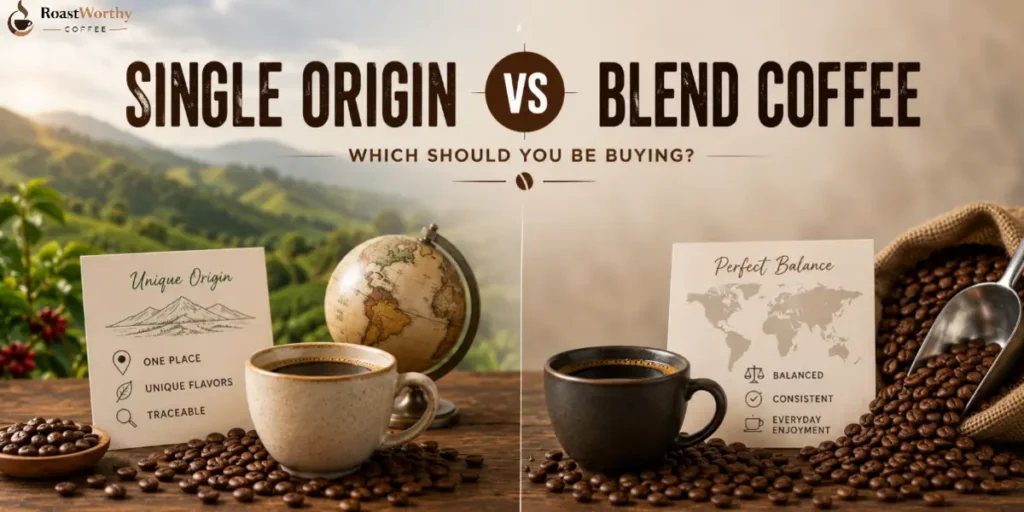
Single Origin vs Blend Coffee: Which Should You Be Buying?

Let's be honest.
Most people buying coffee don't actually know what they're choosing between. The bag says “single origin.” Another says “house blend.” You pick one. You move on.
That's fine. But if you're here, you want to actually understand the difference between single origin vs blend coffee — not just the marketing version.
Here it is.
What “Single Origin” Actually Means
Single origin means the coffee comes from one defined place.
That could be a country. A region. A single farm. Sometimes a single lot within a farm, harvested from one specific processing batch.
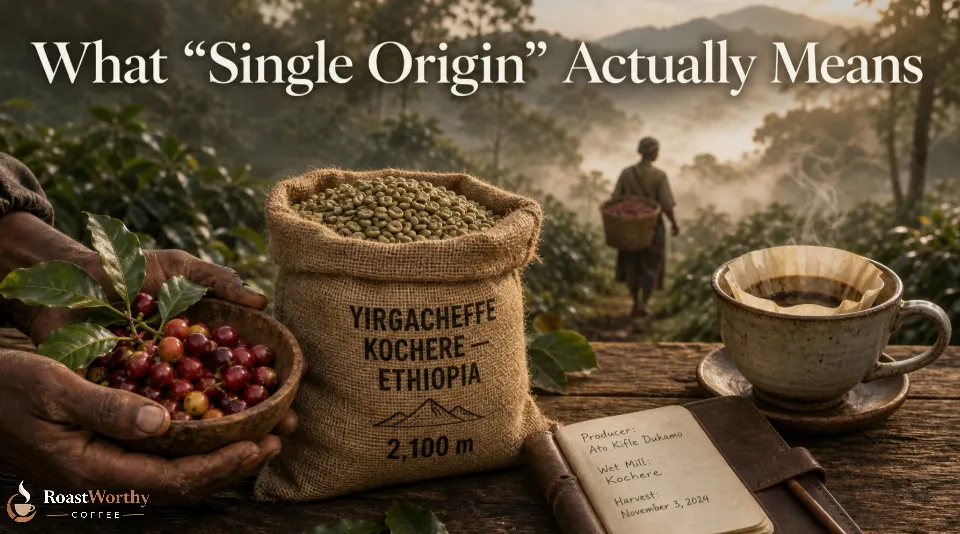
The terroir is doing something here. When you buy a washed Yirgacheffe from the Kochere woreda in Ethiopia, you're tasting the altitude (roughly 1,900–2,200 metres), the heirloom varietals grown wild in that forest, and the decisions of the producers at the wet mill. No other bag gives you that.
Single origin is traceability made drinkable.
That's its real value — not just flavour complexity, but accountability. You know where your coffee came from. The people who grew it deserve credit for that.
There's a whole story in this cup — and single origin is how that story reaches you intact.
What a Blend Actually Is
A blend is a deliberate combination of two or more coffees, usually from different origins.
Roasters blend for one reason above all: consistency.
A seasonal Ethiopian might taste like blueberries and hibiscus in March. In October, that same farm's lot could taste completely different — different harvest, different fermentation conditions, different cherry ripeness. Single origin buyers accept that variation. It's part of the deal.
Blenders don't accept it. They engineer around it.
A skilled roaster blends to hit a target flavour profile year-round. They might anchor it with a Brazilian natural for body and low acidity, then layer in a Colombian washed for brightness, then finish with a Guatemalan for sweetness and structure. The result? A coffee blend vs single origin that consistently tastes the same every time you order it. ☕
That consistency is the whole point — and it's genuinely hard to achieve.
Flavor Complexity: Who Actually Wins?
This is where people have strong opinions. Often wrong ones.
The argument goes: single origins are more complex, blends are more boring.
That's not quite right.
A well-constructed blend can be extraordinarily layered. Some of the most technically impressive coffees I've cupped have been blends — where a roaster has spent months dialling in the ratio between three origins to hit a specific sweetness, body, and finish.
But here's the honest version: single origins tend to express more distinct, unusual flavour characteristics. A natural-processed Sidama might taste overtly like strawberry jam. A Kenyan SL28 might hit you with blackcurrant and tomato in the same sip. You're unlikely to get that from a house blend.
Blends are built for balance. Single origins are built for character.
Neither is better. They're doing different jobs.
The Terroir Argument
Terroir is a word borrowed from wine. It describes how geography, climate, and soil shape what ends up in the cup.
In coffee, terroir is everything.
Start with the origin, not the roaster. A coffee grown at 2,000 metres in Huila, Colombia has a fundamentally different cellular structure than one grown at 1,200 metres in Sumatra. The altitude affects how slowly the cherry develops. Slower development means more sugar accumulation. More sugar means more complexity in the final cup.
When you buy single origin coffee, you're paying for terroir to come through clearly — unblended, undiluted.
🌱 Washed processing highlights terroir most cleanly. It strips the fruit away and lets the bean's inherent character speak. Natural processing adds fermentation character on top of terroir — different, not better or worse.
Blends, by design, moderate terroir. They smooth it. That's the trade-off.
Single Origin vs Blend for Espresso
This is where things get technical. ⚗️
Pulling espresso at 9 bars of pressure with water at 93°C is not forgiving. Every flavour defect in a single-origin bean gets amplified. High acidity — which is a virtue in a light pour-over — can become sharp and unpleasant under pressure.
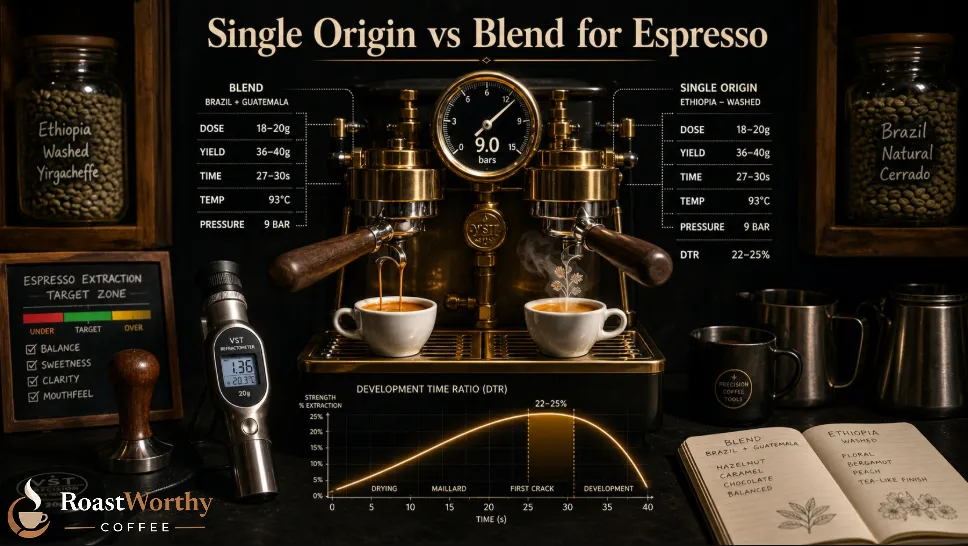
That's why espresso blends dominate commercial settings.
Roasters building espresso blends typically target:
Single-origin espresso absolutely works. A medium-roast Ethiopian washed can produce a genuinely brilliant shot — clean, floral, complex. But the extraction window is narrower. You'll dial it in tighter. It's less forgiving if your grind is slightly off.
For home baristas starting out: a well-crafted espresso blend is your friend. You'll hit a drinkable result faster.
For experienced home espresso pullers: single origin espresso is worth the challenge. DTR is the number that matters when you're roasting for espresso — keep development time ratio at 22–25% for a medium-light roast, and you'll get something that stands up under pressure. 🔥
Roast Level and What It Does to the Difference
Roast level affects the single origin vs blend coffee debate more than most people realise.
Light roasts preserve origin character. A light roast of a Kenyan washed will taste like that Kenyan. The terroir survives because the bean hasn't been pushed far enough into the Maillard and caramelisation reactions to obscure it.
Dark roasts homogenise. This is just chemistry.
Take any three single-origin beans and roast them all to a full city plus or Vienna roast. Taste them blind. The differences between origins collapse. What you're tasting at that point is roast character, not origin character. Dark-roasted blends and dark-roasted single origins taste more similar than their light-roasted equivalents.
That's not an opinion. That's what happens when you log 800 roast profiles and track RoR curves across multiple green coffees.
Here's what the heat is actually doing: it's burning off the volatile aromatic compounds that carry origin-specific flavours. Floral top notes. Bright fruit acids. Delicate sweetness. All sensitive to high heat.
Roast light. Buy single origin. The curve doesn't lie.
Which Should You Actually Buy?
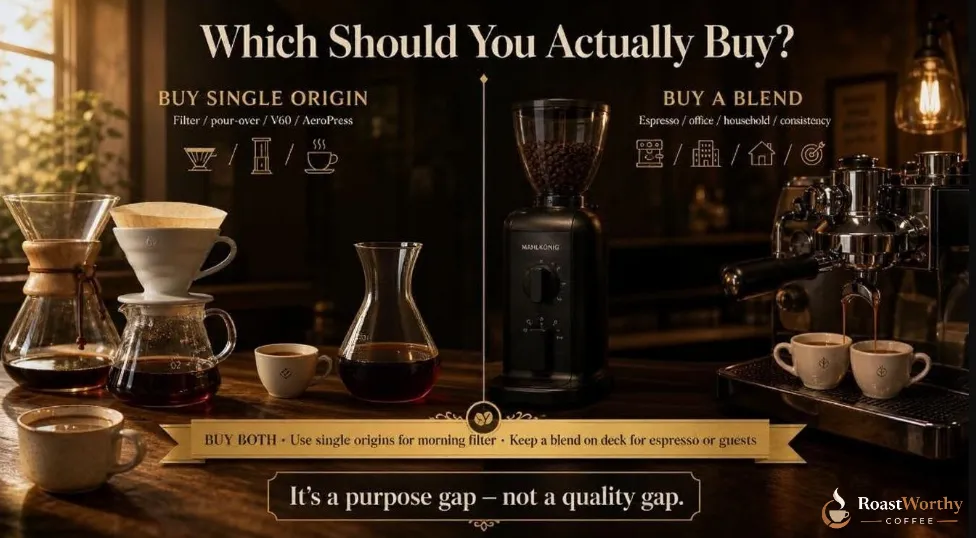
Here's a clean framework. No waffle.
Buy single origin if:
Buy a blend if:
Buy both. Honestly. Use single origins for your morning filter ritual. Keep a blend on deck for espresso or for guests.
The difference between single origin and blended coffee isn't a quality gap — it's a purpose gap. The best roasters make excellent versions of both.
How to Read a Bag: What the Labels Are Actually Telling You
🗺️ Not all single-origin labels are created equal.
“Single origin” on a specialty coffee bag from a reputable roaster usually means traceability to a farm, a cooperative, or a specific lot. That information matters.
“Single origin” on a supermarket bag often just means a country. “Colombia” or “Ethiopia” as a country designation tells you very little — there are enormous flavour differences between a low-altitude commercial Colombian robusta blend and a high-altitude Huila washed Caturra from a direct-trade farm.
Look for:
Blends should tell you the origin components. “Brazilian + Colombian + Ethiopian” tells you more than “house blend.” If a roaster won't tell you what's in their blend, ask. The good ones will answer.
This matters beyond the flavour. Traceability is how farmers get paid fairly.
The Specialty Coffee Perspective
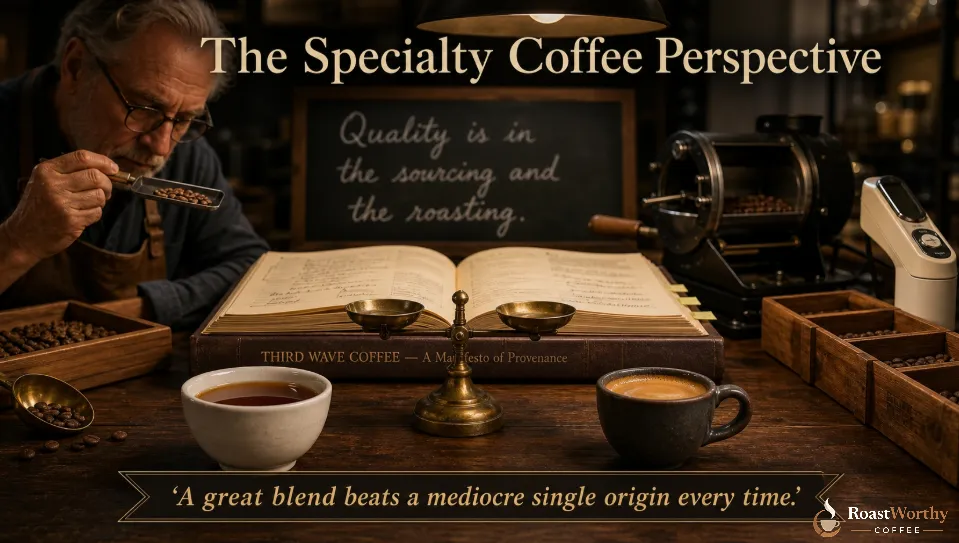
Specialty coffee culture, for better or worse, has fetishised single origins.
The Third Wave movement drove this. The idea was: let the origin speak. Don't obscure it with dark roasting, don't dilute it by blending, don't add milk. Taste what the farmer grew.
That ethos produced some genuinely brilliant coffees. It also produced a lot of expensive, underextracted light-roast single origins that tasted sour and confused.
Let's be honest: the single origin vs blend debate is not a battle between artisan and commercial. Some of the most thoughtful coffees I've tasted have been blends built by roasters who spend more time on flavour development than most single-origin shops.
The quality is in the sourcing and the roasting. Not in whether something says “single origin” on the label.
A great blend beats a mediocre single origin every time. ✒️
FAQ: Single Origin vs Blend Coffee
Is single origin coffee better than blend?
Not inherently. Single origin expresses terroir and distinct flavour character. Blends prioritise consistency and balance. Both can be excellent — the difference is purpose, not quality.
Why do most coffee shops use blends for espresso?
Blends offer a consistent, predictable extraction window. Single origins can be more acidic or delicate under espresso pressure, making them harder to dial in reliably — especially for high-volume service.
What does “single origin” mean on a coffee bag?
It means the coffee comes from one defined source — usually a country, region, farm, or specific processing lot. The more specific the information on the bag, the higher the likely traceability and quality.
Are coffee blends lower quality than single origins?
No. A well-crafted espresso blend from a reputable roaster requires significant skill and sourcing knowledge. Blends can use the same high-quality specialty coffee beans as single-origin offerings.
Can you use single origin coffee for espresso?
Yes. Single-origin espresso is genuinely rewarding — especially with washed African coffees. The extraction window is narrower, so grind accuracy and dose consistency matter more. Not ideal for beginners.
What's the best way to explore single origin coffee?
Start with a washed Ethiopian for floral, fruity character. Then try a washed Colombian for balance and sweetness. Then a Kenyan for high acidity and fruit complexity. Brew all three as pour-over for maximum origin expression.
More Recommendations from RoastWorthy Coffee