
Vietnamese Iced Coffee Recipe: Sweet, Strong, and Irresistible


Vietnam doesn't do subtle. Not in its food, not in its streets, and definitely not in its coffee.
Ca phe sua da — Vietnamese iced coffee — is Robusta brewed strong, sweetened with condensed milk, and poured over ice. It's the kind of drink that hits you immediately. You don't sip it slowly wondering what you're tasting. You know.
This is how you make it properly. At home. No shortcuts.
What Actually Makes Vietnamese Iced Coffee Different
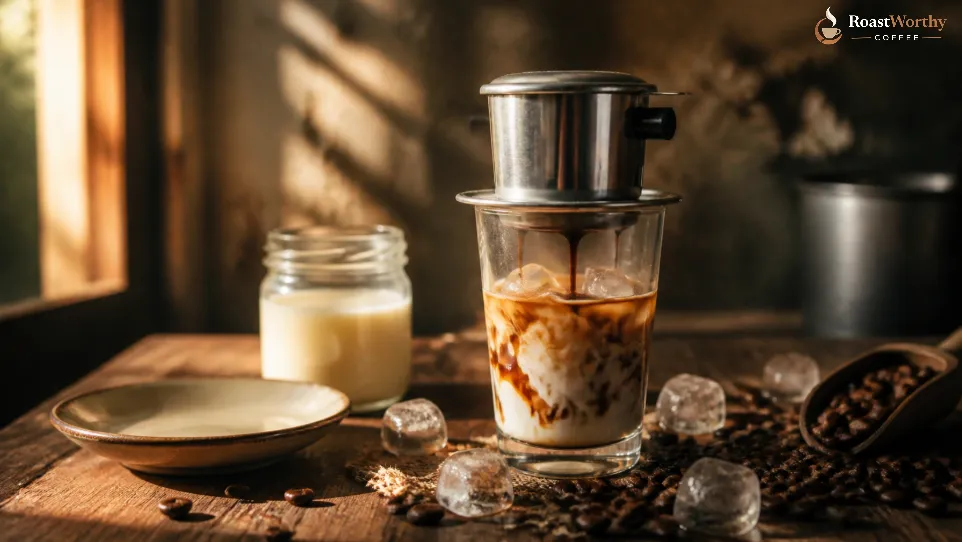
Most Western iced coffee is brewed light and chilled. Vietnamese coffee is built differently from the ground up.
It starts with Robusta beans — not Arabica. Robusta has nearly twice the caffeine, a heavier body, and a bitterness that stands up to condensed milk without disappearing into it. That's not a flaw in the bean. That's the whole point.
The brew method is the phin filter — a small, gravity-fed Vietnamese drip device made of stainless steel. No paper filter. No pressure. Just hot water, time, and patience. The result is a concentrate that's thick, almost syrupy, and intensely dark.
The condensed milk is not optional. It's not a sweetener you can swap for oat milk and call it the same drink. Sweetened condensed milk caramelizes slightly in the heat of the brew. It coats the coffee. It creates the drink. There's a whole story in this cup.
The Ingredients You Actually Need
That's it. Five components. The magic is in the ratio and the patience.
The Phin Filter: Don't Skip This
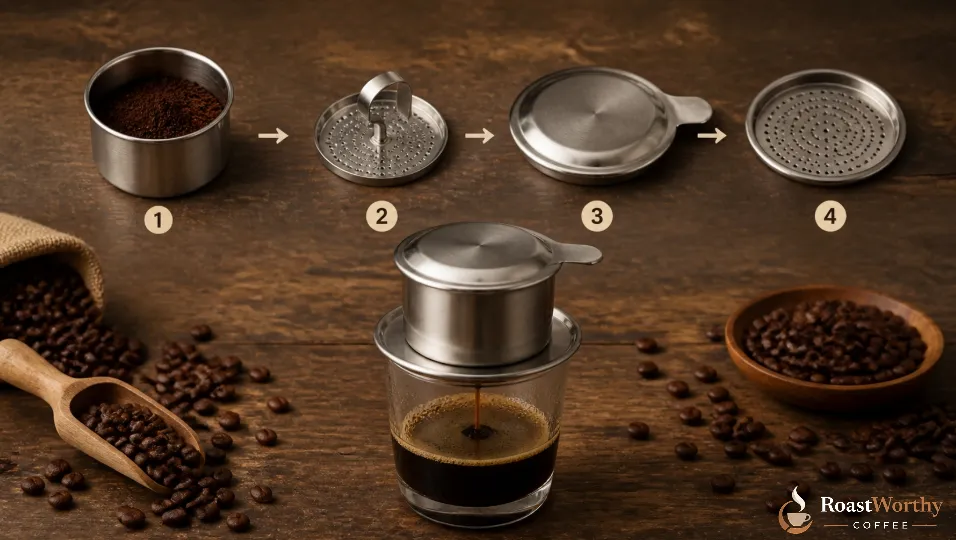
You can't fake a phin brew with a French press or a pour-over. The physics are different.
A phin filter has four parts: the chamber, the gravity press insert, the lid, and the base plate. The press sits on top of the grounds and uses its own weight to compress them slightly. This controls the flow rate. Too loose and the coffee runs through fast and weak. Too tight and it stalls.
The ideal drip time is 4 to 5 minutes for a full chamber. If yours finishes in 90 seconds, your grind is too coarse. If it's still dripping at 8 minutes, tighten the press or grind finer.
Phin filters cost between $5 and $15 online. There's no expensive version that brews better. Buy the cheap one. It works.
Vietnamese Iced Coffee Recipe — Step by Step
Step 1: Set Up Your Glass
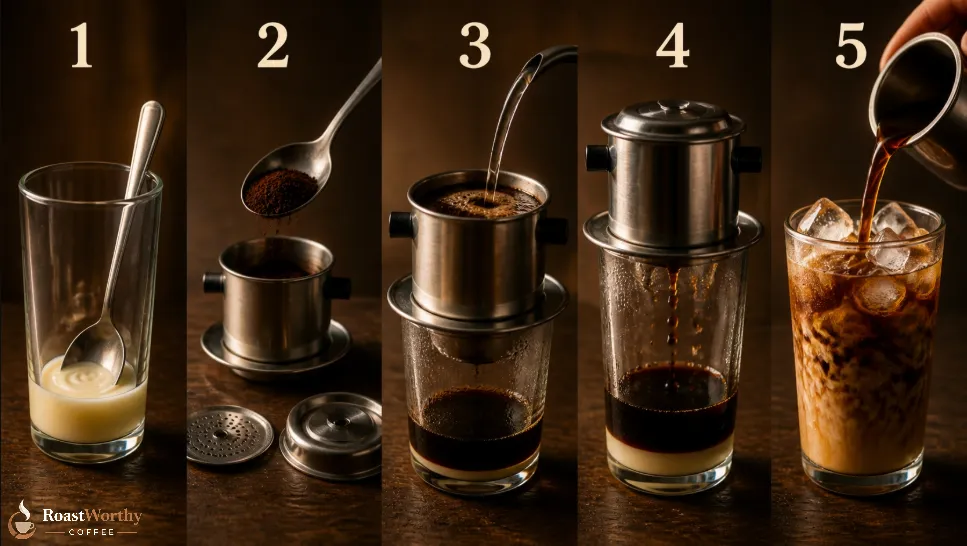
Add 30ml of sweetened condensed milk to the bottom of your glass. Don't stir it yet. Let it sit there.
Set a tall glass aside and fill it completely with ice — not halfway, not loosely. Pack it.
Step 2: Prep the Phin Filter
Place the base plate on top of your condensed milk glass. Disassemble the phin and add 20g of ground Robusta into the chamber. Robusta for a phin should be ground slightly coarser than espresso — think coarse sea salt.
Place the gravity press on top of the grounds. Don't screw it down. Let gravity do the work.
Step 3: Bloom the Grounds
Pour 20–25ml of hot water (93–96°C) slowly into the chamber. Just enough to saturate the grounds. Wait 30 seconds. This is the bloom — CO2 releases, the grounds open up, and the extraction improves.
You'll see small bubbles. That's right.
Step 4: Fill the Chamber
After the bloom, pour the remaining hot water to fill the chamber — usually 100–120ml total including the bloom water. Put the lid on top.
Now wait. Don't rush it. This is where patience becomes flavour.
The coffee will drip through slowly, drop by drop, over the next 4–5 minutes. The lid keeps it hot. Don't lift it.
Step 5: Assemble the Ca Phe Sua Da
Once the chamber is empty, remove the phin filter. You'll have a small amount of intensely dark coffee concentrate sitting on top of the condensed milk.
Stir thoroughly. This is your ca phe nau — the base.
Now pour it directly over the ice-packed glass. Pour fast. The temperature contrast is part of the drink.
Watch it cascade through the ice. The colour shifts from near-black to caramel as the condensed milk mixes in. Stir once, drink immediately.
Getting the Ratio Right
The standard ratio is 1:6 — 20g of coffee to 120ml of water. This produces a concentrate, not a full cup. That concentrate then dilutes slightly over the ice.
If you want it stronger, drop to 1:5. If you're new to Robusta and it's hitting too hard, try 15g of coffee and add 5g of Arabica to soften the edge.
The condensed milk ratio is personal. 30ml is traditional. 20ml if you prefer less sweet. 40ml if you grew up in Saigon.
Don't mess with the water temperature. Below 90°C and the extraction is flat. Above 96°C and you're scalding the Robusta and pulling harsh bitterness.
The Bean Question: Why Robusta Matters Here

This is where most homemade Vietnamese coffee fails.
People use whatever dark roast Arabica they have in the cupboard and wonder why it doesn't taste right. It won't. Arabica dissolves into the condensed milk and loses its identity. Robusta doesn't.
Robusta has a higher concentration of chlorogenic acids and caffeine. It brews dense. It brews dark. It has an earthy, almost rubbery bitterness that isn't a flaw here — it's the backbone the drink is built on.
The terroir is doing something here. Vietnamese Robusta, grown in the Central Highlands around Buon Ma Thuot at 500–800m altitude, has a character that's specific to that soil and that climate. It's not the same as Indonesian Robusta or Ugandan Robusta. Don't substitute blindly.
Trung Nguyen's Creative line and their Premium Blend are the most widely available options internationally. The Premium Blend uses a Robusta-Arabica-Excelsa blend. It's slightly smoother. Classic Robusta-only is bolder.
Ca Phe Den: The Black Version
If you want the unadulterated version — ca phe den — skip the condensed milk entirely.
Brew the same way. Pour over ice. Add a small amount of sugar syrup if you want sweetness without the creaminess.
Ca phe den is what you drink in the morning in Hanoi, sitting on a plastic stool on the pavement, watching the motorbikes. It's direct. It's caffeinating. It doesn't apologise for itself.
The flavour without the milk shows you what the Robusta is actually doing — dark cocoa, rubber, earth, and a finish that lingers longer than any light-roast Arabica will.
Common Mistakes (And How to Fix Them)
Where to Buy the Right Gear
Phin filter: Any Vietnamese grocery store, Amazon, or directly from Vietnamese brands like Nguyen Coffee Supply. Spend $8–12. Don't overthink it.
Robusta beans or pre-ground coffee: Trung Nguyen is available at most Asian supermarkets internationally. Nguyen Coffee Supply ships single-origin Vietnamese Robusta in the US. For the UK and EU, try specialty importers.
Sweetened condensed milk: Longevity brand (red and white tin) is the traditional Vietnamese choice. Eagle Brand and Carnation are acceptable alternatives.
Scaling Up: Make a Batch for Two
Double everything proportionally:
The phin isn't designed for batch brewing. Brew sequentially, not simultaneously. The second brew will be slightly cooler — that's fine. It's going over ice anyway.
FAQ: Vietnamese Iced Coffee
What's the difference between ca phe sua da and regular iced coffee?
Ca phe sua da uses a Vietnamese phin filter, Robusta beans, and sweetened condensed milk. Regular iced coffee is typically brewed Arabica, chilled, and sweetened separately. The flavour, strength, and texture are completely different.
Can I use a French press instead of a phin filter?
You can get a similar concentrate using a French press with a 1:5 ratio, steeped for 4 minutes. The flavour won't be identical — no gravity drip, no slow extraction — but it's a reasonable substitute if you don't have a phin.
What Robusta coffee brand is best for Vietnamese iced coffee?
Trung Nguyen is the most widely available and the most traditional. Their Premium Blend is a good starting point. For single-origin Vietnamese Robusta, Nguyen Coffee Supply is excellent.
Can I make Vietnamese iced coffee without condensed milk?
Yes — that's ca phe den. Brew the same way and skip the condensed milk. Add simple syrup if you want sweetness. The drink is bolder and less sweet but completely valid.
Is Vietnamese iced coffee stronger than espresso?
By volume, a phin-brewed Robusta concentrate is comparable to espresso in caffeine and strength. Robusta beans naturally contain more caffeine than Arabica. A full glass of ca phe sua da typically has more total caffeine than a single espresso shot.
Why does my Vietnamese iced coffee taste bitter?
Most likely causes: water temperature too high (above 96°C), over-roasted beans, or extraction too slow (over 7 minutes). Try dropping water temp slightly and adjusting grind coarseness.
The phin is on your counter in five minutes. The brew takes five more.
There is no equipment barrier here. There's no technique that takes months to learn. You just need the right beans, the right ratio, and the patience to let the drip do its work.
Make it once. Then make it again with 5ml less water and see what changes.
Taste it. Write it down. Make it again. ☕
More Recommendations from RoastWorthy Coffee