Comparing Solubility Profiles of Different Roast Levels for Optimal Brewing


TL;DR — The Short Answer:
Light roast = dense bean, slow extraction, needs fine grind + high heat + longer time.
Medium roast = peak solubility, most forgiving.
Dark roast = porous, fast-extracting, less total soluble mass — go coarser, go cooler.
One brew recipe does not fit all three. Never did.
Roast level changes the physical structure of the bean itself.
That structure decides how much coffee dissolves in your water. Which decides your cup.
Most brewers adjust flavor preference. Almost nobody adjusts for coffee roast solubility. That's the gap this piece closes.
❓ What Solubility Actually Means Here
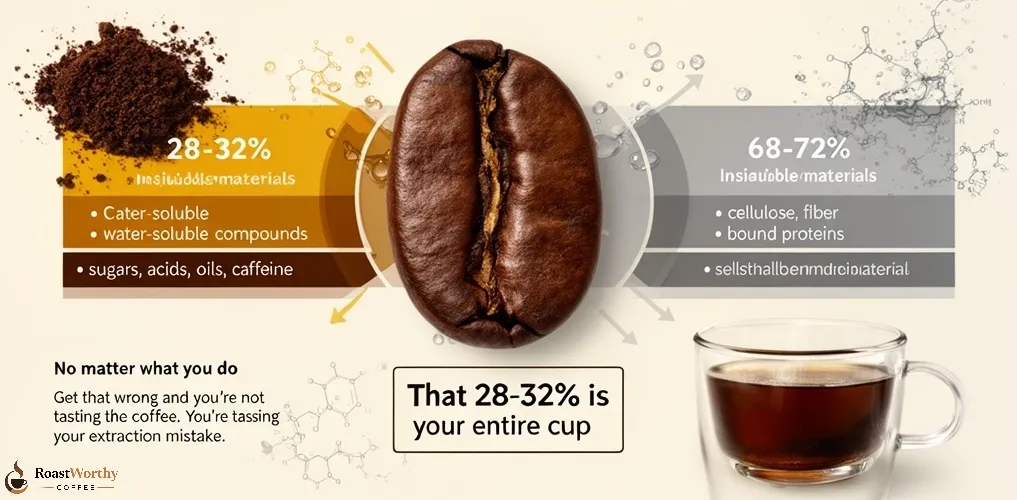
Only 28–32% of a dry coffee bean is water-soluble.
The rest — cellulose, insoluble fiber, bound proteins — never leaves the grounds. No matter what you do.
That 28–32% is your entire cup. Roasting changes how much of it survives, how accessible it is, and how fast water can pull it out.
Get that wrong and you're not tasting the coffee. You're tasting your extraction mistake.
🆚 The Comparison: Light vs. Medium vs. Dark Coffee Roast Solubility
This is where most articles bury the lead. Here it is up front.
| Variable | Light Roast | Medium Roast | Dark Roast |
|---|---|---|---|
| Roast Mass Loss | 12–14% | 14–17% | 18–22% |
| Total Soluble Mass | Highest | High | Lower |
| Bean Structure | Dense, intact | Partially open | Porous, brittle |
| Extraction Speed | Slow | Moderate | Fast |
| Peak Solubility | Hard to access | Most accessible | Burns off with heat |
| Grind Direction | Finer | Baseline | Coarser |
| Water Temp | 93–96°C | 91–93°C | 88–91°C |
| Brew Ratio | 1:15–1:16 | 1:15 | 1:13–1:14 |
| Pour-over Time | 3:30–4:00 min | 3:00–3:30 min | 2:30–3:00 min |
Medium roast wins the solubility accessibility race. Cell walls have opened up. Sugars have developed but not burned off. Water gets in fast and pulls out clean compounds.
Light roast has the most total solubles — but the least accessible ones. That's the paradox most home brewers never understand. Dense cell walls resist water. You need heat, time, and surface area to get those compounds out.
Dark roast is the opposite problem. High porosity. Water rushes through. But extended heat has already destroyed a significant share of soluble mass. You're extracting faster from a depleted pool.
🔥 What the Heat Is Actually Doing to Each Roast
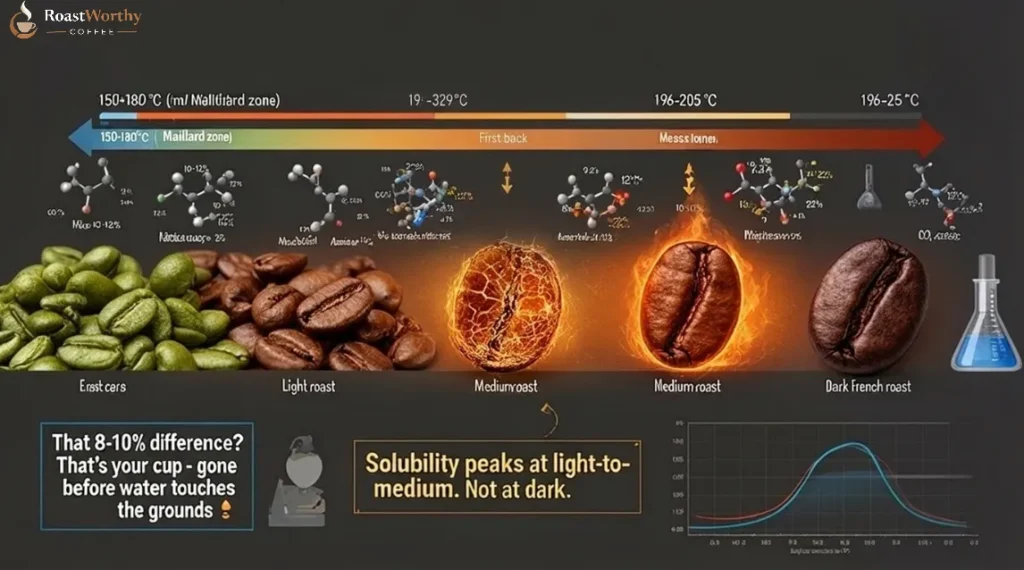
When green coffee hits the drum, it carries 10–12% moisture. As internal temperature climbs through the Maillard zone — roughly 150–180°C — sugars and amino acids react. Flavour compounds form. The bean browns.
First crack hits around 196–205°C. Cell walls fracture. The bean expands. CO₂ escapes. Mass is lost.
Every degree past first crack is a trade-off. More development. More solubility accessibility. But also — more soluble mass converting to CO₂, smoke, and degraded compounds.
A dark French roast loses up to 22% of its original mass in the drum. A well-pulled light loses 12–13%.
That 8–10% difference? That's flavour. That's soluble compounds. That's your cup — gone before the water ever touches the grounds.
Solubility peaks at well-developed light-to-medium. Not at dark. This surprises people. Dark roasts extract faster. That's not the same as being more soluble. Speed of extraction and volume of extractable mass are two different things. ⚗️
⚡ Grind Size: The Variable That Changes Everything
Grind is your most powerful lever. And most people never move it when they switch roast levels.
Light Roast — Go Finer
Dense bean. Intact cell walls. Water can't penetrate easily.
A medium grind on a light roast is under-extraction waiting to happen. Sour. Thin. Hollow.
Go 2–3 notches finer than your medium roast baseline. More surface area means more water contact. More water contact means you can actually access those locked-in solubles.
For espresso: shot pulling in under 22 seconds? Grind finer. The resistance isn't there yet.
Medium Roast — Your Baseline
This is your reference point for every other adjustment. If you're new to dialling in by roast, calibrate with a medium first. Then move outward.
Dark Roast — Go Coarser
Porous and brittle. Fine grinding a dark roast accelerates extraction into over-extraction territory fast.
The result: bitter, ashy, sharp. Not bold. Bitter.
Go 2–3 notches coarser than medium baseline. The bean doesn't need help getting water in. It needs you to slow the extraction down.
For espresso: shot pulling over 38–40 seconds? Grind is too fine. Open it up.
☕ Water Temperature: Small Shift, Big Impact
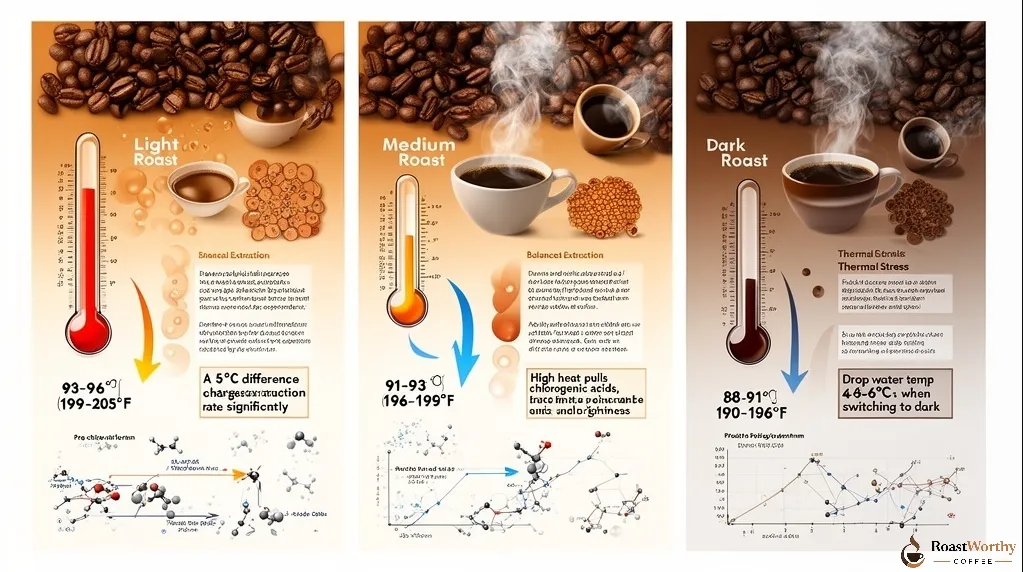
A 5°C difference in water temperature changes your extraction rate significantly. This is not marginal.
Light Roast: 93–96°C (199–205°F)
You need thermal energy to force water through dense cell walls. Don't go lower thinking you're being gentle. You're just under-extracting.
High heat with a light roast pulls out the chlorogenic acids, fruit compounds, and brightness that make light roasts worth drinking.
Medium Roast: 91–93°C (196–199°F)
Balanced. Compounds are accessible. A small temperature drop from light roast prevents over-emphasising bitterness.
Dark Roast: 88–91°C (190–196°F)
The bean has already been under enormous thermal stress. Remaining soluble compounds extract bitterness quickly at high temps.
Drop your water temperature 4–6°C below your light roast setting when switching to dark. Most brewers never do this. Most dark roasts taste harsher than they need to as a result.
👀 Brew Time: Contact Time Is Not Universal
Dark roasts are porous. Water moves through faster. Same grind, same pour — shorter effective contact time than you think.
Light roasts resist flow. Water moves slower through dense grounds. Contact time creeps up.
Pour-Over Target Times
If your dark roast pour-over runs long, your grind is too fine. Fix the grind. Don't compensate by pouring faster — that causes channeling.
If your light roast finishes in under 2:45, the grind is too coarse. Tighten it.
Brew time is a symptom. Grind is the cause. Always fix grind first. Then temperature. Then recalibrate time.
⚗️ Brew Ratio and Soluble Solids (TDS)
The SCA target for filter coffee is 1.15–1.45% TDS.
Here's the math that matters: a dark roast with 15–18% less extractable mass than a light roast cannot hit the same TDS at the same brew ratio. You're starting from a smaller soluble pool.
A blanket 1:15 ratio across all roast levels is lazy brewing. It's not wrong in the middle. It fails at both ends.
This is not about making dark roast bolder by dumping more grounds in. It's correcting for what the drum already removed.
✨ One More Variable: Days Off Roast
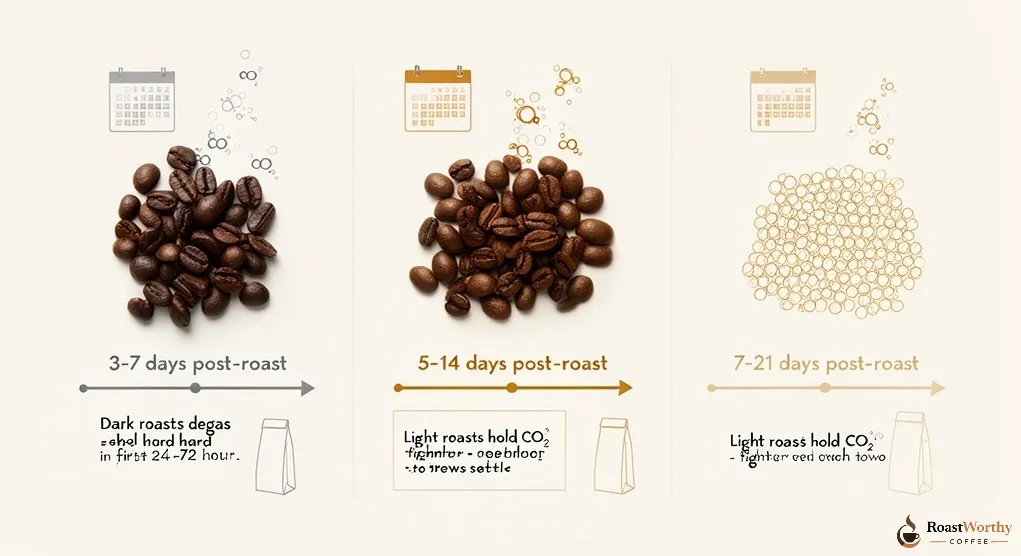
Solubility doesn't just depend on roast level. It depends on when you're brewing relative to roast date.
Dark roasts degas CO₂ hard in the first 24–72 hours. Brew them too fresh and you get channeling, hollow extraction, a gassy mess.
Light roasts need longer to settle — the cell structure holds CO₂ tighter.
No roast date on the bag? That tells you everything about how that roaster thinks about freshness. Pass.
Taste it. Write it down. Roast it again. ☕
⭐ Quick Reference: Brew Parameters by Roast
Light Roast
| Parameter | Setting |
|---|---|
| Grind | Fine (Comandante: ~18–22 clicks) |
| Water Temp | 93–96°C |
| Brew Ratio | 1:15–1:16 |
| Brew Time (Pour-over) | 3:30–4:00 min |
| Days Off Roast | 7–21 days |
Medium Roast
| Parameter | Setting |
|---|---|
| Grind | Medium (Comandante: ~24–26 clicks) |
| Water Temp | 91–93°C |
| Brew Ratio | 1:15 |
| Brew Time (Pour-over) | 3:00–3:30 min |
| Days Off Roast | 5–14 days |
Dark Roast
| Parameter | Setting |
|---|---|
| Grind | Coarse (Comandante: ~28–34 clicks) |
| Water Temp | 88–91°C |
| Brew Ratio | 1:13–1:14 |
| Brew Time (Pour-over) | 2:30–3:00 min |
| Days Off Roast | 3–7 days |
🎯 FAQ: Coffee Roast Solubility and Brewing
Why does my light roast taste sour even when I brew hot?
Under-extraction. Grind finer. Extend brew time to at least 3:30. Sourness at correct strength = extraction too low, not temperature too low.
Why does my dark roast taste bitter no matter what I try?
You're over-extracting. Grind coarser first. Drop water temp to 88–91°C. If it's still bitter, the roast itself may be too far gone — carbon doesn't extract clean at any setting.
Does roast level change caffeine content in the cup?
Marginally. Caffeine is highly soluble across all roasts. Dark roasts lose slightly more caffeine to heat degradation. Your brew ratio and extraction yield matter far more than roast level for caffeine.
Is TDS measurement worth it for home brewing?
Yes. A refractometer (~$30–50) removes the guesswork. Once you know your target TDS range, you replicate great cups reliably instead of chasing them every morning.
Should I adjust grind when switching origins at the same roast level?
Yes. High-altitude Ethiopians are denser than Brazilian naturals at the same roast level. Same grind setting, different extraction. Always dial in by taste when you switch origins.
What's the biggest coffee roast solubility mistake home brewers make?
Treating all three roast levels like they're the same coffee. Same grind, same temp, same time — just with different-colored beans. They're not the same. Never were.