
What Is Kopi Luwak (Civet Coffee)? World’s Most Controversial Coffee

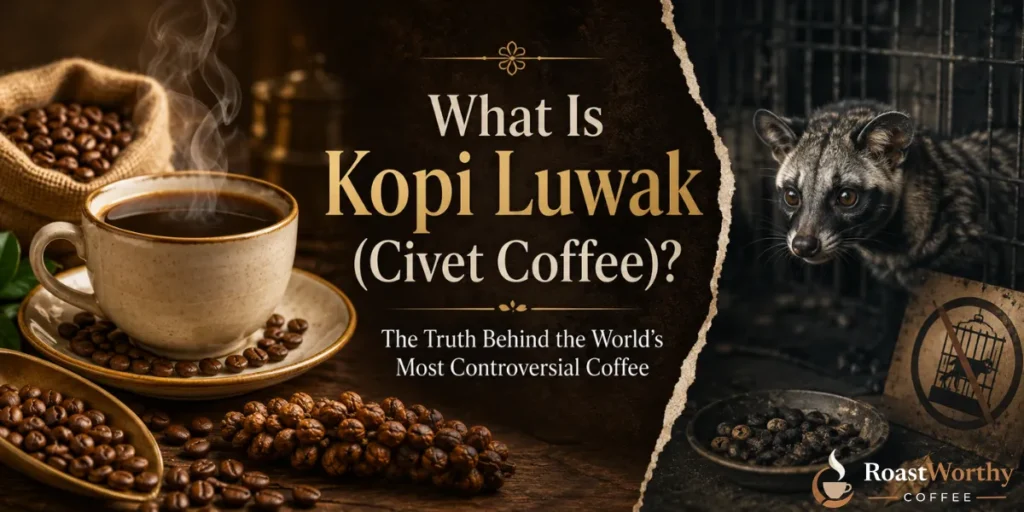
A small nocturnal animal eats a coffee cherry. Digests it overnight. And leaves the seed behind in its droppings.
Someone collects that seed, washes it, roasts it, and charges you $80 for a single cup.
That is Kopi Luwak coffee — in full, unfiltered reality. And the story behind it is far more complicated than any café menu will tell you.
Key Takeaways
Kopi Luwak coffee is genuine Indonesian coffee history — born from colonial resistance, transformed by a civet's digestion, and now largely corrupted by mass-market demand. Wild and ethical versions technically exist but are nearly impossible to independently verify.
Caged production causes documented animal suffering and produces inferior coffee. The price reflects a story and a scarcity premium — not exceptional flavour.
The Basics: What Exactly Is Kopi Luwak?
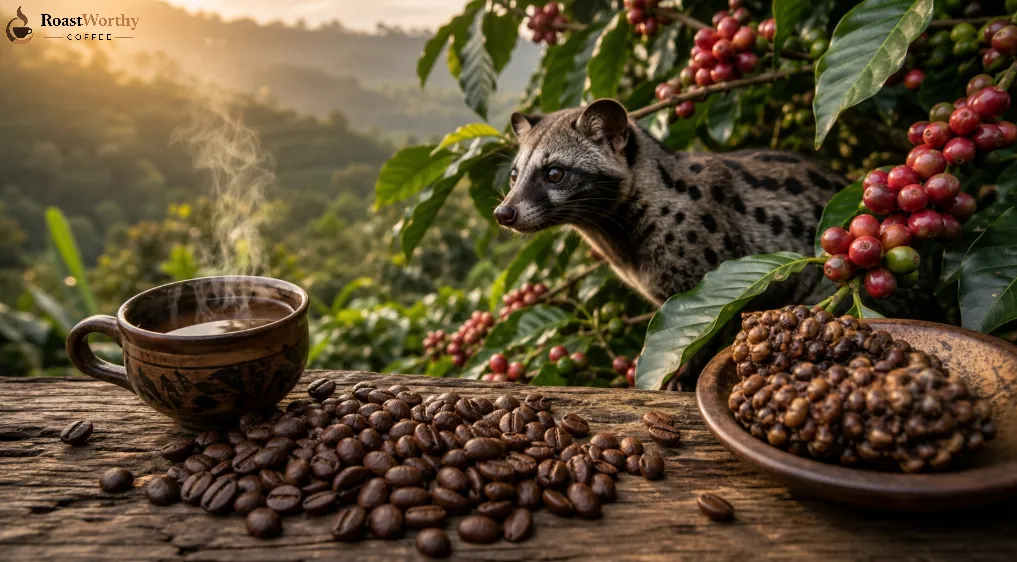
Kopi Luwak is Indonesian coffee processed through the digestive system of the Asian palm civet.
“Kopi” is the Indonesian word for coffee. “Luwak” is the local name for the palm civet — a small, cat-like mammal native to South and Southeast Asia. It is not a cat. Not even close. It's closer to a mongoose.
The civet roams coffee plantations across Sumatra, Java, Bali, and Sulawesi at night. It eats the ripest coffee cherries it can find. During digestion — a process taking roughly 24 hours — the fruit pulp breaks down but the hard inner seed survives intact.
Those seeds exit the civet in its droppings. Collectors gather them by hand. The beans are then washed thoroughly, sun-dried, and roasted.
The result is what the specialty coffee world calls civet coffee, and what tourists in Bali call “cat poop coffee.”
Both descriptions are accurate. 🌱
The History: This Wasn't Always a Luxury
Start with the origin, not the roaster.
Kopi Luwak wasn't invented as an expensive novelty. It was invented as an act of survival under colonialism.
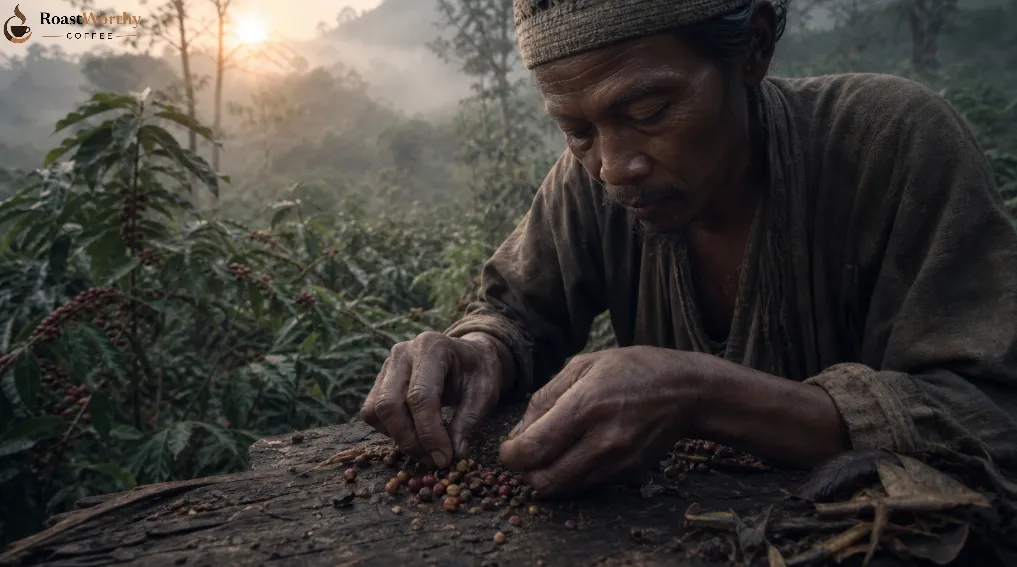
During Dutch colonial rule in the 18th and 19th centuries, Indonesian plantation workers — primarily on Java and Sumatra — were banned from harvesting coffee for personal use. The Dutch East India Company controlled all of it.
So the workers observed something. The wild palm civets that moved through the plantations ate the ripest cherries and left the seeds behind in their waste. Workers started collecting those seeds, cleaning them, and roasting them quietly.
The coffee was good. Genuinely good. Word eventually reached Dutch plantation owners, who began drinking it themselves — unknowingly consuming a drink born from the ingenuity of the people they were oppressing.
The people who first brewed Kopi Luwak never got credit for it. That history matters.
How Kopi Luwak Is Made: The Full Process
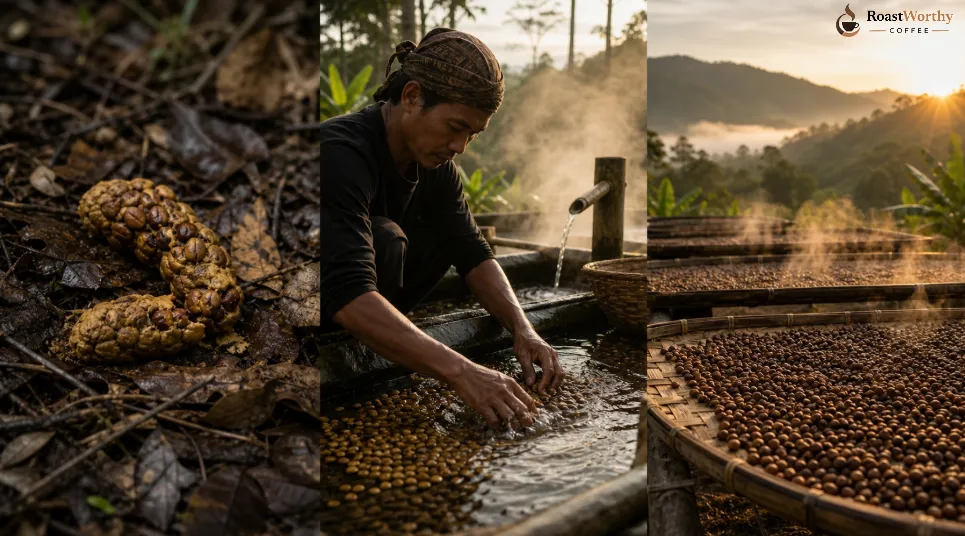
Here's what the digestion is actually doing. ⚗️
The civet's stomach contains proteolytic enzymes — they break down the proteins in the coffee bean's outer layers. This process is believed to reduce bitterness by breaking down the short peptide chains responsible for it.
The full production process, start to finish:
Real wild-harvest Kopi Luwak is produced in tiny quantities. Credible estimates put global authentic wild production at just a few hundred kilograms per year. That scarcity is the primary driver of the price.
The problem is what happened when the world decided it wanted much more than a few hundred kilograms.
Wild vs Farmed Kopi Luwak: The Line That Changes Everything
Let's be honest. Most Kopi Luwak sold globally is not wild.
Demand surged dramatically after the 2007 film The Bucket List featured two characters drinking it as a bucket-list experience. Western tourism to Bali and Java boomed. Cafés everywhere started marketing the “world's most expensive coffee.” Producers couldn't meet wild harvest demand.
So they built cages.
| Factor | Wild Kopi Luwak | Farmed (Caged) Kopi Luwak |
|---|---|---|
| Animal living conditions | Roams free, natural habitat | Confined in small wire cages |
| Diet | Selects only the ripest cherries | Force-fed coffee cherries continuously |
| Cherry selection quality | High — instinctive and precise | None — random and compulsory |
| Flavour consistency | Distinctive, complex | Often flat and inconsistent |
| Annual production volume | A few hundred kg globally | Mass-produced on demand |
| Price transparency | Reflects genuine scarcity | Inflated far beyond quality |
| Ethical status | Defensible | Widely condemned |
Caged Kopi Luwak has no ethical defence. The civets are kept in conditions that cause documented psychological and physical distress — pacing, fur loss, repetitive stress behaviours.
They are fed a diet that is almost entirely coffee cherries, which is nutritionally wrong for an animal that eats insects, small reptiles, and a wide variety of fruit in the wild.
The terroir is doing something here — but not something good.
Is Kopi Luwak Ethical? The Honest Breakdown
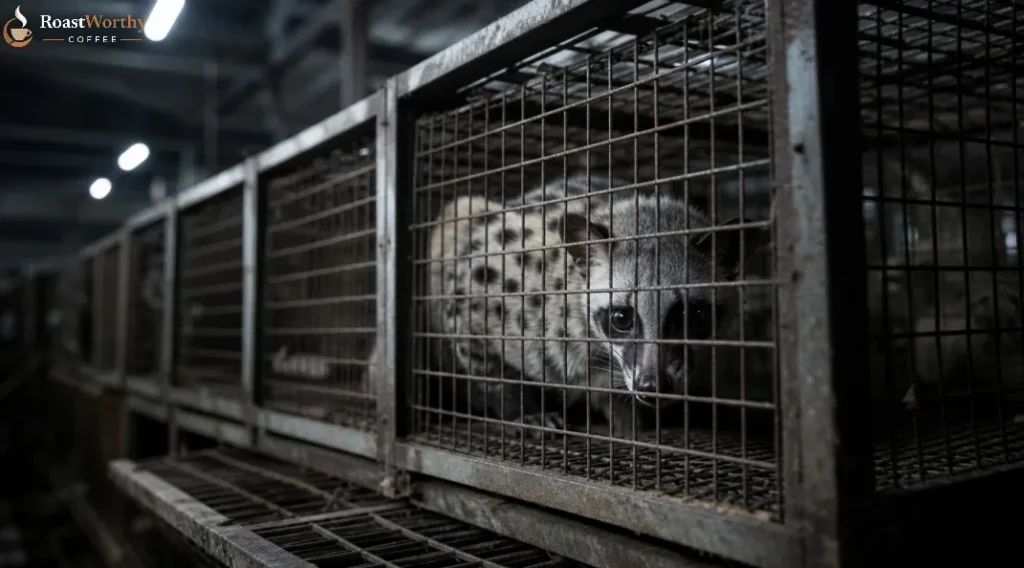
This is the question that gets avoided on every premium menu listing it.
The truthful answer: ethically sourced wild Kopi Luwak can exist, but it is almost impossible to verify.
Here's the structural problem. There is no internationally recognized, independently audited certification system for wild-harvested Kopi Luwak.
Any producer can label their product “wild-sourced” with essentially no accountability. PETA investigations and BBC journalism have repeatedly caught operations marketing “wild” coffee that was actually farmed.
Some questions to ask before ever purchasing:
If the answer to any of these is “no” or “unclear” — walk away. The civet coffee industry's transparency problem is well-documented and not improving fast enough.
For most buyers, the ethical choice is to skip it entirely. This matters beyond the flavour.
What Does Kopi Luwak Actually Taste Like? ☕
Kopi Luwak, when genuinely wild-sourced and properly roasted, has a specific profile:
It's smooth. There's no argument about that.
But here's the inconvenient truth — blind cupping tests have consistently placed Kopi Luwak in the average to slightly-above-average range for specialty coffee.
A properly processed Sulawesi Toraja or a natural Sumatran Mandheling will match it or beat it on flavour. For $20 to $30 a pound.
The digestion removes bitterness. But it also strips some of the complexity that makes great coffee great. You're trading character for smoothness.
The flavour doesn't lie. The price does.
Why Is Kopi Luwak So Expensive?
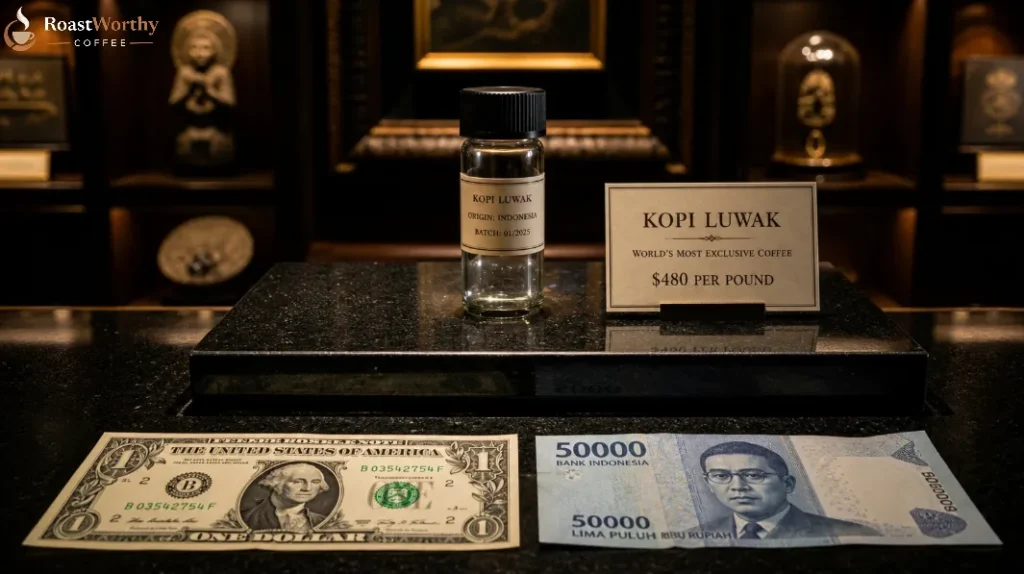
The price of Kopi Luwak — ranging from $100 to $600 per pound retail, or $35 to $100 per cup at premium cafés — is driven by three factors that have almost nothing to do with flavour quality:
1. Genuine scarcity of wild beans. A few hundred kilograms of authentic wild Kopi Luwak a year, spread across global demand, makes unit economics brutal.
2. The novelty premium. “Coffee made from animal droppings” is a story. Stories sell. Western and East Asian luxury tourism markets pay a steep premium for the experience of saying they've had it.
3. Marketing inflation. Once international media branded it the world's most expensive coffee, price became self-reinforcing. No one wants to sell the “second most expensive coffee.” The label justifies the number.
For comparison: Panama Geisha — arguably the most technically accomplished coffee on the planet — sells for $60 to $100 per pound. Kopi Luwak consistently outsells it on price despite losing to it on flavour. Every time.
Indonesia's Other World-Class Coffees
Worth knowing: Indonesia doesn't need Kopi Luwak to be a great coffee origin.
Sumatra Mandheling, Sulawesi Toraja, Flores Bajawa, and Java Estate coffees are world-renowned for a reason. They offer deep body, earthy complexity, low acidity, and remarkable terroir that no digestive process can manufacture.
If you want to explore Indonesian coffee seriously — start there. Same geography. Same volcanic soil. No welfare concerns. Better cup clarity.
The people who grew those coffees deserve credit too.
Frequently Asked Questions
What is Kopi Luwak coffee?
Kopi Luwak is an Indonesian coffee made from beans that have been eaten and passed through the digestive system of the Asian palm civet. The beans are collected from civet droppings, washed, dried, and roasted.
Why is Kopi Luwak the most expensive coffee in the world?
Genuine wild-harvested Kopi Luwak is produced in very small quantities — only a few hundred kilograms per year globally. Combined with heavy novelty marketing and luxury tourism demand, retail prices reach $100 to $600 per pound.
Is civet coffee ethical?
Only wild-collected Kopi Luwak — from free-roaming civets — is defensible. Most commercial Kopi Luwak comes from caged animals on a forced diet, which is widely condemned for animal cruelty. Verifying wild sourcing is very difficult.
Does Kopi Luwak taste better than regular coffee?
It is notably smooth with low acidity and earthy chocolate undertones. But in blind taste tests, trained cuppers rarely rate it above quality specialty coffees that cost a fraction of the price. Smoothness comes at the cost of complexity.
What does Kopi Luwak taste like?
Earthy, full-bodied, low in acidity. Hints of dark chocolate, mild caramel, and a long, slightly syrupy finish. Less bitter than most coffees. Smooth — but not complex.
Is Kopi Luwak safe to drink?
Yes. The beans are extensively washed, sun-dried, and roasted at temperatures that eliminate bacteria. Despite the processing method, the final product is clean and food-safe.
Should You Try Kopi Luwak?
Honest answer: probably not. But if you do, here are the three rules.
- Only consider verified wild-sourced beans — and accept upfront that verification is difficult
- Never buy cheap Kopi Luwak — sub-$150/lb almost certainly means caged
- Calibrate your expectations — the smoothness is real, the flavour complexity is not extraordinary
If animal welfare is something you care about and you cannot confirm the source with confidence… skip it. There are better uses for $80.
Buy a high-quality Sumatran natural process instead. Same region. Better coffee. No cages.
Taste it. Write it down. Roast it again. 🔥
More Recommendations from RoastWorthy Coffee