Danger Coffee Review: Is Dave Asprey’s Coffee Worth It?

Quick Verdict
Danger Coffee is a clean, well-tested functional coffee, but its mineral benefits are harder to verify than its contaminant-testing claims.
Danger Coffee combines specialty-grade Arabica with added fulvic and humic substances. It is also tested for mycotoxins, pesticides, glyphosate, heavy metals, and other contaminants.
This Danger Coffee review examines the taste, sourcing, testing standards, mineral claims, pricing, compostable pods, and overall value. The coffee itself is solid. Some of the health marketing needs a more careful reading.
What Is Danger Coffee?
Danger Coffee is Dave Asprey’s functional coffee brand, launched after his departure from Bulletproof.
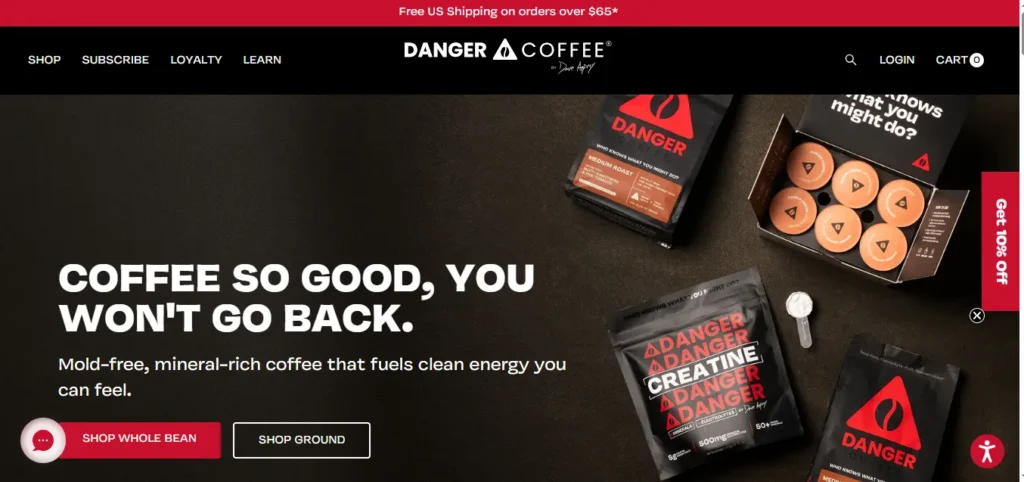
Its main selling point is a proprietary remineralization process. Fulvic and humic substances are added after roasting rather than exposed to the highest roasting temperatures.
The range includes medium roast, dark roast, Swiss Water decaf, instant coffee, ground coffee, and compostable pods.
What Does “Remineralized Coffee” Mean?
Danger Coffee adds a blend of fulvic and humic substances to the beans after roasting.
That timing matters. High roasting temperatures can destroy or alter heat-sensitive compounds. Adding the blend later keeps it outside the main thermal roasting cycle.
A 310-gram bag is advertised as containing:
The brand describes these compounds as supporting nutrient absorption, energy, gut health, immune function, and natural detoxification.
This is the part of the pitch that needs the most context.
Humic and fulvic substances are mixtures derived from decomposed organic matter. Their chemical composition can vary according to the source and extraction method.
Danger Coffee does not publish a full elemental breakdown on its main product page. You cannot see exactly how much magnesium, sodium, potassium, zinc, or other named minerals enter one brewed cup.
That makes “50+ trace minerals” technically interesting but nutritionally difficult to judge.
A Labeling Inconsistency Worth Fixing
The product page lists a 310-gram bag as providing 36 servings. It also displays per-serving quantities of 8.5 fulvic and 34.5 humic, without clearly printing the measurement unit beside those figures.
Elsewhere, the same page states that the bag contains 255mg of fulvic substances and 1,035mg of humic substances.
Those bag totals equal 30 servings at the displayed per-serving amounts, not 36.
It may be a serving-definition issue or an outdated page element. Either way, a functional product should make its dosage arithmetic cleaner.
The curve doesn’t lie. Neither does division.
Is Danger Coffee Really Mold-Free?
Coffee can contain mycotoxins. Ochratoxin A is the best-known example.
Poor drying, humid storage, damaged coffee cherries, and weak warehouse controls can increase contamination risk. Roasting may reduce some compounds, but it does not make poor green-coffee handling acceptable.
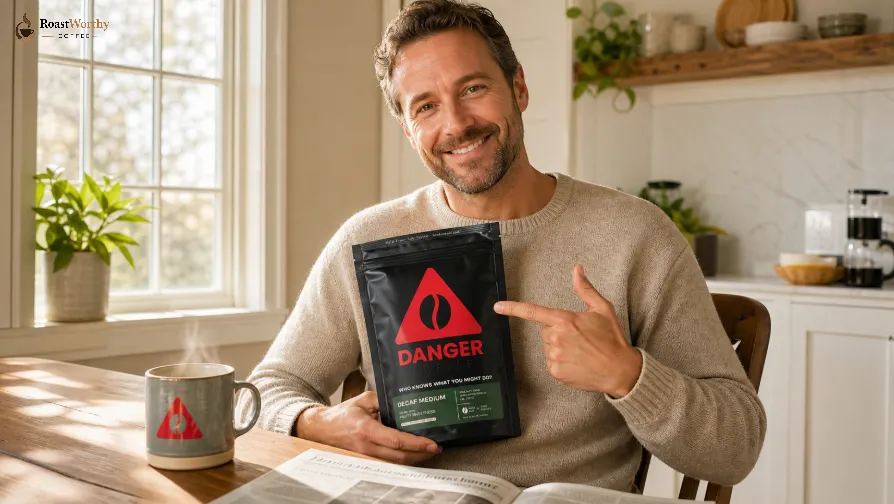
Danger Coffee says every lot is independently tested before roasting. Its testing panel covers mold toxins, glyphosate, more than 500 pesticides, and other contaminants.
The company says it then tests roasted coffee for arsenic, cadmium, mercury, and lead. It also reports testing the final brewed coffee.
That farm-to-cup testing sequence is one of Danger Coffee’s strongest features.
Still, the phrase “mold-free coffee” needs careful reading.
The important result is not that a laboratory found literally zero molecules. Analytical laboratories work with detection limits. A more useful statement would identify the compounds tested, laboratory method, detection threshold, and result for each production lot.
Danger Coffee describes the protocol but does not place downloadable certificates of analysis beside each bag on the product page.
I would like to see that. A QR code linked to the current lot report would turn a strong claim into unusually good transparency.
The wider claim that most coffee is contaminated enough to cause brain fog or energy crashes is far less settled. Mycotoxins are a legitimate food-safety subject, but ordinary caffeine response, sleep, dose, brewing strength, and individual tolerance also affect how coffee feels.
Testing is valuable. Fear is not a flavor descriptor.
Origin and Regenerative Farming Claims
Danger describes its coffee as single origin, farm direct, and sourced from small Central American estates.
The beans are selectively hand-picked, mechanically demucilaged, and dried through a combination of patio and mechanical drying.
Those are useful production details.
Yet “Central America” is broad. It covers countries with very different soils, elevations, cultivars, harvest calendars, and processing traditions.
The product page does not clearly identify:
Danger also says its partners receive higher-than-Fairtrade earnings, medical care, training, clean-water support, and ecosystem restoration. The brand reports planting thousands of native shade trees.
Those are good commitments. The missing piece is documentation tied to named farms and measurable annual impact.
The sourcing sounds responsible, but the traceability falls short of top specialty roasters.
If origin transparency matters most to you, compare this with our guide to the best ethically sourced coffee brands.
What Does Danger Coffee Taste Like?
Danger Coffee is built for people who want a familiar, low-friction cup. This is not a floral Ethiopian light roast.
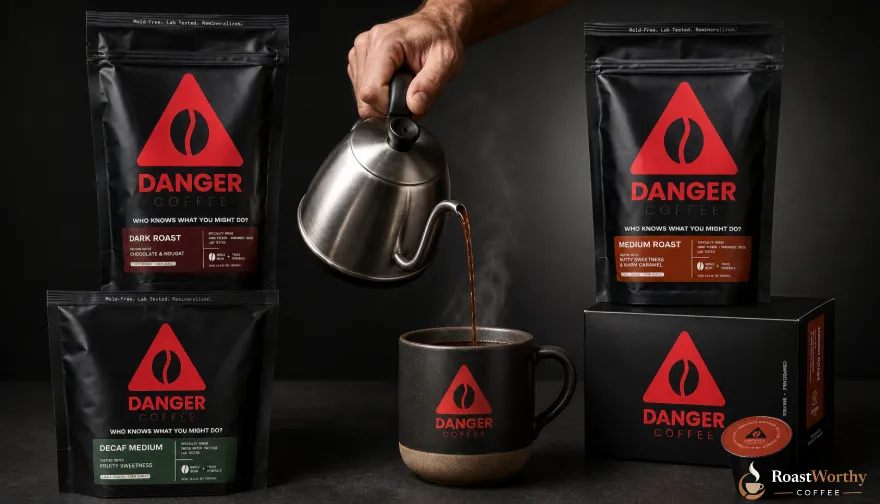
Medium Roast
The published profile points toward:
That combination suggests moderate acidity, medium body, and a roast profile designed for black coffee, AeroPress, drip machines, and milk drinks.
“Pipe tobacco” may sound alarming if you prefer fruit-led coffee. In tasting language, it usually means dry sweetness, cedar, warm spice, and cured-leaf aromatics.
Dark Roast
The dark roast is positioned around:
Expect heavier body and more roast character. This should work better with cream, butter, MCT oil, or a generous splash of milk.
It will not satisfy someone chasing jasmine, peach, blackcurrant, or sparkling citrus.
Decaf
The decaf is processed through the Swiss Water method. Danger describes it as warm, fruity, sweet, and slightly tart.
That is the option I would choose for an evening cup. Swiss Water processing is also a better fit for the brand’s clean-coffee positioning than an unspecified solvent process.
Best Brewing Recipe for Danger Coffee
Danger counts roughly 8.6 grams as one serving when dividing 310 grams across 36 servings.

That is weak for a full mug.
Use 15 grams for a 250-gram cup. You will get about 20 proper brews from one bag.
Medium-Roast Pour-Over
Pour in three controlled stages. Keep the coffee bed level.
Dark-Roast Dripper Recipe
Here’s what the heat is actually doing. Lower-temperature water reduces harsh extraction from a more developed roast.
For more control, follow our medium-roast pour-over recipe.
Is Danger Coffee Good for Fasting?
Plain Danger Coffee contains coffee plus fulvic and humic substances. It does not list sugar, milk, protein, or added fat.
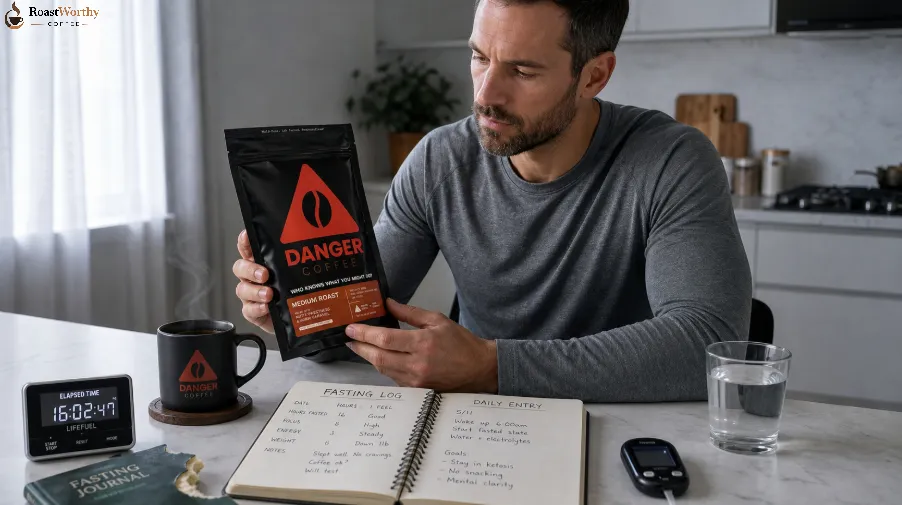
That makes it suitable for most routines that permit black coffee during a fast.
Still, fasting rules vary. A strict water-only fast excludes coffee. A practical intermittent-fasting routine often allows unsweetened black coffee.
Danger Coffee does not become an electrolyte drink simply because it contains trace minerals.
The label does not show meaningful amounts of sodium, potassium, or magnesium per cup. Do not use it as a replacement for water or a properly dosed electrolyte product.
It is fasting coffee with added mineral substances, not a sports hydration formula.
Danger Coffee Prices and Value
| Product | Current Price | Practical Cost |
|---|---|---|
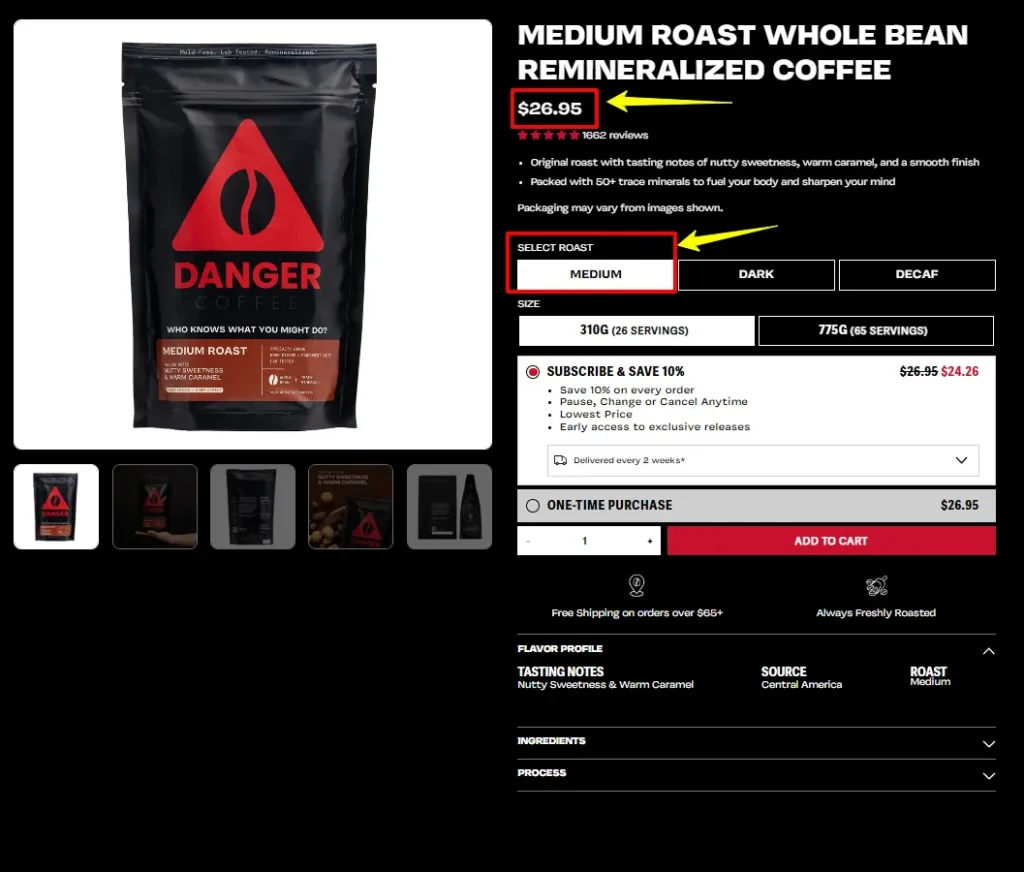
| Medium whole bean, 310g | $26.95 | About $1.30 per 15g brew |
| Dark whole bean, 310g | $26.95 | About $1.30 per 15g brew |
| Decaf whole bean, 310g | $28.95 | About $1.40 per 15g brew |
| Compostable pods, 12 count | $28.95 | About $2.41 per pod |
| Instant coffee | $39.95 | Depends on serving size |
| Subscription | 10% off | Medium roast falls to $24.26 |
Current prices and subscription terms come from Danger Coffee’s store.
At $26.95 for 310 grams, this is expensive daily coffee.
A 15-gram dose produces about 20.7 cups. That puts the bean cost near $1.30 per cup.
The pods are harder to justify. Each contains 16 grams of coffee, which is unusually generous for a pod. Still, $2.41 per serving approaches café pricing without café labor.
The whole beans offer acceptable premium value. The pods do not.
You are paying for contaminant testing, added minerals, functional branding, and convenience. You are not paying for rare microlot genetics or detailed producer traceability.
Are the Compostable Pods Better?
Danger’s pods are plastic-free, contain 16 grams of coffee, and work with recent Keurig and K-Cup-style machines. The brand describes the complete pod as compostable and says no separation is required.
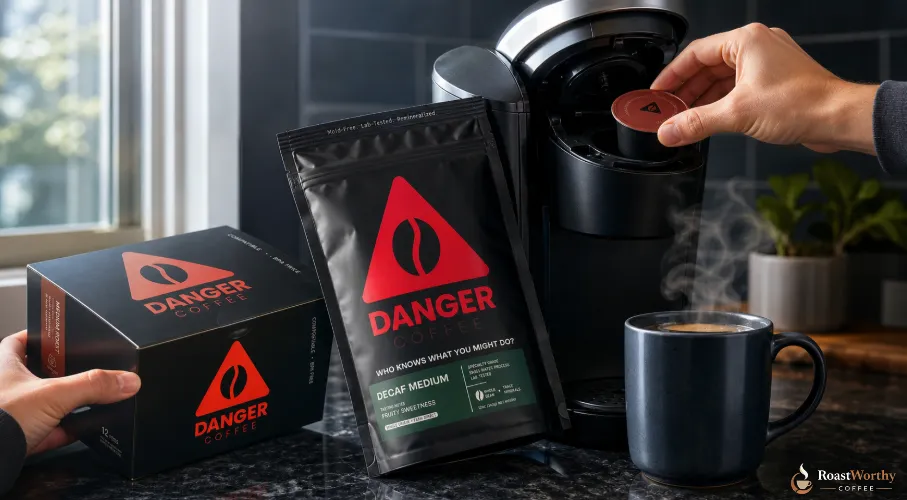
The 16-gram dose is impressive. Many single-serve pods taste thin because they contain too little coffee.
The composting claim needs local context.
“Compostable” does not always mean an item will disappear quickly in a cold backyard pile. Temperature, moisture, microbial activity, and local collection rules matter.
Check with your municipal composting service before putting used pods in a green bin.
Danger Coffee Pros and Cons
Pros:
Cons:
Who Should Buy Danger Coffee?
Danger Coffee makes sense for:
Skip it if you want:
For the closest comparison, read our Bulletproof Coffee review and best mold-free coffee brands roundup.
Frequently Asked Questions
Is Danger Coffee really mold-free?
Danger Coffee says each lot undergoes third-party testing for mold toxins and other contaminants. The company does not currently display lot-specific certificates beside every product listing.
What minerals are added to Danger Coffee?
The coffee contains fulvic and humic substances advertised as carrying more than 50 trace minerals. A complete per-cup elemental breakdown is not clearly displayed.
Is Danger Coffee organic?
No. Danger Coffee says its beans are naturally farmed without harmful pesticides, but the coffee does not hold USDA Organic certification.
Can I drink Danger Coffee while fasting?
Plain Danger Coffee fits many intermittent-fasting routines because it has no listed sugar, milk, or added fat. It does not fit a strict water-only fast.
Does Danger Coffee contain electrolytes?
It may contain trace mineral elements, but the label does not show substantial sodium, potassium, or magnesium amounts. It should not replace a measured electrolyte drink.
How much caffeine is in Danger Coffee?
The brand lists approximately 95–120mg of caffeine per serving. Actual extraction varies with dose, grind size, water temperature, and brew method.
Are Danger Coffee pods compostable?
Danger markets the pods as plastic-free and fully compostable. Local composting rules still apply, so check which materials your municipal service accepts.
Final Verdict: Is Danger Coffee Worth It?
Danger Coffee gets the coffee fundamentals mostly right.
The beans are specialty grade. The processing information is useful. The testing protocol is more serious than what most mainstream coffee brands publish.
The remineralization concept is less convincing.
Fulvic and humic substances may contain a broad range of trace elements. Danger does not provide enough elemental data to show how nutritionally meaningful one brewed cup is.
The brand also needs sharper origin transparency. “Central America” and “small estate farms” are not enough at this price.
Still, I would choose Danger over a stale supermarket dark roast. I would also choose the whole beans over the pods every time.
This is good functional coffee with a strong testing story. It is not a mineral miracle… and it does not need to be.
Verdict: Shop this bean if purity testing matters more to you than farm-level traceability.
More Recommendations from RoastWorthy Coffee