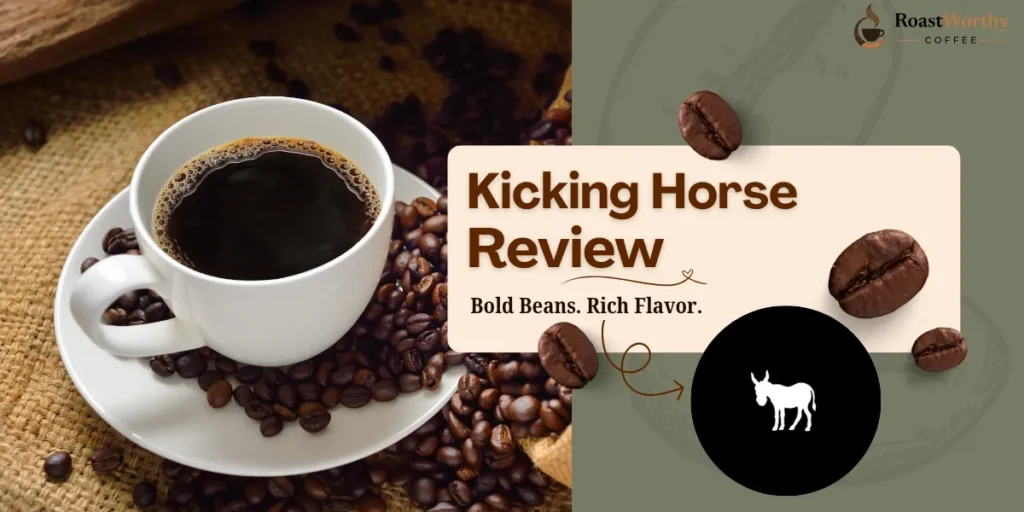
Kicking Horse Coffee Review 2026: Best Value Organic Dark Roast?

Kicking Horse sells bold coffee with unusually strong sourcing credentials for a widely available brand.
That is the real finding from this Kicking Horse Coffee Review.
Every blend uses organic, Fairtrade Arabica coffee. The dark roasts have enough sweetness to avoid tasting like plain charcoal. The medium roasts are often better balanced.
Price is the complication.
A small bag is no longer cheap. The larger 2.2-pound bags offer far better value, especially for households brewing coffee every day.
My verdict: Kicking Horse is one of the better organic coffee brands for dark-roast drinkers. Three Sisters is the best all-round blend, while Grizzly Claw offers the safest entry into the darker range.
Kicking Horse Coffee at a Glance
| Detail | Current information |
|---|---|
| Founded | 1996 |
| Roasted in | Invermere, British Columbia, Canada |
| Ownership | Part of the Lavazza Group |
| Coffee type | 100% Arabica |
| Certifications | Organic, Fairtrade and Kosher |
| Main formats | Whole bean and ground |
| Standard bag | 10 oz |
| Bulk bag | 2.2 lb |
| Official US price | $16.99 for 10 oz |
| Official bulk price | $43.99 for 2.2 lb |
| Subscription saving | 10%, rising to 15% on qualifying quantities |
| Free US shipping | Orders above $75 |
| Best overall blend | Three Sisters |
| Best dark roast | Grizzly Claw |
| Best espresso option | Cliff Hanger Espresso |
| Best decaf option | Swiss Water Process Decaf |
| Overall score | 8.4/10 |
What Is Kicking Horse Coffee?
Kicking Horse began in Invermere, British Columbia, in 1996.
Founders Elana Rosenfeld and Leo Johnson built the company around organic and Fairtrade coffee. Lavazza acquired a majority interest in 2017, and Kicking Horse is now a wholly owned Lavazza subsidiary.
The coffee is still roasted in Invermere.
That ownership has not turned it into Lavazza with a louder bag. Kicking Horse keeps its own blends, branding and roast style.
The company buys green coffee through certified cooperatives across Central America, South America, Africa and Indonesia.
Recent sourcing information names countries including Colombia, Peru, Honduras, Nicaragua, Uganda, India, East Timor and Sumatra.
This is good sourcing information for a national retail brand. It does not match the traceability offered by small specialty roasters.
Most bags do not identify a farm, harvest, variety or processing lot.
Kicking Horse is selling consistent blends, not transparent micro-lots. Judge it on that basis.
Which Kicking Horse Blend Is Best?
There is no single best bag for every drinker.
The dark roasts receive most of the attention, but Three Sisters and Cliff Hanger show more balance.
| Blend | Roast | What it tastes like | Best use | Rating |
|---|---|---|---|---|
| Three Sisters | Medium blend | Cocoa, dried fruit and toasted coconut | Daily drip coffee | 8.8/10 |
| Grizzly Claw | Dark | Dark chocolate, brown sugar and hazelnut | French press and milk | 8.7/10 |
| Cliff Hanger Espresso | Medium | Berry syrup, cocoa and brown sugar | Espresso and flat whites | 8.6/10 |
| Kick Ass | Dark | Chocolate malt, molasses, smoke and liquorice | Bold drip or French press | 8.4/10 |
| Smart Ass | Medium | Red currant, cane sugar and milk chocolate | Pour-over | 8.3/10 |
| 454 Horse Power | Dark | Earth, peat, tobacco and black liquorice | Heavy dark-roast drinkers | 8.0/10 |
| Decaf | Medium-dark | Chocolate and roasted hazelnut | Evening coffee | 8.4/10 |
| Hola | Light | Red currant, honey and cocoa | Lighter drip coffee | 8.0/10 |
Three Sisters: Best Overall
Three Sisters is the bag I would buy most often.
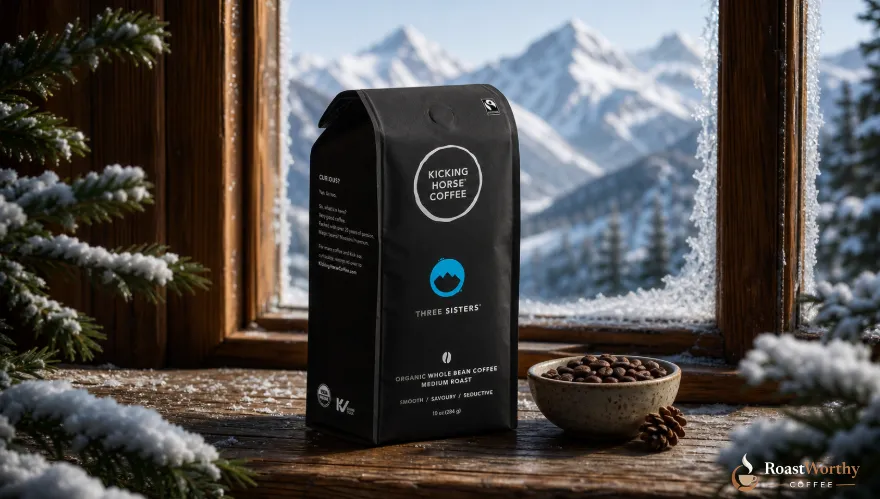
It combines light, medium and dark-roasted beans in one blend. That sounds like a branding exercise, but it works.
The lighter portion provides dried-fruit sweetness. The darker beans add cocoa and body.
It tastes like stone fruit, chocolate malt and toasted coconut. The finish is rounded rather than smoky.
Three Sisters works in a drip machine, French press or pour-over. It also handles a small amount of milk.
This is the most complete coffee in the range.
It is not a bright specialty medium roast. Kicking Horse develops its coffee further than many independent roasters.
Still, it has more flavour separation than the brand’s darker blends.
Grizzly Claw: Best Organic Dark Roast
Grizzly Claw makes the strongest case for Kicking Horse as a value organic dark roast.
It tastes like cocoa powder, dark chocolate, brown sugar and roasted hazelnut. The body is full, but the finish is not excessively smoky.
That makes it easier to drink than 454 Horse Power.
It also has less liquorice than Kick Ass.
Grizzly Claw works particularly well in a French press. The metal filter keeps the coffee’s oils and heavier texture.
Use 30 grams of coffee with 450 grams of water at 92°C. Steep for four minutes, then let the grounds settle before pressing.
Milk brings out its chocolate character.
This is the safest Kicking Horse recommendation for dark-roast drinkers.
Kick Ass: Best for Smoke and Molasses
Kick Ass is the best-known Kicking Horse blend.
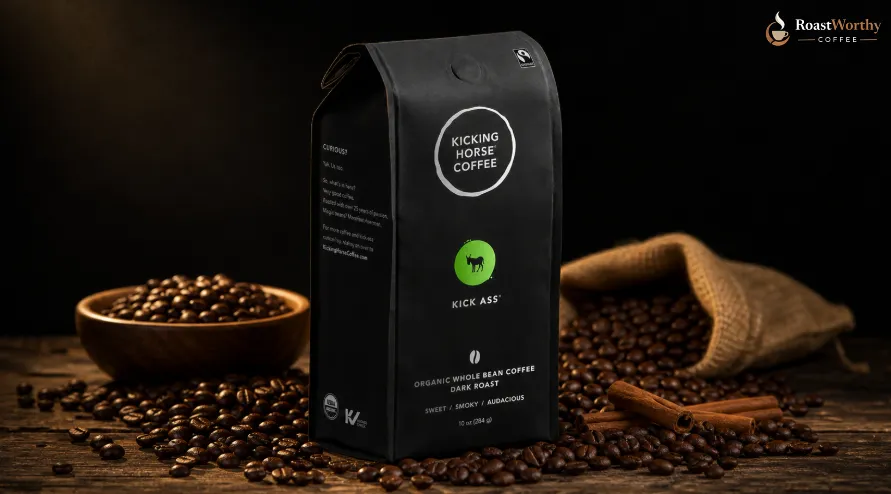
It is not the best blend overall.
The cup is heavier and smokier than Grizzly Claw. Expect chocolate malt, molasses, liquorice and an earthy finish.
There is enough sweetness to stop it becoming hollow. Brewing it too hot destroys that balance.
Keep the water between 91°C and 93°C. Use a medium-coarse grind for drip and a coarse grind for French press.
Kick Ass is particularly good with cream.
Drink it black, and the dry liquorice finish becomes much more obvious. Some people will love that. Others will finish the bag slowly.
454 Horse Power: Darkest and Heaviest
454 Horse Power is built around Indonesian coffee.
It tastes like cacao nibs, peat, nutmeg, sweet tobacco and black liquorice. The body is dense.
This is not a subtle cup.
It works for people who find normal dark roast too restrained. It also stands up to a generous amount of milk.
The downside appears halfway through a large mug. The earthy finish can become tiring.
Use a shorter brew time and slightly cooler water. Overextraction makes it dry and severe.
I respect it more than I enjoy it.
Cliff Hanger Espresso: Best for Espresso
Cliff Hanger is sold as a 2.2-pound whole-bean bag on the official US store.
That is a large commitment for a first purchase, but the coffee itself is good.
It combines Indonesian, Central American and South American Arabica. The cup tastes like blackcurrant, milk chocolate, berry syrup and cocoa.
This is not an oily, nearly black espresso roast.
Its medium roast preserves enough acidity to keep milk drinks lively.
Start with:
The shot has enough cocoa for a flat white and enough berry sweetness for straight espresso.
Owners of automatic espresso machines should also consider Smart Ass. Its less oily surface may be easier on the built-in grinder.
Smart Ass: Best for a Brighter Cup
Smart Ass tastes like red currant, sugar cane, vanilla and milk chocolate.
The acidity is noticeable but controlled. It does not taste sour.
This blend suits people moving from dark roast toward fruitier coffee. Paper-filter brewing gives the cleanest result.
Use a 1:16 ratio for pour-over. Start with 20 grams of coffee and 320 grams of water.
Smart Ass is not the bag for someone seeking heavy body. It is the bag for someone tired of smoke.
Decaf: Better Than an Afterthought
Kicking Horse uses the Swiss Water Process for its Decaf.
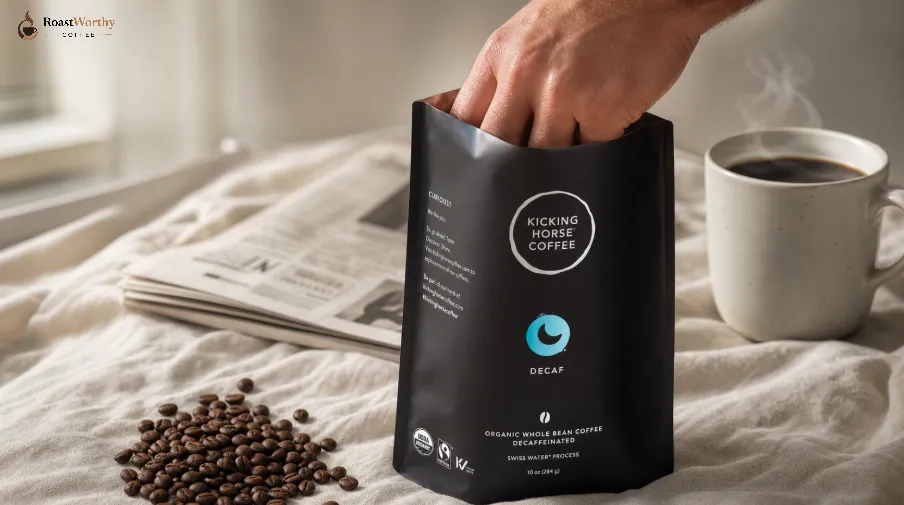
The process removes 99.9% of the caffeine using water, temperature and time rather than conventional chemical solvents.
The coffee tastes like roasted hazelnut and chocolate. Its body is balanced, with a long finish.
Many decaf coffees taste papery or stale. This one does not.
It is available in 10-ounce and 2.2-pound whole-bean bags. That large format is useful for decaf-only households but excessive for occasional evening use.
Kicking Horse estimates about 0.08 mg of caffeine in an eight-ounce serving prepared with two tablespoons. Actual amounts can vary.
Does Kicking Horse Coffee Taste Burnt?
Some blends do. Most do not.
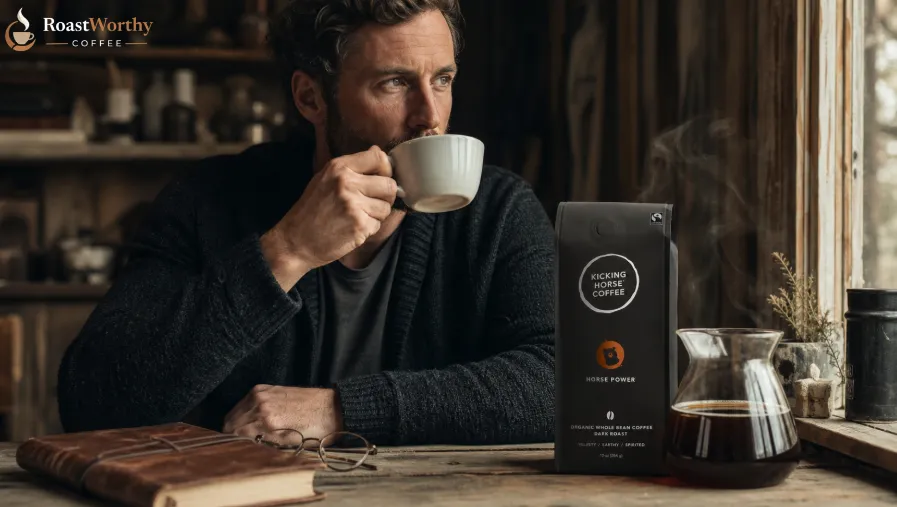
454 Horse Power comes closest to burnt territory. Kick Ass can also become harsh with boiling water.
Grizzly Claw controls its roast better. Three Sisters is cleaner again.
Kicking Horse dark roast is darker than modern specialty coffee. Surface oil is normal on these beans.
That oil does not automatically mean the coffee is stale. It does mean the beans were roasted far enough for oils to move outward.
Clean your grinder more frequently when using them.
The roast style favours chocolate, caramelisation, smoke and body. Fruit and floral character sit further back.
That is a style choice, not a quality failure.
Freshness Is the Main Weakness
Kicking Horse does not make the roast date immediately obvious.
The company says unopened coffee has an 18-month freshness period. To estimate the roast date, subtract 18 months from the printed best-before date.
That is needlessly awkward.
A coffee can remain safe for 18 months without tasting remotely fresh. Whole beans usually perform best much earlier.
Dark beans also oxidise quickly because their structure is more porous.
Look for the latest best-before date when shopping in person. When buying online, order from sellers with quick stock turnover.
Once opened:
The bags use a protective foil lining, but that lining means the packaging is not currently recyclable.
Is Kicking Horse Really Organic and Fairtrade?
Yes.
All Kicking Horse coffee is certified organic and Fairtrade. Its organic certification is handled by ECOCERT, with annual audits.
The brand uses 100% Arabica coffee.
It also states that its coffee comes from small-scale, shade-grown farms. The company does not carry the Smithsonian Bird Friendly seal, so do not describe it as officially Bird Friendly certified.
Fairtrade does not provide perfect farm-level transparency.
It does provide external standards and better accountability than unsupported phrases such as “responsibly sourced.”
For a widely distributed coffee brand, this is a meaningful strength.
Caffeine and Acidity
Kicking Horse estimates about 140 mg of caffeine in a 12-ounce drip coffee prepared with two tablespoons of grounds.
A double espresso contains around 80 mg under the company’s general estimate.
The word “strong” on a bag usually describes flavour, not caffeine.
Kicking Horse uses Arabica rather than a high-Robusta formula. Kick Ass and 454 taste intense because of roast level and body.
The company lists these brewed pH figures for its dark roasts:
| Blend | Listed brewed pH |
|---|---|
| Kick Ass | 5.2 |
| Grizzly Claw | 5.4 |
| 454 Horse Power | 5.6 |
A higher pH number means lower measured acidity.
Curiously, 454 has the highest listed pH despite tasting harsher than Grizzly Claw. Bitterness and acidity are not the same thing.
None of these figures guarantees easier digestion. Individual tolerance varies.
How Much Does Kicking Horse Coffee Cost?
Most core blends follow the same pricing on the official US website.
| Format | One-time price | Approximate cost per ounce |
|---|---|---|
| 10 oz whole bean | $16.99 | $1.70 |
| 10 oz ground | $16.99 | $1.70 |
| 2.2 lb whole bean | $43.99 | $1.25 |
| 10 oz subscription | About $15.30 | $1.53 |
| 2.2 lb subscription | About $39.60 | $1.13 |
The 2.2-pound bag costs around 26% less per ounce than the smaller bag.
That changes my opinion of the value.
At $16.99 for 10 ounces, Kicking Horse competes with entry-level specialty coffee. Fresh local beans may offer better roast-date transparency at a similar price.
At $43.99 for 2.2 pounds, the calculation becomes much stronger.
Using 18 grams per brew, the large bag makes roughly 55 cups. That puts the bean cost near $0.80 per cup.
A subscription drops it closer to $0.71 per cup.
The large whole-bean bag is the sensible purchase.
Do not buy that much coffee unless you can store it correctly. Keep two weeks of beans at room temperature and freeze the rest in airtight portions.
Subscription, Shipping and Discounts
Kicking Horse subscriptions currently reduce the standard price by 10%.
The discount rises to 15% when ordering at least four large bags of the same blend or six smaller bags. Subscriptions can be cancelled without a fee.
Free standard US shipping starts above $75.
That threshold means one large bag does not ship free. Two large bags cross the limit.
The company also runs separate order-value promotions. Those offers change, so compare the subscription price with the current one-time discount before checking out.
Kicking Horse states that its direct US prices have risen because the coffee is roasted in Canada and affected by US tariffs. Canadian prices may therefore look lower.
Retailers can also price the coffee differently. Check the roast-age indicator before choosing the cheapest bag.
What Kicking Horse Gets Right
What Holds It Back
Who Should Buy Kicking Horse Coffee?
Buy it if you prefer full-bodied coffee with chocolate, brown sugar and roast-driven flavour.
It also makes sense for shoppers prioritising organic and Fairtrade certifications.
Choose:
Skip it if you want floral light roasts, farm-level traceability or ultra-fresh beans carrying a clear roast date.
Frequently Asked Questions
What is the best Kicking Horse Coffee?
Three Sisters is the best all-round blend. Grizzly Claw is the best choice for most dark-roast drinkers.
How much does Kicking Horse Coffee cost?
Official US prices start at $16.99 for a 10-ounce bag. A 2.2-pound whole-bean bag costs $43.99 before subscription savings.
Is Kicking Horse Coffee organic?
Yes. The entire coffee range is certified organic and Fairtrade.
Is Kicking Horse Coffee owned by Lavazza?
Yes. Kicking Horse joined the Lavazza Group in 2017 and is now a wholly owned subsidiary.
Is Kicking Horse Coffee high in caffeine?
It has normal Arabica coffee caffeine levels. A 12-ounce drip serving contains about 140 mg under the company’s stated preparation.
Is Kicking Horse Coffee good for espresso?
Cliff Hanger Espresso is the best dedicated option. Smart Ass also works well in automatic espresso machines.
Does Kicking Horse print a roast date?
The brand primarily uses a best-before date. Subtract 18 months from that date to estimate when the coffee was roasted.
Is Kicking Horse Decaf chemical-free?
It uses the Swiss Water Process, which removes caffeine with water, temperature and time.
Final Verdict
Kicking Horse is not cheap grocery coffee anymore.
The standard 10-ounce bag costs enough to face serious competition from smaller roasters. Its unclear roast dating makes that price harder to defend.
The large bag is different.
At about $1.25 per ounce before subscription savings, it delivers organic, Fairtrade Arabica at a fair daily-drinking price.
Three Sisters is the best complete blend. Grizzly Claw is the strongest dark-roast value. Cliff Hanger is the espresso pick.
The company’s roasting is consistent. Its certifications are real. The coffee has enough character to stand apart from ordinary supermarket dark roast.
Freshness transparency stops it scoring higher.
More Recommendations from RoastWorthy Coffee