
What Is a Cortado? How It Compares to Flat White, Latte, and Macchiato

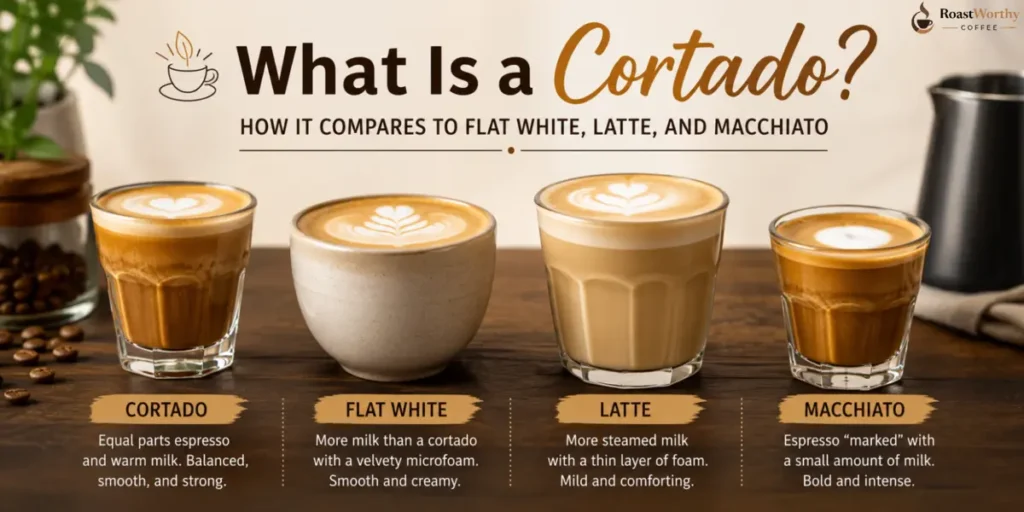
The cortado is two things: espresso and warm milk. In equal parts. That's it.
No mountain of foam. No 12-ounce cup. No syrup required.
It's a small coffee drink that originated in Spain, and it's one of the most misunderstood drinks on a specialty menu. People assume smaller means weaker. It doesn't. The cortado is a precision drink. Every variable matters because there's nowhere to hide.
If you've ever stood at a coffee counter and wondered what separates a cortado from a flat white or a macchiato — this is the article you needed before you ordered.
What Is a Cortado, Exactly?
The word cortado comes from the Spanish verb cortar — to cut. The espresso is “cut” by milk.
That's the whole concept. A double shot of espresso, roughly 2 oz, paired with 2 oz of warm, lightly textured milk. The ratio is 1:1. Not 1:3. Not 1:5. Equal parts.
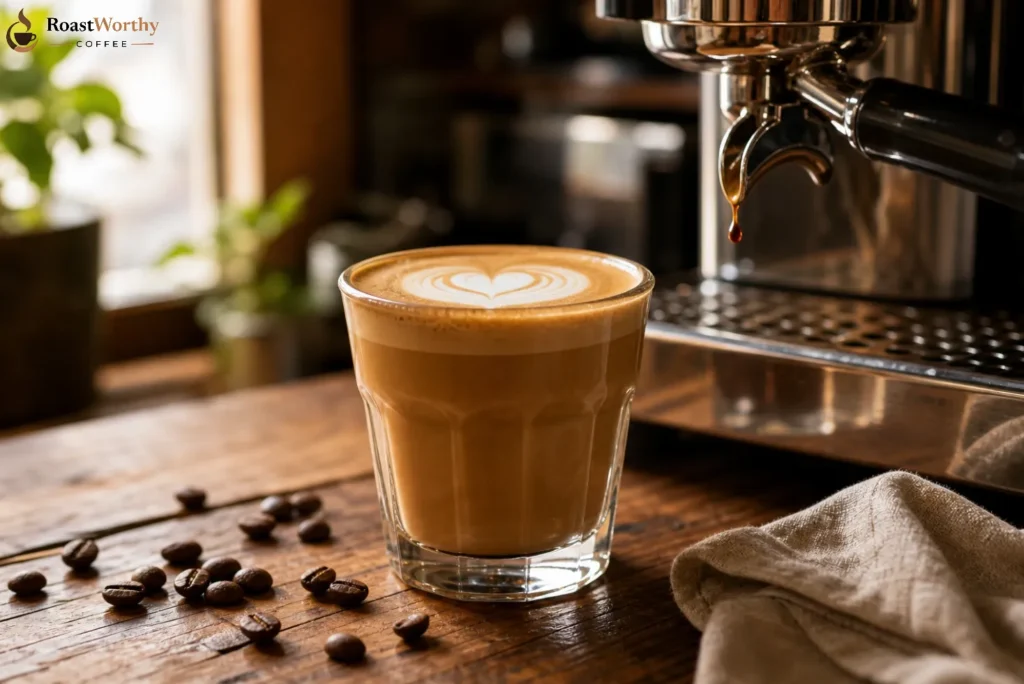
The milk is steamed to around 55–60°C. It's silky, not frothy. The goal is integration — you want the milk to soften the espresso's edge, not drown it. You still taste the coffee. That's the point.
Served in a 4–5 oz glass, usually a Gibraltar glass if you're in the US. Some menus in California and New York actually list it as a Gibraltar — same drink, different name. The Gibraltar glass just became the de facto vessel for the drink in North American specialty shops.
The cortado is a Spanish coffee drink at its core. You'll find variations across Spain, Portugal (where it's called a pingo or garoto), and across Latin America. In Cuba, a similar drink called a cortadito exists — slightly sweeter, often made with Cuban espresso.
The Milk-to-Espresso Ratio Is Everything
Most people don't think about milk ratios until they try a cortado.
The 1:1 milk coffee ratio means nothing gets to hide.
A weak espresso pull will show immediately. Bad milk texture will ruin the balance. The cortado demands a well-extracted shot — ideally a double ristretto or a tight double, somewhere between 18–20g in, 36–40g out, pulled in 25–30 seconds.
If a café's cortado tastes thin and flat, the fault is almost always the espresso, not the concept. The drink has no margin for error.
This is actually why serious coffee drinkers gravitate to it. It tells you more about a café's espresso quality than a flat white can. Less milk means less camouflage. ☕
Cortado vs Flat White
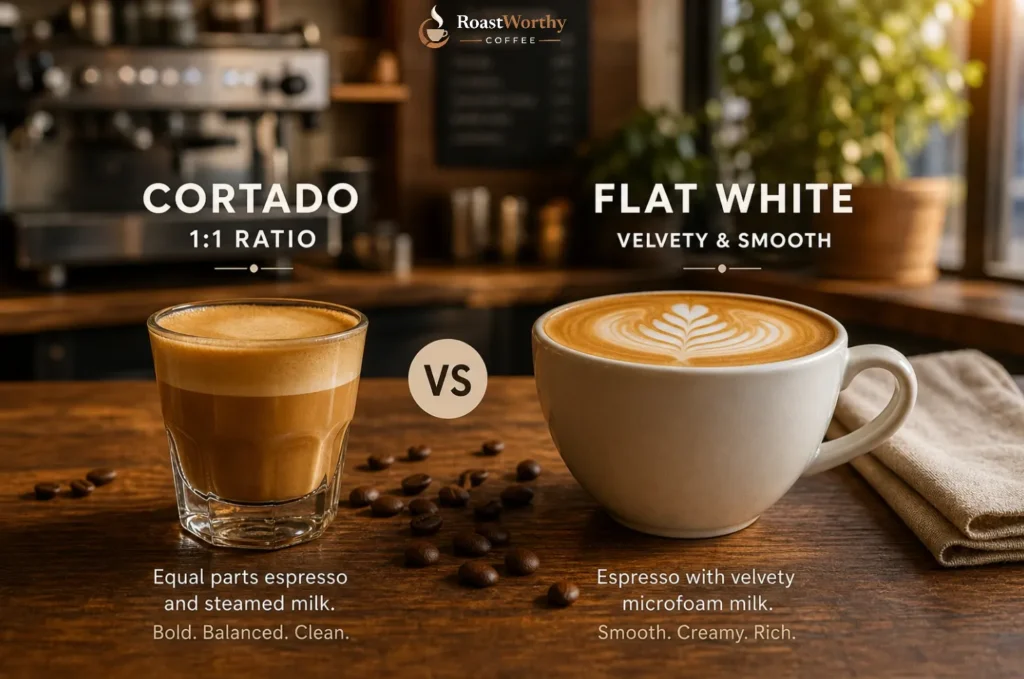
Let's be honest — these two get confused constantly. Here's why they're not the same.
| Feature | Cortado | Flat White |
|---|---|---|
| Volume | ~4 oz | ~5–6 oz |
| Milk ratio | 1:1 (espresso:milk) | ~1:2 to 1:3 |
| Milk texture | Lightly steamed, minimal microfoam | Velvety microfoam throughout |
| Origin | Spain | Australia / New Zealand |
| Strength | Higher espresso forward | Slightly softer, milk-forward |
| Serving vessel | Gibraltar glass | Ceramic cup or tulip |
The flat white uses more milk and is built around microfoam integration from top to bottom. A well-made flat white has a thin layer of velvet microfoam sitting on top — it's designed to be latte art territory.
The cortado doesn't chase latte art. It chases balance.
A flat white is softer on the palate. Still strong, but the milk smooths the edges more completely. If you find cortados slightly intense, the flat white is your next step down. But not much further.
Cortado vs Macchiato
This one gets messier because the word macchiato means three different things depending on where you're standing.
A traditional espresso macchiato (the Italian kind) is a single or double espresso with just a dollop — a stain — of steamed milk or foam on top. Maybe half an ounce of milk. It's barely modified. The macchiato is still essentially an espresso.
A latte macchiato is the opposite: steamed milk “stained” with espresso. It's milk-forward, layered, and can be 8–12 oz.
Neither of these is a cortado.
The cortado sits between them — more milk than an espresso macchiato, far less than a latte macchiato, and rigorously balanced. The macchiato is about staining; the cortado is about equal partnership. Different philosophy.
If you're ordering at a specialty shop, ask specifically for an espresso macchiato or a cortado — not just “a macchiato.” You'll get very different drinks depending on the café.
Cortado vs Latte
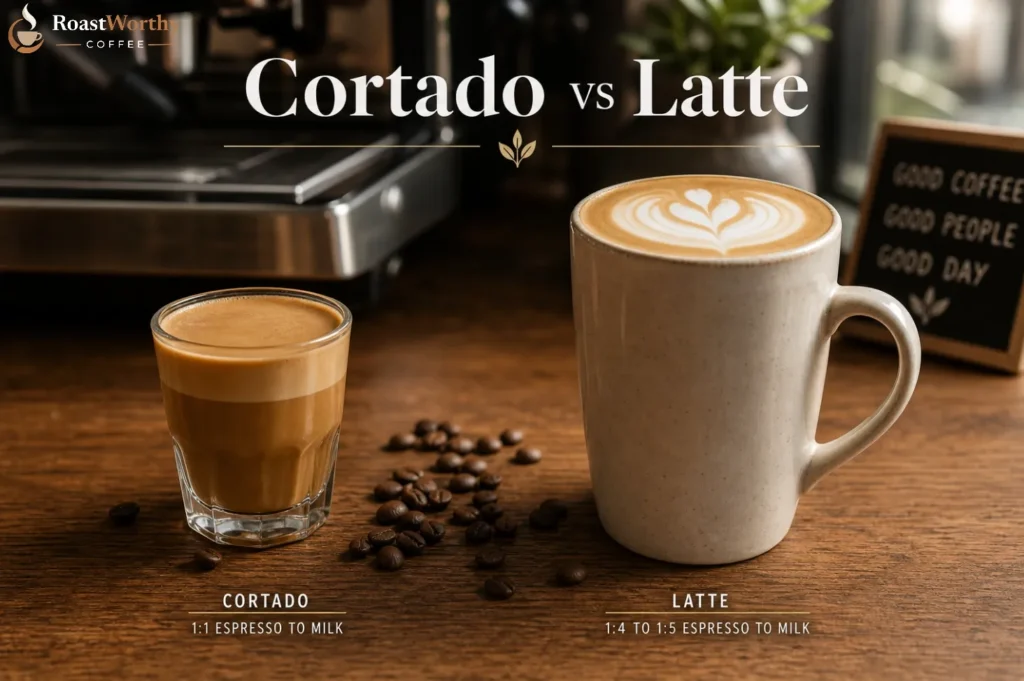
The latte is the most popular espresso-based drink on earth. The cortado is its more disciplined, smaller sibling.
A standard latte is 8–12 oz. It uses a double shot and a significant volume of steamed milk — roughly a 1:4 or 1:5 ratio. The milk is the main event. The espresso is there for structure and flavour, but it's not dominant.
In a cortado, the espresso is always dominant. The milk softens. It doesn't take over.
For people transitioning from lattes to something more coffee-forward, the cortado is a logical next step. The flavour of the espresso comes through clearly — origin, roast level, processing method, all of it registers.
Ngl, if you're drinking a latte and wondering why the coffee tastes “thin,” it's probably not the beans. It's the ratio.
How to Order a Cortado (Without Sounding Lost)
Not every café uses the same terminology. Here's a quick field guide:
If a menu doesn't list it, ask for “a double espresso cut with equal parts steamed milk, no foam.” Any capable barista will know exactly what you mean.
What Makes a Great Cortado ☕
There are four variables that separate a good cortado from a forgettable one.
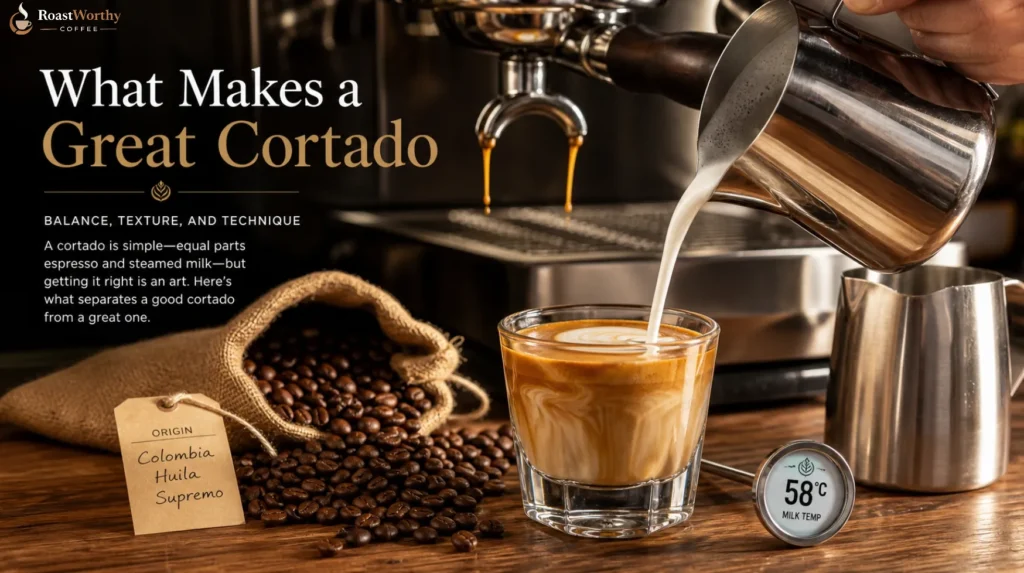
Espresso quality first. The shot is exposed, not hidden. Use a well-developed roast — medium to medium-light works best. You want sweetness and body in the pull, not just acidity.
Milk temperature matters. Overheat the milk and you lose sweetness. Steamed milk between 55–62°C retains its natural lactose sweetness. Above 70°C and it tastes flat.
Minimal texture. Not frothy. Not foam-heavy. The milk should be silky — think glossy, not airy. Baristas call this microfoam, but for a cortado it should be as fine as possible.
The right glass. A 4.5 oz Gibraltar glass or similar clear glass lets you see the ratio. It also retains heat well without insulating too much. Don't use a paper cup if you can help it.
Why Small Coffee Drinks Deserve More Respect
There's a broader conversation here. Small coffee drinks — cortados, macchiatos, piccolo lattes — get underestimated because “small” reads as less value to most consumers.
It isn't.
A 4 oz cortado can carry more flavour complexity than a 12 oz latte made from the same beans. The milk volume in a latte smooths and mutes. A cortado concentrates and clarifies.
This is why in origin-forward specialty shops, the cortado is often the drink staff drink themselves. It's a diagnostic tool. Taste the espresso without burying it.
The cortado is also the ideal format for evaluating a new espresso blend or a single-origin seasonal offering. Less milk means more information.
Cortado Variations Worth Knowing
The core drink has spawned some legitimate variations.
FAQ: Cortado Questions People Actually Ask
Is a cortado stronger than a flat white?
Yes, in effect. Both use a double espresso, but the cortado has less milk — so the espresso flavour is more concentrated and forward. Volume-for-volume, it hits harder.
What's the difference between a cortado and a macchiato?
A traditional espresso macchiato has only a dot of milk — barely modified. A cortado has equal parts milk and espresso. Completely different balance. The macchiato is still an espresso; the cortado is a partnership.
Is a cortado the same as a Gibraltar?
Yes. Gibraltar is the North American specialty shop name for the same drink, named after the Gibraltar glass it's served in. Same ratio, same concept.
How much caffeine is in a cortado?
A standard cortado uses a double shot — roughly 120–150mg of caffeine. Same as a flat white or latte made with a double. The milk doesn't affect caffeine content.
What milk is best for a cortado?
Whole milk gives the best balance of sweetness, fat, and texture at a 1:1 ratio. Oat milk works well as an alternative — it steams cleanly and adds slight sweetness. Skim milk loses body at this ratio; not recommended.
Can you make a cortado at home without an espresso machine?
With a Moka pot or AeroPress you can get close. Pull a strong, concentrated shot and pair it with warm, lightly frothed milk using a handheld frother. It won't be identical, but the ratio concept still works. The espresso quality is the ceiling.
The Bottom Line
The cortado is not a complicated drink. It's a disciplined one.
Equal parts espresso and steamed milk. No foam theater. No size upsell. Just a well-pulled shot and milk that knows its role.
If you've been defaulting to lattes because the menu felt overwhelming, try a cortado next time. It will tell you more about what good espresso actually tastes like than anything else on that menu.
The flavour doesn't lie. ✒️
More Recommendations from RoastWorthy Coffee