
Timemore Chestnut C3 Review: The Best Manual Grinder Under $100?

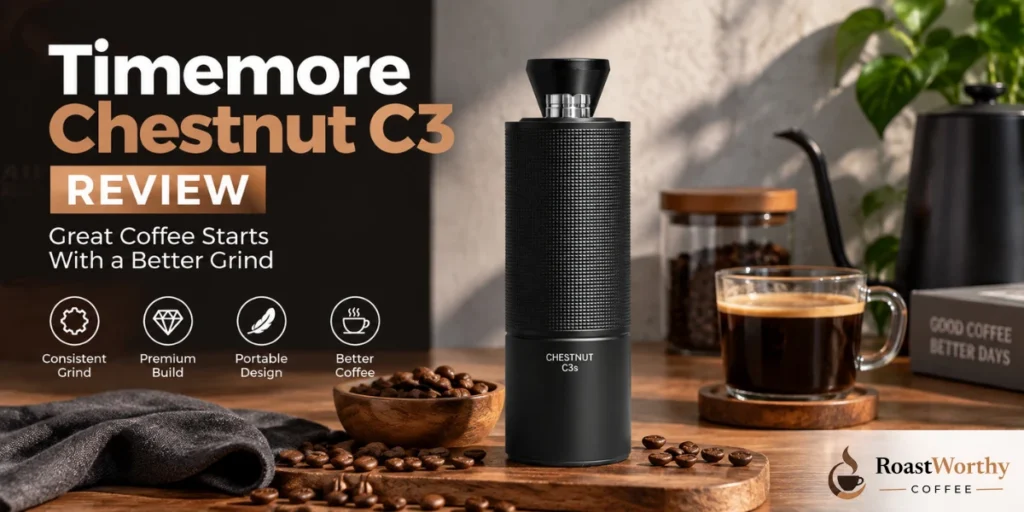
The Timemore Chestnut C3 is easy to recommend below $100. Its 38mm S2C660 stainless-steel burr produces clean, even grounds for pour-over, AeroPress, moka pot, and French press.
It can grind for espresso. The standard adjustment steps, however, are too wide for painless dialling-in.
The answer is mostly yes. This Timemore Chestnut C3 review finds a grinder that gets the important parts right: sharp steel burrs, stable alignment, useful grind consistency, and a body that does not feel disposable.
The current C3 starts around $79 through Timemore. It uses a 38mm S2C660 conical burr, holds about 20g, and has an internal stepped adjustment dial. The standard C3 uses 12 clicks per rotation.
For pour-over coffee, the C3 punches above its price. For espresso… the answer needs more honesty.
Timemore C3 Specifications at a Glance
| Specification | Timemore Chestnut C3 |
|---|---|
| Burr | 38mm S2C660 stainless-steel conical burr |
| Adjustment | Internal stepped dial |
| Standard dial | 12 clicks per rotation |
| Bean capacity | About 20g |
| Body | Aluminum exterior with some plastic internal parts |
| Catch cup | Threaded aluminum cup |
| Best brew methods | V60, AeroPress, moka pot, drip, French press |
| Espresso ability | Possible, but difficult to dial in |
| Current official price | From $79 |
| Review score | 8.7/10 |
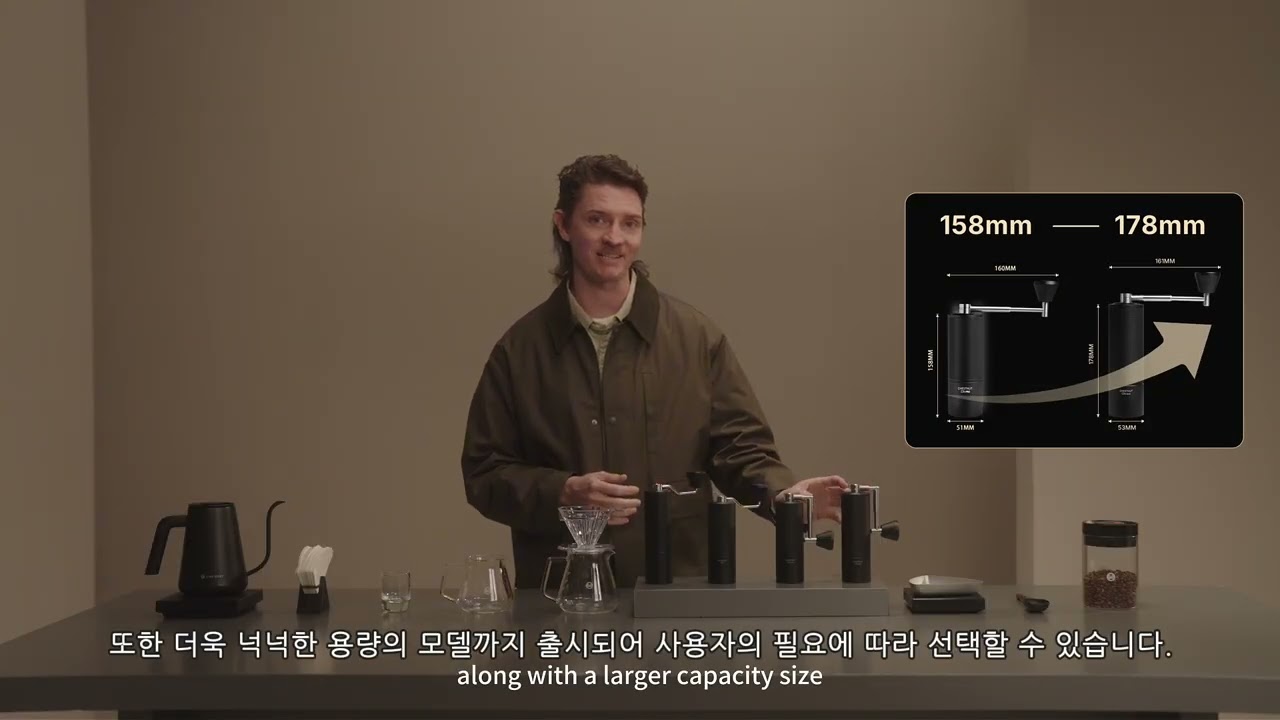
Timemore’s range also includes C3S, Pro, Max, and ESP models. The C3S uses more metal internally. ESP versions use smaller adjustment steps for espresso.
What Makes the S2C Burr Different?
The burr is the reason to buy the C3.
S2C means “spike to cut.” The upper section breaks the bean into smaller pieces. Lower teeth then cut those pieces to the chosen size.
That geometry is more controlled than crushing beans between blunt ceramic surfaces.
The result is fewer boulders, fewer powdery fines, and better grind consistency at filter settings.
Uneven grounds make a V60 taste sharp at the front and dry at the finish. Fine particles over-extract while larger pieces remain under-extracted.
The C3 keeps the spread tight enough that sweetness and acidity stop fighting. Light Ethiopian coffee tastes clearer. Medium Colombian coffee gains caramel sweetness without the papery finish cheap grinders often produce.
The flavour does not lie. ☕
Build Quality and Daily Use
The C3 feels dense, narrow, and properly machined.
Its textured aluminum body gives enough grip without a rubber sleeve. The slim cylindrical shape also suits smaller hands better than the wide Hario Skerton Pro.
A dual-bearing shaft keeps the burr centred and reduces wobble. The standard C3 has some plastic inside its aluminum shell, which is its main construction compromise.
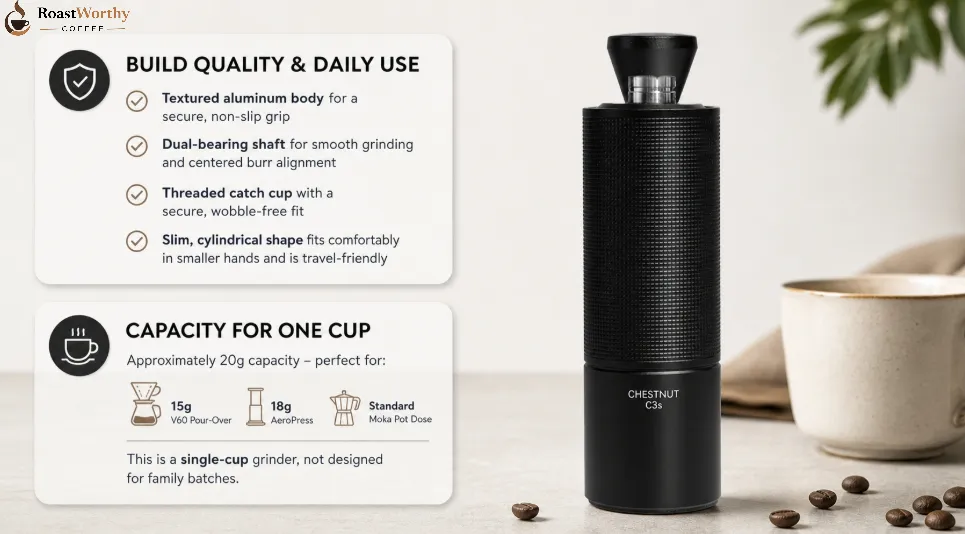
The threaded catch cup feels secure. Static can leave dust on its walls, especially with dark roasts. One tiny water droplet stirred through the beans usually controls it.
Capacity Is Built for One Cup
The regular C3 holds about 20g.
That covers a 15g V60, an 18g AeroPress, or a normal moka pot dose. A 30g batch needs two loads.
This is not a family grinder. It is a single-cup grinder that travels well.
Timemore C3 Grind Settings
Timemore recommends counting outward from burr lock. Its manual lists 7 to 8 clicks for espresso, 13 to 16 for pour-over, and 17 to 20 for French press. It warns against grinding at the finest 0 to 6 positions.
Treat those numbers as starting points. Roast level, dose, brewer, and water flow all affect the final setting.
Pour-Over: The C3’s Best Work
Start around 14 clicks for a V60 using 15g of coffee and 250g of water.
If the brew finishes before 2:30 and tastes thin, move one click finer. If it runs beyond 3:30 and tastes dry, move one click coarser.
The steps are wide enough to notice, which helps beginners. The C3 produces its best balance between medium-fine and medium settings. Clarity is good. Sweetness is better than expected at this price.
Flat-bottom brewers also suit it. Try 15 to 17 clicks, then adjust by taste. Our Hario V60 review explains how flow rate changes the setting you need.
AeroPress and Moka Pot: Very Good
For AeroPress, start between 10 and 13 clicks.
Use the finer end for short concentrated recipes. Use the coarser end for longer immersion brews.
A moka pot usually lands around 9 to 11 clicks. Do not chase espresso-fine powder. Moka pots need resistance, not a blocked basket.
French Press: Good, Not Exceptional
Start between 17 and 20 clicks.
The C3 can produce a usable coarse grind, but its best consistency sits closer to filter settings. At the coarse end, particle variation becomes more visible.
The brew still tastes clean when you skim the crust and decant carefully.
Espresso: Technically Yes
The manual lists 7 to 8 clicks for espresso. That gives you only two practical positions for dialling a shot.
One may run too fast. The next may choke the machine.
You can change the dose to compensate, but that turns a simple grind problem into a three-variable puzzle.
Buy the standard C3 for occasional espresso, not daily espresso.
C3 ESP models reduce adjustment movement from 0.0833mm to 0.0233mm per click and use 30 clicks per rotation. That finer control makes them far more sensible for espresso.
Grinding Speed and Effort
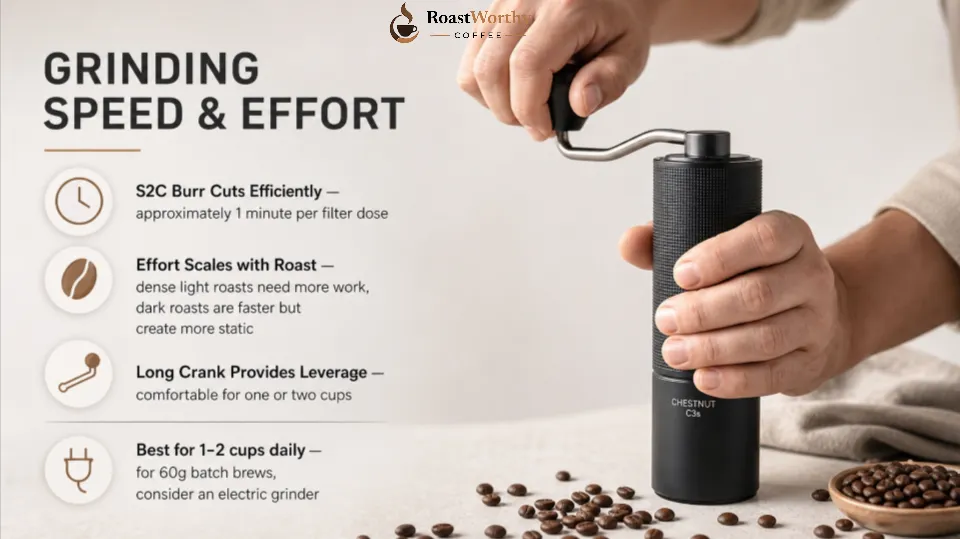
The S2C burr cuts efficiently.
A normal filter dose takes roughly a minute, depending on roast density and grind size. Dense light roasts take more effort. Dark roasts pass through faster but create more static.
The long crank gives decent leverage. For one or two cups, the work is reasonable.
For 60g batch brews every morning, read our best coffee grinders for home use guide.
Timemore C3 vs Hario and 1Zpresso Q Air
| Grinder | Timemore C3 | Hario Skerton Pro | 1Zpresso Q Air |
|---|---|---|---|
| Burr material | Stainless steel | Ceramic | Stainless steel |
| Capacity | About 20g | Up to 100g beans | 15 to 20g |
| Adjustment | 12 clicks per rotation | Internal stepped | 30 clicks per rotation |
| Body | Slim aluminum | Glass and plastic | Polycarbonate |
| Travel use | Very good | Poor | Excellent |
| Filter consistency | Very good | Fair | Very good |
| Espresso use | Limited | Weak | Pour-over focused |
| Official price | From $79 | Varies | $69 |
The Hario Skerton Pro has a 100g bean capacity and a washable ceramic burr assembly. It suits larger batches, but its glass bowl is bulky and less travel-friendly.
The 1Zpresso Q Air costs $69, weighs about 365g, holds 15 to 20g, and uses 30 clicks per rotation. Its plastic body saves weight. The Timemore feels more substantial.
Timemore C3 vs Hario: Which Is Better?
Choose the C3 for grind quality, speed, compactness, and daily filter brewing.
Choose the Skerton Pro when its large capacity matters more than portability. The C3 is the better grinder.
Pros and Cons
What I Like:
What I Do Not Like:
Cleaning and Maintenance
Do not wash the grinder with water. Timemore recommends cleaning it with a brush and keeping the burr assembly dry.
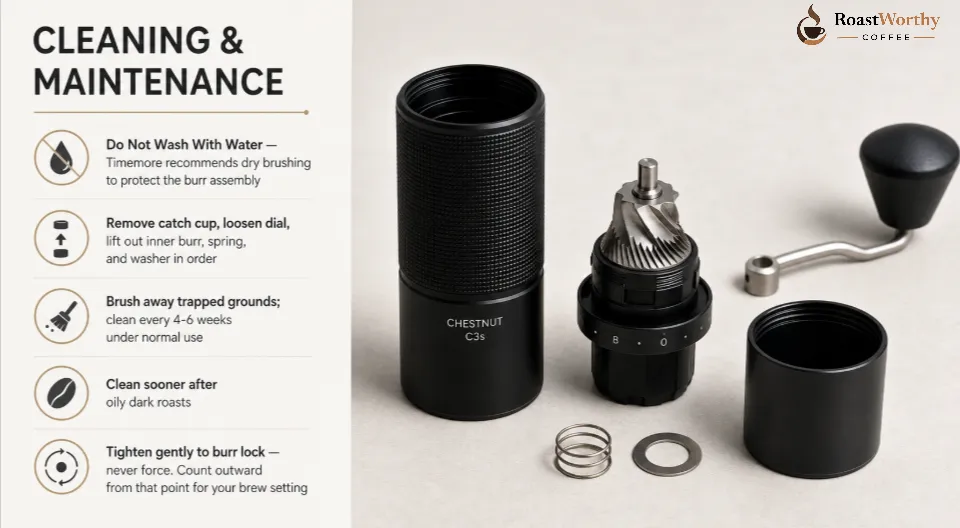
Remove the catch cup, loosen the dial, and lift out the inner burr, spring, and washer in order. Brush away trapped grounds.
Clean it every four to six weeks under normal use. Do it sooner after oily dark roasts.
After reassembly, tighten gently to burr lock. Never force it. Count outward from that point for your brew setting.
Who Should Buy the Timemore Chestnut C3?
The C3 makes sense for:
Skip it when you pull espresso every day, grind more than 25g at once, or hate manual work.
Value Assessment
At about $79, the C3 earns its price.
You are paying for burr geometry, alignment, and a sturdy body. The jump from a ceramic Hario grinder is obvious in both speed and cup quality.
Premium $150 to $250 grinders can give cleaner light-roast acidity and finer adjustment. The C3 still captures most of the filter performance many home brewers need.
It is one of the strongest value picks below $100.
Frequently Asked Questions
Is the Timemore C3 good for espresso?
It grinds fine enough, but the standard adjustment steps are wide. It works for occasional shots. The C3 ESP is better for regular espresso.
How many clicks should I use on the Timemore C3?
Start at 7 to 8 clicks for espresso, 13 to 16 for pour-over, and 17 to 20 for French press. Adjust one click at a time.
Is the Timemore C3 better than the Hario Skerton Pro?
Yes, for grind consistency, speed, travel, and one-cup brewing. The Hario holds more coffee but feels bulkier.
Can the Timemore C3 grind for French press?
Yes. Start around 17 to 20 clicks. Expect slightly more variation than at medium filter settings.
How much coffee fits in the Timemore C3?
The regular C3 holds about 20g. That covers most single-cup recipes but not a large batch.
Is the Timemore C3 good for travel?
Yes. Its narrow body, removable handle, and 20g capacity make it a strong travel grinder. The standard handle does not fold like the C3 Pro handle.
Final Verdict: Is the Timemore C3 the Best Manual Grinder Under $100?
The Timemore C3 is one of the best manual coffee grinders under $100, especially for filter coffee.
It is fast, compact, solid in the hand, and more consistent than common ceramic-burr alternatives. The 20g capacity suits one-cup brewing. Its S2C burr gives light and medium roasts enough clarity to justify buying better beans.
Espresso is the caveat. The standard dial lacks the control needed for easy shot adjustment. A C3 ESP or dedicated espresso hand grinder makes more sense there.
For V60, AeroPress, moka pot, and travel, the standard C3 scores 8.7/10. This one earns its price.
More Recommendations from RoastWorthy Coffee