
How to Clean Your Espresso Machine: A Step-by-Step Maintenance Guide


A dirty machine doesn't fail loudly. It fails slowly. The shots get bitter. The crema thins. The pump starts to whine.
Most people blame the beans. It's almost always the machine.
If you want to clean your espresso machine properly, you need three separate routines: daily wipe-downs, weekly backflushing, and monthly descaling. They do different jobs. Skip one and the others can't save you. ☕
Here's what each cleaning step is actually doing — and exactly how often to do it.
TL;DR
Why Espresso Machine Cleaning Matters
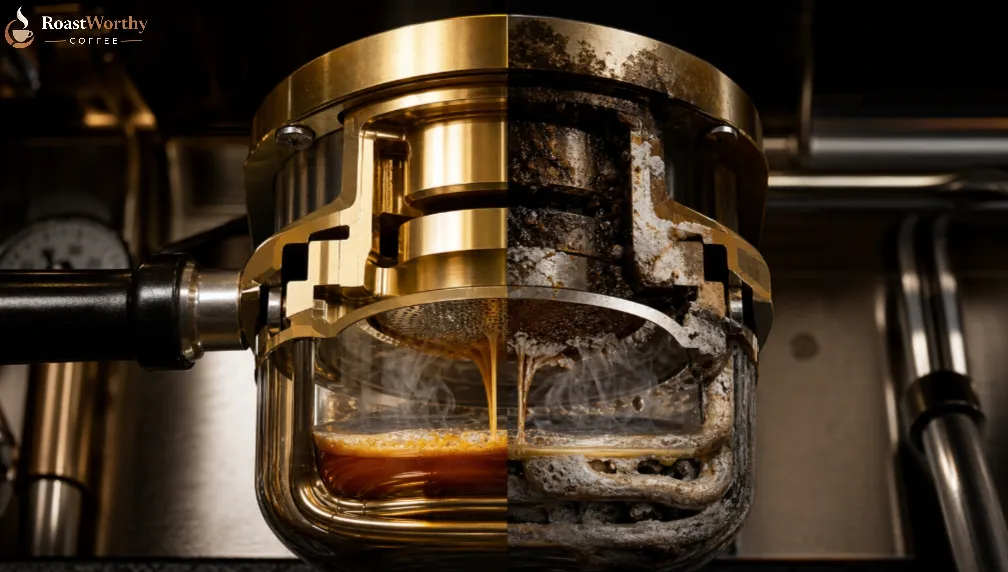
Two enemies live inside your machine: coffee oils and scale.
Coffee oils go rancid. They coat the group head, the portafilter, and the screen. Within a week they taste like a stale ashtray. No bean survives that.
Scale is worse. It's calcium and magnesium from your water, baked onto the boiler and pipes. Scale buildup chokes flow, throws off temperature, and eventually kills the machine.
Here's the science in one line. Espresso brews at around 9 bars of pressure and roughly 200°F. Any oil residue or mineral crust in that path changes both the pressure and the temperature your coffee actually sees. That's why a clean machine tastes “dialed in” with zero recipe changes.
The finding that matters: a clean machine adds years to its life and removes 90% of the off-flavors people blame on their grinder.
The Tools You'll Need
Get these before you start. Improvising mid-clean is how parts get damaged.
Skip the dish soap. It leaves a film and tastes like it. Use proper detergent or nothing.
One more note on cost. A full cleaning kit runs $25–$40 once. A boiler replacement runs $150 and up. The math is not close.
Daily Cleaning Routine
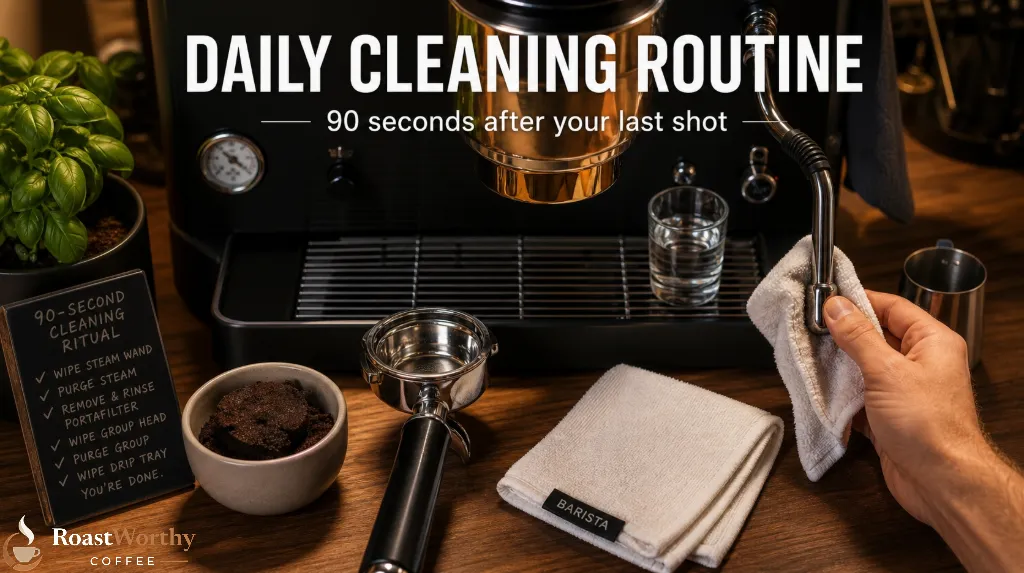
Do this after your last shot of the day. It takes 90 seconds.
- Knock the puck out and rinse the portafilter under hot water.
- Wipe the group head gasket with a damp cloth.
- Run a blank shot of water through the empty group head for 2–3 seconds to flush loose grounds.
- Purge the steam wand and wipe it immediately — milk hardens in minutes.
- Wipe down the drip tray and machine body.
The steam wand is the one most people skip. Dried milk inside the tip blocks steam and breeds bacteria. Purge it every single time.
Also pull the portafilter out and leave it off the group head overnight. Locking it in while hot crushes the gasket and shortens its life. Small habit, real payoff.
Weekly Cleaning: Backflushing the Group Head
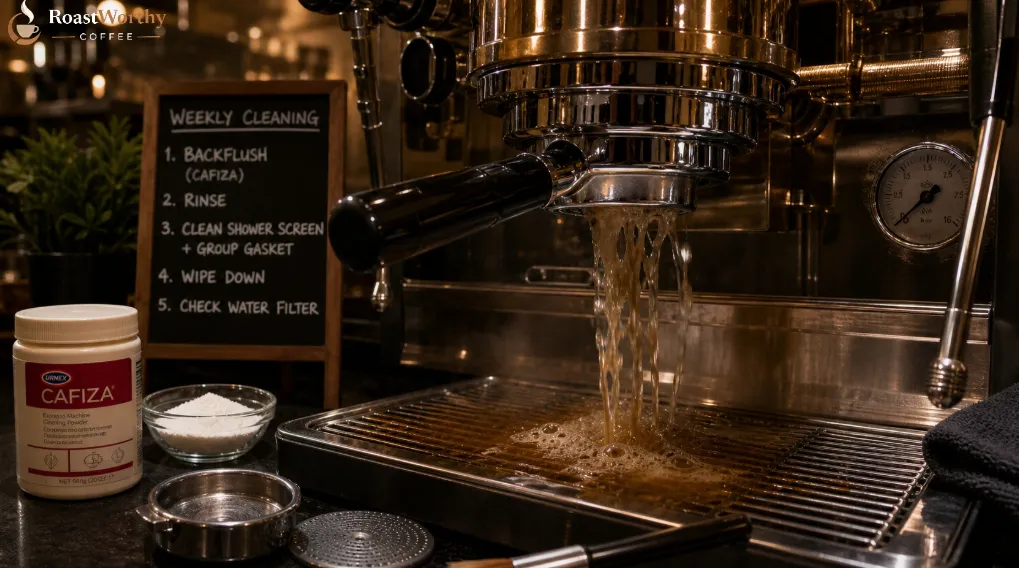
Backflushing is how you clear coffee oils from the inside of the machine. You can only do it on machines with a three-way solenoid valve — most pump machines have one. Lever and single-boiler manual machines often don't, so check your manual first.
How Backflushing Works
You put a solid blind basket in the portafilter. Water can't escape forward. So the pressure forces it backward, through the group head and out the drain — carrying oils and detergent with it.
Here's what the pressure is actually doing: it's reverse-flushing the screen and valve that your daily routine can't reach. No brush gets in there. Only pressure does.
Step-by-Step Backflushing
- Insert the blind filter into the portafilter.
- Add about half a teaspoon of espresso detergent (Cafiza) onto the basket.
- Lock the portafilter into the group head.
- Run the pump for 5 seconds, then stop. Wait 5 seconds.
- Repeat that cycle 5 times. You'll see brown water draining.
- Remove the portafilter, rinse it, and reinsert the empty blind basket.
- Run 5 more clean-water cycles to rinse all detergent out.
- Pull one shot of water through the bare group head before brewing again.
Do this once a week for daily home users. Bump it to twice if you pull 8+ shots a day.
Cleaning the Portafilter and Baskets
Backflushing cleans the machine. It doesn't fully clean your portafilter. Once a week, drop the baskets and the portafilter (spout removed if possible) into a hot detergent soak for 20 minutes. Brush the basket holes, rinse hard, dry.
You'll know it's working when the rinse water runs clear instead of amber. That amber is oil. That oil is bitterness.
Monthly Cleaning: Descaling Your Espresso Machine
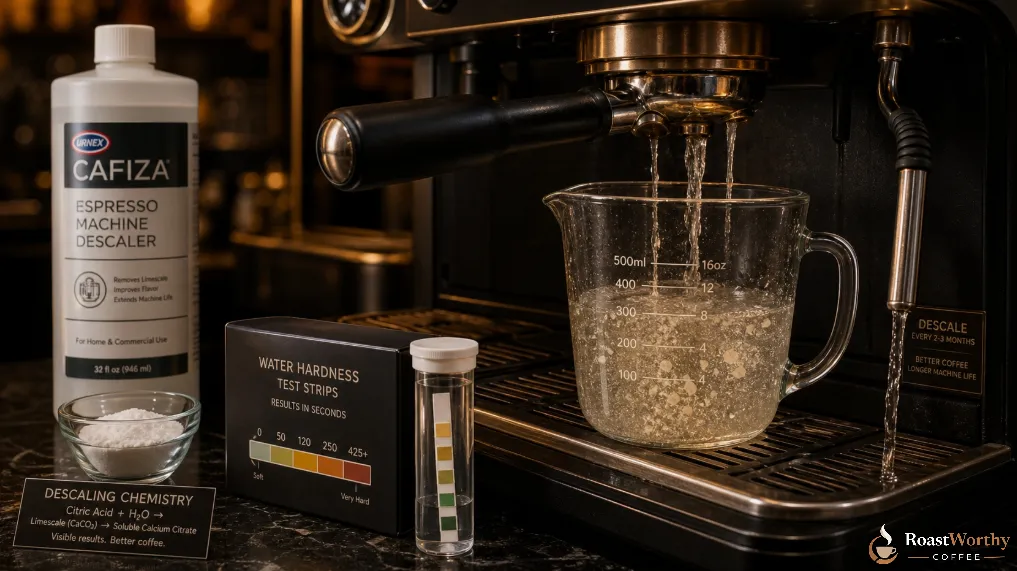
Backflushing handles oils. Descaling handles scale. They are not interchangeable. This is the single most misunderstood part of espresso machine maintenance.
Descaling dissolves the mineral buildup inside your boiler and water lines. Skip it and your machine slowly strangles itself.
How Often to Descale
It depends entirely on your water hardness. Cleaning frequency is not one-size-fits-all.
| Water Type | Hardness | Descale Every |
|---|---|---|
| Soft / filtered | 0–60 ppm | 3 months |
| Moderate | 60–120 ppm | 6–8 weeks |
| Hard | 120–180 ppm | 4 weeks |
| Very hard | 180+ ppm | 2–3 weeks |
Don't know your water hardness? A $10 test strip tells you in 10 seconds. The curve doesn't lie — and neither does a test strip.
Using filtered water cuts your descaling frequency in half. That single habit saves more machines than any cleaning product on the market.
Step-by-Step Descaling
- Empty the water tank and remove any in-tank filter.
- Mix your descaling solution per the label — usually 1 part solution to 2 parts water.
- Fill the tank with the mixture.
- Run roughly one-third of the tank through the group head into a cup.
- Run another third through the steam wand.
- Let the machine sit 15–20 minutes so the acid dissolves the scale.
- Run the rest of the solution through both outlets.
- Refill the tank with clean, filtered water and flush two full tanks through to rinse.
That final rinse is non-negotiable. Leftover descaler tastes sour and is not something you want in your cup.
A quick gut check: if the first descale in months produces visible flakes or cloudy water, your interval was too long. Tighten it next time.
What Happens If You Don't Clean It
Let me be specific about the failure timeline.
Your first deep clean might reveal how bad it got. Do it anyway. ⚗️
A Realistic Cleaning Schedule
Pin this somewhere near your machine.
Set a recurring phone reminder for the weekly and monthly tasks. The whole reason machines die early is that “I'll do it later” becomes never.
Cleaning a Super-Automatic vs. Manual Machine

Super-automatics (Jura, DeLonghi, Philips) usually have guided cleaning cycles built in. The machine prompts you. Use the manufacturer's cleaning tablets and descaler — third-party products can void the warranty.
Manual and semi-auto machines (Gaggia, Rancilio, Breville) need the hands-on routine above. More work, more control, longer lifespan if you do it right.
| Task | Super-Automatic | Manual / Semi-Auto |
|---|---|---|
| Daily wipe-down | Yes | Yes |
| Backflushing | Auto cycle | Manual, weekly |
| Descaling | Guided prompt | Manual, by water hardness |
| Brew unit cleaning | Removable, rinse weekly | N/A (group head brush) |
Either way, the principles don't change. Oils get backflushed. Scale gets descaled. Milk gets purged immediately.
Common Cleaning Mistakes to Avoid
Fix those five and you're ahead of 95% of home baristas.
Frequently Asked Questions
How often should I clean my espresso machine?
Wipe and flush after every use, backflush weekly, and descale every 4–12 weeks depending on water hardness. Filtered water lets you descale less often.
Can I use vinegar to descale my espresso machine?
You can, but most makers advise against it. Vinegar is harsh on internal seals and leaves a smell that's hard to rinse out. A citric-acid descaler is safer and cleaner-tasting.
What's the difference between backflushing and descaling?
Backflushing removes coffee oils from the group head and valve using detergent. Descaling removes mineral scale from the boiler and pipes using acid. You need both — they solve different problems.
Do I need a blind filter to clean my espresso machine?
Yes, for backflushing. The blind (solid) basket blocks water from flowing forward, forcing it backward to flush the group head. Without it, you're just running a normal shot.
Why does my espresso taste bitter after cleaning?
Usually leftover detergent or descaler. Run extra rinse cycles with clean water until the taste disappears. Two full tanks after descaling is the safe minimum.
How do I clean the steam wand properly?
Purge it right after each use, wipe with a damp cloth, and clear the tip holes with a pin weekly. For stubborn buildup, soak the detached tip in hot detergent water.
More Recommendations from RoastWorthy Coffee