Caffeine & Coffee Health Statistics 2026: The Research Data

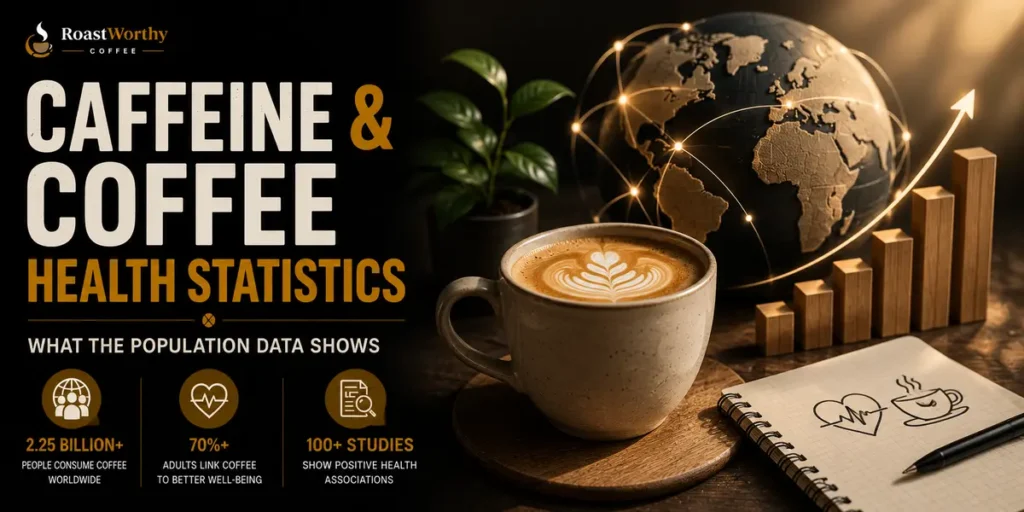
350,000 people. 13 years of tracking. 32% lower cirrhosis risk. 47% lower liver cancer risk. 42% fewer liver-related deaths.
Those numbers came out of a July 2026 study published in Clinical Gastroenterology and Hepatology. The largest coffee health study ever conducted. And almost nobody outside clinical circles is talking about the scale of it.
This isn't a guide to how much caffeine is in your cup — we've already covered that in detail. This is a statistics article. It answers a different question: what does caffeine consumption and coffee's health impact look like at a population level?
The data is stronger than most people realize. And the research consensus has shifted faster than the public conversation. ☕
Caffeine Health Risk Statistics: Which Groups Are Most Affected?
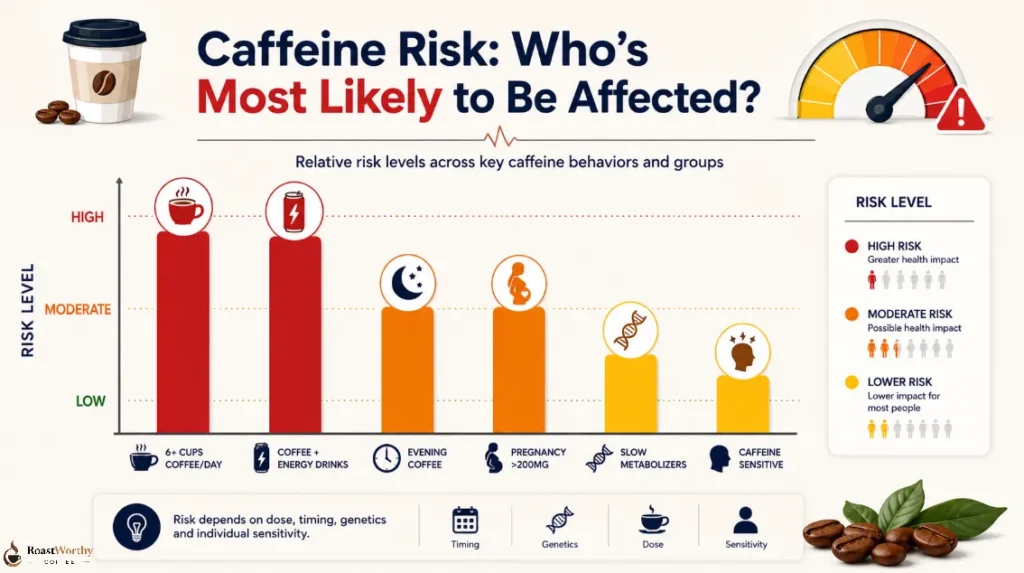
The research consensus is clear: moderate coffee consumption (3–4 cups daily) is associated with health benefits, not harm. But risk concentrates at the extremes and in specific populations.
| Risk Factor | Caffeine Behavior | Population Risk Level |
|---|---|---|
| 6+ cups coffee/day | 576mg+ from coffee alone | High — ~4% of US drinkers |
| Coffee + energy drink stacking | 500–750mg combined | High — concentrated in 18–30 age group |
| Evening coffee (after 5pm) | Sleep disruption | Moderate — ~11% of US adults |
| Pregnancy (exceeding 200mg) | FDA advisory | Moderate — individual |
| CYP1A2 slow metabolizers | Extended caffeine half-life | Individual — ~50% of population |
| Caffeine-sensitive individuals | Symptoms at low doses | Individual |
The 50% figure for CYP1A2 slow metabolizers is worth noting. Roughly half the population processes caffeine more slowly than the other half. This means the FDA's 400mg limit — set as a population average — may be too high for half of adults.
This is where individual variation meets population statistics. The data says coffee is safe for most people at moderate intake.
But “most people” isn't “everyone.” And the 7% exceeding 400mg daily are the group where health risks — sleep disruption, elevated blood pressure, anxiety — are statistically concentrated.
Global Caffeine Consumption Statistics 2026
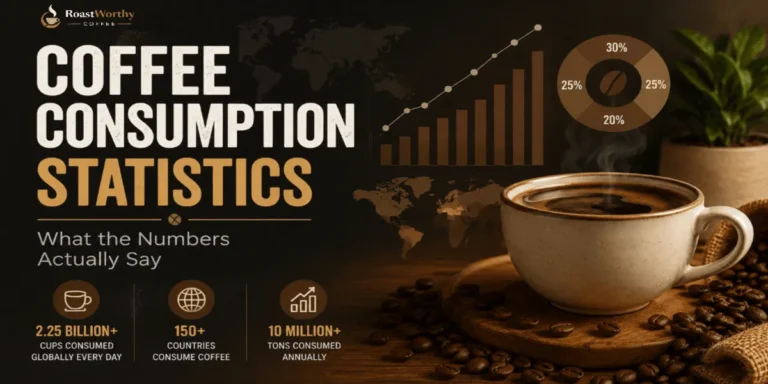
Approximately 2.25 billion cups of coffee are consumed worldwide every day.
When you add tea, energy drinks, and caffeinated sodas, the global population consumes an estimated 120,000 tonnes of caffeine annually — equivalent to roughly 12 billion 100mg doses.
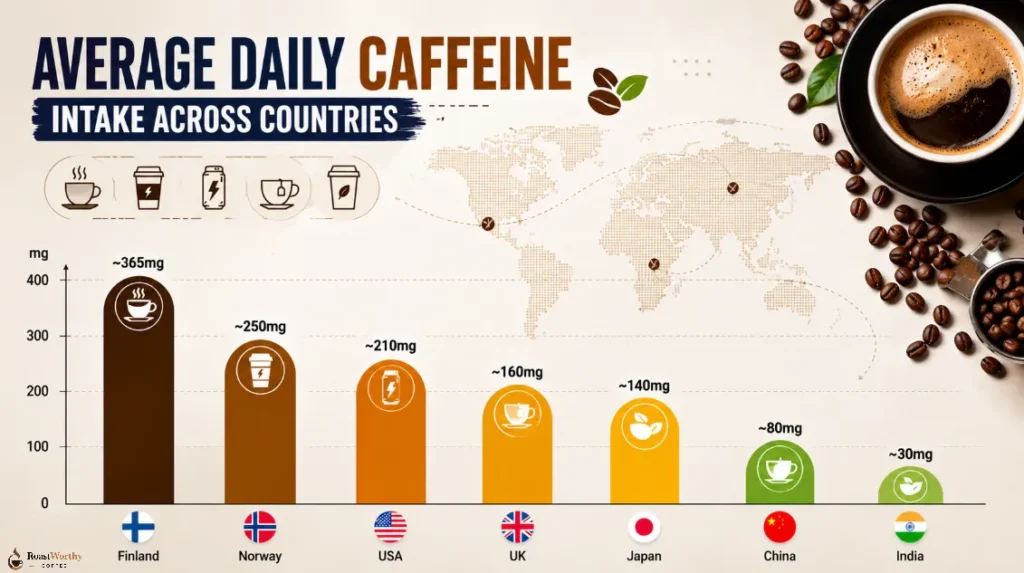
Per-capita caffeine intake varies significantly by country, driven by coffee consumption volumes, tea traditions, and energy drink adoption.
| Country / Region | Primary Caffeine Source | Est. Daily Caffeine (mg) |
|---|---|---|
| Finland | Coffee (3.8 cups/day) | ~365mg |
| Norway | Coffee (2.6 cups/day) | ~250mg |
| United States | Coffee + energy drinks | ~210mg |
| United Kingdom | Tea + coffee | ~160mg |
| Japan | Coffee + tea | ~140mg |
| China | Tea (coffee growing) | ~80mg |
| India | Tea (coffee growing) | ~30mg |
Finland's 365mg average is remarkable — nearly at the FDA's 400mg safe daily limit, from coffee alone, across the entire adult population. China and India show the lowest per-capita caffeine intake — but both are growing as coffee culture expands.
India's coffee market is projected to grow at 9.87% CAGR through 2032. As that growth materializes, population-level caffeine intake in these countries will rise.
Global caffeine consumption distribution
| Daily Caffeine Intake | Est. % of Global Adult Population | Primary Source |
|---|---|---|
| 0mg (non-consumers) | ~30% | None |
| 1–99mg (light) | ~20% | 1 cup coffee or tea |
| 100–199mg (moderate) | ~25% | 2 cups coffee |
| 200–399mg (regular) | ~18% | 3–4 cups coffee |
| 400mg+ (high) | ~7% | 5+ cups or stacking |
Most of the world is within safe limits. But that 7% consuming 400mg+ daily — roughly 350 million adults globally — are the population-level risk group. And their caffeine rarely comes from coffee alone.
Caffeine stacking: the real population risk
The people consuming 400mg+ daily are rarely getting it all from coffee. They're stacking — multiple caffeine sources across the day that nobody tracks cumulatively.
Among adults aged 18–30 globally, energy drink consumption combined with coffee is the primary driver of excessive intake. The coffee itself is rarely the problem. It's the stacking — energy drinks (200mg), pre-workout supplements (150mg), caffeinated sodas (40mg), and coffee (200mg+) combined.
The global energy drink market was valued at approximately $86 billion in 2024 and is growing at 7% CAGR. As energy drink consumption grows alongside coffee, total population-level caffeine intake is rising from two directions simultaneously. Coffee contributes the baseline. Energy drinks add the spike.
A study of young adults found that consumption peaked in the 19–30 age bracket and that smokers consumed significantly more caffeine than non-smokers. People sleeping 3–5 hours a night also consumed more caffeine than well-rested individuals — creating a cycle where poor sleep drives caffeine intake, which further disrupts sleep.
For a full breakdown of caffeine content by brew method, bean type, and serving size, see our complete caffeine content guide.
US Caffeine Consumption: Regional Breakdown
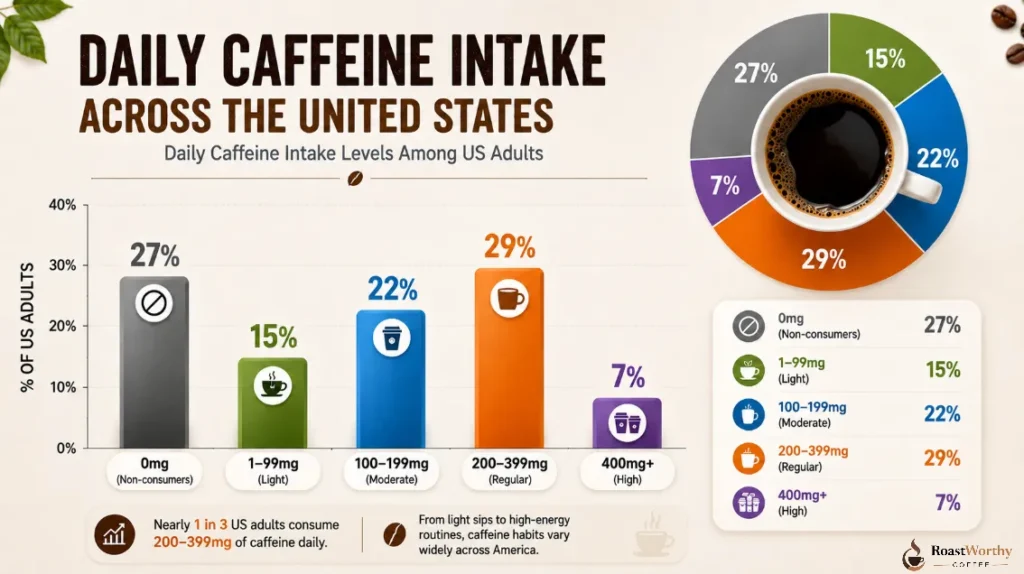
The United States sits mid-range globally — ~210mg average daily caffeine intake, below the Nordic leaders but above Asian markets.
The average US coffee drinker consumes 2.8 cups per day — well under the FDA's 400mg safe daily limit.
| Daily Caffeine Intake | % of US Adults | Primary Source |
|---|---|---|
| 0mg (non-consumers) | ~27% | None |
| 1–99mg (light) | ~15% | 1 cup coffee or tea |
| 100–199mg (moderate) | ~22% | 2 cups coffee |
| 200–399mg (regular) | ~29% | 3–4 cups coffee |
| 400mg+ (high) | ~7% | 5+ cups or stacking |
Approximately 7% of US adults — roughly 18 million people — exceed the FDA's 400mg daily limit. The 4% who drink 6+ cups daily consume 576mg+ from coffee alone. Add an energy drink, and they're at 750mg+. Nearly double the safe ceiling.
Caffeine Intake Trends: Why Average Consumption Is Rising
Here's a statistic most health articles miss. The average caffeine content in a cup of coffee is increasing — not because brewing methods changed, but because the beans did.
As global production shifts toward Robusta — which contains nearly double the caffeine of Arabica — average per-cup caffeine content is rising year over year. This shift is driven by climate pressure on Arabica-growing regions, competitive Robusta pricing, and production recovery in Vietnam.
The increase is small per cup. But multiplied across 2.25 billion daily cups globally, it's a measurable population-level shift in total caffeine exposure.
Coffee Health Research Statistics: The Numbers Behind the Findings
The 2026 liver study is the headline. But it's part of a larger research consensus that has been building for years. This section covers research statistics — sample sizes, effect sizes, and study scale.
Liver disease: the 350,000-person study
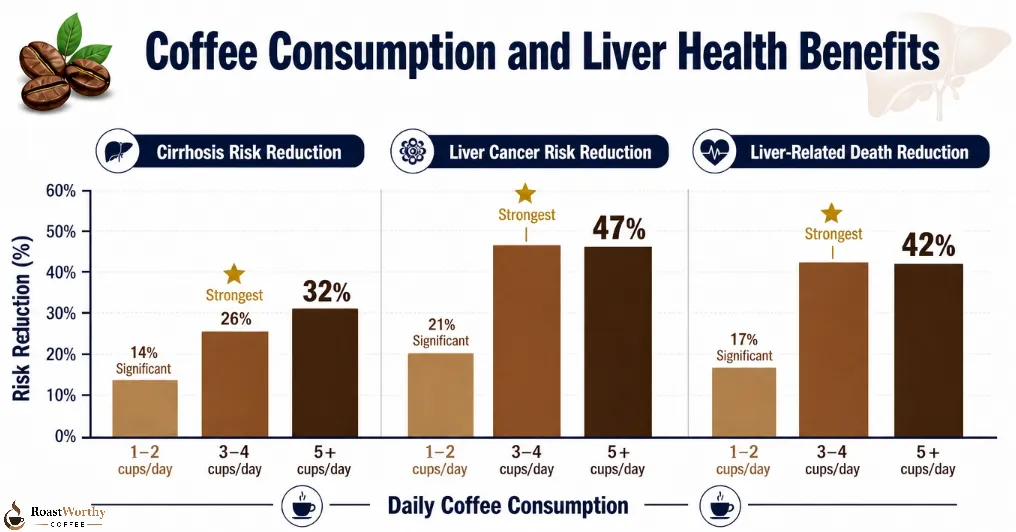
Published in Clinical Gastroenterology and Hepatology, July 2026. UK Biobank data. 350,000+ participants tracked over 13 years. No cirrhosis or liver cancer at baseline.
| Coffee Intake | Cirrhosis Risk Reduction | Liver Cancer Risk Reduction | Liver-Related Death Reduction |
|---|---|---|---|
| 5+ cups/day | 32% | 47% | 42% |
| 3–4 cups/day | Strongest association | Strongest association | Strongest association |
| 1–2 cups/day | Significant | Significant | Significant |
Coffee drinkers showed lower liver fat, lower liver iron, reduced fibrosis markers, and lower inflammation. Blood tests revealed higher levels of liver-protective proteins.
Both caffeinated and decaf showed similar associations. The protective effect comes from coffee's 1,000+ bioactive compounds — chlorogenic acids, melanoidins, trigonelline, polyphenols — not from caffeine itself.
Heart health: the AFib reversal
January 2026 research found regular coffee consumption associated with a reduction in atrial fibrillation frequency. This directly contradicts decades of clinical assumption that caffeine triggers arrhythmias.
The data shows moderate consumption — 3–4 cups daily — correlated with lower heart disease risk, not higher. The mechanism appears anti-inflammatory rather than stimulant-driven.
Type 2 diabetes: the 6–7% per cup
Multiple meta-analyses consistently show an inverse relationship between coffee consumption and type 2 diabetes. Each additional cup per day is associated with a roughly 6–7% reduction in diabetes risk.
Decaf shows a similar but slightly weaker association. This suggests the protective compounds work partly independent of caffeine — reinforcing the liver study's finding that coffee's health benefits are a coffee effect, not a caffeine effect.
All-cause mortality: coffee drinkers live longer
A 2025 umbrella review of meta-analyses found coffee consumption consistently linked to reduced all-cause mortality. The protective effect peaks at 3–4 cups daily and plateaus or slightly declines at 6+ cups.
Coffee drinkers, on average, live longer than non-drinkers across multiple large-scale cohort studies. Not a marketing claim. Pooled epidemiological data.
Caffeine and Sleep Disruption Statistics
11% of US adults drink coffee in the evening. That's roughly 28 million people consuming caffeine within 6 hours of bedtime — the threshold at which research shows sleep quality significantly degrades.
Research consistently shows that people who claim caffeine doesn't affect their sleep still experience measurable sleep quality degradation when monitored. The body processes caffeine more slowly than the mind perceives.
This creates a population-level health concern: millions of adults are consuming evening caffeine, believing it has no effect, while objective sleep data shows otherwise. Poor sleep is linked to cardiovascular disease, metabolic disorders, cognitive decline, and weakened immune function.
The smoker variable complicates this further. Smokers metabolize caffeine roughly 50% faster than non-smokers due to CYP1A2 enzyme induction.
They process caffeine quickly, need more to feel the effect, and drink more coffee as a result. When they quit smoking, their caffeine clearance rate drops — and their usual coffee intake suddenly becomes excessive.
Decaf Coffee Consumption Statistics: Market Share and Growth
Decaf accounts for approximately 10% of total US coffee consumption. That share has been growing steadily — up from roughly 8% five years ago.
The growth is driven by two demographics. Older adults reducing caffeine for health reasons. And younger consumers drinking decaf in the evening specifically to avoid sleep disruption — a behavior directly tied to the sleep data above.
The decaf market isn't huge. But its growth rate outpaces regular coffee — and the demographic driving it (health-conscious younger drinkers) is the same group driving specialty and cold brew growth. Decaf isn't a separate market anymore. It's a format within specialty.
The 2026 liver study's finding that decaf matches caffeinated coffee's liver-protective effects is likely to accelerate this trend. If the health benefits don't require caffeine, the argument for decaf gets stronger — particularly for evening consumption and caffeine-sensitive individuals.
FAQ: Caffeine & Coffee Health Statistics 2026
What is the average daily caffeine consumption globally?
An estimated 120,000 tonnes of caffeine are consumed globally each year — roughly 12 billion 100mg doses daily. Per-capita intake varies widely: Finland leads at ~365mg/day, while India sits at ~30mg. The global average adult consumes 100–200mg daily.
Is coffee linked to lower liver disease risk?
Yes. A July 2026 study of 350,000+ participants over 13 years found 5+ cups/day linked to 32% lower cirrhosis risk, 47% lower liver cancer risk, and 42% fewer liver-related deaths. Decaf showed similar benefits.
How is Robusta's market growth affecting caffeine intake?
As global production shifts toward Robusta — which contains nearly double the caffeine of Arabica — average per-cup caffeine content is incrementally rising. Multiplied across 2.25 billion daily cups, it's a measurable population-level shift.
What percentage of adults drink coffee in the evening?
~11% of US adults drink coffee in the evening — roughly 28 million people consuming caffeine within 6 hours of bedtime, the threshold at which research shows significant sleep quality degradation.
Does decaf coffee offer the same health benefits?
The 2026 liver study found decaf matched caffeinated coffee's protective effects. The benefits come from coffee's 1,000+ bioactive compounds, not caffeine. Decaf accounts for ~10% of US consumption, growing steadily.
How many people exceed the safe caffeine limit globally?
Approximately 7% of the global adult population — roughly 350 million people — exceed 400mg daily. The primary driver is caffeine stacking — coffee combined with energy drinks, supplements, or caffeinated sodas.
Is the 400mg caffeine limit safe for everyone?
The FDA's limit is a population average. ~50% of adults are CYP1A2 slow metabolizers who process caffeine more slowly. For this group, 400mg may be excessive. The strongest health benefits appear at 3–4 cups/day.
Which country consumes the most caffeine per capita?
Finland leads at ~365mg/day from coffee alone — nearly at the FDA's 400mg safe limit. Norway follows at ~250mg. The US averages ~210mg from coffee and energy drinks combined.
What These Caffeine Statistics Actually Mean
Three takeaways from the population-level data.
Coffee's health benefits are real and statistically significant. 350,000-person studies don't happen by accident. 32% cirrhosis risk reduction, 47% liver cancer risk reduction, 6–7% diabetes risk reduction per cup. The research consensus has shifted from “is coffee bad?” to “how much is optimal?” The answer, consistently, is 3–4 cups daily.
Population caffeine intake is rising — from two directions. The Robusta production shift is increasing per-cup caffeine content. Energy drink growth is adding a second caffeine source that most people don't track. Combined, these forces are pushing average daily intake upward. Not dramatically. But measurably.
The risk is in the extremes, not the average. The 93% of US adults consuming under 400mg daily are within safe limits. The 7% exceeding it — through heavy coffee consumption, stacking, or both — are where health risks concentrate. Evening caffeine consumption affecting 28 million adults' sleep is a population health concern that flies under most people's radar.
The flavour doesn't lie. And the research, finally, is catching up. Coffee isn't the villain the wellness industry spent a decade pretending it was. The data says something different entirely. ☕✒️
More Recommendations from RoastWorthy Coffee