Coffee Grinder Statistics 2026: The Equipment Behind Every Cup

Your grinder matters more than your roaster. More than your kettle. More than the beans themselves.
I'll die on that hill. I've burned enough batches on my Bullet R1V2 to know that a inconsistent grind will wreck a perfect roast faster than any temperature curve.
DTR is the number that matters — but only if your particle distribution is tight enough to actually extract evenly. ⚗️
So when the global household coffee grinder market crossed $2.84 billion in 2026, I wasn't surprised. People are figuring this out.
The equipment market is where the real growth is — because the grinder is the one piece of equipment that directly determines what's in your cup.
Here's what the coffee grinder statistics for 2026 actually show. And why the numbers matter beyond the market reports.
Coffee Grinder Statistics: What the Numbers Mean for Home Brewers
If you're reading this on a coffee website, you probably already care about your grind. Here's what the market data means for you practically.
The $150–$400 tier is where the value lives. That's where you get genuine burr quality, consistent particle distribution, and replaceable parts without commercial-grade pricing.
If you're brewing pour-over, the Baratza Encore at $150 is the floor. If you're pulling espresso, the DF64 at $400 is the entry point for flat-burr performance that actually matters.
Built-in grinders are a compromise. The 10% of UK machine owners with bean-to-cup setups are trading grind quality for convenience.
That's a valid choice for some people. But if you care about extraction — and if you're reading this, you probably do — a dedicated grinder will always outperform an integrated one.
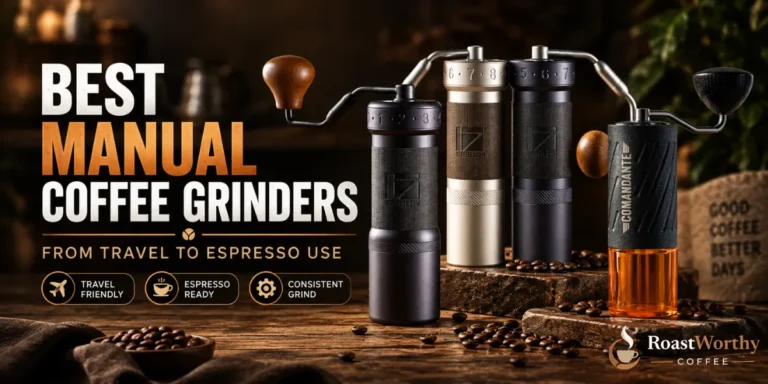
Manual grinders have a real place. They're not just for travelers and hipsters. A Comandante C40 at $260 produces grind quality that rivals electric grinders at twice the price.
For pour-over specifically, manual grinding is a legitimate choice, not a compromise. The lack of motor means more money spent on burr geometry.
Don't buy a blade grinder. Seriously. The market data shows blade grinders declining in revenue share while burr grinders grow. The market is telling you something.
A $15 blade grinder produces bimodal particle distribution — dust and boulders. That means channeling, over-extraction of fines, and under-extraction of coarse particles simultaneously. You're tasting inconsistency, not coffee.
Taste it. Write it down. Grind it again. But grind it on a burr. ☕
Coffee Grinder Market Size 2026: $2.84 Billion and Climbing
The numbers depend on what you count as a “coffee grinder market.” Let me break it down by source, because the variance is significant.
Reed Intelligence values the global Household Coffee Grinding Machines Market at $2.84 billion in 2026, projected to reach $6.41 billion by 2034. That's a 10.7% CAGR — one of the fastest growth rates in any coffee equipment category.
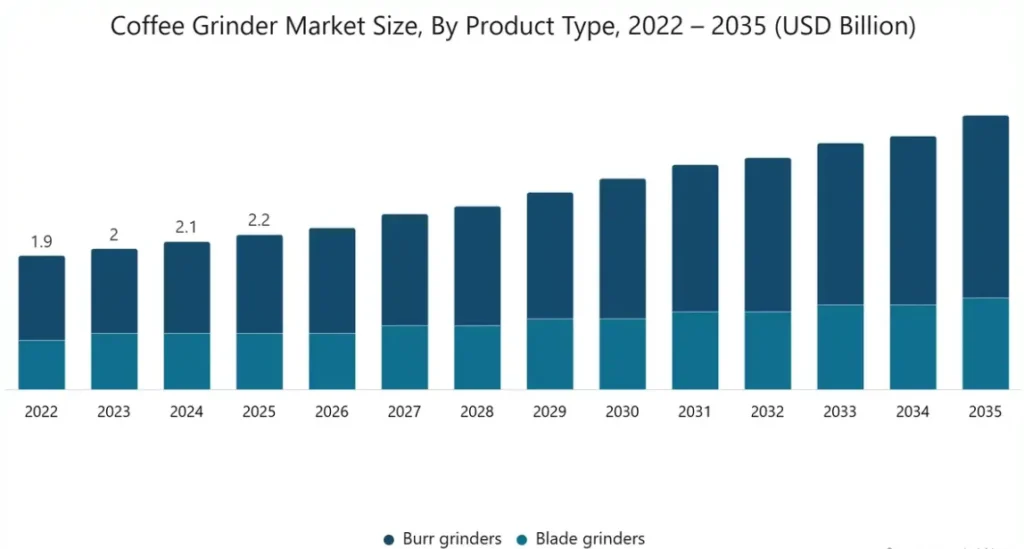
Global Market Insights puts the broader coffee grinder market at $2.2 billion in 2025, growing at 5.7% CAGR through 2035. Their number is lower because it includes commercial and industrial grinders alongside household units, with different growth weighting.
Global Growth Insights tracks “Coffee Bean Grinders” specifically at $1.02 billion in 2025, projected to $1.55 billion by 2033 at 5.4% CAGR. A narrower product definition.
| Source | Segment | 2026 Value | Forecast | CAGR |
|---|---|---|---|---|
| Reed Intelligence | Household grinding machines | $2.84B | $6.41B by 2034 | 10.7% |
| GMI | All coffee grinders (broad) | $2.2B (2025) | — | 5.7% |
| Global Growth Insights | Coffee bean grinders | $1.02B (2025) | $1.55B by 2033 | 5.4% |
| Market Growth Reports | Home grinders | $910.34M | $1.52B by 2035 | 5.3% |
| Research and Markets | Coffee grinders | $457.93M | $731.28M by 2032 | 7.8% |
The disagreement comes down to classification. Some reports count only standalone household grinders. Others include built-in grinder modules in espresso machines.
Some include commercial café grinders. The widest definition — Reed Intelligence's household grinding machines at $2.84 billion — is growing the fastest at 10.7% CAGR.
That 10.7% tells you something. It's nearly double the overall coffee market's 5.4% growth rate. People aren't just drinking more coffee. They're investing in the equipment to grind it fresh. The “buy pre-ground” habit is dying.
The US coffee grinder market
The United States is the dominant country market. US household grinder values hit $690 million in 2024 and $755 million in 2025 — a 9.4% single-year jump.
That growth tracks directly with the consumption shift we covered earlier. 82% of coffee drinkers now brew at home. You can't brew great coffee at home with pre-ground beans from a supermarket tin. You need a grinder. The market is responding to the behavior.
Burr vs Blade Coffee Grinder Statistics: Market Share Breakdown
This is the question every home brewer asks first. And the market data tells a clear story.
In the European Union — the most mature grinder market outside the US — annual unit sales sit between 18 million and 22 million units. Burr grinders account for approximately 40–45% of unit sales. But here's the kicker: those burr grinders generate 65–75% of total market revenue.
Translation? Blade grinders sell more units because they're cheap. Burr grinders earn more money because they're premium. The revenue split tells you where the market is actually heading — toward burr.
| Grinder Type | Unit Share (EU) | Revenue Share | Price Tier |
|---|---|---|---|
| Blade grinders | 55–60% | 25–35% | €20–€50 |
| Burr grinders | 40–45% | 65–75% | €80–€1,500+ |
A blade grinder costs €20 and lasts two years. A burr grinder costs €150 and lasts a decade. The consumer who buys burr is investing in consistency. The one who buys blade is solving for cost.
But the growth rate tells you which way the wind blows. The burr segment is growing faster than blade in both units and revenue. People who upgrade from blade to burr don't go back.
The particle distribution difference is that stark — bimodal vs unimodal grind. One gives you channeling and uneven extraction. The other gives you a balanced cup.
I burned three batches on a popcorn popper in 2017 before I figured out my $15 blade grinder was producing dust and boulders in the same portafilter. The roast wasn't the problem. The grind was. ☕
Electric vs Manual Coffee Grinder Sales Statistics
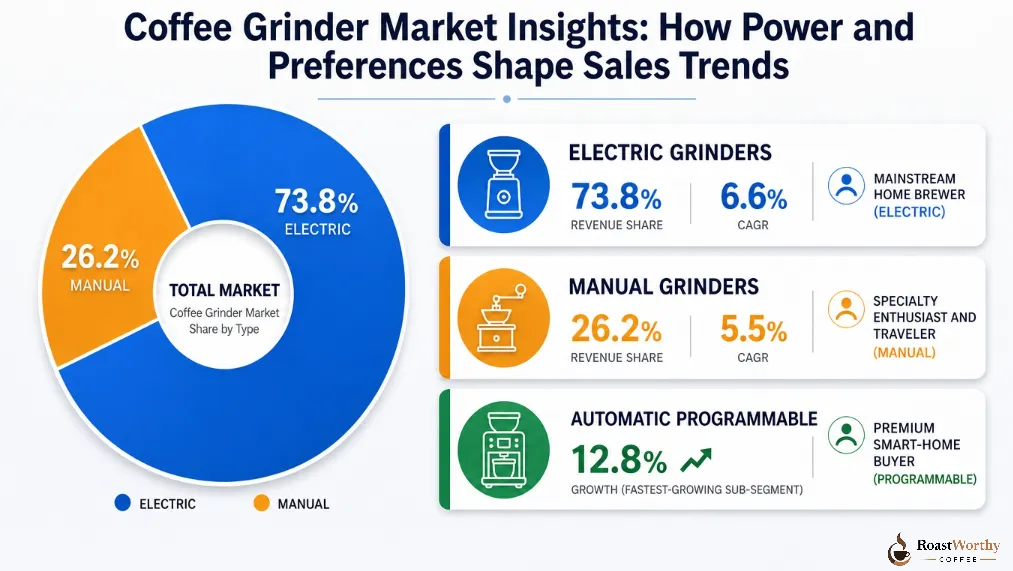
Electric dominates. But manual is growing faster than people think.
Electric grinders held approximately 73.8% of global household grinder revenue in 2024, according to Reed Intelligence. GMI's broader market analysis puts electric at 66% of total market share in 2023, growing at 6.6% CAGR.
Manual grinders — hand-cranked, ceramic or steel burr — are growing at 5.5% CAGR. Slower in absolute terms, but notable because manual grinders are almost entirely a specialty coffee phenomenon. Nobody buys a manual grinder for convenience. They buy it for grind quality at a price point.
| Operation Mode | Revenue Share (2024) | CAGR | Primary Buyer |
|---|---|---|---|
| Electric | 73.8% | 6.6% | Mainstream home brewer |
| Manual | 26.2% | 5.5% | Specialty enthusiast / traveler |
| Automatic programmable | Fastest-growing sub-segment | 12.8% | Premium / smart-home buyer |
That automatic programmable segment is the one to watch. 12.8% CAGR — the fastest growth rate in any grinder sub-category.
These are grinders with programmable dosing, timed grinding, and app connectivity. The smart-kitchen trend is hitting coffee equipment hard.
People want to set their grind time, dose weight, and particle size on an app, press a button in the morning, and have perfectly ground coffee waiting. That's convenience married to precision. The market for that combination is exploding.
Coffee Grinder Sales Volume: How Many Units Are Sold?
Let's talk unit volume. Because revenue tells you about price. Units tell you about adoption.
The EU market alone moves 18–22 million coffee grinders annually. That's one region.
In the US, the $755 million market at an average retail price of roughly $80–$120 per unit suggests approximately 6.3 to 9.4 million household grinders sold annually. The math depends on price mix — cheaper blade units drag the average down; premium burr units pull it up.
GMI's broader analysis estimated global unit sales exceeded 3.2 million units in 2024 at approximately $330 average factory price — but that's factory-gate pricing for standalone grinders, not retail consumer purchases. The retail unit count is significantly higher.
Commercial coffee grinder statistics
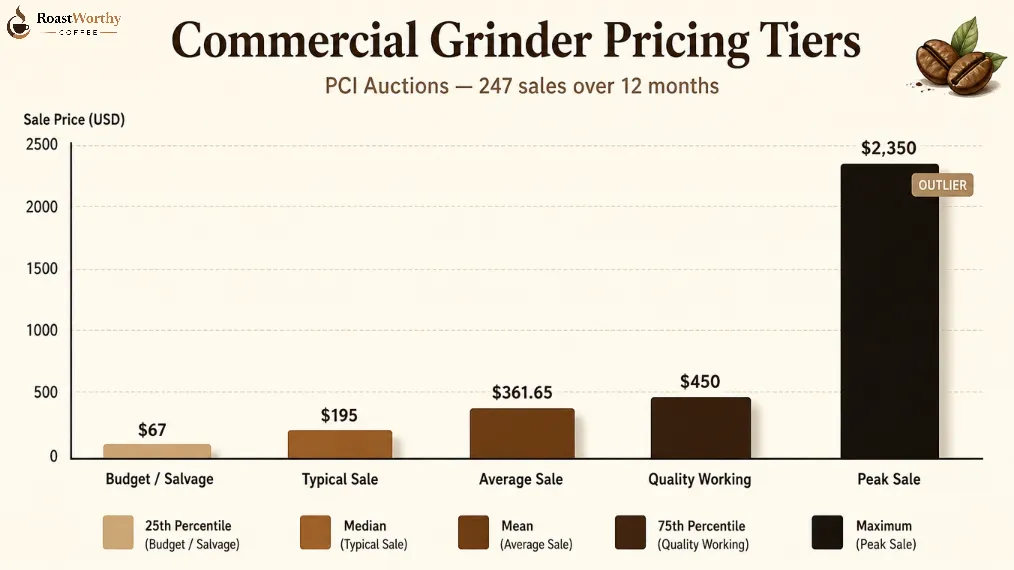
Commercial grinders are a different animal entirely. They're built for throughput, durability, and consistency at volume.
PCI Auctions analyzed 247 commercial coffee grinder sales over 12 months. The data paints a picture of a bifurcated market.
| Metric | Figure |
|---|---|
| Median sale price | $195 |
| Mean sale price | $361.65 |
| Price range | $0.26 to $2,350 |
| 25th percentile | $67 (budget/salvage tier) |
| 75th percentile | $450 (quality working units) |
The median of $195 tells you most commercial grinders trade in the entry-to-mid range — Mahlkönig EK43 alternatives, Bunn G-series, Baratza Forte. The $2,350 high end is where you find the Mahlkönig EK43 S and similar café workhorses.
The $0.26 low-end data point? That's salvage equipment — dead grinders sold for parts at auction. The real working commercial grinder market sits between $200 and $600 for most transactions.
Coffee Machine Statistics 2026: The Bigger Equipment Picture
Grinders don't exist in isolation. They sit alongside coffee machines — and that market is larger and growing differently.
The global coffee machines market was valued at $12.2 billion in 2026 and is projected to reach $15.69 billion by 2035. That's the broader equipment ecosystem that grinders feed into.
In the UK, 56% of adults now own a coffee machine. 22% own pod machines. 15% own espresso machines. 10% own bean-to-cup machines. And 53% of Brits say they've stopped spending money on coffee-shop visits since investing in home equipment.
Those bean-to-cup machines — 10% of UK owners — typically include built-in grinders. That's a segment that partially cannibalizes standalone grinder sales. If your espresso machine grinds for you, you don't buy a separate grinder.
But serious home baristas don't use built-in grinders. The quality gap between a built-in ceramic burr and a dedicated Niche Zero or DF64 is significant. Built-ins prioritize convenience. Standalone grinders prioritize consistency. Different buyers. Different markets.
Why equipment growth outpaces coffee consumption growth
Here's the pattern that matters. Coffee consumption grows at 5.4% annually. Household grinder market grows at 10.7%. Coffee machine market grows at roughly 5% annually.
The grinder market is growing nearly twice as fast as the coffee market itself. That means existing coffee drinkers are upgrading equipment, not just drinking more. The market is deepening, not just widening.
This is the premiumization signal in hardware form. Someone who drank pre-ground coffee for years buys a Baratza Encore. Then they upgrade to a DF64. Then they add a single-dose hopper. The equipment ladder is real, and the market data shows people climbing it.
Coffee Grinder Price Statistics: What People Actually Pay
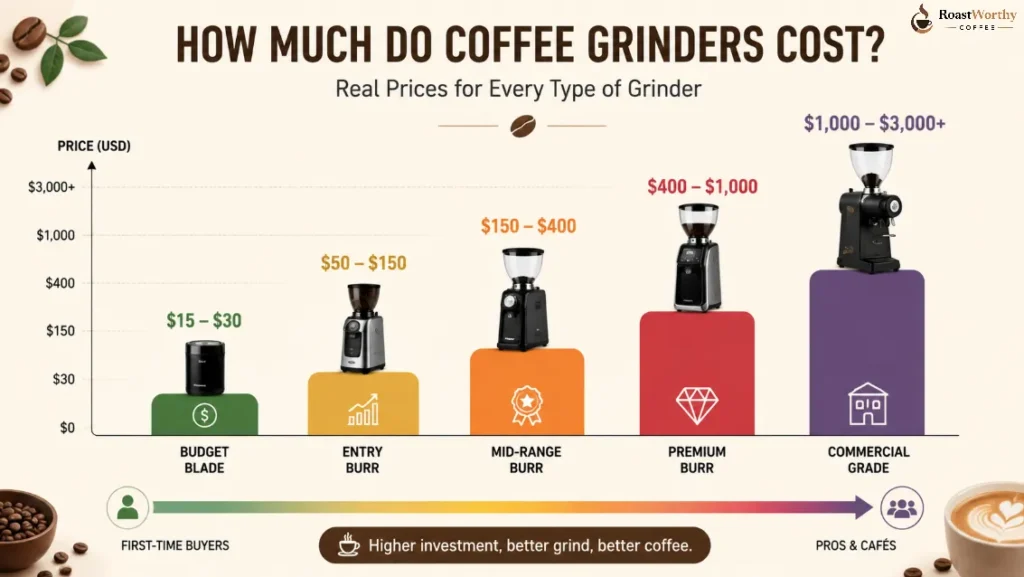
Let's get specific about pricing. Because the range in this category is absurd.
| Grinder Tier | Price Range | Examples | Target Buyer |
|---|---|---|---|
| Budget blade | $15–$30 | Mr. Coffee, Krups blade | First-time / casual |
| Entry burr | $50–$150 | Baratza Encore, Capresso Infinity | Upgrading from blade |
| Mid-range burr | $150–$400 | Baratza Virtuoso+, Fellow Ode, Niche Zero | Specialty home brewer |
| Premium burr | $400–$1,000 | DF64, Eureka Mignon Specialita | Home barista / light roaster |
| Commercial-grade | $1,000–$3,000+ | Mahlkönig EK43, Mythos One | Café / serious enthusiast |
The EU data confirms this spread — from €20 blade grinders sold in grocery channels to €1,500+ precision instruments sold through specialty retailers.
The growth is in the middle. The $150–$400 tier is where the volume expansion is happening. That's the “I've outgrown my blade grinder and I'm getting serious” purchase. Baratza Encore to Fellow Ode. Capresso to Niche Zero.
This tier didn't exist at scale five years ago. The direct-to-consumer grinder brands — Niche, DF64, Fellow — created a price point between commodity blade grinders and commercial-grade equipment. They filled the gap that traditional brands like Breville and Cuisinart weren't serving.
What's Driving Coffee Grinder Market Growth?
Three forces. All converging simultaneously.
Home brewing permanence: 82% of coffee drinkers brew at home. That number hasn't moved since 2022. But the quality of home brewing is improving. People who started with a French press and pre-ground beans are moving to pour-over with freshly ground coffee. The behavior shift creates the equipment demand.
Specialty coffee adoption: 48% of US adults had specialty coffee in the past day — the first time specialty beat traditional. Specialty coffee demands fresh grinding. You can't brew a great single-origin with pre-ground beans that lost their CO₂ three weeks ago. The specialty trend is a grinder sales driver.
Equipment-as-experience: Coffee equipment has become a hobby, not just a utility. People research burr geometries. They debate flat vs conical burrs. They follow grinder reviews on YouTube. The equipment is part of the experience — and consumers are willing to pay for it.
The 10.7% CAGR in household grinders isn't about more people drinking coffee. It's about people who already drink coffee investing in better tools. Your first roast will be imperfect. Make it anyway. But don't grind it on a blade grinder. 🔥
Regional Coffee Grinder Market Statistics
The US leads in household grinder market value — $755 million in 2025. But the growth patterns vary by region.
North America: Highest adoption of premium burr grinders. Strong DTC brand presence (Baratza, Fellow, Niche). E-commerce drives the majority of sales. The specialty coffee infrastructure — roasters, cafés, education — supports a culture of equipment upgrading.
Europe: Largest unit volume (18–22M units annually in the EU). Stronger retail channel presence. Italian and German heritage brands (Eureka, Mahlkönig, Comandante) dominate the premium segment. EU sustainability regulations are pushing manufacturers toward repairable, long-life designs.
Asia-Pacific: Fastest-growing region for grinder adoption. Japan has a long-standing specialty coffee culture with strong manual grinder adoption (Commandante, Hario, Porlex). South Korea's café boom is driving commercial grinder demand. China's emerging specialty scene is creating first-time premium grinder buyers.
Latin America: Producing countries are developing domestic specialty markets. Brazil's growing café culture is creating demand for commercial grinders. Home grinding is still nascent compared to North America and Europe, but growing from a small base.
Coffee Grinder Market Competitive Landscape
The brands building the grinders that build your morning cup.
Baratza — the gateway drug. The Encore is the most recommended entry-level burr grinder in specialty coffee. Their Virtuoso+ and Vario series cover the mid-range. Owned by Breville since 2020, which gives them distribution scale without compromising their specialty positioning.
Eureka — Italian precision. The Mignon series dominates the mid-range espresso grinder market. Specialita, Silenzio, and Mignon Zero are standard recommendations for home espresso setups. Their flat-burr options compete with commercial-grade equipment at a fraction of the price.
Mahlkönig — the commercial standard. The EK43 is the most influential grinder in specialty coffee history. Their retail price starts around $2,000 and climbs fast. If you see a flat-burr grinder on a café counter, there's a good chance it's a Mahlkönig.
Niche Gear — DTC disruptor. The Niche Zero pioneered single-dose grinding at a consumer price point. Their direct-to-consumer model bypasses retail margins, delivering commercial-grade flat-burr performance at $680.
Fellow — design-forward. The Ode grinder brought aesthetic appeal to a category that historically prioritized function over form. Their products are as much about counter presence as grind quality. And they back it up with real burr geometry, not just looks.
DF64 — the value disruptor. Chinese-manufactured flat-burr grinders selling at $400–$650 that compete with $1,500+ European models. They've disrupted the premium segment by removing brand premium and distribution costs. Quality is improving with each generation. The curve doesn't lie. ⚗️
FAQ: Coffee Grinder Statistics 2026
How big is the coffee grinder market in 2026?
The global household coffee grinding machines market is valued at $2.84B in 2026, projected to reach $6.41B by 2034 at 10.7% CAGR (Reed Intelligence) — nearly double the coffee market's growth rate.
How many coffee grinders are sold each year?
The EU sells 18–22M units annually. The US market (~$755M in 2025) suggests ~6.3–9.4M household units sold per year based on average retail pricing of $80–$120.
Are burr or blade grinders more popular?
Blade grinders sell more units (55–60% EU share) due to lower prices. But burr grinders generate 65–75% of revenue. The burr segment is growing faster in both units and revenue.
What is the average price of a coffee grinder?
Prices range from $15 for budget blade grinders to $3,000+ for commercial-grade equipment. The growth tier is $150–$400 (Baratza Encore, Fellow Ode, Niche Zero). Commercial median is $195.
Are electric or manual coffee grinders more popular?
Electric grinders hold ~73.8% of household grinder revenue. Manual holds 26.2% but is growing at 5.5% CAGR, driven by specialty enthusiasts who value grind quality over convenience.
How fast is the coffee grinder market growing?
The household segment grows at 10.7% CAGR — nearly double the overall coffee market's 5.4%. This signals existing drinkers are upgrading equipment, not just new drinkers entering the market.
What is the fastest-growing coffee grinder segment?
Automatic programmable grinders with dosing, timed grinding, and app connectivity are the fastest-growing sub-segment at 12.8% CAGR — reflecting demand for convenience plus precision.
Who are the major coffee grinder manufacturers?
Key players include Baratza (entry-mid burr), Eureka (Italian espresso grinders), Mahlkönig (commercial standard), Niche Gear (DTC single-dose), Fellow (design-forward), and DF64 (value flat-burr).
More Recommendations from RoastWorthy Coffee