Koa vs Volcanica Kona Coffee 2026: Best 100% Kona Compared

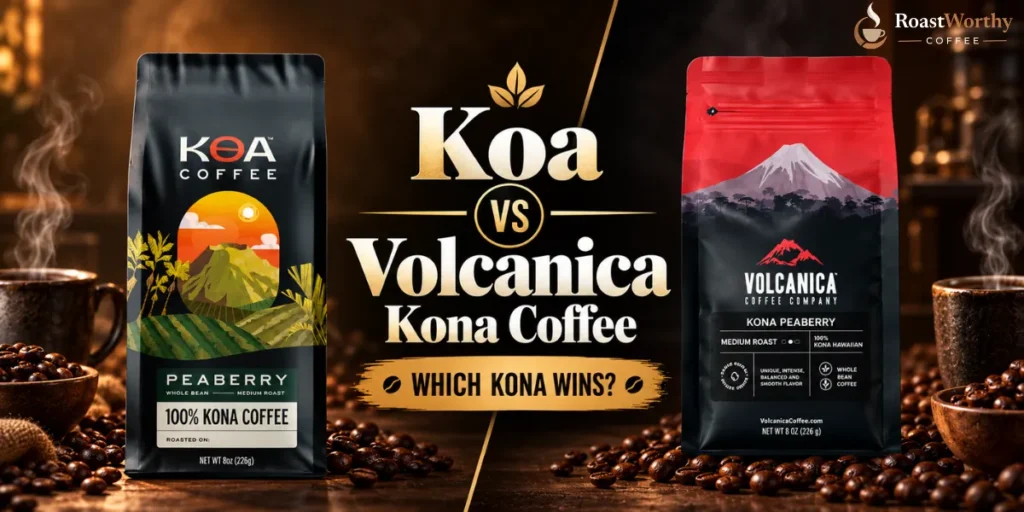
Koa Coffee wins this comparison for buyers who want the strongest specialist 100% Kona lineup. Its Peaberry, Estate, Private Reserve, and Grande Domaine coffees create clearer steps between everyday premium and full splurge.
Volcanica is the better choice for grind flexibility, published flavor details, named-farm sourcing, and a clearly stated roast-on-demand policy.
The Koa vs Volcanica Kona Coffee argument comes down to one question: do you want a Kona specialist or a broad specialty roaster with strong Kona options?
Koa is the Kona-first brand. Its range feels built for people already convinced that 100% Kona coffee deserves the price.
Volcanica sells coffee from many volcanic regions. Its Kona Peaberry and Extra Fancy bags are still serious, but they sit inside a much larger global catalog.
I compared matching 100% Kona offerings by origin disclosure, grade, roast, freshness, ordering options, and value. Customer reviews were not treated as cupping data.
Good marketing is not cupping.
Koa vs Volcanica at a Glance
| Category | Koa Coffee | Volcanica Coffee |
|---|---|---|
| Best for | Kona-focused buyers | Convenience and grind choice |
| 100% Kona range | Peaberry, Estate, Private Reserve, Grande Domaine, Natural | Peaberry and Extra Fancy |
| Flagship roast style | Medium, dark, and Vienna | Mainly medium |
| Peaberry price | $60 for 8 oz | $129.99 for 16 oz |
| Entry point | Private Reserve from $42 for 8 oz | Extra Fancy from $129.99 for 16 oz |
| Farm disclosure | Single-estate option, farm not named on product page | Cancino Family Farm named |
| Freshness statement | Batch cupping and freshness-focused packaging | Roasted weekly and generally shipped within days |
| Grind options | Whole bean and ground products | Whole bean, drip, espresso, French press |
| Winner | Koa Coffee | Best for flexibility |
Prices can move. Compare bag weight before reacting to the sticker.
Kona punishes lazy price comparisons. Current product, price, grind, and freshness information comes from the brands’ active product and customer-service pages.
What Does 100% Kona Coffee Actually Mean?
Real Kona coffee comes from the Kona growing districts on Hawaiʻi Island. It is not the same product as a “Kona blend.”
Hawaiʻi’s labeling rules require coffees using a Hawaiʻi geographical name to disclose the local origin and weight percentage.
Products claiming to be 100% Hawaiian must be grown and processed in the state. That matters because a blend can contain a small Kona portion alongside cheaper imported coffee.
Both brands sell genuine 100% Kona options.
That clears the first hurdle.
The next question is quality within that category.
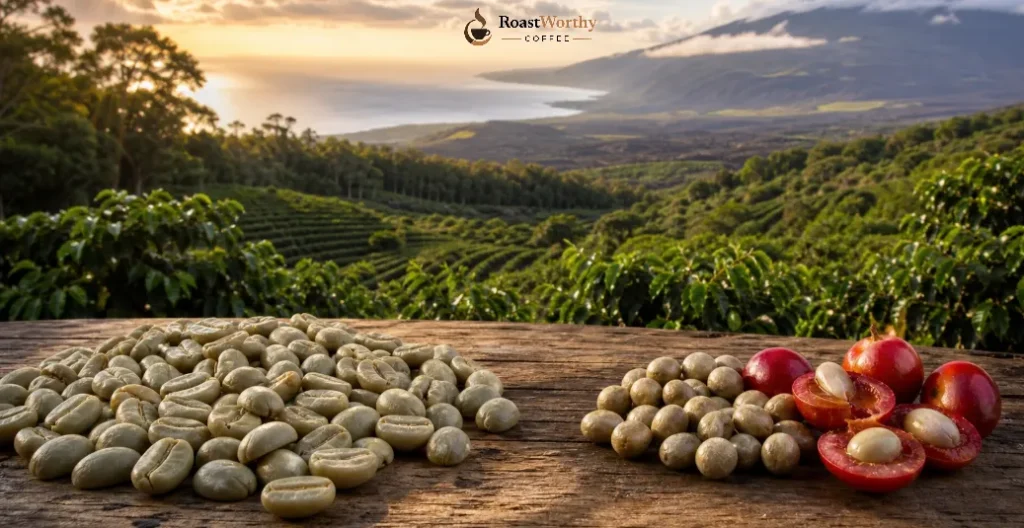
Extra Fancy is Hawaii’s highest conventional Type I green-coffee grade. It uses large beans, tight defect limits, controlled moisture, and uniform green color.
Peaberry is Type II. One rounded seed develops inside the cherry instead of the usual pair.
Grade is not a flavor score.
A large, clean Extra Fancy bean can roast evenly. A Peaberry can taste concentrated and lively.
Neither label guarantees that the roast was handled well.
The flavour doesn’t lie.
Koa Coffee: The Kona Specialist
Koa Coffee began as a family business in 1997.
The company says its coffees are hand-picked at the red-cherry stage, roasted by people, packed by people, and cupped after roasting. Its range stays heavily centered on Hawaiian coffee.
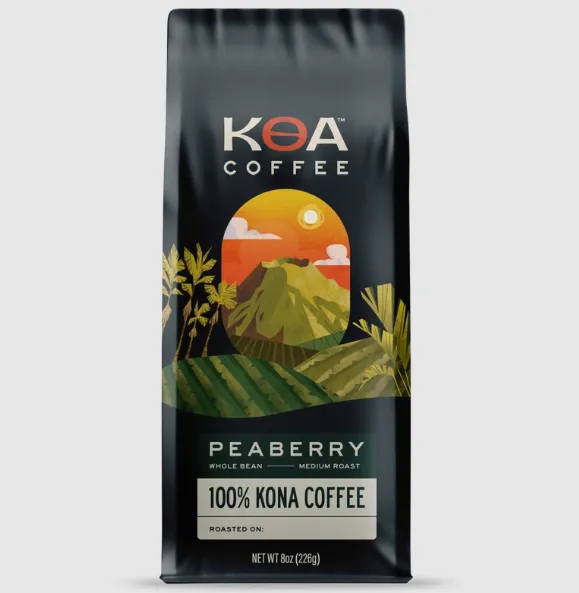
Koa Peaberry
Koa’s Peaberry Medium Roast costs $60 for an 8-ounce bag.
The company describes it as full-bodied, smooth, and carrying a slight bite. Koa says Peaberry represents roughly 3% to 5% of Kona production.
At $7.50 per ounce, it is slightly cheaper than Volcanica’s current Peaberry price per ounce.
Peaberry is the headline product. It is also the bag most likely to make a first-time buyer hesitate at checkout.
Koa Estate
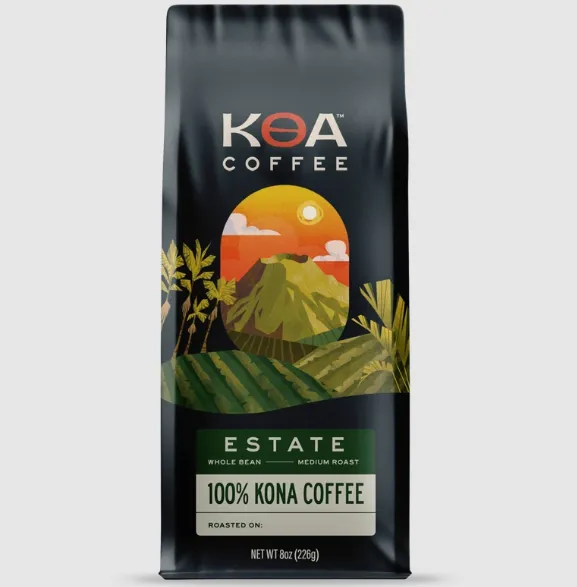
The Estate Medium Roast starts at $46 for 8 ounces.
Koa defines it as coffee from one high-elevation Kona farm, without mixing crops from other farms. The roast is medium and aimed at showing the Mauna Loa-grown character rather than heavy roast flavor.
This is the smarter Koa purchase for most readers.
Estate gives you traceability and a lower entry price. It also provides a more useful baseline before moving into expensive Kona Peaberry.
Koa Private Reserve and Grande Domaine
Private Reserve starts at $42 for 8 ounces.
It is a proprietary mix of 100% Kona grades, roasted medium. This is Koa’s practical gateway bag.
Grande Domaine starts at $48 for 8 ounces.
It combines selected Kona grades with some Peaberry, then takes them to a Vienna roast, just beyond medium.
It suits drinkers wanting deeper caramelization without going fully dark. Brew it too hot and origin detail can flatten.
Volcanica Kona Coffee: Better Details, Broader Catalog
Volcanica is a family-owned roaster based in Atlanta.
It follows a roast-to-order model, though it is not a farm-direct Kona retailer in the strictest sense.
Its roots are tied to a Costa Rican coffee-growing family, and its catalog covers volcanic origins around the world.
Volcanica roasts weekly and says most coffee ships within days of roasting. It also states that no coffee is sent more than two weeks past its roast date.
Koa talks about improved packaging and cupping every roast. Volcanica publishes a clearer maximum roast-age policy.
Based on the public information available, Volcanica wins freshness transparency, though that does not prove every delivered bag will be fresher.
Volcanica Kona Peaberry
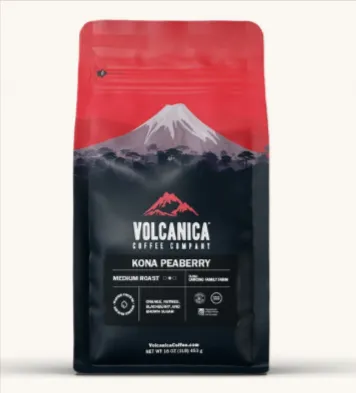
Volcanica’s Kona Peaberry costs $129.99 for 16 ounces.
It is a washed, sun-dried, medium roast from Cancino Family Farm.
The published flavor profile includes orange, nutmeg, blackberry, and brown sugar. Volcanica also offers whole bean, drip, espresso, and French press grinds.
Orange and blackberry suggest brighter fruit. Nutmeg and brown sugar add sweetness and spice.
At roughly $8.12 per ounce, it costs about 8% more than Koa Peaberry.
That difference is not enormous at this level. Still… expensive coffee does not become cheaper because the percentage looks small.
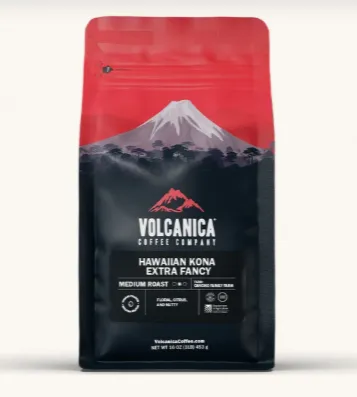
Volcanica Extra Fancy Kona
Volcanica’s Extra Fancy also costs $129.99 for 16 ounces.
It comes from Cancino Family Farm and uses washed processing, sun drying, and a medium roast.
Its stated cup is floral, citrusy, and nutty. The coffee is State of Hawaii certified and sold in whole-bean or multiple ground formats.
This is Volcanica’s better all-round Kona.
Expect cleaner structure, gentler fruit, and a more traditional premium Kona shape.
Flavor and Roast Comparison
Their roast choices still tell us plenty.
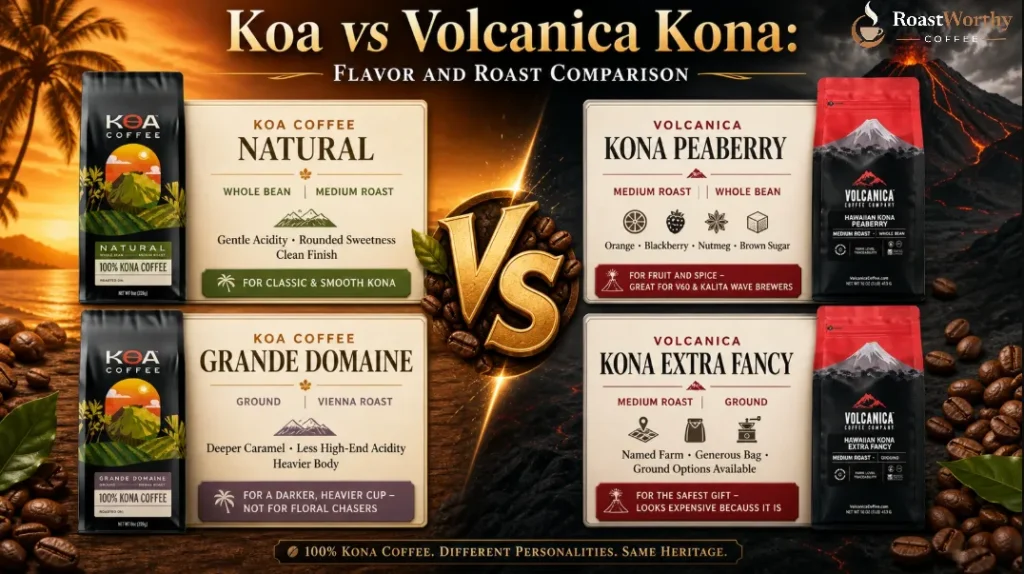
For Classic, Smooth Kona
Choose Koa Estate Medium Roast.
Its single-estate format and medium roast make sense for drinkers chasing gentle acidity, rounded sweetness, and a clean finish.
It is also less financially painful than starting with Peaberry.
For Fruit and Spice
Choose Volcanica Kona Peaberry.
Its published orange, blackberry, nutmeg, and brown-sugar profile sounds more vivid.
That should work well in a V60, Kalita Wave, or another paper-filter brewer.
For a Darker, Heavier Cup
Choose Koa Grande Domaine.
The Vienna roast brings more roast character. Expect deeper caramel tones and less high-end acidity than the medium-roast bags.
This is not the bag for someone chasing delicate florals.
For the Safest Gift
Choose Volcanica Extra Fancy.
The farm is named, the bag is generous, and ground options suit recipients without a grinder.
It looks expensive because it is expensive. At least the presentation and information support the price.
Koa vs Volcanica Kona: Which Brand Offers Better Value?
Koa wins value within premium Kona.
None of this coffee is cheap.
Koa’s Private Reserve costs about $5.25 per ounce. Estate lands near $5.75. Grande Domaine is $6.00. Peaberry reaches $7.50.
Volcanica’s Peaberry and Extra Fancy sit near $8.12 per ounce at current prices.
Koa also advertises $7 domestic shipping on qualifying orders. Volcanica offers free shipping over $60 and a $6.95 flat rate below that threshold.
Volcanica partly earns its premium through grind choice, named-farm disclosure, and a larger bag.
Koa gives you more ways to enter the category. That matters when a full pound costs nearly $130.
Peaberry vs Extra Fancy: Which Should You Buy?
Buy Peaberry for rarity and concentrated character.
Buy Extra Fancy for uniformity and a cleaner comparison of farm and roast.
Peaberry is not automatically better.
It is botanically different and scarcer. Extra Fancy is a formal grade based on bean size and defect tolerance.
Start with Estate or Extra Fancy. Try Peaberry once you have a reference point.
Taste it. Write it down. Brew it again. ☕
Best Brewing Recipe for Premium Kona Coffee
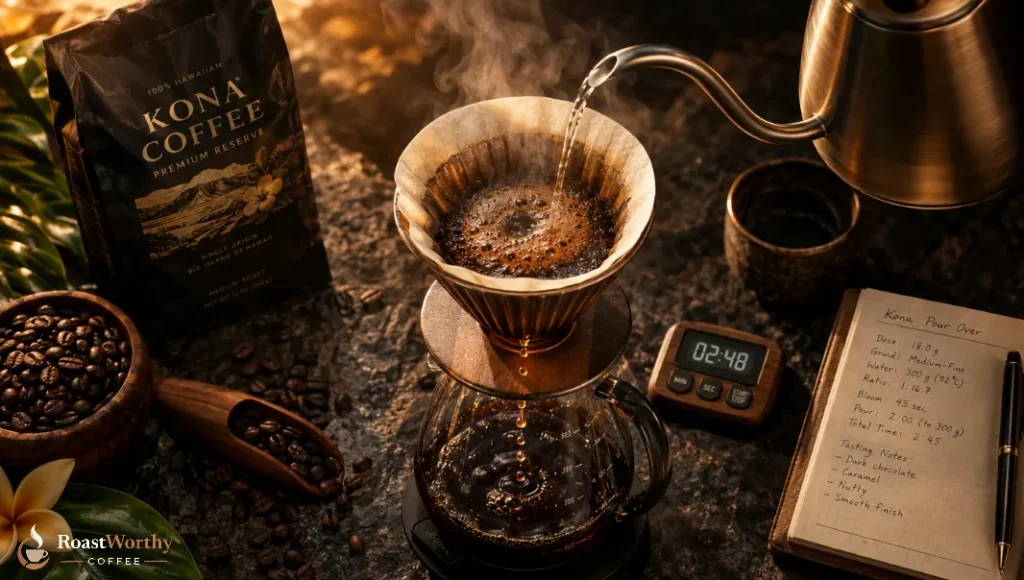
Do not drown a $60 half-pound bag in a 1:18 ratio.
Use this pour-over starting point:
Use 198°F for Koa Grande Domaine.
Use 201°F to 202°F for the medium-roast Estate, Extra Fancy, and Peaberry coffees.
If the cup tastes thin, grind finer.
If the finish turns dry and woody, grind coarser or lower the water temperature by 2°F.
The curve doesn’t lie… and neither does extraction.
For more context, pair this comparison with our Kona Coffee Buying Guide, Best Coffee Beans for Pour Over, and Medium Roast Brewing Guide.
Who Should Buy Koa Coffee?
Choose Koa when:
Koa is the better enthusiast brand.
Who Should Buy Volcanica Coffee?
Choose Volcanica when:
Volcanica is the better convenience brand.
Frequently Asked Questions
Is Koa Coffee better than Volcanica?
Koa is better for a broad, Kona-focused selection and lower entry prices. Volcanica is better for grind options, named-farm details, and freshness transparency.
Is Koa Coffee really 100% Kona?
Koa sells multiple products labeled 100% Kona, including Peaberry, Estate, Private Reserve, and Grande Domaine. Check the exact bag because the company also sells other Hawaiian origins.
Is Volcanica Kona Coffee 100% Kona?
Volcanica’s Kona Peaberry and Hawaiian Kona Extra Fancy products are sold as 100% pure Kona and State of Hawaii certified. They are not 10% Kona blends.
Which is better, Kona Peaberry or Extra Fancy?
Peaberry is rarer and often more concentrated. Extra Fancy uses larger Type I beans with strict defect limits. Roast quality matters more than the prestige label.
What is the best Koa Coffee to try first?
Koa Estate Medium Roast is the best starting point. It is single-estate, medium roasted, and cheaper than Koa Peaberry.
What is the best Volcanica Kona Coffee?
Volcanica Extra Fancy is the safer all-round choice. Pick its Kona Peaberry when you want brighter fruit, spice, and more intensity.
Final Verdict: Koa or Volcanica?
It offers the stronger 100% Kona range, better entry pricing, and more roast variety.
The Estate Medium Roast is my best overall choice in this matchup.
Its named-farm sourcing, grind options, and roast-on-demand statement are excellent. Its Kona Peaberry also has the more adventurous published flavor profile.
Let’s be honest. At these prices, buying the wrong roast hurts.
Start with Koa Estate for classic Kona.
Pick Volcanica Peaberry when fruit and spice matter more than price.
No notes. And that’s rare. ☕✒️
More Recommendations from RoastWorthy Coffee