
How Many Cups of Coffee a Day Is Too Many? Caffeine Safety Explained

Most people never ask the question until something goes wrong.
Heart racing at 2pm. Hands slightly shaky. Sleep that just… won't come. You've been drinking coffee your whole life — so when did it become a problem?
Here's the honest answer: how many cups of coffee a day is safe depends on the coffee, the person, and one very specific number — 400mg of caffeine.
That's the ceiling. Let's build up to it properly.
The 400mg Caffeine Limit: Where It Comes From
The U.S. Food and Drug Administration (FDA) and most global health bodies put safe daily caffeine intake for healthy adults at 400 milligrams per day.
That's the number. Not a rough estimate. A researched ceiling.
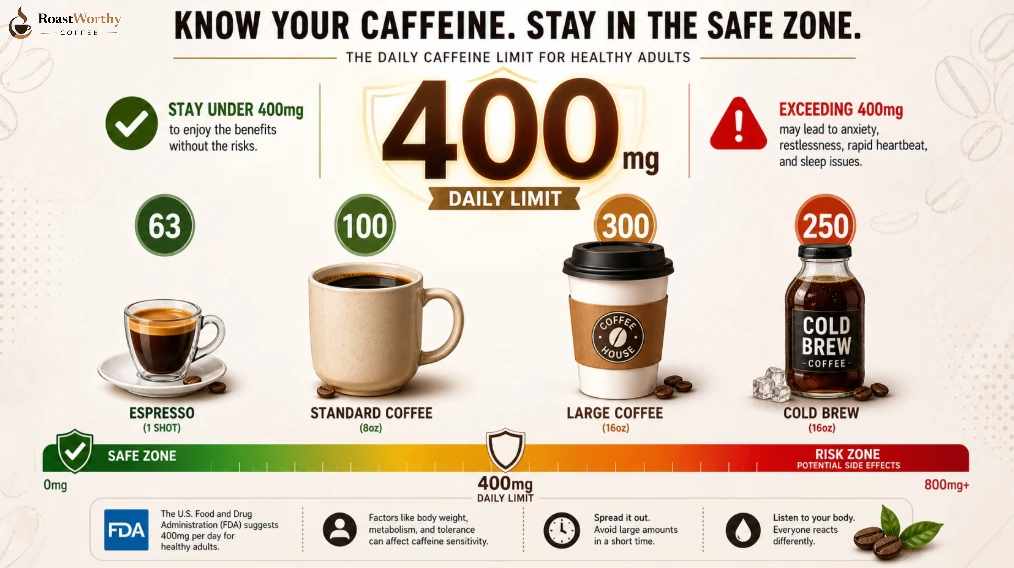
Four hundred milligrams is roughly 4 standard 8oz cups of drip coffee. But that word “standard” is doing a lot of work.
A shot of espresso runs about 63mg. A large drip coffee from a major chain can hit 300mg alone. A cold brew can clock 200–250mg per 12oz serving.
So “four cups” can mean 200mg or 800mg depending entirely on what you're drinking.
Measure by milligrams, not mugs. ⚗️
So How Many Cups of Coffee a Day Is Actually Safe?
For a healthy adult with no caffeine sensitivity issues, here's what the math looks like in practice:
The number of cups is almost meaningless without knowing caffeine content. A single gas station large coffee can exceed what two pour-overs deliver.
Research consistently shows that 3–5 cups of coffee per day is associated with neutral-to-positive health outcomes in most adults. The European Food Safety Authority (EFSA) also sets 400mg as the safe upper limit — and drops that to 200mg for pregnant individuals.
The number is clear. The cups are not.
What Happens When You Go Over the Limit
Caffeine is a stimulant. It blocks adenosine receptors — the chemical that makes you feel tired. At moderate doses, that's useful. At high doses, it becomes a problem.
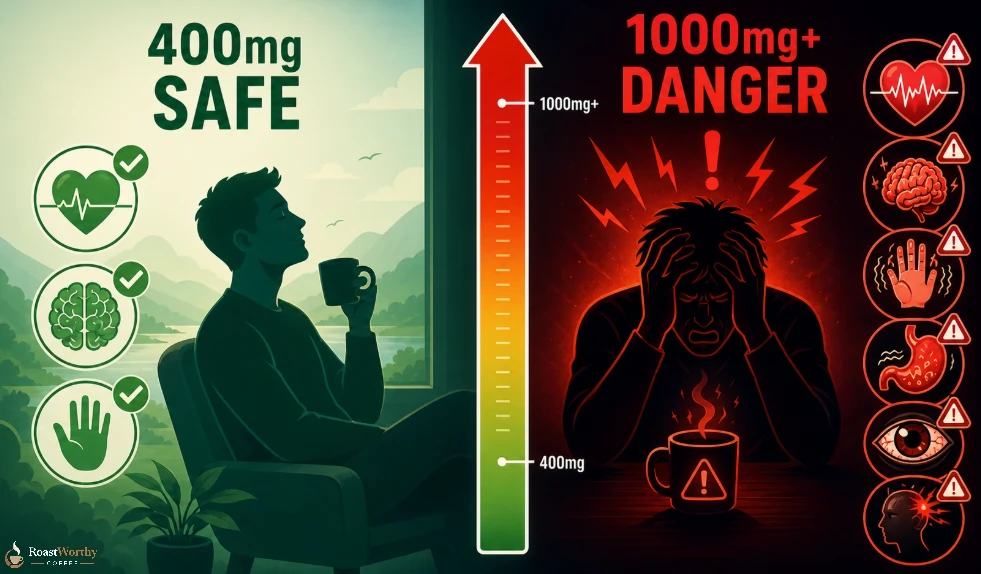
Too Much Coffee Symptoms to Watch For
These aren't rare edge cases. These are what caffeine overconsumption looks like in real life.
The technical term is caffeine toxicity. At doses above 1,000mg — roughly 10 strong cups in a short window — symptoms become dangerous: severe vomiting, cardiac arrhythmia, seizures in extreme cases.
That's not typical coffee drinking. But it is achievable if you're stacking energy drinks, pre-workout supplements, and coffee in the same day without tracking.
Total daily caffeine from all sources is what matters. Not just the cups. ☕
Why Your Personal Limit May Be Lower
Four hundred milligrams is a population average. It is not a universal safe zone.
Several factors push individual thresholds significantly lower:
Caffeine Sensitivity Factors
Genetics. CYP1A2 is the liver enzyme that metabolizes caffeine. Some people are fast metabolizers — caffeine clears quickly and they feel fine. Slow metabolizers feel every milligram for hours. You can't know which you are without genetic testing, but years of lived experience will give you a working answer.
Body weight. A smaller person metabolizes caffeine differently than a larger one. The 400mg guideline assumes average adult body composition.
Medications. Certain antidepressants, antibiotics (particularly fluoroquinolones), and hormonal contraceptives slow caffeine metabolism dramatically. 200mg might hit you like 400mg if you're on the wrong combination.
Pregnancy. Maximum daily coffee consumption drops to approximately 200mg — roughly 2 cups — during pregnancy. Most health authorities are consistent on this point.
Anxiety disorders. Caffeine directly amplifies anxiety symptoms. If you have generalized anxiety disorder or panic disorder, your practical ceiling may be 150–200mg regardless of what your tolerance history says.
Age. Older adults often metabolize caffeine more slowly. A two-cup habit that felt fine at 30 can cause noticeable disruption at 55.
The Brewing Method Variable Nobody Explains
Here's what most caffeine safety articles skip entirely.
Your brewing method changes everything. Same bean. Same amount. Completely different caffeine extraction.
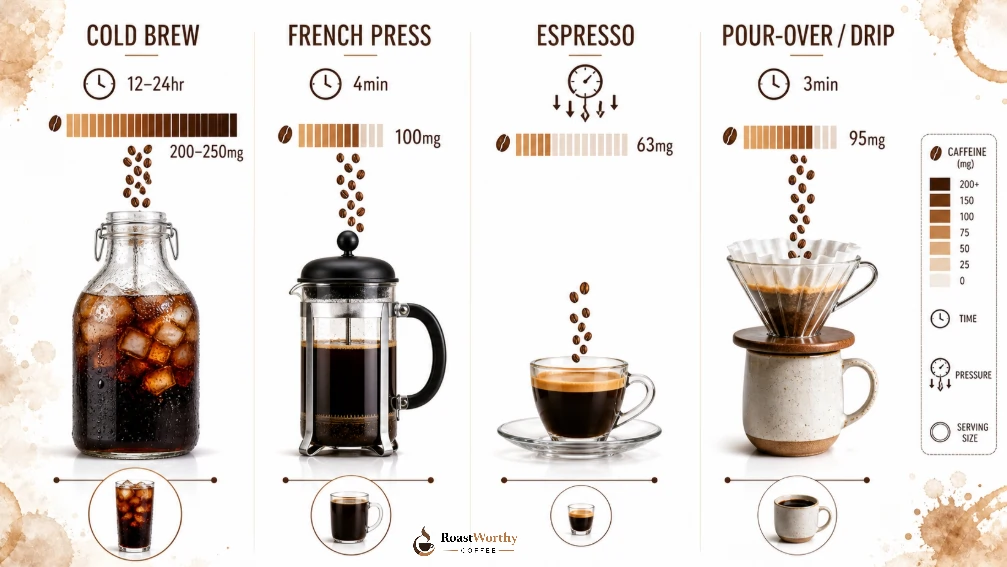
Cold brew steeps for 12–24 hours in cold water. That extended contact time pulls significantly more caffeine from the grounds than a 3-minute pour-over does. A 12oz cold brew can contain twice the caffeine of a same-sized hot drip coffee.
French press retains more cafestol and kahweol — compounds that affect cholesterol — but caffeine is similar to drip.
Espresso is often misunderstood. Per ounce, it's highly concentrated. But the serving size is small — 1–2oz. Total caffeine per drink is often lower than a full mug of drip.
Here's what the extraction is actually doing: longer contact time + finer grind = more caffeine pulled from the bean. Cold brew exploits time. Espresso exploits pressure and grind size but limits volume.
Know your brew method before you calculate your daily intake. The cup size printed on your mug is irrelevant without that context. ⚗️
The Timing Problem Nobody Talks About
You can drink within the 400mg limit and still wreck your sleep.
Caffeine has a half-life of approximately 5–6 hours in healthy adults. That means a 3pm coffee still has roughly half its caffeine active in your system at 9pm.
A slow metabolizer? That half-life stretches to 9–10 hours.
This is why people who swear they “sleep fine after an espresso at 8pm” are often wrong about their sleep quality — even if they fall asleep. Caffeine disrupts deep sleep architecture even when it doesn't prevent sleep onset entirely. You lose slow-wave sleep. Recovery suffers. You wake up tired. You reach for more coffee. The cycle continues.
Cut caffeine intake by 2pm if sleep quality matters to you. That's the practical rule. Non-negotiable for most people.
The Actual Health Benefits at Moderate Doses
This article isn't a caffeine scare piece. The data on moderate coffee consumption is genuinely positive.
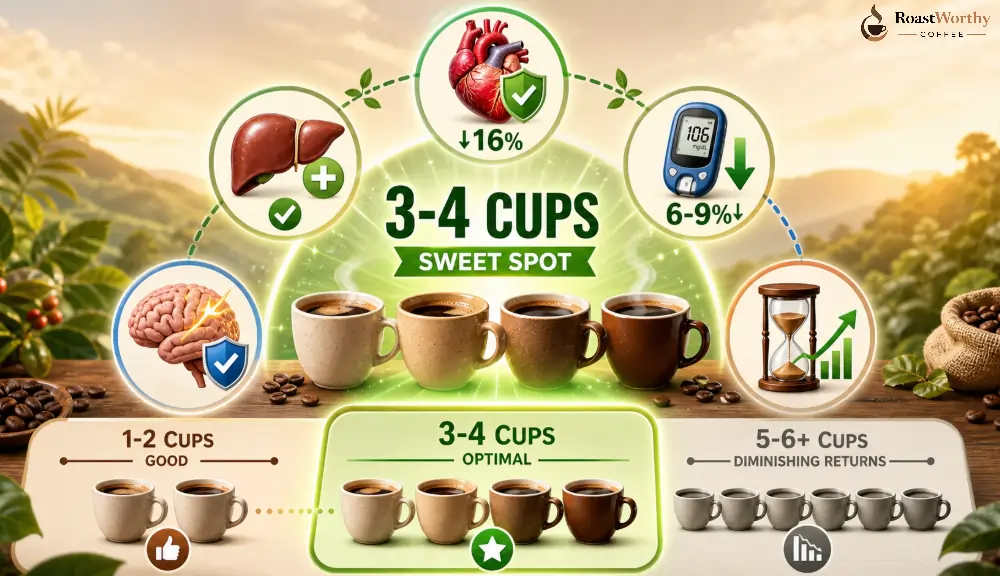
At 3–4 cups per day, research links regular coffee drinking to:
The dose matters enormously here. These benefits appear at moderate intake. They plateau — and in some cases reverse — above 5–6 cups per day.
More coffee is not more benefit. The sweet spot is 3–4 cups. That's where the science is clearest.
Caffeine in Context: It's Not Just Coffee
Maximum daily coffee consumption calculations fall apart if you're not tracking everything.
| Source | Caffeine (approx.) |
|---|---|
| Drip coffee (8oz) | 80–100mg |
| Espresso (1 shot) | 63mg |
| Cold brew (12oz) | 200–250mg |
| Black tea (8oz) | 40–70mg |
| Green tea (8oz) | 25–45mg |
| Energy drink (8oz) | 70–150mg |
| Pre-workout (1 serving) | 150–300mg |
| Dark chocolate (1oz) | 12–25mg |
| Matcha latte (8oz) | 50–70mg |
Someone drinking 3 drip coffees, a black tea, and a pre-workout supplement is easily at 600–700mg before they register it.
Track total daily caffeine, not just coffee cups. That is the only number that actually protects you.
What Happens When You Cut Back: Caffeine Withdrawal Is Real
If you decide to reduce your intake — and many people should — don't go cold turkey.
Caffeine withdrawal is recognized by most health bodies as a genuine physiological response. It's not dramatic. But it's real.
Symptoms typically start 12–24 hours after your last dose:
The worst of it usually hits day 1–2. Most people are through it by day 5–7.
The smart approach: reduce gradually. Drop 25–50mg every few days rather than stopping at once. Switch one daily coffee to half-caf. Then to decaf. The headaches stay manageable. The adjustment happens without the crash.
Taste it. Write it down. Roast it again. The same iterative mindset that works in home roasting works in habit management. Small changes. Consistent tracking. Real results.
When to Think About Switching to Decaf
There's no shame in the decaf switch. Let's be clear about that.
Decaf is not zero caffeine — it typically contains 5–15mg per cup. But for someone managing anxiety, a cardiac condition, pregnancy, or caffeine sensitivity, decaf is a practical and legitimate tool.
Signs the decaf switch makes sense:
The specialty coffee world has gotten genuinely good at decaf. Swiss Water Process and CO2 extraction both preserve flavour significantly better than older chemical methods. A well-roasted decaf from a quality origin — an Ethiopian natural, a Colombian washed — can be genuinely good coffee.
Don't write it off because you tried bad decaf once. The category has improved. ☕
The Practical Reset Protocol
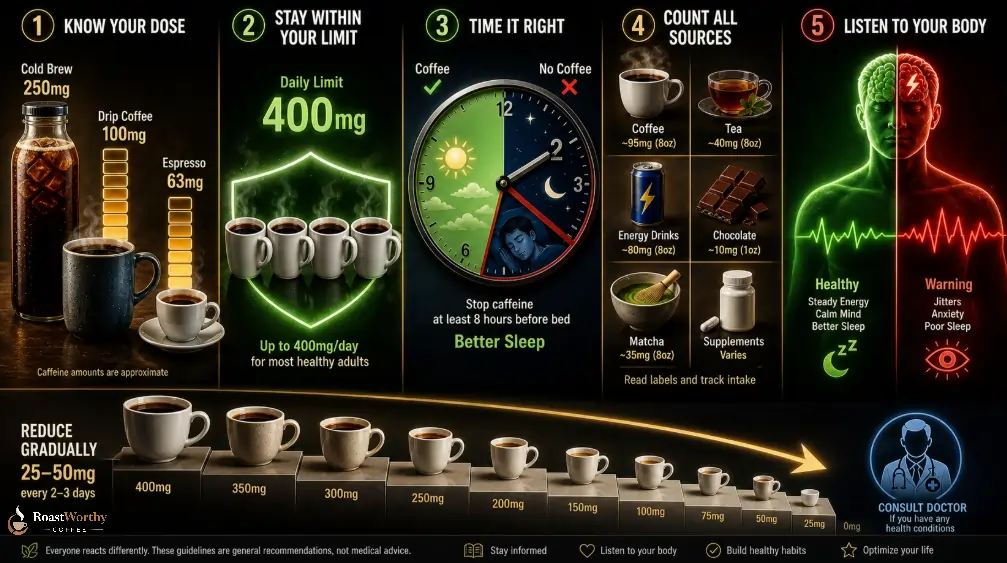
You don't need a spreadsheet. You need a few honest habits:
- Know your coffee's caffeine content. Estimate at minimum. Cold brew and drip are not the same drink in a different temperature.
- Set your daily ceiling at 400mg and work backwards from your preferred drinks.
- Cut caffeine by 2pm. Non-negotiable if sleep matters to you.
- Count all caffeine sources — tea, energy drinks, supplements, chocolate, matcha.
- Listen to your body honestly. Jitteriness, racing heart, and disrupted sleep are data. They mean something.
- If you're pregnant, on specific medications, or managing anxiety or heart issues — your personal limit is not 400mg. Speak to your doctor before using the general guideline as your ceiling.
- If you want to cut back, do it gradually. 25–50mg reductions every few days. Not cold turkey.
The curve doesn't lie. Your body is already telling you whether your current intake is working. The question is whether you're listening.
FAQ: Caffeine Safety Questions People Actually Ask
How many cups of coffee a day is considered too many?
For most healthy adults, more than 4–5 standard 8oz cups per day exceeds the 400mg safe limit. But caffeine content varies significantly by brew method — cold brew and large drip hit much harder than espresso per serving. Count milligrams, not cups.
Can you build a tolerance to caffeine?
Yes. Regular use desensitizes adenosine receptors over time. This is why your first cup hit differently than it does now. Tolerance means you need more to feel the same effect — which is how people creep past safe limits without realizing it.
What are the signs of a caffeine overdose?
Rapid or irregular heartbeat, severe anxiety, vomiting, tremors, and confusion are the primary warning signs. At very high doses — typically above 1,000mg in a short period — caffeine toxicity can become medically serious. Seek attention if symptoms are severe or don't resolve.
Is it safe to drink coffee every day?
For healthy adults, yes — daily coffee consumption within 400mg is associated with neutral-to-positive health outcomes in most research. It is not an inherently harmful habit at moderate intake. The 3–4 cup range is where evidence of benefit is strongest.
Does decaf coffee have caffeine?
Yes, though minimal. Swiss Water Process decaf typically contains 5–15mg per 8oz cup versus 80–100mg for regular drip. Not zero — but dramatically lower and safe for most sensitive individuals.
How does coffee affect sleep even at moderate doses?
Caffeine's half-life means it remains partially active for hours after consumption. A 3pm coffee at 100mg still has roughly 50mg active at 8–9pm. This disrupts deep sleep stages even when sleep onset isn't affected — leaving you less restored and more reliant on caffeine the next morning.
What's the difference between a caffeine crash and withdrawal?
A caffeine crash is a short-term drop in energy a few hours after your last dose — adenosine flooding back in once caffeine clears. Withdrawal is what happens when you stop regular use entirely: headaches, fatigue, and brain fog lasting several days as your system recalibrates.
More Recommendations from RoastWorthy Coffee