Colombian Coffee: Why It’s the World’s Most Recognized Origin

Ask someone to name a coffee country. Most say Colombia. Not Ethiopia, where the plant was born. Not Brazil, which grows twice the volume.
Colombian coffee is the only origin with a fictional farmer more recognizable than most real ones. That tells you everything.
There's a whole story in this cup. Let me tell it properly.
☕ Colombian Coffee: Key Takeaways
The Juan Valdez Effect
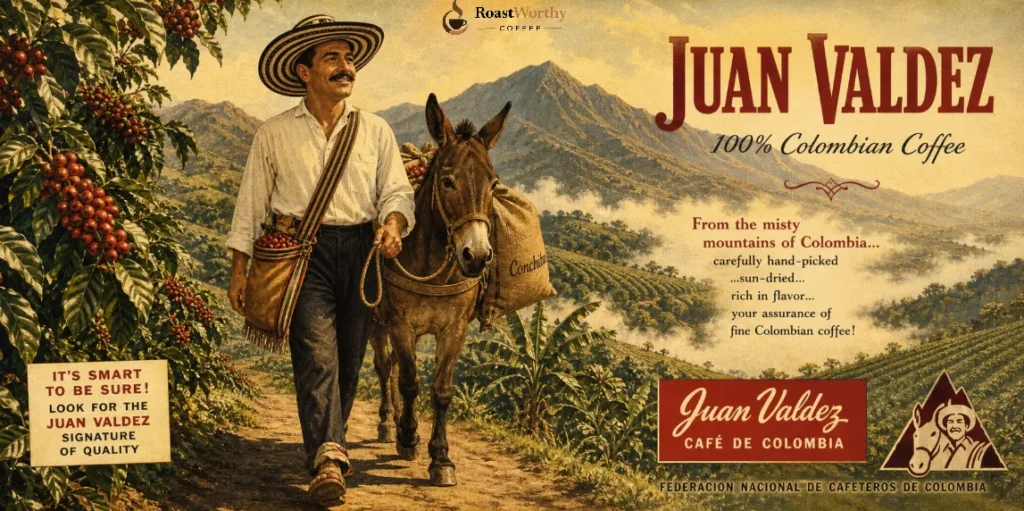
In 1959, the Federación Nacional de Cafeteros — the Colombian Coffee Growers Federation — invented a character. Juan Valdez. Mustachioed farmer. Loyal mule named Conchita. Hand-picked Colombian coffee beans slung over his shoulder.
He ran on American television for decades.
It worked better than anyone expected. By the time most Americans thought of coffee, they pictured a Colombian hillside. That kind of brand recall is worth billions. But here's the part people miss…
It only worked because the coffee backed it up.
You cannot market a mediocre product for sixty-plus years. The beans had to deliver consistently. They did. That's the real story behind why Colombian coffee is so popular.
Where Colombian Coffee Beans Actually Grow
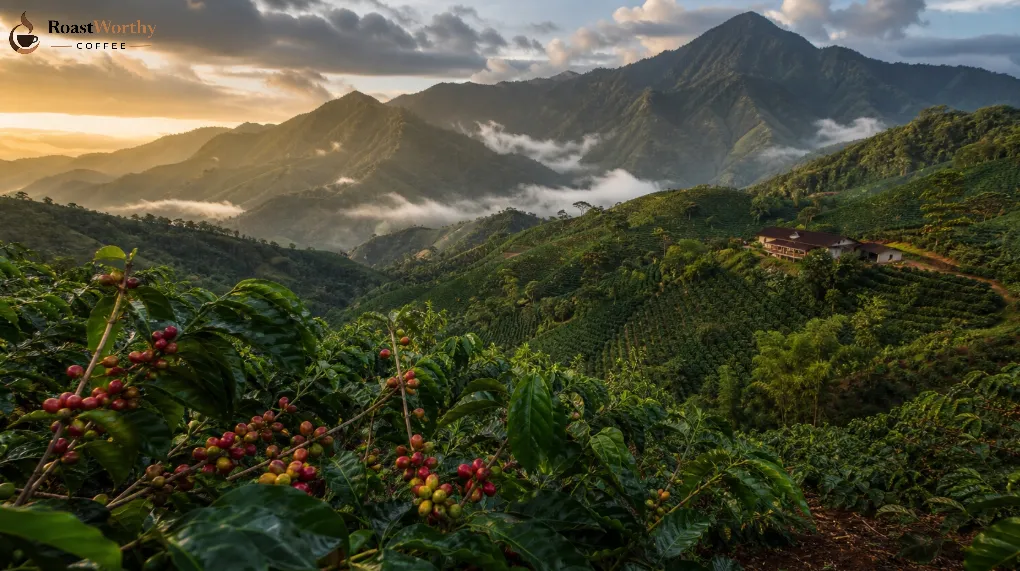
Colombia sits directly on the equator. That sounds like disaster for coffee. It's not — because the Andes change everything.
The Andes split into three cordilleras as they run through the country. Coffee grows on those slopes, typically between 1,200 and 2,200 metres above sea level. Cool nights. Volcanic soil. Steady, well-distributed rainfall. This is the definition of ideal coffee terroir.
The terroir is doing something here that flat-country origins cannot replicate.
High altitude slows cherry development. Slower growth means denser beans and deeper sugar accumulation. That's the chemistry behind the signature caramel sweetness Colombia is known for.
And because the country straddles both northern and southern rainfall cycles, different regions harvest at different times. Fresh Colombia coffee beans are available nearly year-round. Almost no other major origin can say that.
The Regions You Actually Need to Know
🌱 Huila: The Cup of Excellence Capital
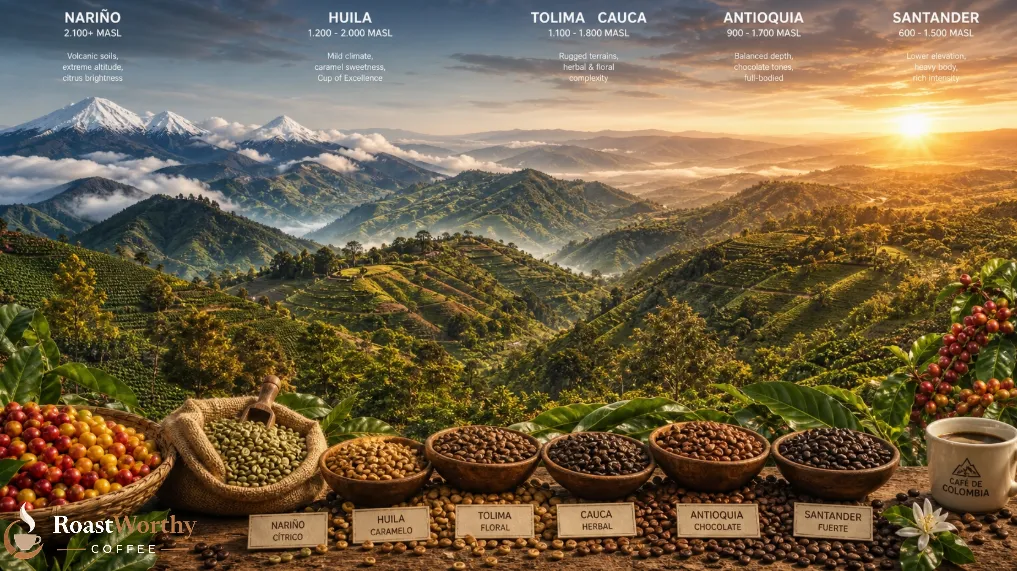
Huila sits in southwestern Colombia, deep in the Andes. It's now the country's largest single producing department. More importantly, it has won more Cup of Excellence titles than any other Colombian region. That's not a marketing line — that's the actual scoreboard.
Huila coffees deliver caramel sweetness, red apple, and a balanced acidity that never tips into sharpness. It's approachable enough for everyday drinking. Complex enough for specialty buyers.
If you're looking for a starting point with Colombian single-origins, Huila is the answer.
🌱 Nariño: High Altitude, Intense Sweetness
Go further south and you reach Nariño, pressed against the Ecuadorian border. Some farms here sit above 2,100 metres. At that altitude, coffee barely survives — but what it produces is extraordinary.
Cold air flows down from the Galeras and Cumbal volcanoes at night. The temperature swing between day and night is extreme. Cherry ripening slows to a crawl. The result is sugar density most origins can't touch.
Nariño coffees taste like citrus and tropical fruit with a clean, almost electric brightness. This is the region that makes light-roast pour-over people lean forward in their chairs.
🗺️ Tolima, Cauca, Antioquia, Santander
Colombia's diversity doesn't stop at Huila and Nariño. Other regions worth knowing:
“Colombian coffee” is not one flavour. It's a spectrum across six major growing departments. That's one reason specialty roasters return to it every season.
Why Colombian Coffee Tastes the Way It Does
People keep asking why is Colombian coffee so popular. The honest answer is balance.
Colombian coffee rarely does any one thing to an extreme. It's not as wild as an Ethiopian natural. Not as heavy and earthy as a Sumatran wet-hulled. Not as brutally acidic as a Kenyan.
It lands in the centre — and it lands there with precision.
The classic Colombia profile: caramel sweetness up front, bright balanced acidity in the mid-palate, clean finish. Regional variations layer on red fruit (Huila), citrus and tropical notes (Nariño), or cocoa (Antioquia). But the structure stays consistent.
This makes Colombian coffee the most beginner-friendly great coffee in the world. It also makes it the easiest sell on a café menu. Every segment of the market finds something to like. That approachability is exactly why it became the global default.
Washed Colombian: The Process That Built the Reputation
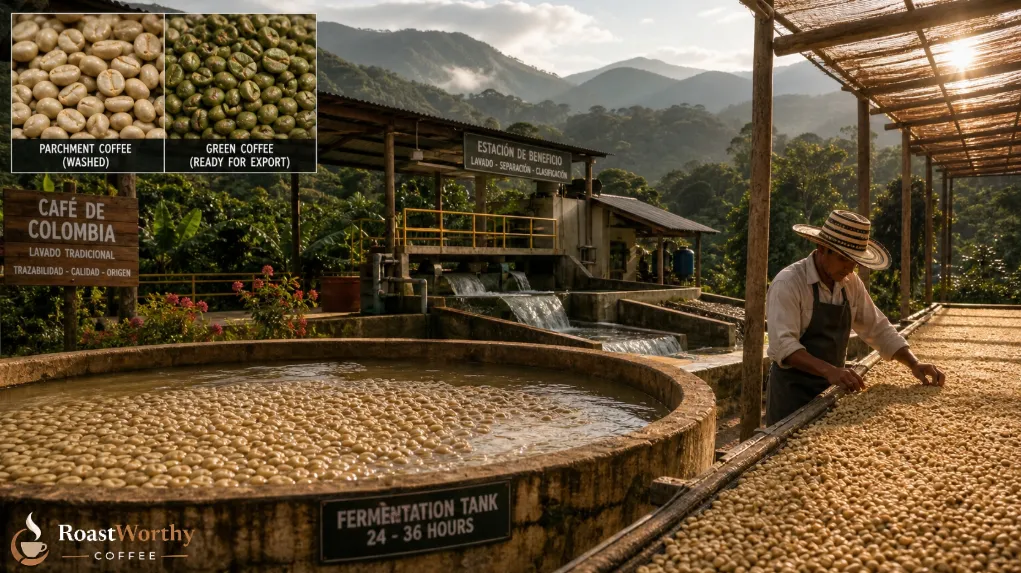
Almost all Colombian coffee is washed. This is central to understanding the flavour.
Washed Colombian processing strips the fruit from the seed before drying. The beans ferment briefly in water tanks — typically 24 to 36 hours — then dry on raised beds or patios. The result is a clean, bright cup where origin character shows through without fruity interference.
Why did Colombia standardize on washed processing? Consistency and traceability.
The Federation built Colombia's reputation on reliable, clean lots. Washed processing is the most controllable method. It eliminates the variability of fermentation that natural processing introduces. Buyers in the 1960s and 70s knew what they were getting every time. That reliability became a competitive weapon.
| Process | What Happens | Flavour Outcome |
|---|---|---|
| Washed (Colombia standard) | Fruit stripped before drying | Clean, bright, balanced acidity |
| Natural | Fruit dries on the seed for weeks | Heavy, jammy, wine-like |
| Honey | Partial mucilage left on seed | Sweeter, rounder body, middle ground |
| Anaerobic | Sealed oxygen-free fermentation | Intense, funky, experimental |
Lately, Colombian producers experiment with naturals and anaerobic lots — and they're producing excellent results. But washed is still the backbone. It's what built the name.
The People Behind the Bag
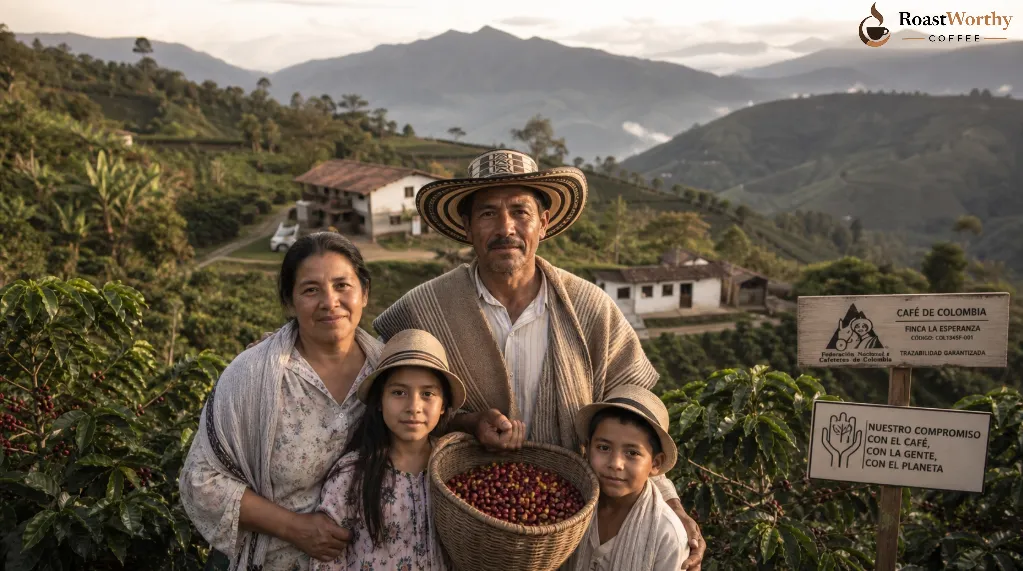
Here's what most coffee marketing skips. Colombia is a country of smallholder farmers.
The average coffee farm covers roughly 1.5 to 2 hectares. Small enough to farm by hand. There are over 540,000 coffee-growing families registered with the Federation. This is not an industrial commodity operation. This is half a million households picking cherries by hand on steep Andean slopes every season.
The people who grew this deserve credit.
The Federación Nacional de Cafeteros — the same organization that created Juan Valdez — built infrastructure around those farmers. Guaranteed purchase price floors. Rural road construction.
Research programs at Cenicafé, one of the world's most respected coffee research centres. School and hospital funding in coffee-growing municipalities.
The system isn't perfect. Global commodity price crashes still hurt smallholders. But Colombia built more farmer protection infrastructure than almost any other producing country attempted.
When you buy a named Huila or Nariño lot from a specialty roaster, you're often buying from an identified producer or co-op. That traceability is a direct result of what the Federation built. Start with the origin, not the roaster.
How to Buy the Best Colombian Coffee
Skip the supermarket can. That's blended commodity coffee. It's fine. It is not what we're talking about.
For the best Colombian coffee, look for these signals on the bag:
If the bag just says “Colombian blend” with no region, it's a mix of unknown lots. Skip it.
Which Roast Level Works Best?
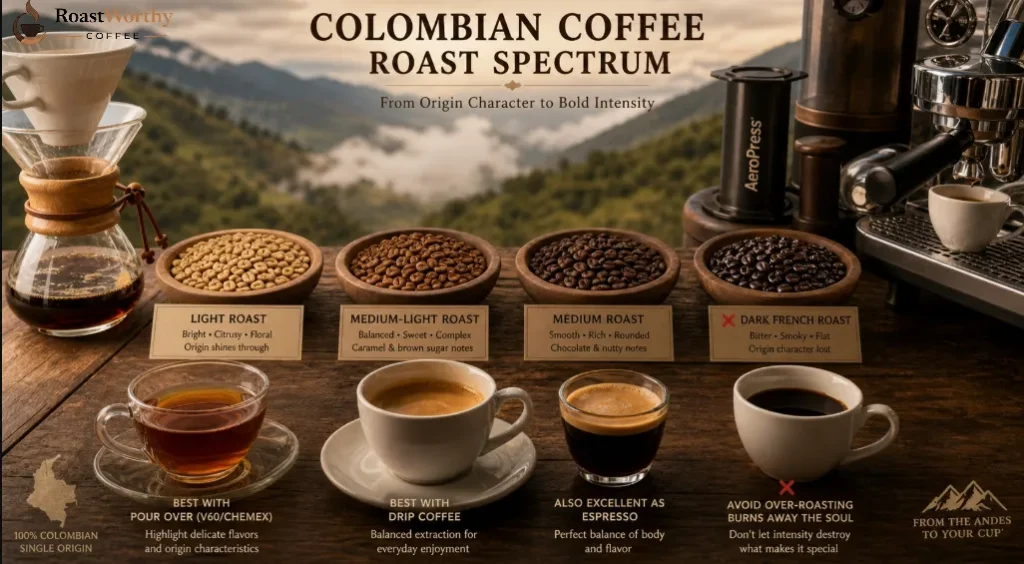
Colombian coffee handles both light and medium roasts exceptionally well.
Light roast — brings out citrus brightness and red fruit. Best for Nariño and high-altitude Huila lots. Brew as pour-over or AeroPress.
Medium roast — unlocks the caramel sweetness and chocolate notes. Great for everyday drip or as a single-origin espresso. This is where Antioquia and Huila really shine.
Dark roast — avoid it. A French roast burns away the origin character you paid for. You're left with generic bitterness. That's the opposite of the point.
How Colombian Coffee Compares to Other Origins
| Origin | Flavour Signature | Acidity | Best Brew Method |
|---|---|---|---|
| Colombia | Caramel, red apple, balanced | Medium-bright | Any method, very forgiving |
| Ethiopia | Floral, bergamot, blueberry | High, tea-like | Light-roast pour-over |
| Brazil | Hazelnut, cocoa, low acid | Low | Espresso base, milk drinks |
| Kenya | Blackcurrant, tomato, intense | Very high | Bold pour-over |
| Guatemala | Dark chocolate, brown sugar | Medium | Espresso, French press |
Ethiopia is more exciting on its best days. Kenya is more intense. Brazil is cheaper at volume.
But Colombia wins on one thing none of them match consistently: reliability. You can buy a Colombian blind and rarely get burned. That's why it became the world's most recognized origin. Not the flashiest. The most trustworthy.
Frequently Asked Questions
Why is Colombian coffee so popular worldwide?
Consistent quality, clean washed processing, and approachable balanced flavour made it the global default. Decades of Juan Valdez advertising locked in brand recognition that no other origin has matched.
What does Colombian coffee taste like?
Caramel sweetness, balanced acidity, and a clean finish. Regional variations add red apple and stone fruit (Huila), citrus brightness (Nariño), or chocolate and nuttiness (Antioquia). It's the cup that tastes like what most people think coffee should taste like.
What is the difference between Huila and Nariño coffee?
Huila produces a rounder, caramel-forward cup with soft red-fruit acidity. Nariño grows at extreme altitude and delivers more intense sweetness with a brighter, citric edge. Both are exceptional — Nariño is for light-roast enthusiasts; Huila works across roast levels.
Is all Colombian coffee washed process?
Almost all of it. Washed processing built Colombia's reputation for clean, consistent cups. Some specialty producers now offer natural and anaerobic experimental lots, but washed remains the Colombian standard.
What roast level is best for Colombian coffee?
Light or medium. Light roasts show origin brightness; medium roasts bring out caramel and chocolate. Avoid dark roasts — they overwrite the origin character entirely.
Who is Juan Valdez and why does he matter?
Juan Valdez is a fictional character created by the Colombian Coffee Growers Federation in 1959 to market 100% Colombian coffee in the United States. He became the most recognized coffee mascot in history — and a major reason Colombian coffee is the most identifiable origin in the world.
How do I know if I'm buying high-quality Colombian coffee?
Look for a named growing region, altitude above 1,700m, a recent roast date, a named farm or co-op, and washed process. Bags that just say “Colombian” with no further detail are usually commodity blends.
More Recommendations from RoastWorthy Coffee