Bulletproof vs Danger Coffee 2026: Which Asprey Brand Wins?

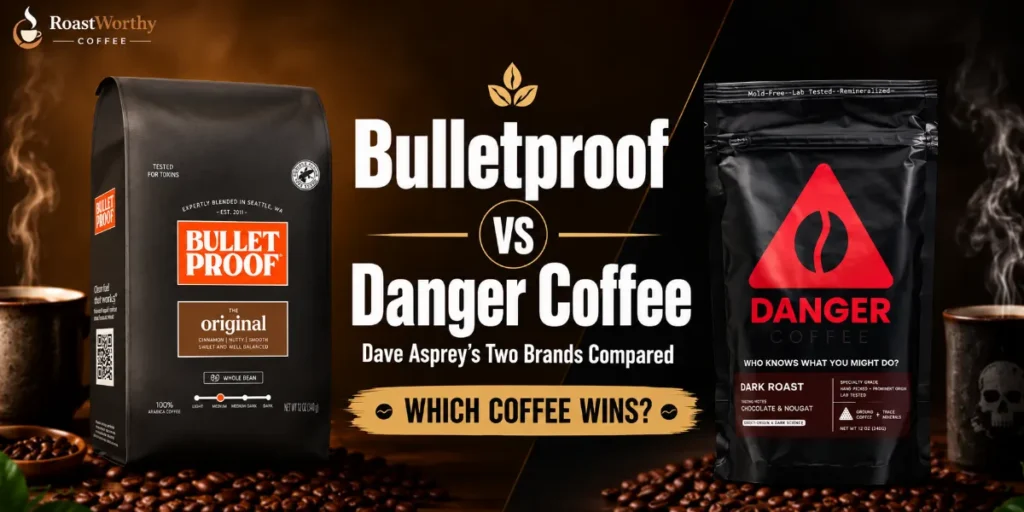
Bulletproof is the better everyday buy. Danger Coffee is the more interesting functional coffee.
Choose Bulletproof for lower pricing, more roast choices, wider availability, and a familiar keto coffee routine.
Choose Danger Coffee for remineralized coffee, broader stated lab testing, farm-direct Central American beans, and a bolder functional formula.
My overall scores:
Danger has the more ambitious formula. Bulletproof wins on value and flexibility.
That is the short answer to Bulletproof vs Danger Coffee. The longer answer gets more interesting… because these two brands are solving different problems.
Bulletproof vs Danger Coffee at a Glance
| Feature | Bulletproof Coffee | Danger Coffee |
|---|---|---|
| Founder connection | Founded by Dave Asprey | Launched by Dave Asprey in 2022 |
| Main idea | Clean, toxin-tested coffee built around keto routines | Toxin-tested coffee treated with humic and fulvic minerals |
| Standard roast price | $18.99 per 12oz bag | $26.95 per 310g bag |
| Main roast styles | Light, medium, medium-dark, dark and decaf | Medium, dark and decaf |
| Listed origin | Colombia, El Salvador and Guatemala | Central America |
| Mineral treatment | No added trace-mineral blend | 50-plus claimed trace minerals |
| Mycotoxin testing | Green coffee tested for mold toxins and heavy metals | Testing before roasting, after roasting and in brewed coffee |
| Organic certification | Some coffee sourced from Rainforest Alliance Certified farms | Not certified organic |
| Decaf process | Swiss Water Process | Swiss Water Process |
| Coffee formats | Whole bean, ground, pods and ready-to-drink products | Whole bean, ground, compostable pods and instant |
| Best for | Value, keto coffee and roast variety | Mineral-focused biohacking coffee |
Bulletproof Original currently sells for $18.99 per 12oz bag. Danger’s medium and dark roasts start at $26.95 per 310g bag. Danger also lists 95 to 120mg of caffeine per serving and adds measured amounts of humic and fulvic material.
Are Bulletproof and Danger Coffee the Same Company?
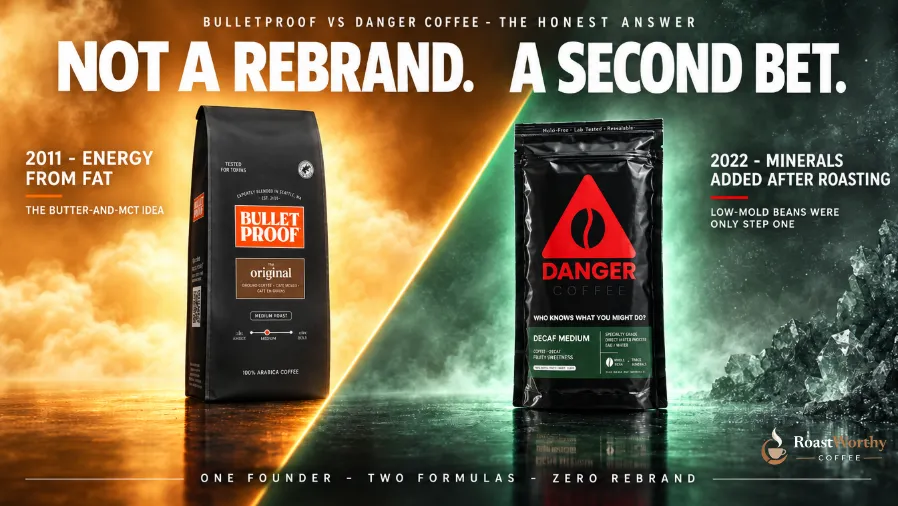
No.
Dave Asprey founded Bulletproof and made the butter-and-MCT coffee recipe famous. He later launched Danger Coffee as a separate concept in 2022.
Calling them “Dave Asprey’s two brands” makes sense historically. It should not suggest that Danger is simply Bulletproof with a different bag.
Bulletproof started with fat-powered coffee. Danger starts with remineralization.
Bulletproof’s original story centres on Asprey recreating the sustained energy he associated with yak-butter tea. Danger’s story presents the newer coffee as a step beyond low-mold beans, adding a proprietary mineral treatment after roasting.
Same founder. Different pitch.
The Biggest Difference: Danger Coffee Adds Minerals
Danger Coffee is coated after roasting with Danger Dust, its proprietary blend of humic and fulvic minerals.
A 310g bag is listed as containing:
The medium and dark roast pages list about 8.5mg of fulvic material and 34.5mg of humic material per serving.
That makes Danger more than a standard bag of Dave Asprey coffee. It sits somewhere between specialty coffee and a powdered wellness product.
Does remineralized coffee matter?
It matters as a product difference. The harder question is how much it matters biologically.
Minerals play real roles in hydration, enzyme activity and nerve signalling. That does not automatically prove that a mineral-treated coffee produces a meaningful advantage for every drinker.
Danger gives total humic and fulvic quantities. Its current product pages do not give a milligram-by-milligram breakdown for every one of the claimed 50-plus trace minerals.
That missing detail matters.
The mineral process is still interesting. It is also the main reason to pay more for Danger. Just treat the bigger performance statements as brand claims, not settled coffee science.
Mycotoxin Testing: Which Brand Goes Further?
Both brands place toxin testing near the centre of their identity.
That already puts them ahead of coffee companies that say nothing about green-bean screening, storage defects or contaminant testing.
Bulletproof testing standards
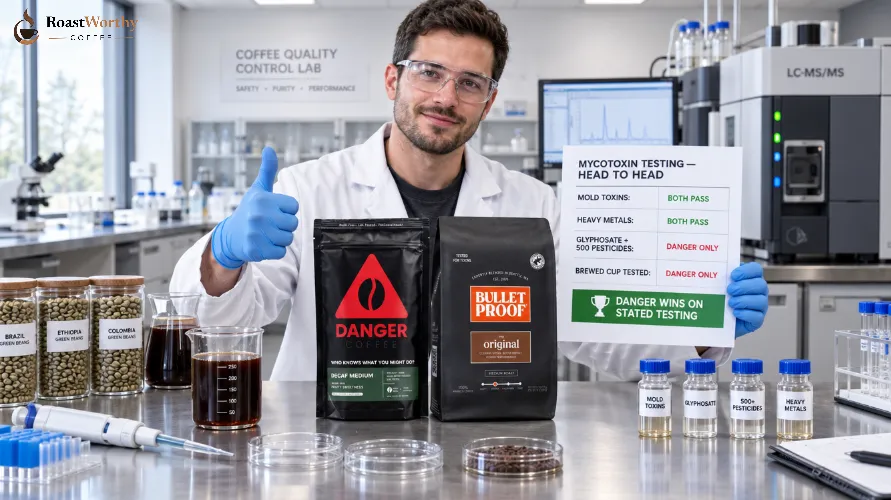
Bulletproof says every shipment of green coffee is tested for mold toxins and heavy metals.
The company uses accredited third-party laboratories and lists LC-MS/MS as a testing method. It also says roasted batches are assessed by trained coffee specialists and that its sourcing includes Rainforest Alliance Certified farms.
That is a credible quality-control programme.
The limitation is transparency. Shoppers are given an explanation of the testing system, but not an easy public library of current batch-specific coffee reports.
Danger Coffee testing standards
Danger describes a broader process.
The company says each lot is tested before roasting for mold toxins, glyphosate, more than 500 pesticides and other contaminants. It then tests roasted coffee for heavy metals such as arsenic, cadmium, mercury and lead.
Danger also says it tests the brewed result. That last step is smart. The liquid in the mug matters more than a dramatic number found in unbrewed green coffee.
Danger wins the stated testing comparison.
Its testing description covers more stages and more contaminant categories. I would still like both companies to make batch-specific reports simpler for buyers to find.
A reality check on “mold-free coffee”
Mycotoxins are not invented marketing jargon.
The FDA identifies coffee as one of the foods susceptible to mycotoxins. Ochratoxin A can appear when coffee is dried or stored poorly. The agency monitors mycotoxins across the food supply and uses laboratory methods including LC-MS/MS.
Still, detection does not automatically mean a dangerous dose.
The louder corners of biohacking coffee marketing can make an ordinary supermarket bag sound like a damp laboratory sample. That is too neat.
Good farming, drying, sorting and storage already reduce contamination risk. Independent testing adds reassurance. It does not prove that every unbranded coffee is unsafe.
For a broader comparison, see our Best Mold-Free and Mycotoxin-Free Coffee Brands ranking.
Taste Comparison: Which Coffee Is Better in the Cup?
This is where the branding finally has to face hot water.
A coffee can have immaculate laboratory paperwork and still taste like roasted plywood.
Bulletproof Original flavour
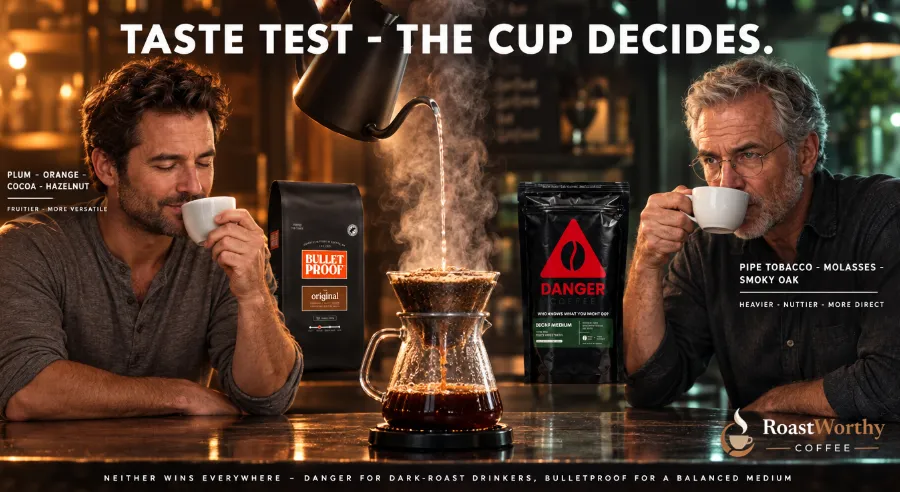
Bulletproof lists cinnamon, plum and orange, followed by cocoa and hazelnut.
That points towards a medium roast with some fruit left intact. The cocoa-hazelnut finish keeps it familiar enough for drip machines, French presses and milk drinks.
The fruit description is more attractive than I expected from a biohacking brand. It suggests some restraint in the roaster rather than taking every bean into dark, oily territory.
Do not expect competition-level acidity or clear farm character. Bulletproof does not give enough producer, cultivar, altitude or harvest detail for that.
It is approachable coffee first. Specialty transparency comes second.
Danger medium roast flavour
Danger’s medium roast is listed as tasting like nutty sweetness, pipe tobacco and a smooth finish.
Pipe tobacco is the interesting part. It suggests dried leaf, cedar and mild spice rather than bright fruit.
This is likely to suit drinkers who find lighter specialty coffee too sharp. It also makes sense for AeroPress, automatic drip and a short French press brew.
The profile sounds darker than many modern medium roasts. Not burnt. Just traditional.
Danger dark roast flavour
The dark roast is described with baker’s chocolate, nougat, molasses and smoky oak.
That is a coherent dark-roast profile. Bitter cocoa and smoke are expected. Molasses and nougat should stop it becoming flat.
I would choose the dark roast for cream, milk or a butter-and-MCT blend. Those additions can bury a lighter coffee.
Taste winner
Danger Coffee wins for dark-roast drinkers. Bulletproof Original wins for a more balanced medium roast.
Bulletproof sounds fruitier and slightly more versatile. Danger sounds heavier, nuttier and more direct.
Neither gives enough origin detail for serious single-origin buyers. “Central America” is a region, not a traceable coffee identity.
Start with the origin, then the process, then the roast. These brands start with function.
That is the trade-off.
Bulletproof vs Danger Coffee for Keto Coffee
Bulletproof owns this category culturally.
The classic Bulletproof Coffee recipe blends brewed coffee with grass-fed butter or ghee and MCT oil. The coffee beans themselves do not contain those fats. You add them separately.
Danger Coffee can be prepared the same way.
There is nothing about its remineralized beans that prevents you from adding butter, ghee or MCT oil. Danger may even suit the recipe better in dark roast, since chocolate and molasses flavours hold up under fat.
Still, Bulletproof has the cleaner ecosystem:
Bulletproof is the easier keto coffee system.
Danger is a functional bean that can be used for keto coffee. Bulletproof was built around the whole routine.
Which Is Better for Fasting Coffee?
Plain Bulletproof beans and plain Danger beans are both coffee.
Brew either one black and you get a very low-calorie drink. Add butter, cream, collagen or MCT oil and you are consuming calories. That ends a strict zero-calorie fast, even when the drink still fits a low-carbohydrate diet.
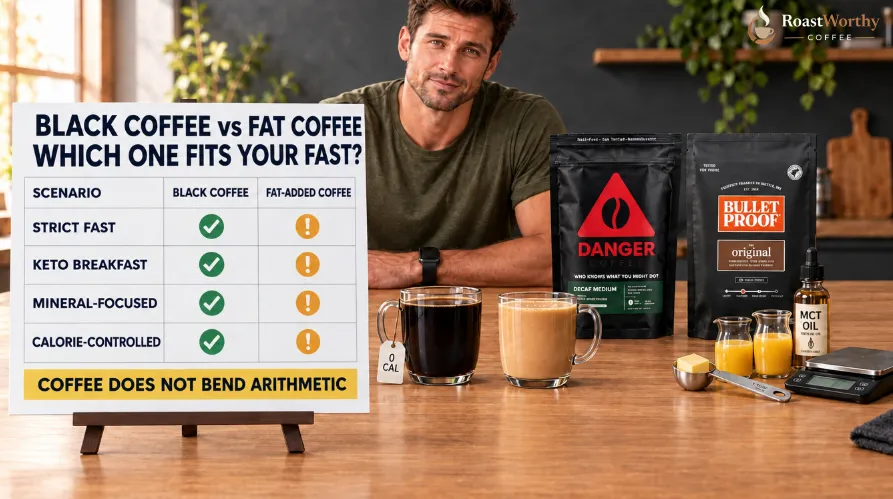
This is where product language gets messy.
“Bulletproof fasting” may permit fat coffee under a specific diet protocol. A strict fast does not.
Danger Coffee’s added mineral material does not turn it into a meal. For people using black coffee during intermittent fasting, it is the simpler option straight from the bag.
My practical call:
Coffee does not bend arithmetic. A tablespoon of fat is still a tablespoon of fat.
Caffeine: Is Danger Stronger Than Bulletproof?
Danger provides the clearer number.
Its medium and dark product pages list approximately 95 to 120mg of caffeine per serving.
Bulletproof says there is no major caffeine difference across its regular roast levels. It does not present one universal cup number because caffeine changes with dose, grind, brewing method and extraction.
That is the correct technical position.
A 15g pour-over dose will not match a 25g French press dose. An espresso’s concentration also says little about total caffeine unless drink volume is included.
Neither brand is designed as extreme high-caffeine coffee.
These are Arabica-led functional coffees, not Robusta-heavy stimulant blends. Danger’s 95 to 120mg estimate is ordinary for a properly dosed mug.
For more caffeine, use more coffee. Do not chase darker beans. Roast colour is not a reliable shortcut to a much stronger cup.
Roast Options and Formats
Bulletproof has the broader coffee catalogue.
Its core range includes:
The standard whole-bean roasts are generally listed at $18.99 per 12oz bag. Original pods are sold in 24-count boxes.
Danger focuses on:
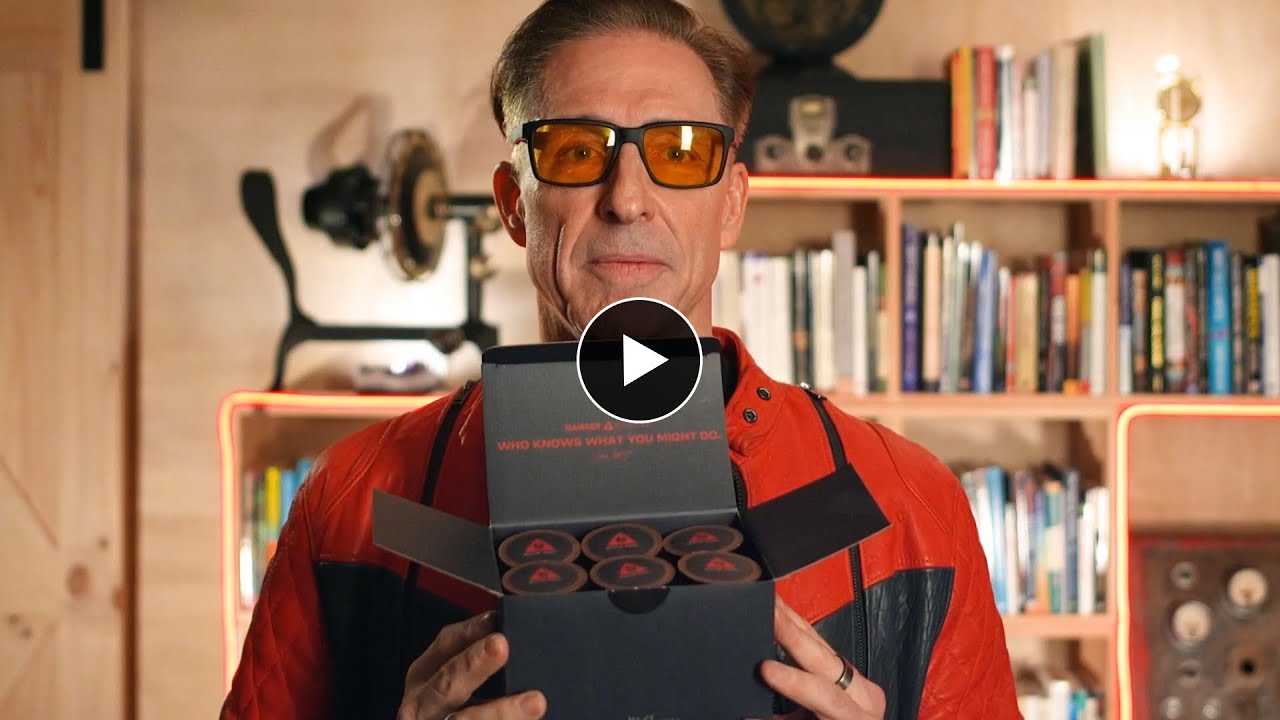
Danger has fewer roast levels but some better format ideas. Compostable pods and remineralized instant coffee give it practical points.
Bulletproof still wins variety.
Price and Value: The Gap Is Not Small
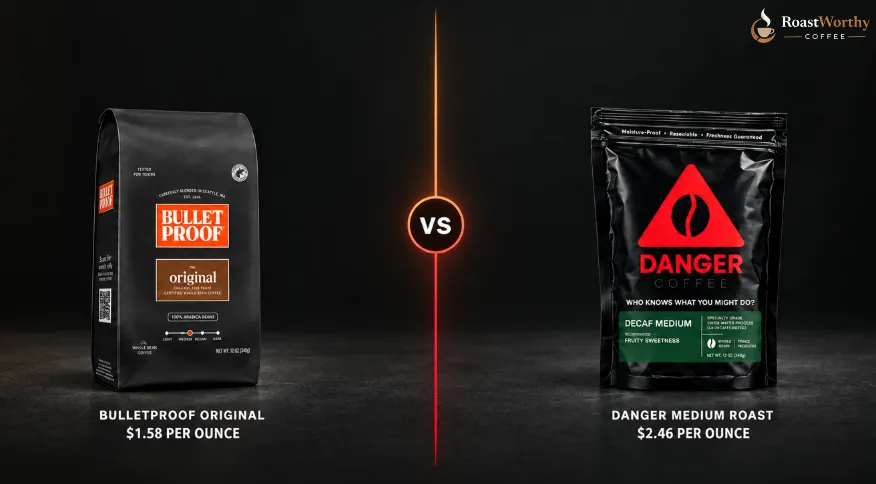
Bulletproof Original costs $18.99 for 12oz.
Danger medium roast costs $26.95 for 310g, which is about 10.9oz.
That works out to roughly:
Danger is about 56% more expensive per ounce before subscription savings.
Bulletproof’s subscription pricing starts with a 10% discount for one bag and rises with larger quantities. Danger offers 10% off recurring orders, bringing its standard bag to about $24.26.
The Danger premium pays for its mineral treatment, farm-direct positioning and broader stated testing process.
Is that worth another eight dollars for a slightly smaller bag?
For most coffee drinkers… no.
For someone already buying separate fulvic or humic mineral products, the calculation changes. Danger combines two purchases into one routine.
Bulletproof gives better coffee value. Danger gives better novelty value.
That sounds dismissive. It is not. Novelty becomes useful when it removes a step from something you already do.
Sourcing and Certification
Bulletproof lists coffee from Colombia, El Salvador and Guatemala. It also says it works with Rainforest Alliance Certified farms.
Danger lists Central American Arabica from small, family-owned farms. Its product pages describe hand picking, mechanical demucilagination, parchment drying and a mixture of patio and mechanical drying.
That processing information is useful. The missing producer name is not.
Danger is not USDA Organic certified. The company says its farms use natural growing and pest-control methods instead.
My view is simple.
Certification is not the only marker of good coffee. It is also not meaningless.
Danger may have excellent farm relationships. Naming the estate, country, cultivar and harvest would make that claim much stronger.
The flavour doesn’t lie. Neither does traceability.
Who Should Buy Bulletproof Coffee?
Choose Bulletproof when you want:
Bulletproof works best for someone replacing ordinary grocery-store coffee with a more controlled product.
It does not feel exotic. That is part of the appeal.
The Original medium roast is the safest first bag. French Kick makes more sense for milk, cream or MCT recipes.
See our Bulletproof vs Purity Coffee comparison for a closer match on antioxidant positioning and testing.
Who Should Buy Danger Coffee?
Choose Danger when you want:
Danger makes most sense for an existing biohacking customer.
It is harder to justify for someone who only wants a tasty medium roast. Plenty of specialty roasters sell more traceable coffee for the same money.
The product becomes more persuasive when the mineral treatment is the reason you came.
That is also why Danger should not be judged as coffee alone. It is coffee plus a supplement concept.
Bulletproof vs Danger Coffee Scores
| Category | Bulletproof | Danger Coffee |
|---|---|---|
| Flavour | 8.0/10 | 8.2/10 |
| Testing transparency | 8.3/10 | 8.8/10 |
| Sourcing detail | 7.6/10 | 7.8/10 |
| Roast variety | 9.0/10 | 7.5/10 |
| Functional formula | 8.2/10 | 9.1/10 |
| Price and value | 8.8/10 | 7.2/10 |
| Format choices | 8.7/10 | 8.5/10 |
| Overall | 8.4/10 | 8.2/10 |
Frequently Asked Questions
Is Danger Coffee the same as Bulletproof Coffee?
No. Dave Asprey founded Bulletproof and later launched Danger Coffee as a separate brand. Danger adds a proprietary humic and fulvic mineral blend after roasting.
Is Danger Coffee more mold-free than Bulletproof?
Both brands say they test for mold toxins. Danger describes testing at more stages, including green coffee, roasted coffee and the brewed drink.
Which tastes better, Bulletproof or Danger Coffee?
Bulletproof Original suits drinkers who prefer fruit, cocoa and hazelnut flavours. Danger suits people who prefer nuts, tobacco, dark chocolate, molasses and smoky roast character.
Is Danger Coffee stronger than Bulletproof?
Not significantly. Danger lists about 95 to 120mg of caffeine per serving. Final caffeine depends more on coffee dose and brewing method than the brand name.
Can I use Danger Coffee for keto coffee?
Yes. Brew Danger Coffee and add butter, ghee or MCT oil. Bulletproof has a broader range of products built specifically around that routine.
Does Bulletproof or Danger Coffee break a fast?
Black coffee is compatible with most non-caloric fasting routines. Adding butter, MCT oil, cream, collagen or other calorie-containing ingredients ends a strict fast.
Final Verdict: Which Is Better?
Danger Coffee is the more ambitious product. Its mineral treatment, multi-stage testing claims and darker cup profiles give it a clear identity.
Bulletproof is the smarter purchase for most people.
It costs less, offers more roast levels and fits naturally into keto coffee routines. Its testing standards are serious enough to make “clean coffee” more than empty packaging copy.
Buy Danger because you specifically want remineralized coffee. Do not buy it merely because the bag sounds more advanced.
Buy Bulletproof for a reliable daily roast with a functional-coffee pedigree.
Danger wins the experiment. Bulletproof wins the cupboard. ☕
More Recommendations from RoastWorthy Coffee