Trade vs Atlas Coffee Club 2026: Which Subscription Should You Pick?

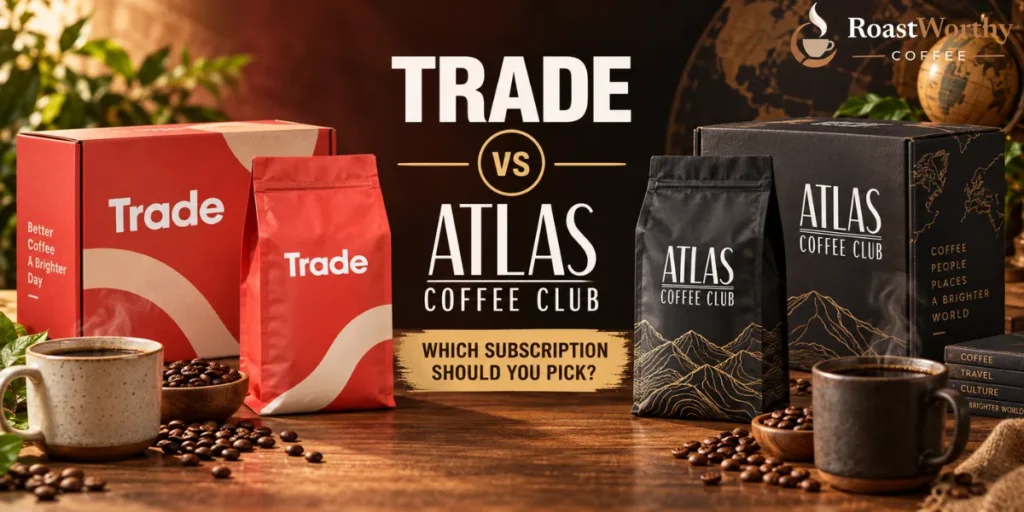
Trade is the stronger coffee subscription for most serious drinkers. Its coffee quiz, multi-roaster catalogue, and flexible queue give you more control.
Atlas Coffee Club is better for drinkers who want one single-origin coffee and a new country story each month.
A coffee subscription should do more than place another brown bag on your doorstep.
The real Trade vs Atlas Coffee Club decision comes down to how you want to explore coffee. Trade follows your taste. Atlas follows the map.
Trade pulls from more than 500 coffees across over 55 American roasters. Atlas sends single-origin coffee from a different producing country.
Both ship fresh coffee and allow delivery changes. The experience is still very different.
Trade vs Atlas Coffee Club at a Glance
| Feature | Trade Coffee | Atlas Coffee Club |
|---|---|---|
| Best for | Personalized matches and roaster variety | Single-origin travel and coffee education |
| Coffee model | Multi-roaster marketplace | One globally curated club |
| Selection | 500+ coffees from 55+ roasters | Rotating coffee from a new country |
| Personalization | Detailed coffee quiz and ratings | Roast, grind, amount, and delivery choices |
| Common size | Two 10.9-ounce bags | 6, 12, or 24 ounces |
| Regular advertised price | $33.98 for two bags | $13, $20, or $34 per shipment |
| Shipping | Free on the current two-bag plan | Free within the United States |
| Delivery rhythm | Starts every two weeks, then adjustable | Commonly every four weeks, adjustable |
| Best feature | Better matching after each rating | Strong origin cards and tasting context |
| Main weakness | Too many choices for some drinkers | Less control over the exact coffee |
Trade gives you more coffee choices. Atlas gives each coffee more context.
What Is Trade Coffee?
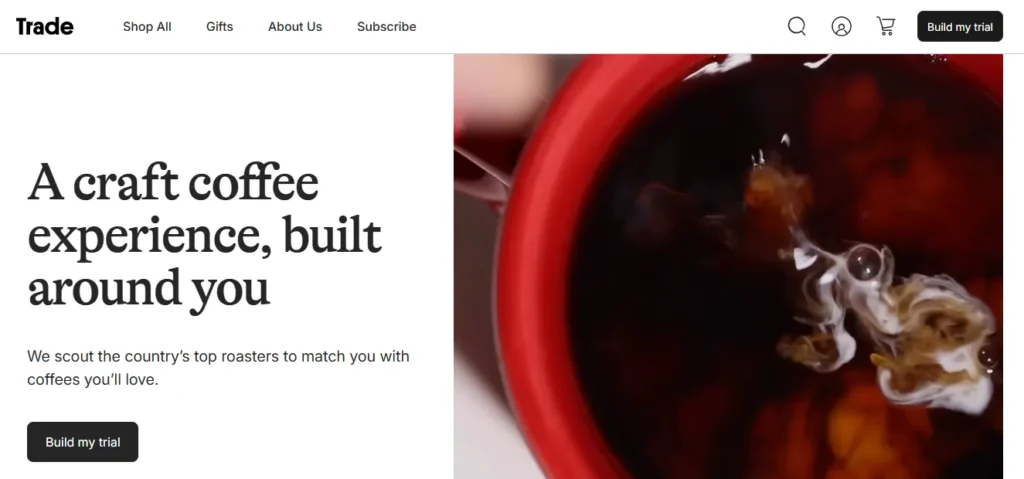
Trade is not a roaster. It is a multi-roaster coffee marketplace with a subscription layer.
You take a coffee quiz covering brew method, roast preference, flavour direction, and how you drink coffee. Trade then builds a queue from partner roasters.
The catalogue covers chocolate-heavy blends, washed Ethiopians, fruit-led naturals, espresso roasts, and decaf.
Each order goes to the selected roaster. It is roasted to order and normally ships within 48 hours.
You can rate, swap, or repeat a bag. That feedback loop is Trade’s real advantage.
We put that matching system through several months of deliveries in our full Trade Coffee review, including how accurate the quiz actually turned out to be.
What Is Atlas Coffee Club?
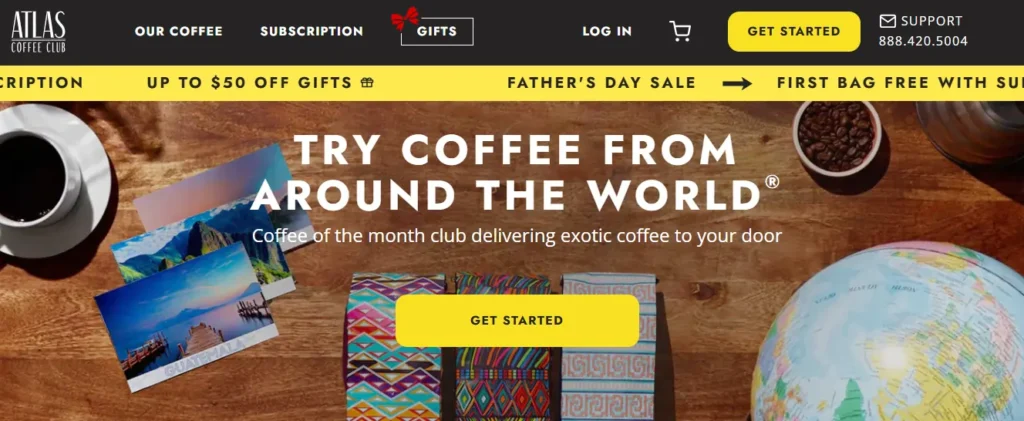
Atlas Coffee Club takes a much tighter approach.
Each shipment focuses on single-origin coffee from one producing country. The box includes coffee, a postcard, tasting guidance, and background about that origin.
Releases may feature Colombia, Ethiopia, Malawi, Myanmar, India, or other producing countries.
You choose light-to-medium, medium-to-dark, or the roaster’s selection. Whole bean and ground options are available.
The country is the organising idea, not the roaster. That makes Atlas easy to follow, but limits choice.
Whether that trade-off holds up past the first few boxes is something we cover in our Atlas Coffee Club review, where the origin rotation starts repeating sooner than expected.
Coffee Selection: Trade Wins Easily
Selection is not close.
Trade has hundreds of coffees from independent roasters across the United States. You can move between washed Kenya, natural Ethiopia, espresso blends, dark roast, cold brew, and decaf.
Atlas sends one featured origin at a time. You select a broad roast direction, but not the exact farm or coffee before every shipment.
Good curation removes work.
Still, experienced drinkers develop specific preferences. You may want washed coffees, high-grown Central Americans, or fruit-heavy naturals.
Atlas may send a good coffee that simply misses your taste.
Winner for selection: Trade.
Personalization: Trade’s Coffee Quiz Actually Matters
Trade’s quiz considers your brewer, roast preference, flavour direction, and drinking habits.
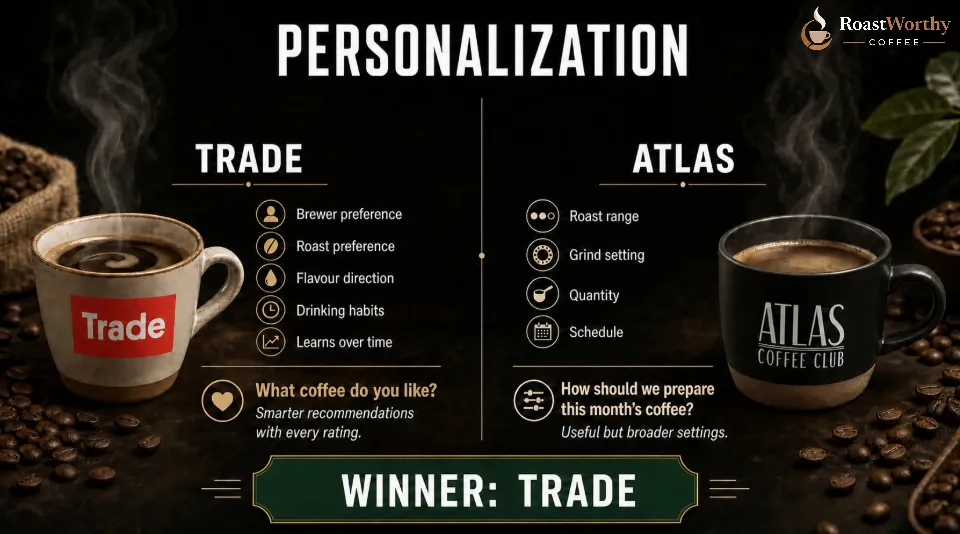
Your ratings shape later recommendations. The queue improves as Trade learns that you prefer crisp acidity over heavy roast flavour.
Atlas offers useful settings, but they are broader. You choose roast range, grind, quantity, and schedule.
You are still joining Atlas’s itinerary.
Trade asks, “What coffee do you like?” Atlas asks, “How should we prepare this month’s coffee?”
Winner for personalization: Trade.
Single-Origin Coffee: Atlas Has the Better Teaching Format
Trade carries plenty of single-origin coffee. Some partner roasters provide excellent farm, producer, process, and altitude details.
The presentation varies by roaster.
Atlas is more consistent. Every shipment frames the coffee around its country, growing conditions, processing, flavour, and local coffee history.
That format helps newer drinkers connect taste with place.
A washed Ethiopian may taste floral and citrus-led. A Brazilian coffee may land closer to cocoa, nuts, and caramel.
The flavour does not lie. Context helps you read it. ☕
Winner for single-origin education: Atlas.
Freshness and Roast Quality
Both services take freshness seriously.
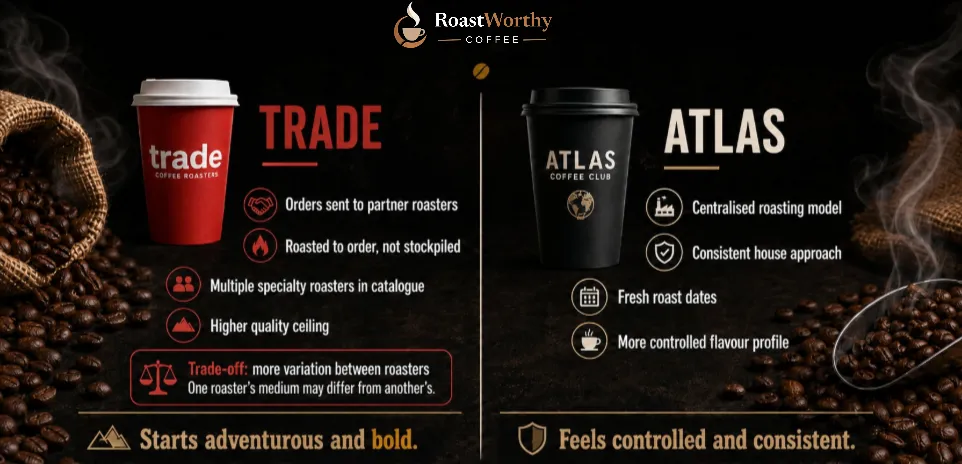
Trade sends the order to a partner roaster. The roaster prepares the bag and ships it rather than moving old stock through a central warehouse.
Roast dates matter.
Atlas also roasts fresh. Its more centralised model creates a consistent house approach.
Trade’s quality ceiling is higher because several respected specialty roasters share one catalogue. The trade-off is variation.
One roaster’s “medium” may be another roaster’s medium-dark. A fruity description may mean peach and jasmine, or a faint berry edge under roast flavour.
Atlas feels more controlled. Trade feels more adventurous.
Winner for peak quality: Trade. Winner for consistency: Atlas.
Price Comparison: Which Subscription Costs Less?
Regular price matters more than the first-box discount. Promotions come and go.
Trade currently advertises two 10.9-ounce bags, 21.8 ounces total, for $33.98 with free shipping. That works out to about $1.56 per ounce.
Atlas offers three common sizes:
The small Atlas plan is expensive for the amount of coffee received. The 24-ounce plan is the strongest pure value.
Trade’s two-bag plan costs almost the same as Atlas’s 24-ounce plan. Atlas gives you 2.2 ounces more.
Trade counters with two different bags and access to multiple roasters.
Atlas wins price per ounce at 24 ounces. Trade wins value through choice.
Neither is the cheapest option in the category, though. Several smaller roasters undercut both on price per ounce, which we ranked in our guide to the best coffee subscription services.
Which One Works Better for Your Brew Method?
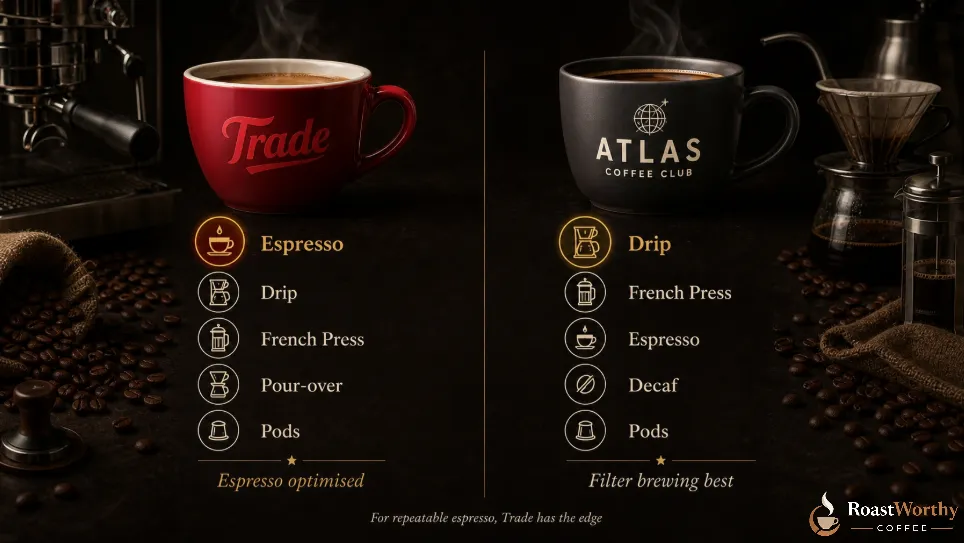
Trade has the edge for espresso.
You can choose coffee built for espresso, rate it, repeat it, or move toward a traditional or modern shot profile.
Espresso is sensitive to roast development and solubility.
A light coffee can produce a brilliant shot. It can also punish a basic grinder.
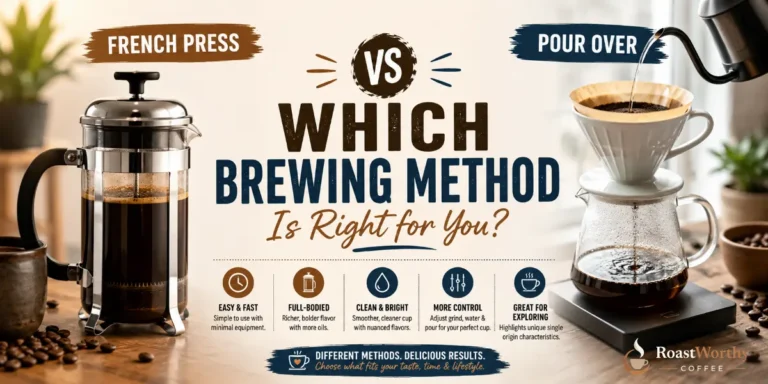
Atlas offers espresso, drip, French press, decaf, pods, and other formats. Its standard club suits filter brewing best.
For a repeatable 1:2 espresso ratio in 28 to 32 seconds… Trade gives you better tools.
Winner for espresso and specific brew goals: Trade.
Delivery, Skipping, and Cancellation
Trade subscriptions start on a two-week shipping rhythm. You can adjust the timing after the first delivery.
You can also swap coffees, repeat a previous bag, and manage the queue.
Atlas commonly uses a four-week schedule. It allows subscribers to skip, pause, change dates, or cancel.
Trade’s starting rhythm can be aggressive for one coffee drinker. Two 10.9-ounce bags contain roughly 618 grams.
At a 20-gram daily dose, that lasts about 31 days. A two-week repeat would create a backlog unless you change the schedule.
Atlas’s monthly cadence feels simpler.
Winner for simple scheduling: Atlas. Winner for coffee control: Trade.
Which Coffee Subscription Makes the Better Gift?
Atlas is the cleaner gift.
The postcard, country card, and monthly theme make each delivery feel complete. No queue management is required.
Trade is better for an enthusiast who wants personalization. Gift recipients can take the quiz and set their own preferences.
Trade gift subscriptions do not auto-renew. Atlas also sells fixed gift plans.
Choose Atlas for someone curious about world coffee. Choose Trade for someone who debates washed versus natural processing.
Winner for presentation: Atlas. Winner for a coffee nerd: Trade.
The Problems Nobody Mentions
Trade’s Weak Points
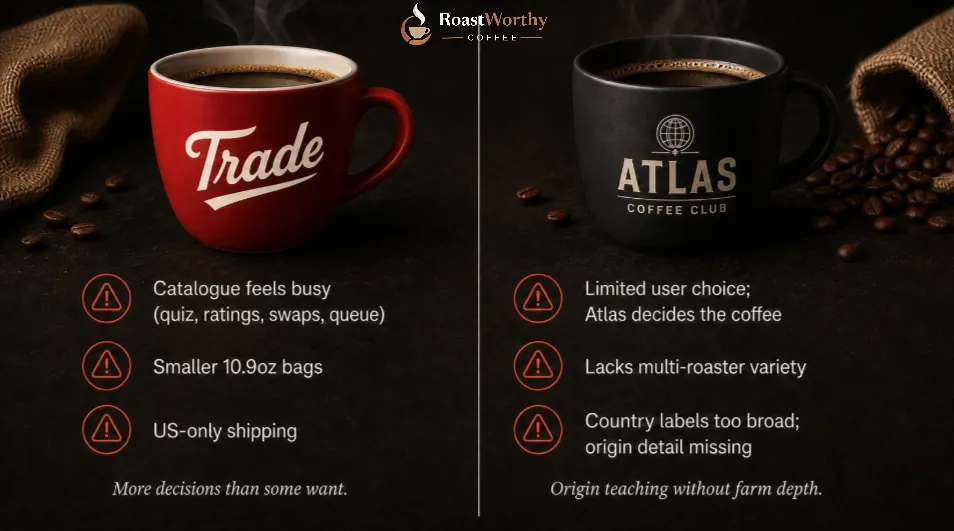
Trade can feel busy.
The catalogue, quiz, ratings, swaps, and queue create more decisions than some subscribers want.
The 10.9-ounce bags are smaller than the traditional 12-ounce format and create more packaging.
Trade only ships subscriptions within the United States.
Atlas Coffee Club’s Weak Points
You choose broad settings. Atlas still chooses the coffee.
The service also lacks multi-roaster variety. You are tasting Atlas’s sourcing and roasting approach month after month.
A country label can be too broad. “Colombia” tells you less than the farm, variety, elevation, and process.
Atlas teaches origin well, but serious origin detail should go beyond a flag and postcard.
Trade vs Atlas Coffee: Who Should Pick What?
Choose Trade Coffee when you:
Choose Atlas Coffee Club when you:
Frequently Asked Questions
Is Trade better than Atlas Coffee Club?
Trade is better for personalization, roaster variety, espresso, and control. Atlas is better for origin education, gifting, and simple monthly curation.
Which is cheaper, Trade or Atlas Coffee Club?
Atlas has the lower price per ounce on its 24-ounce plan. Trade’s common two-bag plan costs slightly less but includes less total coffee.
Does Trade only sell single-origin coffee?
No. Trade offers single-origin coffee, blends, espresso roasts, cold brew coffee, dark roast, and decaf from many independent roasters.
Can I choose my coffee with Atlas Coffee Club?
You can choose roast range, grind, quantity, and delivery schedule. Atlas selects the featured origin and coffee for each shipment.
Which subscription is better for beginners?
Atlas is simpler and more educational. Trade suits beginners who want a detailed coffee quiz and are happy to rate each bag.
Which coffee subscription is best for gifts?
Atlas has the stronger presentation. Trade is the better gift for someone who wants to set personal taste preferences.
Final Verdict: Trade Wins, but Atlas Has a Clear Audience
Trade wins this coffee subscription comparison because it gives the drinker more agency.
The quiz is useful. The multi-roaster model creates real range. Ratings improve later matches, and the queue lets you correct a poor recommendation before it ships.
Atlas is more focused. Its single-origin subscription turns each shipment into a lesson about place, processing, and flavour.
For most specialty coffee drinkers, I would pick Trade.
For a beginner wanting one curated coffee and a monthly story, I would pick Atlas.
Trade is the better subscription. Atlas is the better tour.
More Recommendations from RoastWorthy Coffee