What Is the Difference Between Espresso and Coffee? A Clear Explanation

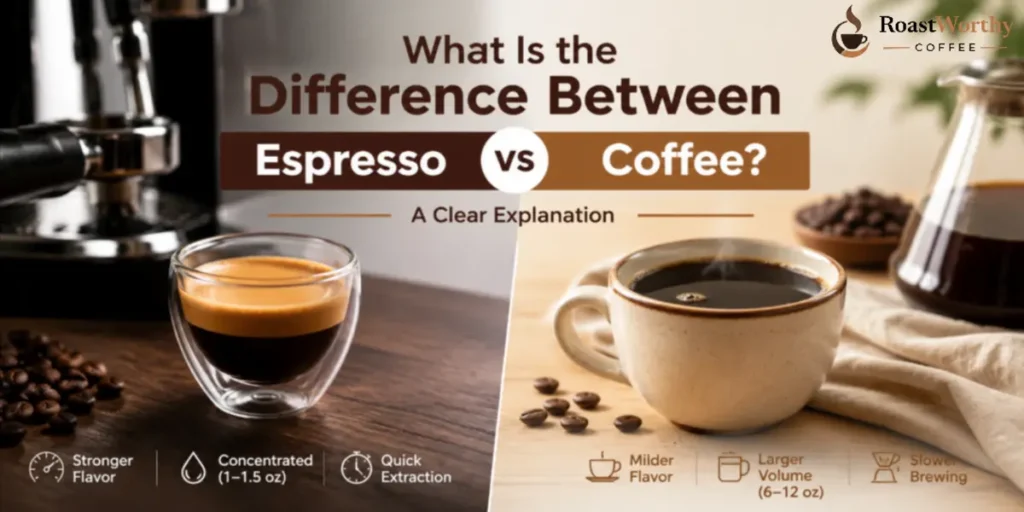
Espresso and coffee. People use the words interchangeably. They shouldn't.
The difference between espresso and coffee isn't about how dark the beans are roasted or how strong the drink tastes. It's about pressure, grind size, extraction time, and brew ratio — four variables that work together as a system. Change any one of them and you change the chemistry of what ends up in your cup.
This isn't a minor distinction. It's the reason a shot of espresso tastes like syrup and a pour-over tastes like tea — even when both start from the same bag of beans.
Difference Between Espresso and Coffee: Quick Overview
| Factor | Espresso | Regular Coffee |
|---|---|---|
| Brewing Pressure | 9 bar (pump-forced) | ~1 bar (gravity) |
| Grind Size | Extra fine (powdered sugar) | Medium to coarse |
| Brew Time | 25–30 seconds | 3–8 minutes |
| Brew Ratio | 1:2 (18g in / 36g out) | 1:15 to 1:17 |
| Serving Size | 30–40ml | 200–350ml |
| Caffeine Per Serving | 63–75mg | 95–140mg |
| Caffeine Per ml | ~2.5mg/ml | ~0.5mg/ml |
| Texture | Thick, syrupy, with crema | Clean, lighter body |
| Equipment Cost (entry) | $400–$800+ | $15–$200 |
| Bean Type Required | Any bean, any roast | Any bean, any roast |
It Starts With Pressure — Not Beans
Most people assume the beans are what make espresso different. They're not.
You can pull an espresso shot from the same beans you use for your morning pour-over. The equipment and the method are what define the drink — not the origin, not the roast level.
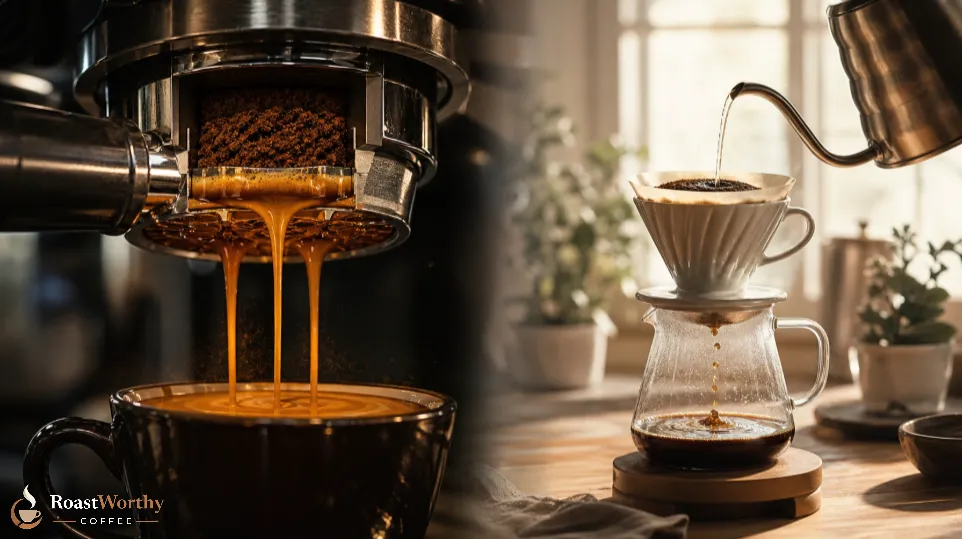
Espresso uses 9 bars of pump pressure to force near-boiling water through tightly packed, finely ground coffee in 25 to 30 seconds. That's roughly nine times the pressure of the atmosphere around you.
Regular brewed coffee — drip, pour-over, French press — uses gravity. Water falls through or steeps in ground coffee at atmospheric pressure (~1 bar). It takes 3 to 8 minutes depending on the method.
That pressure gap is everything. High pressure extracts oils, emulsified compounds, and CO₂ that gravity brewing simply cannot reach. That's where crema comes from. That's why espresso has a syrupy body that no drip machine can replicate.
Here's what the pressure is actually doing: it's forcing water through coffee at a rate and intensity that physically changes which compounds get extracted — and in what form. ⚗️
Grind Size: The Most Sensitive Variable
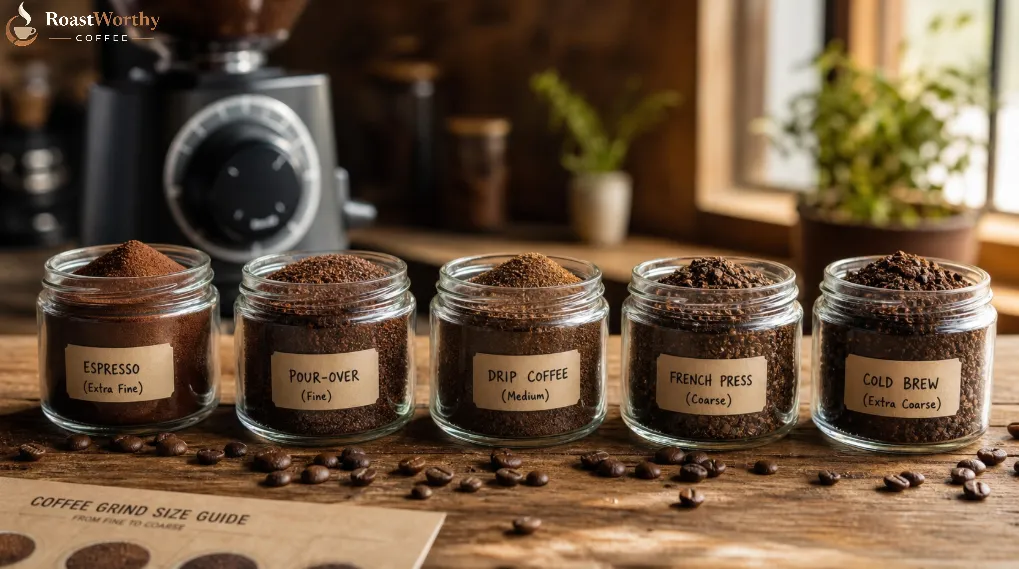
If pressure is the engine, grind size is the steering wheel.
Espresso demands an extremely fine grind — closer to powdered sugar than table salt. Pour-over needs medium-fine. French press takes coarse. Drip sits in the middle.
Why does this matter so much for espresso specifically?
Fine grind = more surface area = faster extraction. Espresso is already a fast brew — 25 to 30 seconds. If your grind is too coarse, water rushes through without extracting properly and you get a sour, thin, underextracted shot. Too fine, and water can't move through at all — the shot chokes, runs slow, and tastes bitter.
A 1 to 2 micron adjustment on a quality burr grinder can flip a shot from sour to balanced. That's not an exaggeration.
Espresso is the most grind-sensitive brew method that exists. A $15 hand grinder won't cut it. A quality burr grinder — $200 minimum for espresso-grade — is not optional equipment. It's the method.
Pour-over and drip are far more forgiving. A medium grind on a decent hand grinder will produce a drinkable cup. The margin for error is wider because the pressure isn't there to amplify every mistake.
Brew Ratios and Concentration Explained
Here's the number that defines what's actually in your cup.
A standard espresso runs a 1:2 brew ratio — 18 grams of coffee in, 36 grams of liquid out. That's it. A 30 to 40ml shot of intensely concentrated liquid.
A standard pour-over or drip brew runs 1:15 to 1:17. Same 18 grams of coffee — but now you're running 270 to 300 grams of water through it.
That's why espresso tastes the way it does. You're consuming a tiny, extremely concentrated liquid packed with compounds that in filter brewing would be spread across ten times the volume.
This is also why “espresso is stronger than coffee” is only half true.
Drink the whole cup of drip. You've had more caffeine than the espresso. Volume matters.
Ristretto vs. Lungo vs. Standard Espresso
These are all espresso variants — same machine, same pressure, different ratios.
None of these are achievable on a pour-over or drip machine. Different system, different results.
What Is Crema — And Why Regular Coffee Doesn't Have It
Crema is the reddish-brown foam that sits on top of a properly pulled espresso. It's not decoration. It's a signal that the extraction worked.
Crema is a colloidal emulsion — CO₂, oils, and water forced into suspension by 9-bar pressure. When the pressure drops as the shot hits the cup, CO₂ releases slowly and holds the oils in suspension. That's the crema.
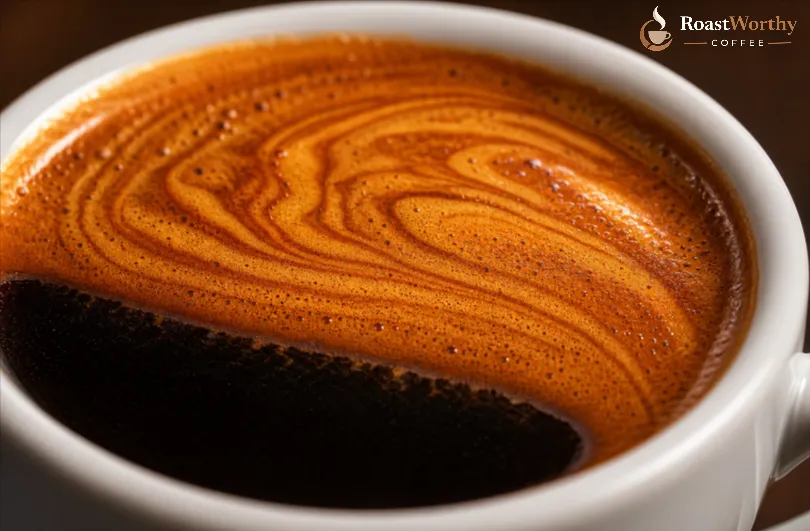
Gravity brewing cannot produce it. 1 bar of atmospheric pressure doesn't have the force to emulsify those compounds. If you're seeing foam on your drip coffee, it's dissolved CO₂ releasing from fresh grounds — not crema. Not the same thing.
A thick, persistent crema is one of the clearest indicators of a well-pulled shot. Pale, thin crema usually means underextraction or stale beans. Dark, burnt-looking crema can signal over-roasting or overextraction.
Taste it. Write it down. Roast it again. 🔥
Is Espresso Just Strong Coffee? The Answer Is No
The “strong coffee” framing fails for a specific reason: strength and concentration aren't the same thing, and neither describes what espresso actually is.
You can make “strong” drip coffee by using more grounds per litre of water. That changes concentration and flavour intensity. But you still won't get crema. You still won't get the syrupy body. The extraction chemistry is fundamentally different.
What makes espresso distinct isn't how much coffee you use. It's the pressure-driven extraction that produces a specific type of liquid — one with emulsified oils, suspended CO₂, and a texture that no gravity brew method can match.
A well-pulled single-origin espresso from a quality Ethiopian natural isn't supposed to taste bitter and intense. At its best, it tastes sweet, almost fruit-forward, with a thick mouthfeel and clean finish. The “espresso is harsh” reputation comes from dark roasts and bad extraction — not from the method itself.
Equipment: What Each Method Actually Requires
The equipment floor for espresso is significantly higher than filter coffee. This is not optional information — it changes what's actually possible at home.
| Equipment | Espresso | Pour-Over / Drip |
|---|---|---|
| Machine/Brewer | $400–$800 (entry-level home) | $15–$200 |
| Grinder | $200–$500 (burr, espresso-grade) | $50–$150 |
| Total Entry Cost | $600–$1,300+ | $65–$350 |
| Grind Precision Needed | Micron-level | Medium tolerance |
| Skill Ceiling | High | Low to medium |
A $100 “espresso machine” that produces 3 to 4 bars of pressure is not making espresso. It's making pressurized coffee with foam on top. The 9-bar benchmark is not arbitrary — it's the pressure threshold at which emulsification and crema formation actually occur.
If you want real espresso at home, the minimum realistic budget is around $600 for a machine and grinder combined. Less than that and you're compromising the extraction before you start. ☕
Roast Level and Bean Selection: What Actually Matters
There is no such thing as an “espresso bean” as a botanical category. The label exists for marketing reasons — it typically signals a darker roast profile, lower acidity, and more body. Historically, that suited espresso's short, intense extraction.
But any bean can be pulled as espresso. Light roast single-origins are increasingly common in specialty cafés. Ethiopian naturals, Colombian washed lots, Kenyan SL28s — these are all being pulled as espresso by serious roasters right now.
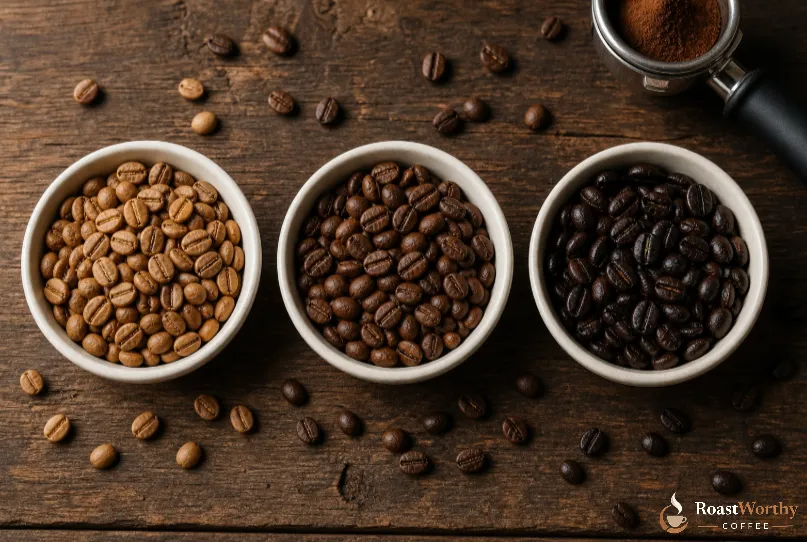
The practical difference for home brewers:
If you're starting out, go medium-dark. Learn the machine and grinder first. Light roast espresso rewards precision — and precision takes practice.
Espresso vs. Coffee: Which Should You Brew at Home?
Depends entirely on what you want.
If you want a quick, intense, small-format drink — or you're building towards lattes, flat whites, and cappuccinos — espresso is the system. Budget for proper equipment.
If you want a larger, more relaxed cup with lower equipment cost and a gentler learning curve — pour-over or drip is the better starting point. A quality burr grinder and a $30 pour-over dripper will produce genuinely excellent coffee.
Both methods reward attention. Neither is better in an absolute sense. They're different systems producing different drinks.
FAQ: Difference Between Espresso and Coffee
Is espresso stronger than regular coffee?
Per millilitre, yes — espresso has roughly 5x the caffeine concentration of drip coffee. Per serving, no — a full cup of drip coffee contains more total caffeine than a single shot of espresso.
What makes espresso different from regular brewed coffee?
Espresso uses 9 bars of pump pressure to force water through finely ground coffee in 25–30 seconds. Regular coffee uses gravity at atmospheric pressure over 3–8 minutes. The pressure changes which compounds are extracted and produces crema.
Can you use espresso beans in a regular coffee maker?
Yes. “Espresso beans” are typically a darker roast — they'll produce a bold, low-acid cup in a drip machine. The term is a roast descriptor, not a different type of bean.
Why does espresso have crema but drip coffee doesn't?
Crema forms because 9-bar pressure emulsifies CO₂ and oils into suspension. Gravity brewing operates at ~1 bar and cannot produce the pressure needed for that emulsification.
What's the difference between an Americano and regular drip coffee?
An Americano is espresso diluted with hot water after brewing. Drip coffee is gravity-brewed from the start. They may look similar but the extraction chemistry — and the flavour — are completely different.
Does grind size matter more for espresso than for other brewing methods?
Yes, significantly. Espresso is the most grind-sensitive brew method. A small adjustment — even 1–2 microns — can shift a shot from sour and underextracted to balanced to bitter and overextracted.
The difference between espresso and coffee is a difference of systems — not just intensity. Pressure, grind, ratio, time. Four variables. One completely different drink.
Get the equipment right. Dial in the grind. Run the numbers.
More Recommendations from RoastWorthy Coffee