AeroPress vs French Press 2026: Which Makes Better Coffee?

You spent good money on that single-origin Ethiopian. You ground it fresh. You got the water temperature right.
Then you brewed it in the wrong brewer — and it tasted like nothing.
That's the real cost of the AeroPress vs French press question. Not the £30 difference in price. The wasted beans. The missed flavour. The cup you could have had.
The AeroPress and French press are both immersion brewing methods. Same category. Completely different cup. And if you're using the wrong one for your beans, your roast level, or your lifestyle — you're leaving flavour on the table every single morning.
I've cupped over 8,000 coffees. I've brewed with both. Here's the honest answer.
AeroPress vs French Press: They're Not The Same Kind of Brewer
Both methods work by steeping coffee grounds directly in hot water. That's where the similarity ends.
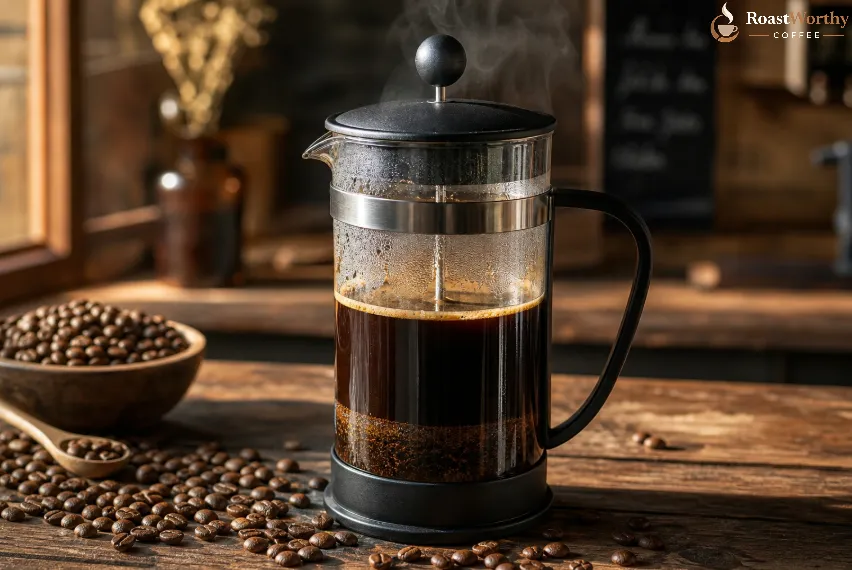
French press uses a metal mesh plunger. You steep coarsely ground coffee for 4–6 minutes, press the plunger, and pour. The metal filter lets oils and fine particles through. The cup is heavy, textured, bold.
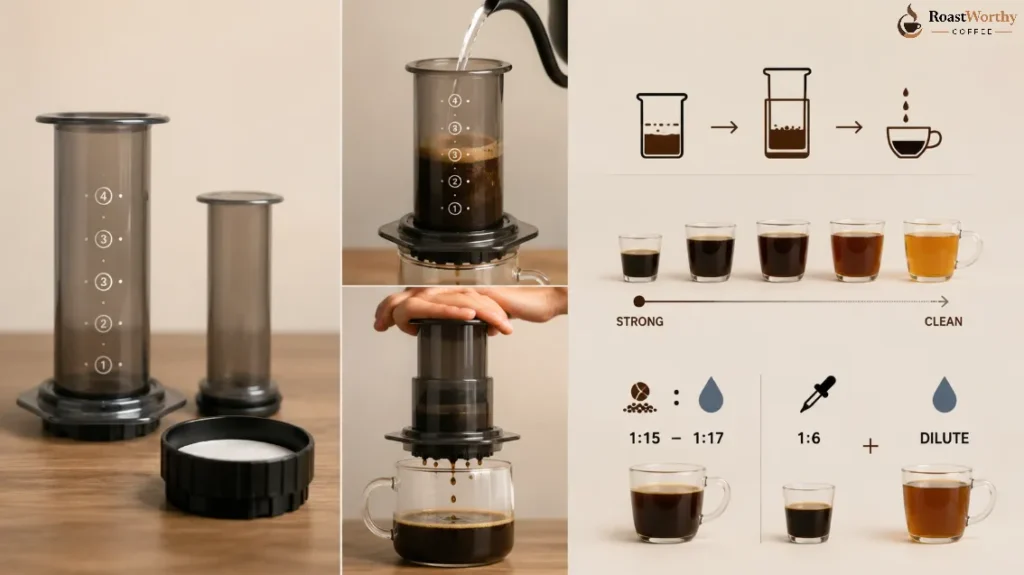
AeroPress combines immersion steeping with pressure. You steep for 1–2 minutes, then press a rubber plunger through a cylindrical chamber. The water is forced through a paper or metal filter under gentle pressure. The cup is clean, concentrated, and fast.
Same broad concept. Different physics. Very different results in the cup.
Brew Time: It Actually Matters More Than You Think
French press needs time. 4 minutes minimum. 6 if you're patient.
Leave it longer and you're over-extracting — bitter, dry, hollow at the finish. Under-steep it and you get weak, grassy, underdeveloped coffee that wastes good beans.
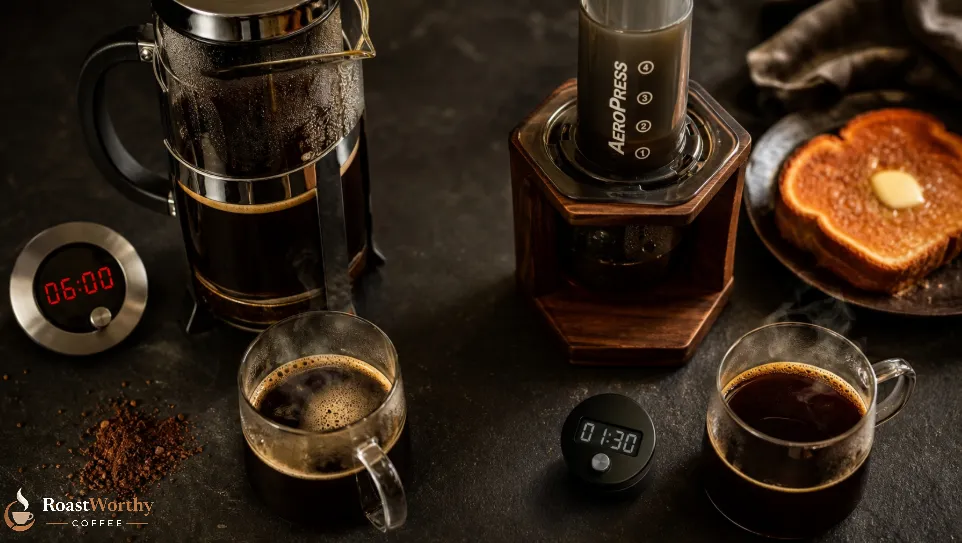
The window for a good French press cup is narrower than most beginners realise.
AeroPress is done in 1–2 minutes. Standard method, inverted method, cold concentrate — all under 3 minutes including cleanup. You can brew and clean the entire device before your toast is done.
The time gap isn't just convenience. It's forgiveness. Forget your French press on the counter for two extra minutes and the cup is ruined. Forget your AeroPress for an extra 30 seconds and you're probably fine.
For morning coffee before work, that margin is everything. ☕
Coffee Grind: Where French Press Gets Punishing
French press demands a coarse grind — roughly 800–1,000 microns. This isn't a preference. It's a technical requirement.
The metal mesh filter has gaps. Fine and medium grinds slip straight through and settle in your cup. You'll taste grit at the bottom of every mug and wonder why your French press coffee always feels muddy. That's why.
A blade grinder makes this worse. Blade grinders produce uneven particle sizes — a mix of boulders and powder. In a French press, those fines over-extract while the coarser chunks under-extract. The cup is simultaneously bitter and thin.
AeroPress tolerates inconsistency far better. It works at medium to medium-fine (400–600 microns) for standard recipes. It works fine with a medium-coarse grind for a longer steep. You can go fine for espresso-style concentrate. The range is wide.
A decent hand grinder — Hario Slim, 1Zpresso Q2 — paired with an AeroPress will outperform a £200 electric burr grinder paired with an under-maintained French press. Every single time.
Sediment and Coffee Strength: The Honest Trade-off
Let's talk about what's actually in your cup.
French press coffee contains coffee oils, micro-fines, and sediment. The metal mesh catches the grounds. It doesn't catch everything else. This is why French press coffee has that heavy, coating texture — it clings to your palate. Some people love this.
Others find it muddy. Gritty halfway through the mug. A slightly stale feeling in the mouth after the last sip.
AeroPress with a paper filter removes oils and virtually all sediment. The cup is clean and bright. You taste extraction, not texture.
AeroPress with a metal filter sits in the middle — more body and oil than paper, less sediment than French press. If you want French press-style weight without the full mud, that's the configuration to use.
On coffee strength: AeroPress produces a more concentrated cup by default. You can dilute it to a long black or drink it straight as an espresso substitute. French press produces a full cup at standard coffee strength — bold and heavy but not concentrated.
Neither is “stronger” in absolute terms. They're solving for different things.
| Factor | AeroPress | French Press |
|---|---|---|
| Body | Medium–full (filter-dependent) | Full, heavy, coating |
| Clarity | High (paper filter) | Low — oils and fines present |
| Acidity | Balanced to bright | Muted, soft |
| Bitterness risk | Low | Moderate–high if over-steeped |
| Sediment | Minimal (paper) / moderate (metal) | Present |
| Best roast level | Light to medium | Medium to dark |
| Grind tolerance | High | Low — coarse only |
| Brew time | 1–2 minutes | 4–6 minutes |
| Portability | Excellent | Poor |
AeroPress vs French Press Taste: What the Cup Actually Tells You

This is where people stop being vague, or they should.
French press coffee tastes like classic coffee. Heavy. Rich. Warm. The oils make it feel substantial. A good medium-dark roast in a French press tastes like the coffee you grew up on — the kind that fills a kitchen with smell at 7am and coats the back of your throat in the best way.
It flatters dark and medium roasts. The weight and texture match those flavour profiles well. A Brazilian natural or a Colombian dark roast in a French press is a legitimate pleasure.
AeroPress coffee tastes like the bean. That's the difference.
A light roast Ethiopian in an AeroPress will show you bergamot, blueberry, and a clean jasmine finish — if the bean has it. A mediocre bean will taste mediocre. More clearly than it would in a French press, where the oils and body cover a lot of sins.
The flavour doesn't lie. ✒️
If you're buying specialty coffee — single-origin, light to medium roast, anything above £15 per 200g — AeroPress is the honest choice. It shows you what you paid for. French press would smooth it down into something pleasant but anonymous.
For an everyday dark roast with milk and sugar at 6am? French press is completely legitimate. It's built for exactly that.
Portability: Not Even a Contest
A glass French press doesn't travel. Full stop.
It's fragile. It's heavy. It takes up space. You can get a stainless steel French press that survives a bag — but it's still bulky, and still harder to clean than an AeroPress in a hostel kitchen.
The AeroPress weighs 230 grams. Injection-moulded plastic. It has survived checked luggage, camping trips, motorcycle panniers, and mountain huts across every continent coffee travellers write about. Look at any serious coffee travel forum and the AeroPress appears within the first three posts.
The AeroPress Go takes it further — it fits inside a travel mug. One unit, one mug, no extra bag space.
Pair it with a 1Zpresso JX-Pro or a Comandante C40 hand grinder and you have a genuinely world-class travel coffee setup in a bag smaller than a hardback book.
French press is a kitchen brewer. AeroPress is a brewer that goes where you go.
The Case for French Press — Because Let's Be Fair
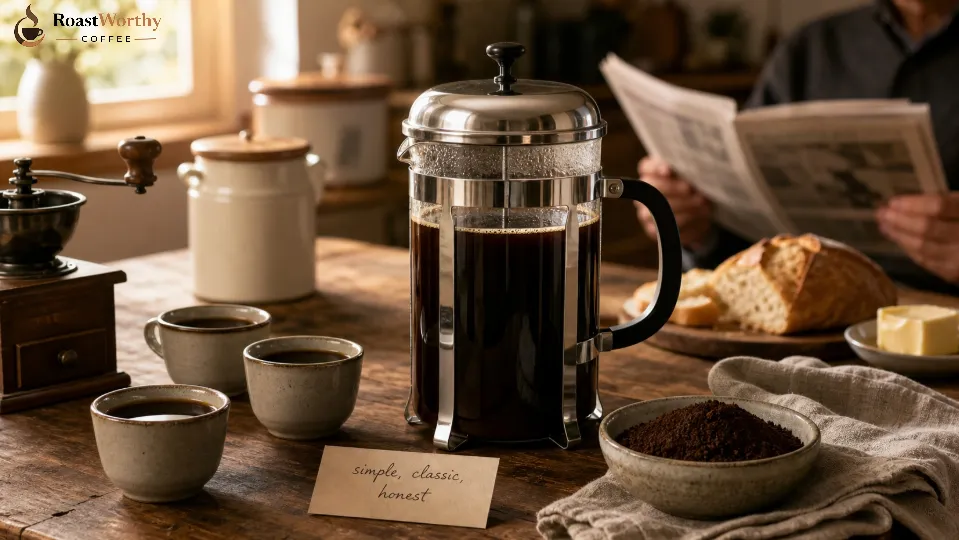
French press has real advantages. Dismissing it entirely is lazy criticism.
The problem isn't the French press. The problem is people using it wrong — blade grinder, wrong steep time, wrong grind — and then blaming the brewer.
Which Is Better for Beginners?
AeroPress. Not close.
The error margin is wider. Short brew time means you can't ruin it by forgetting the timer. Paper filter covers for inconsistent grinds. Cleanup takes 20 seconds.
French press looks simple. It is — when done well. Done badly (blade grinder, two-minute steep, medium grind), it produces a bitter, gritty cup that puts people off specialty coffee entirely. I've seen it happen.
AeroPress teaches you what good extraction feels like before it punishes you for getting it wrong. That's what a beginner needs from a brewer.
There's a reason the World AeroPress Championship has been running since 2008 and attracts baristas who have been brewing for decades. The ceiling is high. The floor is forgiving. That combination is rare.
FAQ
Is AeroPress or French press better for everyday coffee?
AeroPress is better for most people — faster, more forgiving, and produces a cleaner cup with less sediment. French press suits those who prefer a heavy, oily, bold cup without paper filters.
Does AeroPress make stronger coffee than French press?
AeroPress makes a more concentrated cup by default. French press makes a heavier, oilier cup. Both can be adjusted — strength depends entirely on your coffee-to-water ratio and brew time.
What grind size should I use for AeroPress vs French press?
French press requires coarse grind (800–1,000 microns). Fine grinds slip through the metal filter and turn your cup gritty. AeroPress works best at medium to medium-fine (400–600 microns) but tolerates a wide range.
Why does my French press coffee taste bitter?
Almost always over-extraction — too fine a grind, too long a steep, or both. Use a coarse grind, steep for exactly 4 minutes, and press slowly. Inconsistent grind size from a blade grinder is the most common culprit.
Can AeroPress taste like French press?
Close. Swap the paper filter for a metal one and use a longer, coarser steep. You'll get more body and oil in the cup. It won't be identical — the pressure changes the extraction — but it's the nearest AeroPress gets to French press texture.
Is AeroPress worth it if I already own a French press?
Yes — they solve different problems. AeroPress is faster, cleaner, and better for light and single-origin roasts. French press handles batch brewing and bold dark roasts. Most serious home brewers own both.
The Verdict
AeroPress wins. On versatility, flavour clarity, beginner-friendliness, grind tolerance, brew time, and portability — it wins.
French press earns its place for large batches, classic bold cups, and anyone who specifically loves that oil-heavy, texturally rich style.
If you own one brewer: AeroPress. It does more, adapts more, and rewards better beans.
If you already own an AeroPress and want something for Sunday mornings with a dark roast and steamed milk? Pick up a French press. They're £25. They complement each other better than they compete.
Buy the right brewer. Buy good beans. Taste it. Write it down. Roast it again. 🔥
More Recommendations from RoastWorthy Coffee