
The History of Coffee: From Ethiopian Origins to Global Obsession

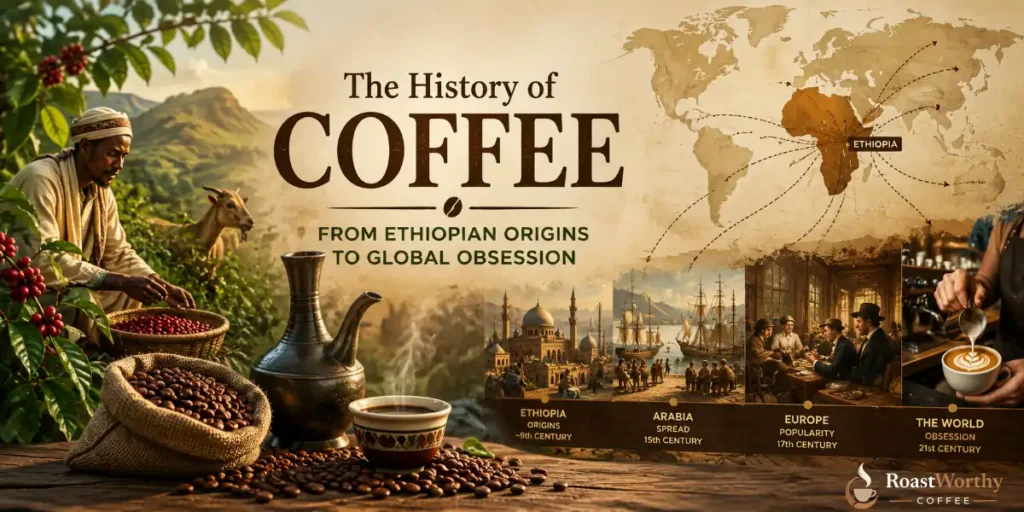
A goat herder watched his animals refuse to sleep after eating red berries off a wild shrub. That's the legend. The reality is richer — and darker.
The history of coffee starts in the forests of southwestern Ethiopia, where the Coffea plant still grows wild today. No other origin can say that. The terroir is doing something here that nowhere else can replicate.
This is the story of how a forest seed became the second-most-traded commodity on Earth. It involves prayer, smuggling, revolution, empire, and forced labor. There's a whole story in this cup.
TL;DR — The Coffee History Timeline
Ethiopian Origins: Where Did Coffee Come From?
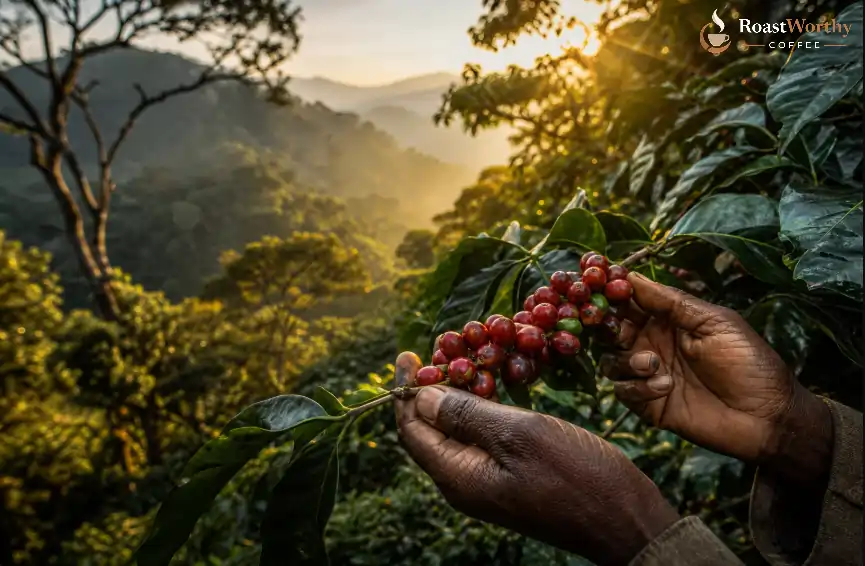
Start with the origin, not the roaster.
The Kaldi legend is charming but unverifiable. What we know: the Oromo people of Ethiopia used coffee long before anyone wrote it down. They ground the cherries, mixed them with animal fat, and rolled them into energy balls for long journeys.
Brewing came later. The arabica plant originated in the highlands around Kaffa and Sidamo — and the word “coffee” likely traces back to that region.
Ethiopia still grows coffee differently. Some of it is forest coffee, semi-wild, harvested from trees nobody planted. This matters beyond the flavour. It's living genetic history.
Yemen and the Birth of Coffee Culture
Coffee crossed the Red Sea into Yemen sometime before the 1400s.
This is where coffee became a drink. Sufi monks in the port city of Mocha brewed it to stay alert through night prayers. The Yemen coffee trade turned a religious aid into a regional economy.
Mocha gave its name to the drink — and to the chocolate-cherry flavour Yemeni naturals still carry. The people who grew this deserve credit.
Yemen guarded its monopoly fiercely. Beans were boiled or roasted before export so they couldn't be planted elsewhere. For a while, it worked.
How the Beans Escaped
Two stories break the monopoly.
A Sufi named Baba Budan smuggled seven fertile seeds out of Mocha, strapped to his chest, and planted them in southern India around 1670. Those plants founded Indian coffee farming.
The Dutch took cuttings to Java soon after. The genie was out.
How the Word Traveled
Follow the word and you follow the trade route.
It started as Arabic qahwa — a term that once meant wine. It became Turkish kahve, then Dutch koffie, and finally English “coffee.” Each spelling marks a border the bean crossed.
That's the thing about coffee etymology. The language map is the trade map.
Coffee Houses and the Ottoman Empire
By the 1500s, Ottoman empire coffee culture was in full bloom.
Coffee houses — qahveh khaneh — opened across Istanbul, Cairo, and Damascus. People gathered to talk, play chess, and argue politics. Rulers got nervous. In 1511, authorities in Mecca banned coffee outright. The ban didn't hold.
These were the first true social hubs built around a drink. Not taverns. Not temples. Something new.
1683: How Coffee Conquered Vienna
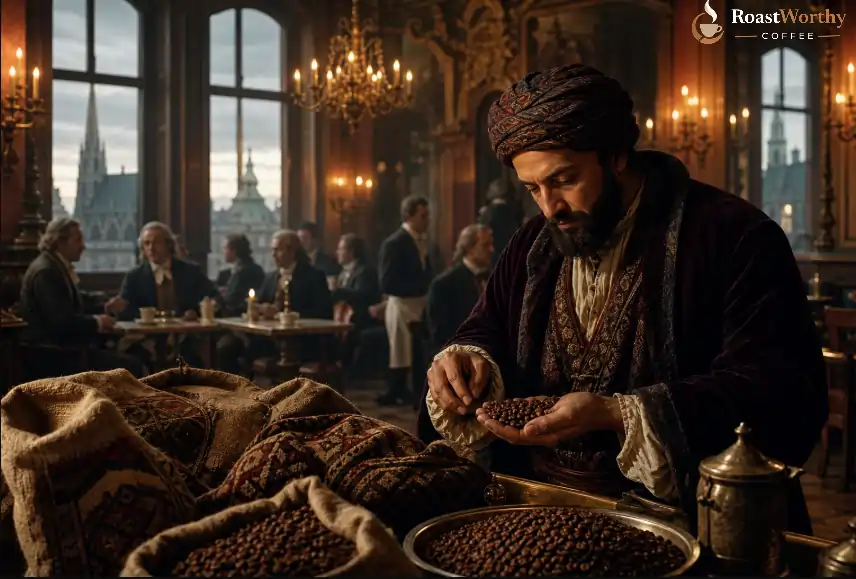
Here's a story most timelines get wrong.
When the Ottoman army retreated from the failed siege of Vienna in 1683, legend says they left behind sacks of strange beans. A man named Georg Kolschitzky supposedly claimed them and opened the city's first café.
The truth is less romantic. Recent research credits an Armenian merchant, Johannes Theodat, with opening Vienna's first real coffee house around 1685.
Either way, the result stuck. Viennese coffee house culture became so iconic that UNESCO now lists it as intangible cultural heritage. The café as a “third place” — not home, not work — was born here.
Coffee, Money, and Revolution
This is the part that proves coffee changed history, not just breakfast.
London's coffee houses earned the nickname “penny universities.” Pay a penny, drink a cup, join the conversation. They became engines of commerce.
Rulers noticed the danger. Charles II of England tried to suppress coffee houses in 1675, calling them seedbeds of sedition. Public outcry forced him to back down within days.
Coffee wasn't just a drink. It was where people thought out loud — and that scared the people in charge.
The Dark Side: Coffee and Forced Labor
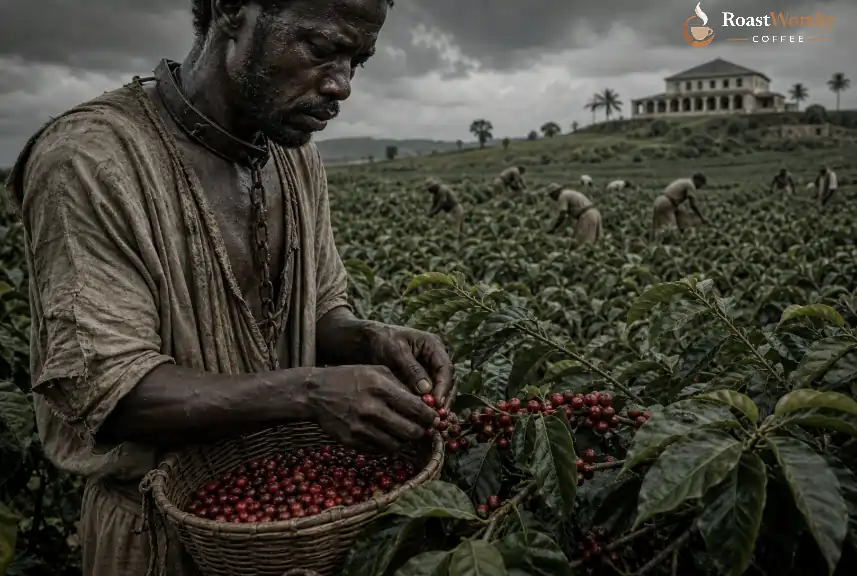
You cannot write an honest history of coffee and skip this. The Americas didn't become a coffee powerhouse by accident. They did it with enslaved labor.
The French planted coffee in the Caribbean. By the late 1700s, the colony of Saint-Domingue — modern Haiti — produced more than half the world's coffee. It ran on the brutal labor of enslaved Africans.
That system collapsed in the Haitian Revolution of 1791–1804, the only successful slave revolt to found a nation. Coffee production shifted south.
The hard truth: much of the coffee that built European café culture was grown by people who had no freedom and no share of the profit.
Brazil took the lead next. Portuguese colonists scaled coffee with vast plantations and enslaved labor, overtaking the world by the mid-1800s. Brazil didn't abolish slavery until 1888 — the last country in the Americas to do so. It remains the world's largest producer today.
Disease, Robusta, and the Modern Bean
In 1869, a fungus changed the global map of coffee.
Coffee leaf rust — Hemileia vastatrix, nicknamed “Devastating Emily” — appeared in the highlands of Ceylon (modern Sri Lanka). Within a few years it wiped out nearly every estate on the island.
The result reshaped the world. Ceylon's ruined coffee planters switched to tea — which is why Sri Lanka is famous for tea today, not coffee.
The rust also pushed growers toward a hardier species: Coffea canephora, better known as robusta. Robusta resists disease and grows at lower altitudes. It's harsher in the cup but cheaper and tougher. Most instant coffee and espresso blends still lean on it.
So the Coffea story is bigger than arabica. Disease forced the second great coffee species onto the world stage.
How Processing Shaped the Flavour
Here's something most timelines skip: how the bean got dried changed everything.
| Method | What happens | Typical taste |
|---|---|---|
| Natural (dry) | Cherry dries on the seed for weeks | Fruity, wine-like, berry |
| Washed (wet) | Fruit stripped before drying | Clean, bright, acidic |
| Honey | Some fruit left on | Sweet, balanced, syrupy |
Ethiopia and Yemen built their reputations on natural processing. That means leaving the fruit on the seed while it dries. The fermentation is why old-world coffees taste like blueberries. Or wine. Or both.
Washed coffee came later and spread with colonial infrastructure. Cleaner cup. More controllable export.
The Three Waves of Modern Coffee

The 20th and 21st centuries split coffee into three eras.
First Wave — Coffee as Commodity
Mass production. Instant coffee. Tins on a supermarket shelf. Nescafé launched in 1938 and exploded during World War II, when it shipped in soldiers' rations. The goal was availability, not quality.
Second Wave — Coffee as Experience
Starbucks led this from the 1970s on. Espresso drinks, café culture, the latte as lifestyle. Origin started to matter — but mostly as marketing.
Third Wave — Coffee as Craft
The third wave treats coffee like wine. Single origin. Named farms. Listed altitudes. Light roasts that taste like the place they came from.
The term was coined by Trish Rothgeb in a 2002 Roasters Guild newsletter. The movement brought Ethiopia's forest heirlooms back into the spotlight. The story came full circle.
Frequently Asked Questions
Where did coffee originate?
Coffee originated in the forests of southwestern Ethiopia, where the Coffea plant still grows wild. It was first cultivated as a beverage in Yemen.
Who discovered coffee?
Legend credits Kaldi, an Ethiopian goat herder, but the Oromo people used coffee long before any written record. There is no single discoverer.
How did coffee spread around the world?
Coffee moved from Ethiopia to Yemen, through the Ottoman empire to Europe, then to the Americas and Asia via colonial trade routes — often built on enslaved labor.
Why is it called “mocha”?
Mocha was Yemen's main coffee port. The name attached to both the drink and the chocolate-cherry flavour of Yemeni beans.
What was coffee leaf rust?
A fungus, Hemileia vastatrix, that destroyed Asian coffee plantations from 1869. It pushed Ceylon to tea and the world toward disease-resistant robusta.
What is third wave coffee?
A movement that treats coffee as craft — single origin, specific farms, light roasts, full traceability. Trish Rothgeb named it in 2002.
Why the History of Coffee Still Matters
The cup in your hand carries more than a thousand years of movement.
Ethiopian forests. Yemeni ports. Ottoman coffee houses. A Viennese siege. Caribbean plantations and the people forced to work them. A fungus that rewrote the map. Modern roasteries chasing the perfect light roast.
When you drink a washed Ethiopian Yirgacheffe today, you taste the end of a very long journey — and the start of the next one. The terroir is doing something here. ☕
More Recommendations from RoastWorthy Coffee