Coffee Grind Size Chart: Which Grind for Every Brewing Method

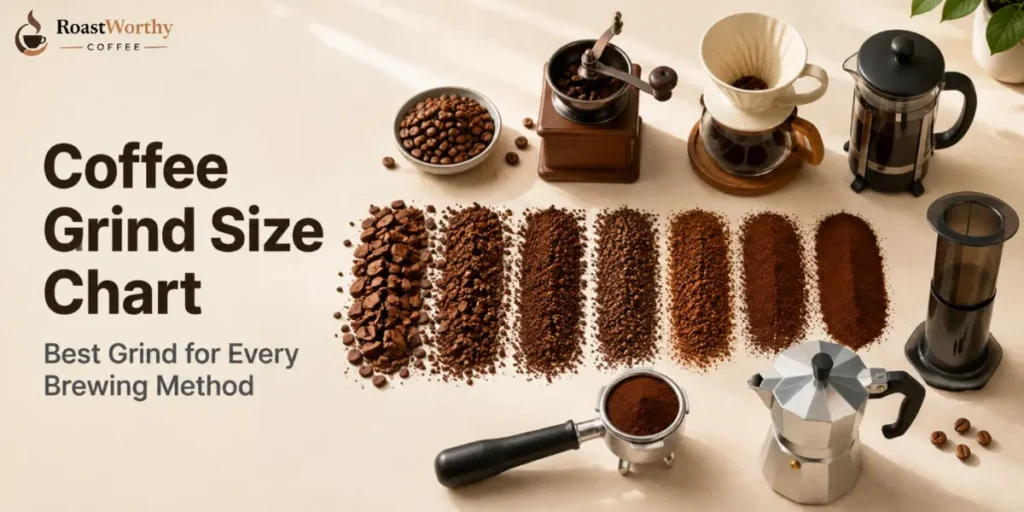
Grind size is the single variable that makes or breaks your brew. Too fine and you over-extract — bitter, dry, astringent. Too coarse and you under-extract — sour, thin, hollow.
This coffee grind size chart gives you exact settings for every method, from Turkish coffee to French press.
You'll find texture references, brew times, and adjustment cues for espresso, pour over, AeroPress, Moka pot, Chemex, cold brew, and more.
Match the grind to the method. Taste the result. Adjust one click finer or coarser from there. Your tongue tells you everything — you just need to know what to listen for.
Why Grind Size Controls Everything
Here's what's actually happening when water hits coffee.
Soluble compounds extract in a specific order. Acids come first — they dissolve fastest. Then sugars. Then the bitter, heavier compounds. Last.
Your grind size controls how fast that process happens. Smaller particles mean more surface area exposed to water. More surface area means faster extraction of everything — acids, sugars, and bitters.
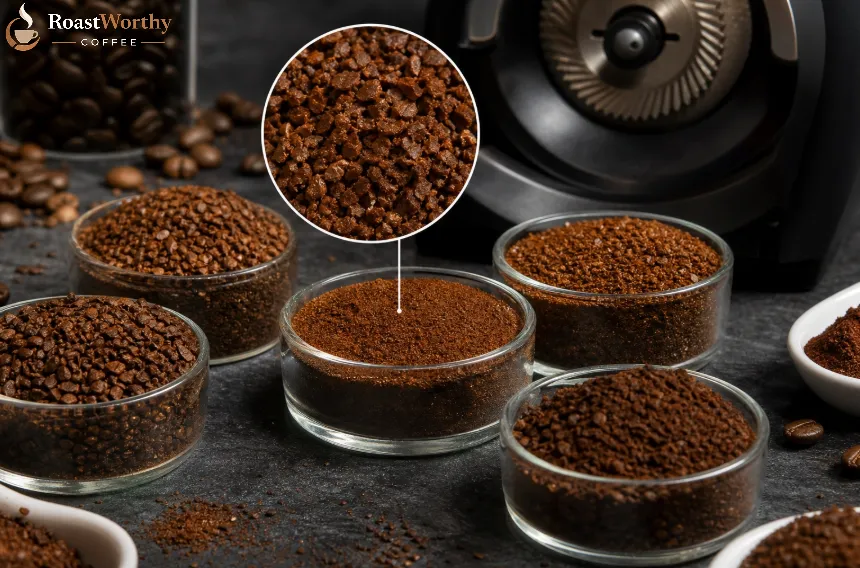
Get the balance right and you taste clean acidity, real sweetness, and structured bitterness. Get it wrong and you get one of two failures.
Too fine for your brewer? Over-extraction. The cup tastes bitter, dry, astringent. Like a tea bag left soaking for an hour.
Too coarse? Under-extraction. Sour, thin, hollow. Like coffee that forgot to be coffee.
The fix isn't better beans or a more expensive brewer. It's the correct grind size for your method.
The Coffee Grind Size Chart
This is the reference you need. Every major brewing method, the correct grind, and what it should look and feel like.
| Brewing Method | Grind Size | Texture Reference | Brew Time |
|---|---|---|---|
| Turkish Coffee | Extra Fine | Powdered sugar, flour-like | 2–3 min |
| Espresso | Fine | Table salt | 25–30 sec |
| AeroPress (short brew) | Medium-Fine | Fine sand | 1–2 min |
| Moka Pot | Medium-Fine | Between salt and sand | 4–5 min |
| Pour Over (V60, Kalita) | Medium | Regular sand | 2:30–3:30 |
| Drip Coffee (auto) | Medium | Sand | 4–6 min |
| Chemex | Medium-Coarse | Coarse sand, sea salt | 4–5 min |
| Siphon | Medium-Coarse | Coarse sand | 2–3 min |
| French Press | Coarse | Cracked pepper | 4 min |
| Cold Brew | Extra Coarse | Raw sugar, large flakes | 12–18 hours |
Bookmark this. Screenshot it. This coffee grind size chart is the one thing that will improve your morning immediately. ⚗️
Fine Grind: Espresso and Turkish Coffee
Fine and extra-fine grinds exist for one reason. Pressure and proximity.
Espresso Grind Size
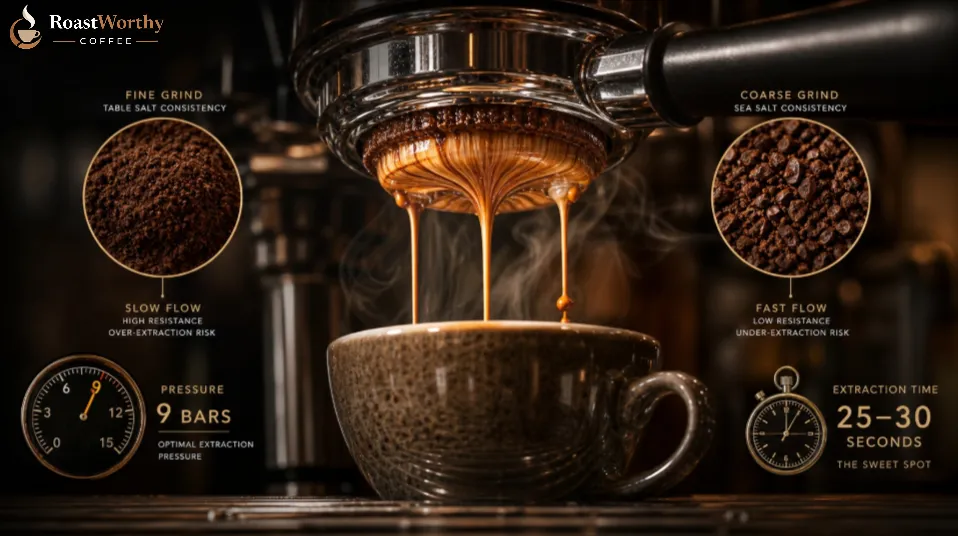
Espresso forces water through a compacted puck of coffee at 9 bars of pressure. That pressure needs resistance. A fine grind — think table salt — creates the density that slows water to a 25–30 second extraction.
Too coarse and the water runs through in 15 seconds. The shot tastes thin and sour. Too fine and the machine chokes. You get a trickle of bitter sludge.
The espresso sweet spot is narrow. We're talking about a fraction of a turn on your grinder making the difference between a great shot and drain material.
Start with table salt texture. Aim for 25–30 seconds for a 1:2 ratio — 18g in, 36g out. Adjust finer if the shot pulls too fast. Adjust coarser if it chokes.
Turkish Coffee Grind Size
Turkish coffee takes it further. Much further.
The grind should be powdery. Like flour or powdered sugar. You should not feel individual particles between your fingers. This is the finest grind in coffee, and most home grinders can't actually produce it.
Traditional Turkish grinders use burrs designed specifically for this. A standard espresso grinder won't get there. A blade grinder will just smash beans into uneven dust.
The reason for the flour-fine grind? Turkish coffee isn't filtered. The grounds sit in the cup. A fine grind suspends particles and creates the thick, velvety texture that defines the style.
If you're grinding for Turkish at home and your grinder can't get fine enough… use a dedicated Turkish hand grinder. Or accept that you're making something close but not traditional.
Medium-Fine Grind: AeroPress and Moka Pot
This is the middle ground between espresso fine and pour over medium. It's where two of the most versatile brewers live.
AeroPress Grind Size
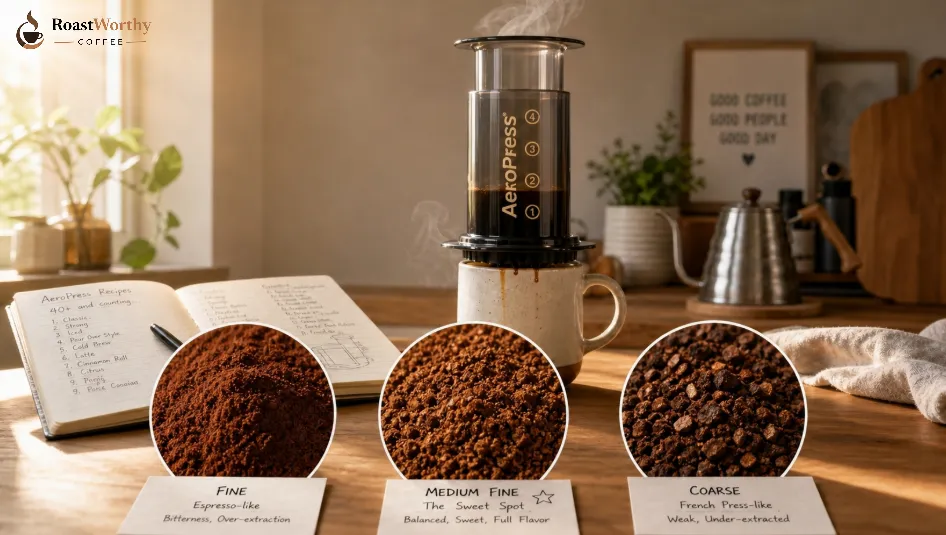
The AeroPress is forgiving. That's the beauty of it. You can brew with anything from espresso-fine to French press-coarse and get something drinkable.
But for optimal results with the standard method — short brew, quick press — go medium-fine. Fine sand. Slightly coarser than espresso, noticeably finer than pour over.
For a standard AeroPress recipe (1:15 ratio, 2 minute brew, quick press): start at medium-fine. If the cup tastes hollow and sour, go finer. If it's bitter and muddy, go coarser.
The AeroPress rewards experimentation. That's not marketing talk. I've logged 40+ recipes on mine. The grind that works for a 2-minute brew won't work for a 10-minute steep. Adjust accordingly.
Moka Pot Grind Size
The Moka pot sits between espresso and drip. It uses steam pressure — not 9 bars, but enough to push water through a coffee bed.
A medium-fine grind gives the right resistance. Too fine and the basket clogs. You get a stalled brew that tastes burnt. Too coarse and the water rushes through. Weak, watery coffee.
Aim for something between table salt and fine sand. Slightly finer than your pour over grind. Slightly coarser than espresso.
Medium Grind: Pour Over and Drip Coffee
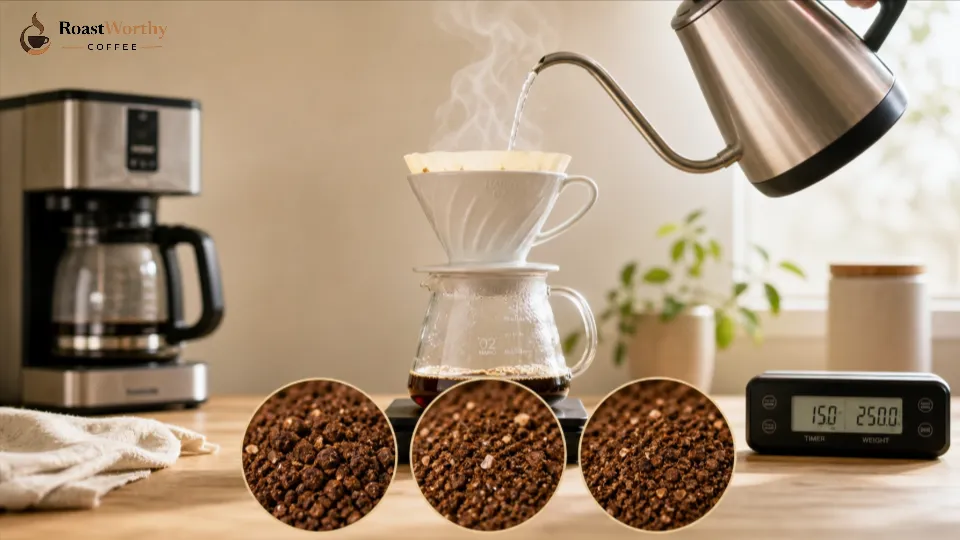
The medium grind is the most common in specialty coffee. If you're buying pre-ground coffee labeled “for drip,” this is what you're getting.
Pour Over Grind Size (V60, Kalita Wave)
Pour over is where grind size gets obsessive. And for good reason.
A V60 uses a paper filter and gravity. Water flows through the bed at a rate determined by the grind. Finer grind means slower flow, longer contact time, more extraction. Coarser grind means faster flow, less extraction.
The target is medium. Regular sand. Not the fine salt you'd use for espresso. Not the chunky sea salt of French press.
For a standard V60 recipe — 15g coffee, 250g water, 3:00 total brew time: start at medium. If the brew finishes under 2:30 and tastes sour, go finer. If it takes longer than 3:30 and tastes bitter, go coarser.
The V60 is unforgiving. That's not a flaw — it's the point. It shows you exactly what your grind and technique are doing.
Drip Coffee Grind Size
Automatic drip machines are less precise than pour over. Water temperature isn't as controlled. Flow rate varies by machine.
But the grind recommendation is the same. Medium. Regular sand consistency.
If your machine brews fast — under 4 minutes — go slightly finer. If it takes 6+ minutes, go slightly coarser. Most home drip machines land in the 4–5 minute range, which is perfect for a medium grind.
Medium-Coarse Grind: Chemex and Siphon
Chemex Grind Size
The Chemex uses thick paper filters. Thicker than any other pour over. This means slower flow and more oils trapped.
You need a slightly coarser grind to compensate. Medium-coarse — coarse sand or light sea salt. If you use a V60-fine grind in a Chemex, the thick filter chokes the brew. You'll be waiting 6 minutes for a bitter cup.
Start one click coarser than your V60 setting on the same grinder. The Chemex rewards a steady pour and a coarser grind with a clean, bright cup that no other brewer replicates.
Siphon Grind Size
Siphon brewing is theatrical. But the grind is straightforward. Medium-coarse.
Water in a siphon hits coffee at high temperature — often 200°F+ — with agitation from the vacuum cycle. A coarser grind prevents over-extraction in that environment.
Coarse Grind: French Press and Cold Brew
French Press Grind Size
The French press uses full immersion. Coffee sits in water for 4 minutes. Then a metal mesh plunger separates grounds from liquid.
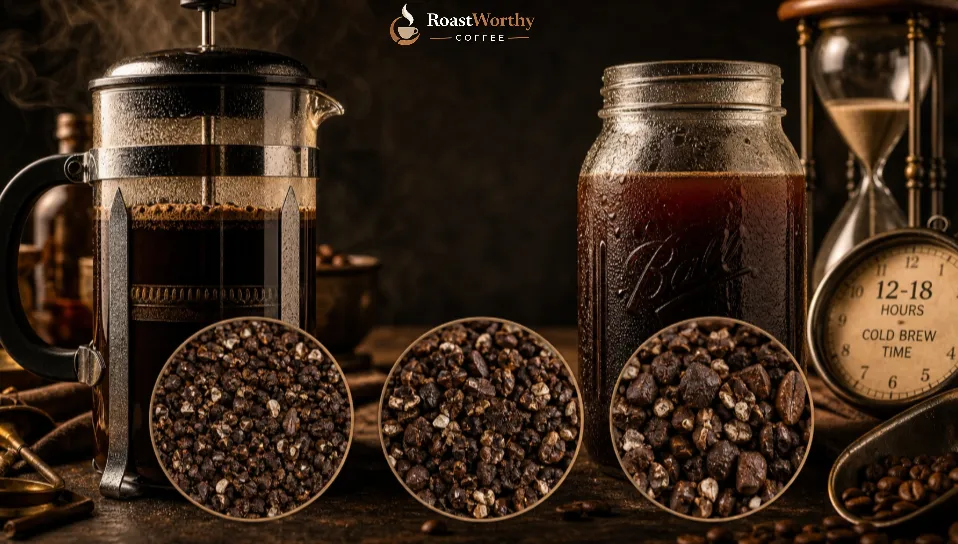
A coarse grind — cracked pepper consistency — serves two purposes. It prevents over-extraction during the long contact time. And it keeps the mesh from clogging with fine particles.
A coarse grind doesn't mean a weak cup. That's a myth. French press coffee is full-bodied because the metal mesh lets oils through that paper filters trap. The grind just keeps it from turning bitter.
If your French press tastes muddy and bitter, your grind is too fine. If it's thin and sour, go slightly finer. The sweet spot is coarse but consistent.
Cold Brew Grind Size
Cold brew runs 12–18 hours. That's a long extraction time. Water is cold, so extraction is slow — but 12 hours is a lot of contact regardless.
A very coarse grind — raw sugar, large flakes — prevents over-extraction. Cold brew made with a fine grind tastes bitter and woody. Cold brew made with a coarse grind tastes smooth, sweet, and clean.
Don't overthink it. Go as coarse as your grinder allows. You're extracting for 12+ hours in cold water. The coarseness is your safety net.
How to Know You Got the Grind Right
Your tongue tells you everything. You just need to know what to listen for.
Sour, thin, quick-finishing brew? Under-extracted. Go finer. The acids extracted but the sugars haven't had time.
Bitter, dry, long-finishing brew? Over-extracted. Go coarser. The bitters have taken over.
Balanced acidity, real sweetness, clean finish? You found it. Write down the setting. That's your baseline for this bean and brewer.
Different beans need different settings. A light-roasted Ethiopian Yirgacheffe may need a finer grind than a dark-roasted Brazilian. Roast level affects density. Density affects how the bean fractures in the grinder.
Taste it. Write it down. Brew it again. That's how you dial in. ⚗️
Common Grind Mistakes (And How to Fix Them)
Using a Blade Grinder
Blade grinders don't grind. They chop. You get a mix of dust and chunks. That's not a grind size — it's a random distribution.
Every particle extracts at a different rate. The dust over-extracts. The chunks under-extract. Your cup has every flaw at once.
Save $50 and buy a burr grinder. Even a cheap one. [We reviewed the best home coffee grinders — from budget to pro level.]
Grinding Too Far Ahead
Ground coffee loses aroma in minutes. Not hours. Minutes.
The CO2 that carries volatile compounds escapes rapidly once the bean is fractured. If you grind the night before, you've lost most of what makes coffee taste like coffee.
Grind right before you brew. Always. This isn't preference. It's chemistry.
Using One Grind for Everything
If your grinder hasn't moved from the setting it came on… you're doing it wrong. Every brewing method needs a different grind size. That's why this coffee grind size chart exists.
Espresso grind in a French press gives you muddy bitterness. French press grind in an espresso machine gives you a 10-second gusher.
Ignoring Bean Density Changes
Light roasts are denser than dark roasts. The same grinder setting produces different particle sizes for different roast levels.
When you switch beans — especially when you switch roast levels — expect to adjust. A light Ethiopian may need 2 clicks finer than a dark Colombian at the same setting.
Grind Size and Roast Level: A Quick Note
This is where roast knowledge meets brew knowledge.
Light roasts are dense and hard. The grinder works harder. The same setting produces slightly coarser results than it would on a dark roast. You may need to go finer.
Dark roasts are brittle. They fracture easily. The same setting produces more fines. You may need to go coarser.
This is why a “universal grind setting” doesn't exist. [Read our guide to roast levels and how they affect brewing — light vs medium vs dark explained.]
Tools: What You Need to Get the Grind Right
You need a burr grinder. That's the one non-negotiable.
A good grinder is more important than an expensive brewer. I'd rather brew on a $20 plastic V60 with a $300 grinder than a $500 espresso machine with a $30 blade grinder.
The grinder is the tool that touches the bean last. It determines what the water has to work with. Make it count. ☕
FAQ: Coffee Grind Size Chart
What is the correct grind size for espresso?
Fine grind. Table salt consistency. Aim for 25–30 seconds of extraction at a 1:2 ratio (18g in, 36g out). If the shot pulls in 15 seconds, go finer. If it chokes past 35 seconds, go coarser.
What grind size for pour over coffee?
Medium grind. Regular sand consistency. Not as fine as espresso, not as coarse as French press. For a V60 with 15g coffee and 250g water, target a 3:00 brew time.
What is the best grind for French press?
Coarse grind. Cracked pepper consistency. This prevents over-extraction during the 4-minute immersion and keeps the metal mesh filter from clogging.
Can I use espresso grind for AeroPress?
Yes. The AeroPress works with espresso-fine to French press-coarse. For short brews (1–2 minutes), use medium-fine. For longer steeps (5+ minutes), go coarser.
What grind size is Turkish coffee?
Extra fine. Powdered sugar or flour consistency. You should not feel individual particles. Most home grinders can't produce this — you may need a dedicated Turkish grinder.
How do I know if my grind is too fine?
The coffee tastes bitter, dry, and astringent. For espresso, the shot takes too long (35+ seconds). For pour over, the brew stalls and takes 4+ minutes. Go one step coarser and taste again.
The Chart Is a Starting Point, Not a Rulebook
Every number on this coffee grind size chart is a starting point — not a law. Your water, your bean's age, your altitude, even your grinder's burr wear all shift the ideal setting slightly.
The engineers among us call this a system with multiple variables. The coffee among us just call it Tuesday.
Change one thing at a time. Grind, then taste, then adjust. Log what works for each bean and method — that log becomes more valuable than any chart, including this one.
Your first dialed-in brew won't be perfect. Make it anyway. The curve doesn't lie, and neither does your tongue. ☕
More Recommendations from RoastWorthy Coffee