Purity Coffee Review 2026: The Most Lab-Tested Coffee Brand?

Let’s be honest. Most “clean coffee” is marketing.
A bag says “mold free” and a health blogger nods along. No lab report. No numbers. Just vibes and a premium price.
Purity Coffee is different. And I don’t say that lightly.
This Purity Coffee review looks at what the brand actually tests for, what it publishes, how the coffee tastes, and whether it earns its price. No sponsorship. No spin.
I’ve cupped over 8,000 coffees. This one’s interesting. And after taking a fresh look… better documented than I expected. Here’s the honest breakdown.
Purity Coffee Review: Quick Verdict
Purity Coffee — 8/10
What Purity Coffee Actually Is
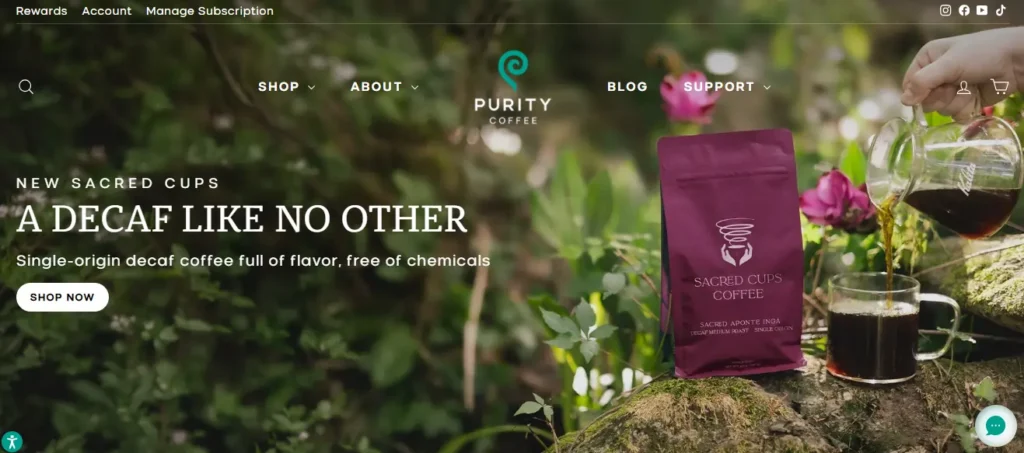
Purity built its whole identity on one idea: coffee should be healthy, not just enjoyable.
Not “healthy” in a lifestyle-influencer sense. Healthy in a lab-report sense.
The brand roasts for antioxidant retention. It tests green beans for contaminants before buying. It flushes bags with nitrogen to protect freshness. And it holds real certifications… USDA organic, Smithsonian Bird Friendly, and Demeter biodynamic on select coffees.
That trio matters. More brands claim “clean” than can back it up.
Their core line is small on purpose:
Whole bean, ground, and pods. That’s it. No sprawling menu… which I respect.
The Lab Testing: What’s Real and What’s Marketing
Here’s where it gets interesting. And where Purity actually delivers.
Purity does test. That part’s true.
They send blind, coded green coffee samples to independent labs. Not their own labs. Real third-party ones — Silliker-Mérieux in Illinois, the Federal University of Rio de Janeiro, and the University of Porto.
They test for mold and yeast colonies, ochratoxin A, aflatoxins, Bacillus cereus, pesticides, and heavy metals like lead, cadmium, and copper.
That’s a genuinely broad panel. Broader than most “mold free coffee” brands that publish nothing at all.
The numbers
From their testing, Purity’s own coffee came back clean.
Mold and yeast: under 10 colonies. Ochratoxin A: below 0.2 µg/kg… the detection floor. Aflatoxins: none. Lead: 0.03 ppm. Cadmium: 0.002 ppm. All well below any regulatory threshold.
Cupping score: 85. Comfortably specialty grade. Its chlorogenic acid level hit 2.1 g/100g… higher than nearly every competitor they tested.
Those are strong results. No notes there.
Credit where it’s due
Here’s the part worth flagging. For years the knock on Purity was simple: great testing philosophy, but the public data was stuck in an old 2016–2018 survey.
That’s changed. Purity now publishes a current, dated certificate of analysis for mold and mycotoxin testing right on the product page. The one I pulled was dated August 2025.
That’s what the best-in-class do. A recent, downloadable COA… not a marketing claim frozen in 2017.
So the “mycotoxin free coffee” label is now backed by current proof, not just history. That matters. It puts Purity back near the front of the pack.
Purity Coffee vs. The Competition
I compared Purity against the other serious names in the lab-tested space. Transparency, panel breadth, and cost.
| Brand | Test Panel | Lab Reports Public | Per-Cup (Retail) | Organic |
|---|---|---|---|---|
| Purity Coffee | Mold, mycotoxins, pesticides, select metals | Yes — current dated COA on product page | ~$0.97–$1.16 | USDA Organic |
| Bulletproof | Mycotoxins + heavy metals | Not public (proprietary) | ~$0.78 | No |
| Kion | “Toxin tested” attestation | Not public | ~$1.02 | USDA Organic |
| Danger Coffee | 13 mycotoxins + 500+ residues | Per-compound limits published | ~$1.22 | No |
| Lifeboost | 400+ toxins (claim) | Not linked publicly | ~$1.19 | USDA Organic |
Read that table honestly.
Purity is stronger than Bulletproof, Kion, and Lifeboost on transparency. It publishes an actual, current, dated certificate of analysis… not just an attestation.
A couple of newer rivals publish broader panels with per-compound detection limits. That’s a genuine edge for the data nerds.
But Purity backs its marketing with proof you can download today. Elite testing philosophy, now matched by current public data.
What It Actually Tastes Like
Enough about labs. This is still coffee. It has to taste good.
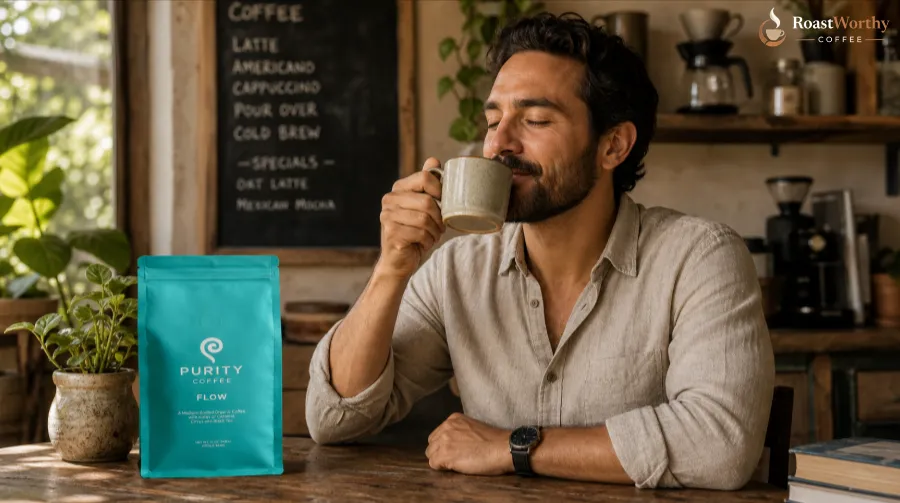
FLOW, the flagship medium roast, tastes like roasted nuts and dark chocolate with a juicy, apple-like high note. There’s a soft brightness that keeps it from going flat.
It’s smooth. Genuinely smooth. Low acid without tasting baked or hollow.
Is it thrilling? No. This isn’t a wild Ethiopian natural bursting with blueberry. It’s not trying to be.
It’s a clean, balanced, everyday cup. The kind you drink two mugs of without thinking. Comforting, not electrifying.
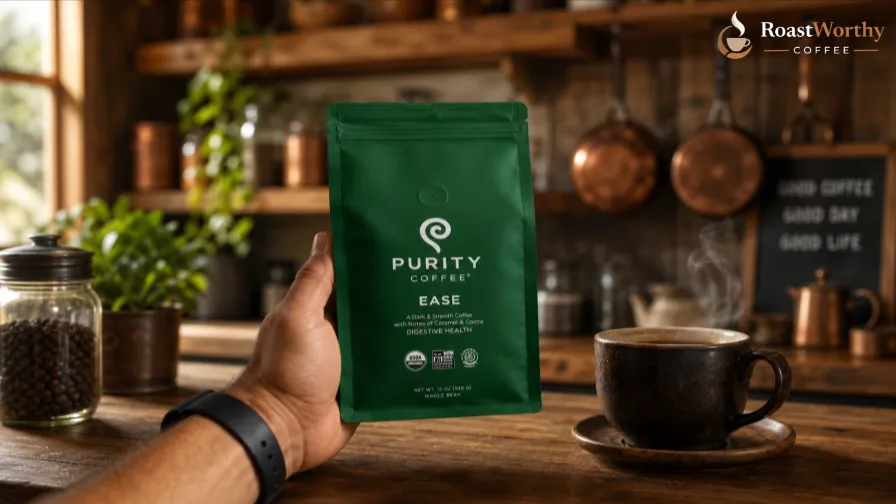
EASE, the dark roast, leans smoky and bold. Less brightness, more body. Fine, if that’s your thing. But dark roasting burns off antioxidants… so you’re trading the health angle for flavour preference.
I’d drink FLOW. That’s the one that balances the brand’s whole pitch.
Purity aims for a pH around 4.95–5.05 and an Agtron of roughly 59. That’s a deliberately balanced medium… and it shows in the cup.
Why “Roasted for Health” Actually Means Something
Here’s what most brands won’t tell you. Roast level changes the chemistry, not just the flavour.
Push a coffee too dark and you destroy chlorogenic acid and trigonelline… the compounds behind coffee’s antioxidant reputation. You also raise the risk of PAHs, the nasties that form in very dark roasts.
Purity roasts to hold those compounds. That’s the entire point of a high antioxidant coffee.
Coffee is already the biggest source of antioxidants in the average Western diet. Purity’s play is simply: don’t waste them.
It’s a real, evidence-based position. Not just a wellness slogan.
The nitrogen-flushing matters too. Oxygen stales coffee and degrades those same compounds. Nitrogen flushed bags protect both freshness and chemistry between roast and cup.
The Certifications: Do They Matter?
Short answer: yes, more than most.
USDA organic means no synthetic pesticides or fertilisers on the crop. Good baseline. But organic is a cultivation-input rule… it doesn’t test the final bean for contamination. That’s why lab testing and organic certification aren’t redundant. They’re complementary.
Smithsonian Bird Friendly is the harder one to earn. It requires organic certification plus genuine shade-grown, biodiverse farming. It’s the strictest sustainability standard in coffee. Real habitat protection, not a logo you buy.
Biodynamic (Demeter certified) goes further still… regenerative, closed-loop farming. Purity holds it on select coffees, not the full line. Worth checking per product.
Add it up and Purity is one of the most ecologically serious brands in the clean-coffee space. That’s not nothing.
Purity Coffee Price: Is It Worth It?
Let’s talk money. Because this is the sticking point.
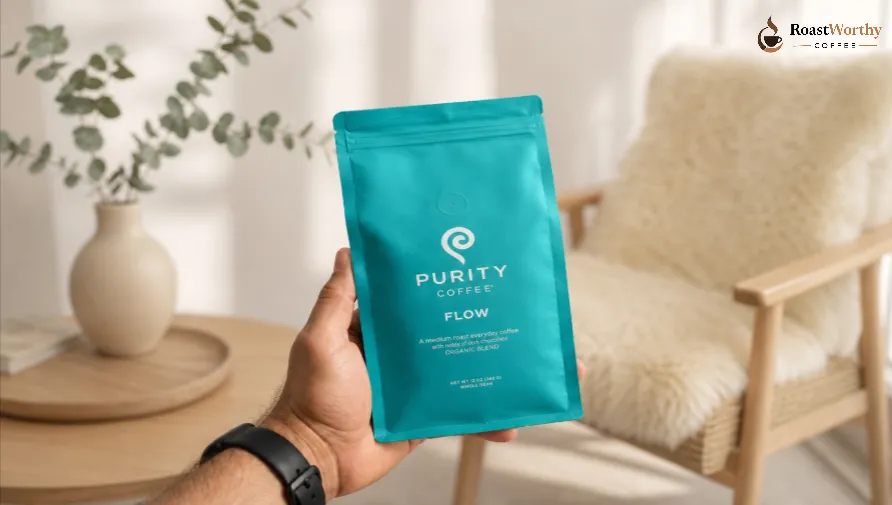
A 12 oz bag of FLOW whole bean runs $29.00 at retail. That bag makes 25–30 cups… so you’re looking at roughly $0.97–$1.16 per cup depending on how strong you brew.
Buy the 5 lb bag and the per-cup cost drops hard. That bag makes about 180 cups.
Subscription knocks the price down further, and first orders often carry a 20% discount. Even so… this sits at the premium end.
Compare that to supermarket organic at 30–40 cents a cup. You’re paying a real premium for the testing and the certifications.
Is it worth it? Depends entirely on who you are.
This one earns its price for the right person. Not for everyone.
What Purity Gets Right
Credit where it’s due. Purity does several things most brands don’t.
That’s a serious brand. Not a wellness cash-grab.
Where It Falls Short
I’d be a bad critic if I stopped there.
The biodynamic certification isn’t across the whole range. The flavour, while excellent and clean, is conservative. If you chase bright, funky, experimental coffees… this won’t excite you.
A couple of rivals publish broader mycotoxin panels with more granular per-compound detection limits.
And the price is steep for what is, ultimately, a very good but not extraordinary cup.
The testing is genuinely current and public now. The range and the pricing are the real trade-offs.
Frequently Asked Questions
Is Purity Coffee actually mold free?
Purity tests for mold, yeast, and mycotoxins through independent labs and publishes a current, dated certificate of analysis on its product pages. Its results show levels below detection limits, making it one of the better-documented mold free coffee options available.
Does Purity Coffee test for mycotoxins and ochratoxin A?
Yes. Purity tests for ochratoxin A and aflatoxins through independent third-party labs, and states it won’t buy green coffee that contains either. Its own coffee tested below 0.2 µg/kg for ochratoxin A, well under regulatory limits.
Is Purity Coffee high in antioxidants?
Yes. Purity roasts specifically to preserve chlorogenic acid and trigonelline. Its tested chlorogenic acid level of 2.1 g/100g was among the highest of the brands it compared, making it a legitimate high antioxidant coffee.
Is Purity Coffee worth the price?
A 12 oz bag is $29 and makes 25–30 cups, roughly $0.97–$1.16 per cup at retail, with the 5 lb bag and subscription costing less. For heavy daily drinkers or those with sensitivities, that premium is justifiable for the testing and certifications. For occasional drinkers, it’s harder to justify versus standard organic specialty coffee.
What certifications does Purity Coffee have?
Purity is USDA organic and Smithsonian Bird Friendly certified, with Demeter biodynamic certification on select coffees. It is also pursuing regenerative organic certification on its own Colombian farm.
How does Purity Coffee taste?
The flagship FLOW medium roast tastes like roasted nuts, dark chocolate, and a juicy apple-like brightness. It’s smooth, low in acidity, and balanced… a comforting everyday cup rather than a bright, experimental one.
Final Verdict
Purity Coffee is the real deal. On intent and on execution.
It’s genuinely one of the cleanest, most thoughtfully roasted coffees you can buy. The certifications are legit. The taste is smooth, balanced, and reliably good. And critically… it now publishes current, dated lab data instead of resting on an old study.
“The most lab-tested coffee brand”? It’s a fair claim to be in that conversation. A few rivals publish broader panels, but Purity backs its marketing with proof you can actually download today.
If you drink coffee daily and want verifiable cleanliness with real sustainability credentials, buy it. FLOW is the one to start with. I’ve had worse… much worse.
If you just want a great cup and testing isn’t your priority… there’s better value elsewhere. But this one’s honest about what it is.
Note on the health angle: mycotoxin exposure from ordinary specialty coffee is generally low for most drinkers. If you have specific health concerns, it’s worth speaking with a medical professional rather than relying on marketing claims from any brand, Purity included.
More Recommendations from RoastWorthy Coffee