How to Taste Coffee Like a Pro: Cupping Basics (2026)


Most people don't taste their coffee. They drink it.
There's a difference. Cupping is how you close that gap. It's the standardized method every serious buyer, roaster, and Q-grader uses to judge a coffee honestly… and once you learn how to taste coffee this way, you can't go back to just drinking it.
Let's be honest. You don't need a lab. You don't need a certificate. You need five things you probably already own, and a willingness to slurp loudly in your own kitchen. That's it.
TL;DR — The Cupping Cheat Sheet
What Cupping Actually Is
Cupping is a tasting protocol codified by the Specialty Coffee Association (SCA). It exists to remove variables.
Same ratio. Same grind. Same water temp. Same timing. Every cup, every time.
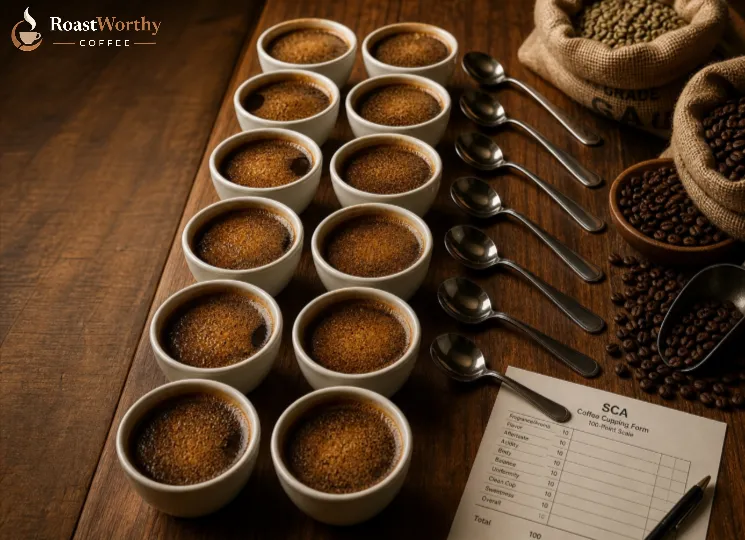
Why the fuss? Because if the method changes, you're tasting the method — not the coffee. Change the grind and you change the extraction. Change the water temp and you change what dissolves. Strip all of that away and what's left is the bean itself. Its origin. Its process. Its roast.
That's the whole point. A cupping protocol lets you compare coffees fairly — one against another, or the same coffee across two roast batches. The controlled cup doesn't lie.
It's also the only way to build a real palate. When every cup is brewed identically, the only thing that varies is the coffee. Your brain starts connecting what you taste to what caused it. That's the entire game.
To be classified as specialty, a coffee needs to score 80+ on the 100-point SCA scale. 80–85 is very good. 85–90 is excellent. 90+ is rare air. Now you know what those numbers on the bag actually mean when a roaster prints them.
Why Slurping Beats Sipping
You slurp because your nose does most of the work.
Around 80% of what you call “flavor” is actually aroma — specifically retronasal aroma, the smell that reaches your nose from the back of your mouth as you taste. A hard slurp sprays the coffee across your whole palate and pushes those aromatics up.
It sounds ridiculous. Do it anyway. It works.
Sipping quietly is polite. It's also useless for evaluation. You want to aerate the liquid and hit every part of the tongue at the same time — front, sides, back. A gentle sip only wets the tip of your tongue, and the tip reads sweetness and not much else.
The proper technique: load your spoon, bring it to your lips, and inhale sharply so the coffee atomizes into a fine mist inside your mouth. Loud is correct. If your neighbours can't hear you, you're doing it wrong.
The Gear You Need
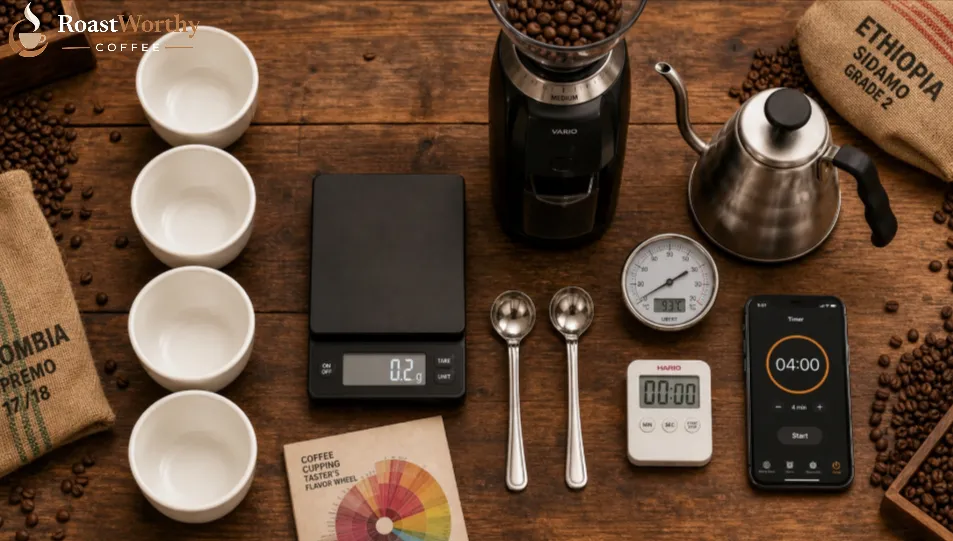
Keep it simple. Fancy equipment does not make you a better taster. A trained palate does.
Freshness is non-negotiable. Cup coffee roasted within the last 24 hours to two weeks. Too fresh — under 24 hours — and CO2 off-gassing muddies things. Too old — past a month — and it's flat. Stale beans tell you nothing true.
The SCA Cupping Protocol, Step by Step
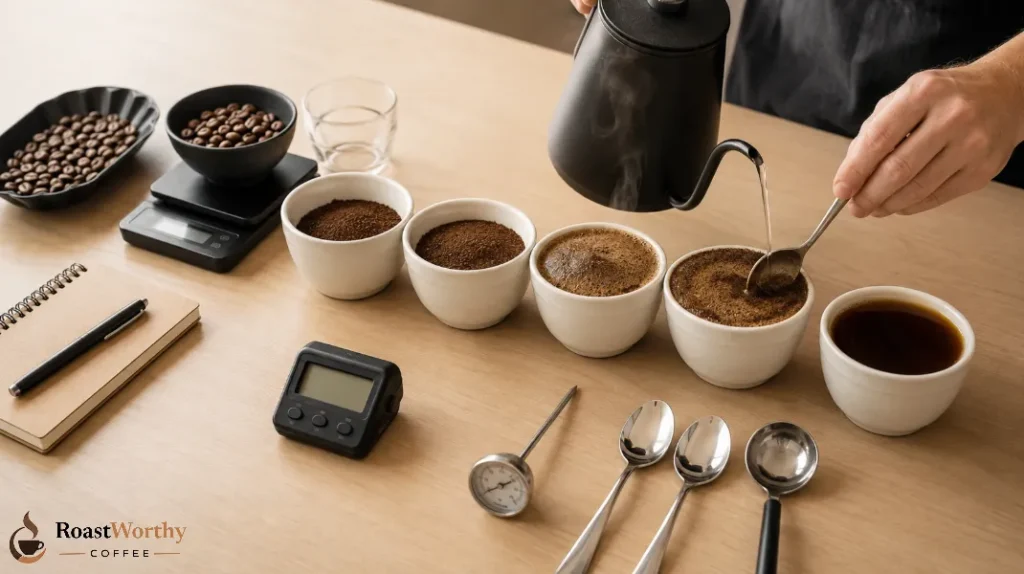
Here's the sequence the pros run. Follow it in order. Each stage reveals something the last one couldn't. Skip a step and you lose a data point you can't get back.
1. Weigh and grind
8.25g of coffee per cup, ground medium-coarse — a bit coarser than drip, around the texture of coarse sand. Grind each cup separately. Don't pre-grind the whole batch, because ground coffee loses aroma by the minute.
2. Smell the dry grounds
Nose right into the cup. This is the dry fragrance. Floral? Nutty? Fruity? Sharp and grassy? Note your first instinct before you overthink it. First impressions are usually the honest ones.
3. Pour and wait
Pour 93°C water to the brim, saturating all the grounds. Start the timer immediately. A crust of grounds floats to the top and forms a cap. Let it steep undisturbed for 4 minutes. Don't stir. Don't peek. Leave it.
4. Break the crust
At exactly 4 minutes, push your spoon through the crust three times, gently, and lean in with your nose at the surface. This is the single best-smelling moment in the whole process. The trapped aromatics release all at once — the wet aroma. Don't miss it. This is where a coffee's true character often shows up first.
5. Skim
Skim off the floating foam and remaining grounds with two spoons, working from the surface. Leave a clean liquid surface behind. Rinse your spoon in hot water between different cups so you don't drag flavor from one coffee into the next.
6. Taste
Wait until the coffee drops to about 70°C — usually 8–10 minutes in. Load your spoon, and slurp hard. Then taste again a few minutes later, and again after that.
This part matters more than beginners realize: coffee is not one thing. It's a moving target as it cools.
The Temperature Trick: Taste as It Cools
Taste It. Write It Down. Do It Again.
That last line is the whole skill. Tasting once teaches you nothing. Tasting the same coffee at 70°C, then 50°C, then near room temperature — that's where the profile actually unfolds.
Hot coffee hides acidity and shows body. As it cools, sweetness and acidity step forward, and defects come out of hiding. A coffee that tastes clean and rich when hot can turn sour or vegetal cold. That contrast is the information. A great coffee stays pleasant all the way down. A mediocre one falls apart as it cools.
Write everything down. Your palate has no memory. Your notes do. Even one word per attribute — “lemon,” “syrupy,” “short finish” — beats trying to remember. Over weeks, those notes become a map of your own palate.
How to Taste Coffee: The 6 Things You're Actually Judging
Forget “complex flavour profile.” That phrase means nothing. Break the cup into parts instead. Judge one attribute at a time, then step back and judge how they fit together.
| Attribute | The question you're asking | What to notice |
|---|---|---|
| Aroma / Fragrance | What does it smell like — dry, then wet? | Floral, fruity, nutty, spicy, roasted |
| Flavor | What does it taste like when you slurp? | Specific: lemon, cocoa, cherry, toast |
| Acidity | Does it make you salivate? Bright or dull? | Crisp like a green apple vs. flat |
| Body | How heavy does it feel in the mouth? | Watery, tea-like, juicy, syrupy |
| Sweetness | Any natural sugar, without adding any? | Caramel, honey, ripe fruit |
| Aftertaste (finish) | What lingers after you swallow? | Long and clean, or short and harsh |
Balance ties them together. A coffee where acidity, body, and sweetness all pull in the same direction feels resolved. One that fights itself feels off — no matter how loud any single note is. A screaming acidity with no sweetness to catch it is unbalanced. So is a heavy body with a flat, lifeless finish.
A quick reframe on acidity, because beginners fear it. Acidity is not a flaw. Bright, structured acidity is what makes a Kenyan or an Ethiopian sing — it's the sparkle, the thing that makes your mouth water.
Sourness, on the other hand — sharp, unpleasant, vinegary — is the flaw. Learn the difference between lively and sour and half the puzzle clicks into place.
Body is the other one people miss. It's not about flavor at all. It's texture — the physical weight and mouthfeel of the liquid.
A washed Ethiopian feels light and tea-like. A natural-process Brazilian can feel thick, almost syrupy. Neither is better. They're just different, and knowing that is part of the skill.
The Flavor Wheel: Read It From the Center Out
You've seen the SCA Coffee Taster's Flavor Wheel. That colorful ring everyone posts. Most people use it wrong.
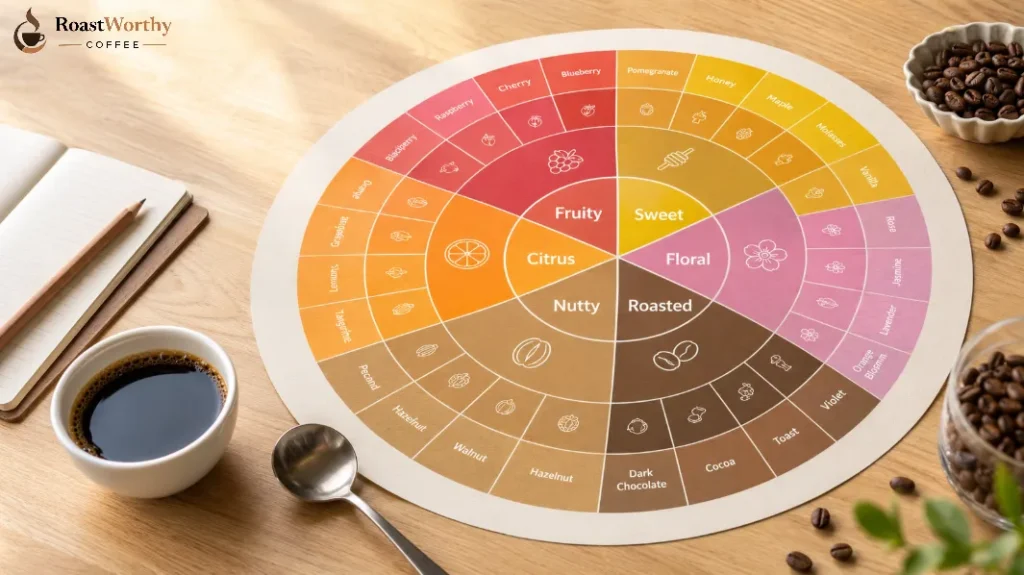
It's built to be read inside-out, not scanned at random.
So the move is: start broad. Slurp, then ask “fruity or roasted?” Land on fruity. Then push outward — “what kind? Citrus.” Then further still — “lemon or grapefruit?”
You don't have to reach the outer ring. Landing on “fruity” is a genuine win when you're starting out. Precision comes with reps, not with pressure. And don't force a note you don't actually taste — that's how beginners fool themselves into “blueberry” because someone else said so. If it tastes like chocolate to you, write chocolate.
The colors on the wheel aren't decorative either. They're arranged so related flavors sit next to each other, which is why moving outward from a center category keeps you on track instead of jumping randomly across the ring.
Common Beginner Mistakes
I've cupped over eight thousand coffees. Here's what trips up nearly everyone at first.
How to Cup Coffee at Home Without the Kit
You can run a stripped-down version tonight. No cupping spoons, no five-cup pro setup, no thermometer even, if you time your kettle.
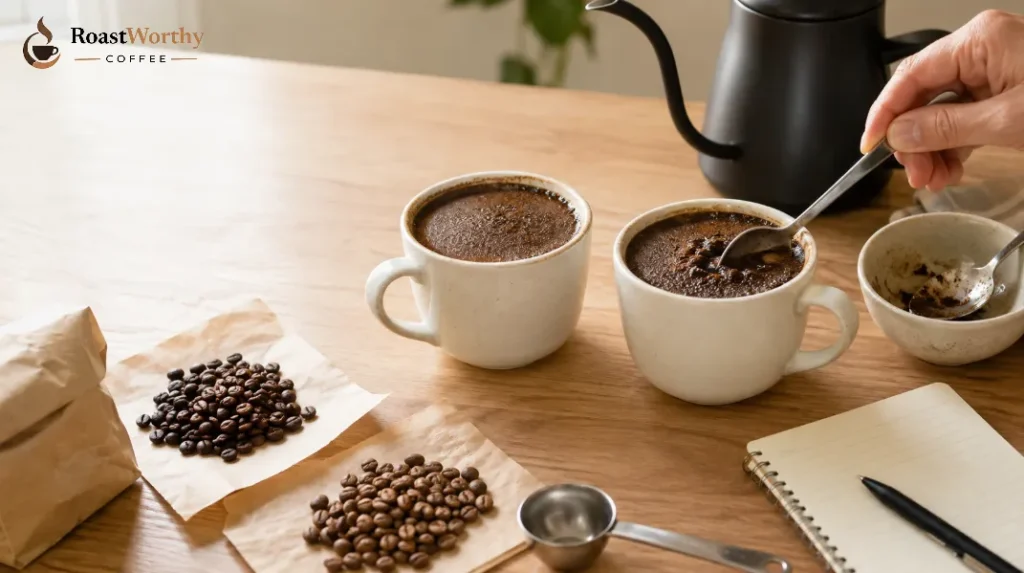
Grind two different coffees — ideally from different origins, so the contrast is obvious. Two mugs each. Same weight, same water, same 4-minute steep. Break the crust with any spoon. Skim. Then slurp both, back to back, as they cool.
That side-by-side contrast is the fastest palate trainer there is. One coffee makes the other's character obvious in a way a single cup never will. A washed Colombian next to a natural Ethiopian teaches you more in ten minutes than a week of solo drinking.
Do this weekly and in a month you'll taste things you're completely blind to right now. That's not a promise. It's just how the palate works — it's a muscle, and comparison is the workout.
FAQ
What is coffee cupping?
Cupping is the SCA's standardized coffee tasting method. You brew ground coffee in hot water at a fixed ratio, break the crust, and evaluate aroma, flavor, acidity, body, sweetness, and aftertaste on a 100-point scale.
What ratio is used for coffee cupping?
The SCA standard is 8.25g of coffee per 150ml of water — roughly 12g per 200ml, or about 1:18. Water should be 93°C.
How long do you steep coffee when cupping?
Four minutes. Then you break the crust with a spoon, skim the surface, and begin tasting once the coffee cools to around 70°C.
Why do you slurp coffee when tasting it?
Slurping aerates the coffee across your whole palate and pushes aromatics up to your nose. Since around 80% of flavor is smell, a hard slurp lets you taste far more than a quiet sip.
Is the coffee flavor wheel necessary for beginners?
No, but it helps. Use it inside-out: start with a broad category like “fruity,” then narrow toward specifics. Landing on a general category is a genuine win early on.
What score makes a coffee “specialty”?
80 points or higher on the SCA 100-point scale. 80–85 is very good, 85–90 excellent, and 90+ is exceptional.
The Verdict
Cupping isn't a party trick. It's the most honest way to know what's in your cup — and whether a roaster is actually worth your money.
Learn the protocol. Slurp without shame. Compare, never sip alone. And write down what you taste, every single time.
Taste it. Write it down. Taste it again. That's the entire method. ☕
More Recommendations from RoastWorthy Coffee