Why Is My Espresso Sour? Under-Extraction Causes + Fixes That Works

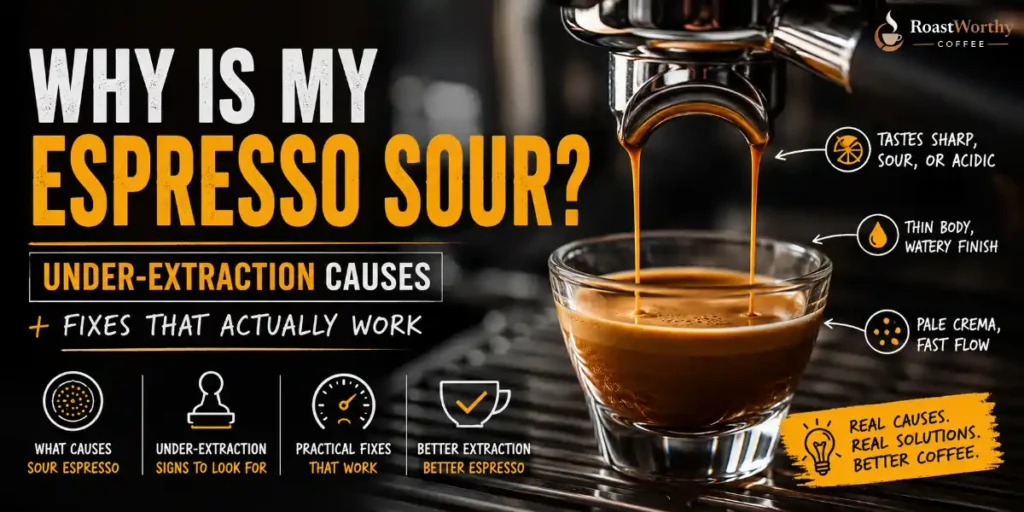
Quick Answer: Sour espresso is almost always caused by under-extraction — the water moved through the puck too fast, pulling acids before sugars had time to dissolve. Fix it by grinding finer, raising brew temperature, and targeting a 25–30 second extraction time.
Sour espresso isn't a mystery. It's a physics problem.
When water hits your coffee puck, it extracts compounds in a fixed sequence — acids first, then sugars, then bitter compounds. Under-extraction means the shot ended too early. You got the acids. You missed the sweetness.
That's why under-extracted espresso tastes sharp, bright, and hollow. No body. No finish. Just vinegar with a crema on top.
Here's what the heat is actually doing — and how to stop it. 🔬
What Is Under-Extracted Espresso?
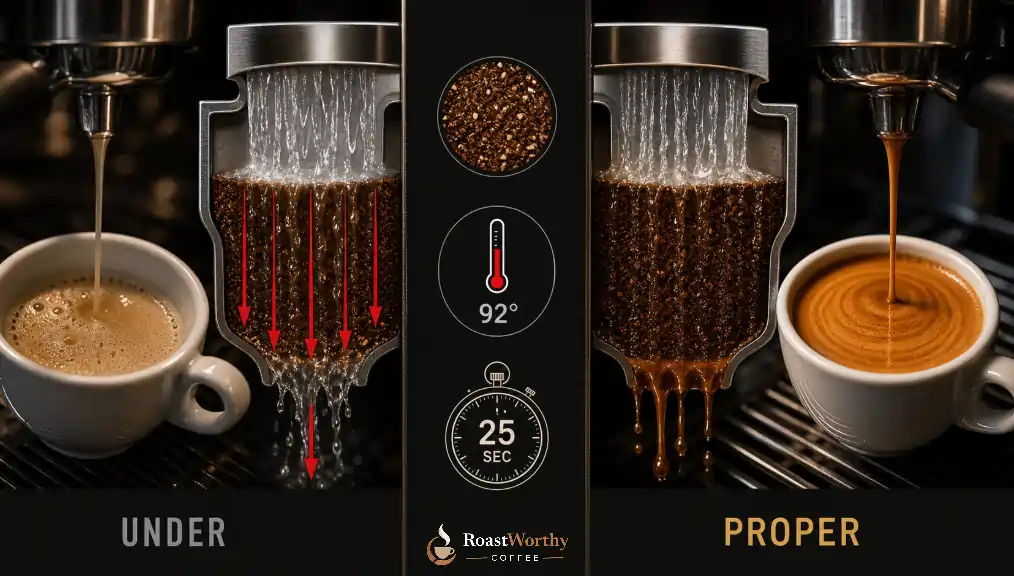
Under-extraction happens when water passes through the coffee puck too quickly to dissolve the full range of soluble compounds.
The target extraction yield for espresso sits between 18–22% TDS (total dissolved solids). Under-extracted shots fall below 18%. You pulled the shot — but left most of the flavour behind.
Three variables control extraction: grind size, water temperature, and time. All three interact. If one is off, your espresso tastes sour no matter what else you do right.
Why Espresso Turns Sour: 4 Real Causes
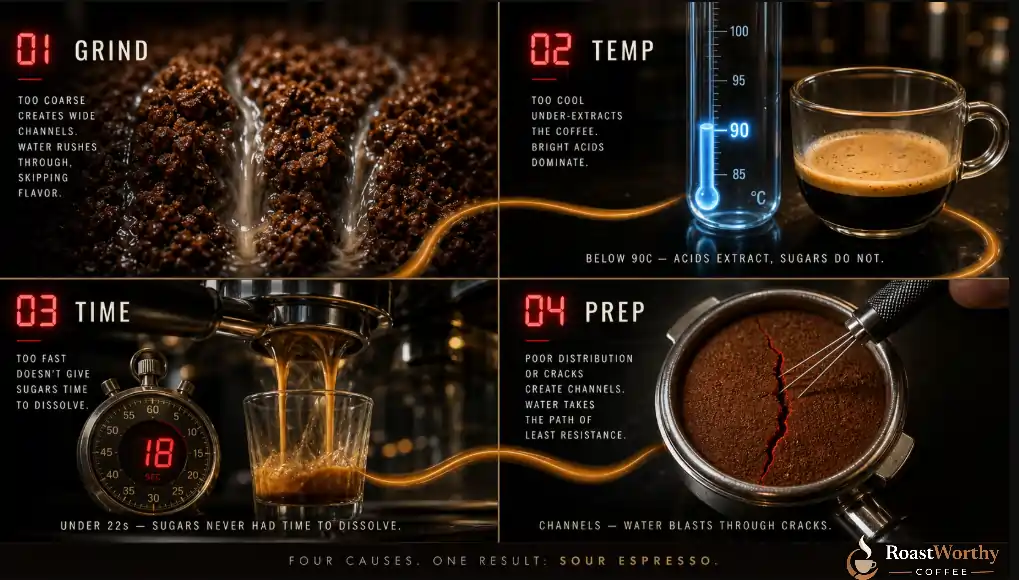
1. Grind Too Coarse — The #1 Culprit 🔬
A grind too coarse is responsible for sour espresso more than any other single variable.
Coarse particles create wide channels in the puck. Water finds the path of least resistance, flows through fast, and exits before it has time to dissolve sugars.
Result: a 17-second shot that tastes like lemon peel.
👉 Fix it: Move your grinder one notch finer. Pull again. If the shot slows down and the sourness drops — you found your problem.
2. Brew Temperature Too Low
Below 90°C (194°F), acids extract but sugars don't. The shot tastes sour because the water never got hot enough to unlock the sweetness.
Most home machines run 93–94°C by default. If yours is lower — or if you're pulling a light roast at dark-roast temps — you'll get sour espresso consistently.
👉 Fix it: Raise brew temperature by 1–2°C. For light roasts specifically, target 93–96°C. For darker roasts, stay in the 88–92°C range.
3. Short Extraction Time
Any shot running under 22 seconds is almost guaranteed to taste sour. There's no workaround.
Standard espresso parameters:
If you're hitting 18 seconds, the water evacuated before sugars had time to dissolve. Grind finer first. That usually fixes the time problem simultaneously.
4. Channeling From Poor Puck Prep
Channeling is when water finds a crack or weak point in the puck and blasts through it instead of flowing evenly. The result is the same as a coarse grind — fast, uneven extraction, sour shot.
You can have perfect grind size and correct temperature and still get sour espresso if your puck has channels.
👉 Fix it: Weigh every dose. Use WDT (Weiss Distribution Technique) — a thin needle tool — to break up clumps before tamping. Tamp level at 15–20 lbs of consistent pressure.
Sour Espresso Troubleshooting: Fast Diagnosis
| Symptom | Most Likely Cause | First Fix |
|---|---|---|
| Sour + watery thin body | Grind too coarse | Go finer, one step at a time |
| Sour + shot under 20 seconds | Short extraction time | Grind finer + check dose |
| Sour + correct time, correct grind | Brew temp too low | Raise temp 1–2°C |
| Sour + uneven extraction flow | Channeling / poor distribution | WDT tool + level tamp |
| Sour + weak aroma | Under-dosed puck | Increase dose by 0.5–1g |
| Sour on light roasts only | Temperature mismatch | Raise to 93–96°C for light roasts |
How to Fix Under-Extracted Espresso: Step-by-Step Dial-In
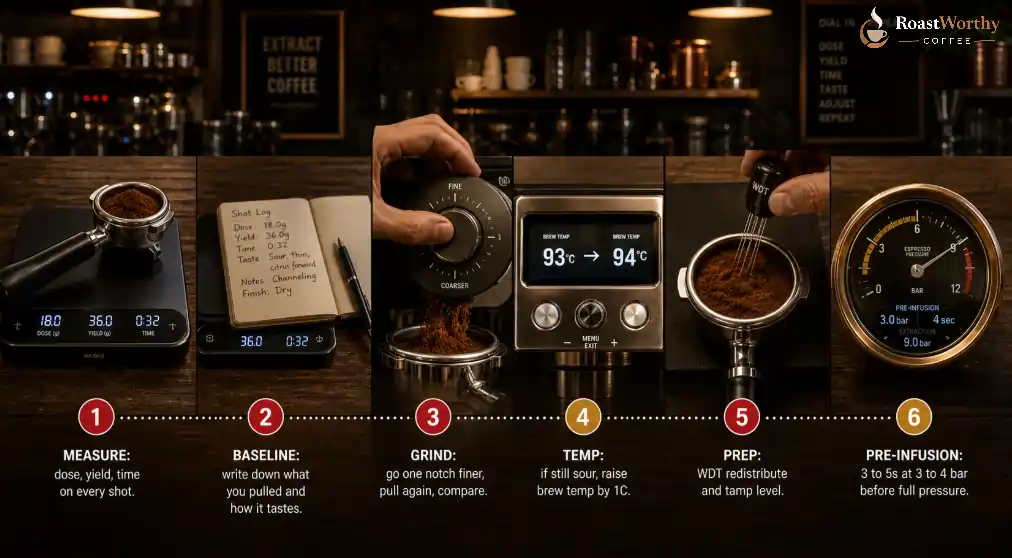
You don't fix sour espresso by guessing. You fix it by changing one variable at a time and tasting between each adjustment.
- Step 1 — Set up a scale and timer before anything else: If you're not measuring dose, yield, and time on every shot — you're not dialing in. You're gambling.
- Step 2 — Pull a baseline shot and record everything: Exact dose. Exact yield. Exact time. What it tastes like. Write it down.
- Step 3 — Adjust grind size first: Go one notch finer. Pull again. Compare. If the shot slowed down and tastes less sour — keep moving in that direction.
- Step 4 — Adjust temperature second: If grind is correct but sourness persists, raise brew temp by 1°C. Pull again. Taste.
- Step 5 — Address puck prep last: If parameters look right but you're still getting sour, uneven shots — clean the basket, redistribute with a WDT tool, and re-tamp with even pressure.
Step 6 — Consider pre-infusion: Many modern machines offer pre-infusion — a low-pressure soak of the puck before full pressure kicks in. Pre-infusion saturates the puck evenly, reduces channeling risk, and gives you more even extraction across the entire dose.
If your machine supports it, try 3–5 seconds of pre-infusion at 3–4 bar before ramping to full pressure. It's one of the most effective tools for fixing subtle under-extraction that grind adjustments alone don't solve.
Taste it. Write it down. Pull it again. ☕
Brew Temperature and Roast Level: The Chart Most Guides Skip
The correct brew temperature isn't a single number. It depends on the roast.
| Roast Level | Recommended Brew Temp | Why |
|---|---|---|
| Light roast | 93–96°C (199–205°F) | Dense beans need higher temps to dissolve |
| Medium roast | 91–93°C (196–199°F) | Balanced solubility, standard range |
| Dark roast | 88–92°C (190–198°F) | Porous beans over-extract at high temps |
If you switch from a medium to a light roast and suddenly get sour espresso — it's not your machine. It's your recipe. Recalibrate temperature first. Expect 3–5 shots to dial in on any new bag.
Under-Extraction Signs Beyond Sour Taste
Sour is the obvious tell — but under-extraction shows up in other ways too.
Watch for these alongside sourness:
Any two of these together and you're under-extracting. All five together means your parameters need a complete reset from scratch.
Grind Size and the Espresso Extraction Window
Grind size is the fastest lever you have. It directly controls puck resistance, which controls flow rate, which controls extraction time.
Move in small increments. One or two steps on your grinder at a time. Jumping five steps at once means you'll overshoot and end up with a bitter, over-extracted shot on the other end.
A single-dose grinder with consistent particle distribution — like the Niche Zero, DF64 Gen 2, or Lagom P64 — makes this significantly easier. Consistent particle size means predictable extraction every time.
Does Coffee Freshness Cause Sour Espresso?
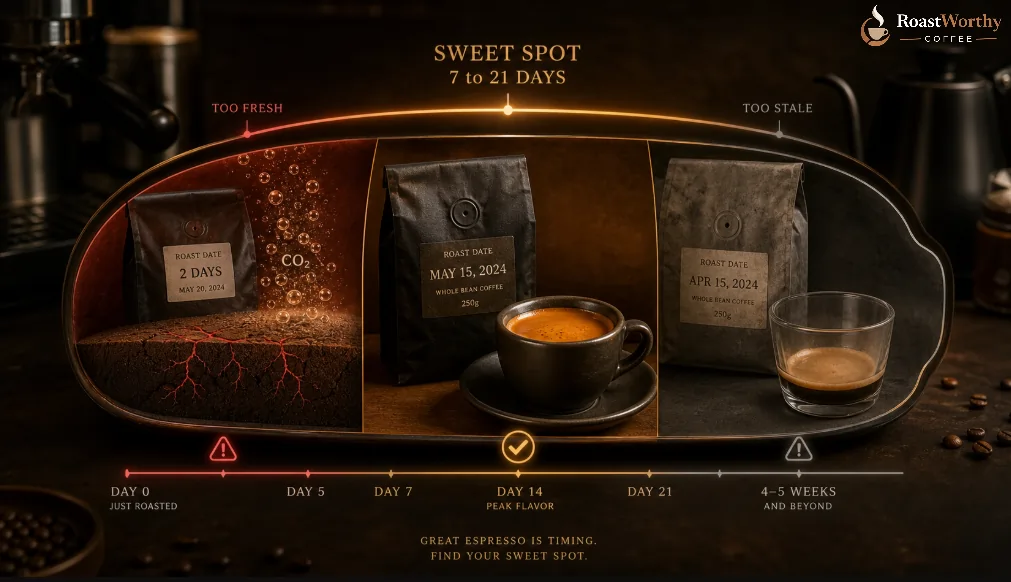
Yes — at both ends of the freshness window.
Too fresh (under 5 days from roast): Beans are still degassing CO₂. Gas in the puck interferes with even water flow. You'll get channeling and sour, uneven extraction no matter how well you prep.
Too stale (over 4–5 weeks from roast): Stale beans lose soluble compounds. They extract unevenly. You'll get thin, sour shots with no body.
The sweet spot for espresso: 7–21 days from roast date.
Write the roast date on every bag. Dial in a new bag fresh. Taste it. Write it down. Roast it again — or buy it again.
Does Water Quality Affect Espresso Sourness?
It does — and it's underrated.
Water that's too soft (under 75 ppm total dissolved solids) under-extracts coffee. Minerals in water help bind to and pull soluble compounds from the grounds. Without them, extraction efficiency drops, and sour shots become more frequent.
Ideal espresso water: 75–150 ppm total hardness, pH close to 7.0.
If you're using distilled or very soft filtered water, try Third Wave Water mineral packets or a dedicated espresso water recipe. The difference is real.
Tools That Make Dial-In Faster
You don't need expensive equipment to fix sour espresso. But a few tools remove the guesswork entirely.
Espresso scale with timer — A scale that reads to 0.1g and has a built-in shot timer. The Acaia Lunar is the gold standard. The Timemore Black Mirror Nano does the same job for a fraction of the cost.
WDT distribution tool — Breaks up clumps, eliminates channeling. The Barista Hustle Weiss or any thin-needle tool under $30 works fine.
Refractometer (optional) — Measures actual TDS and extraction yield. Removes all guesswork from the dial-in process. The Atago PAL-Coffee is the home barista standard.
What Well-Extracted Espresso Actually Tastes Like
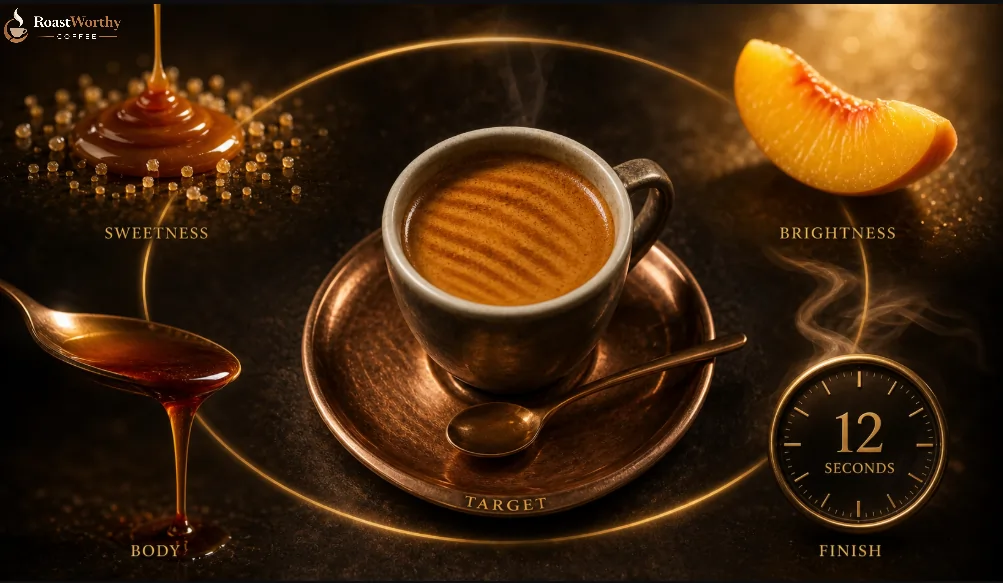
It's worth knowing the target before you chase it.
A correctly extracted espresso — 18g in, 36g out, 27 seconds — should taste like:
That's the benchmark. If your shot doesn't match that — it's not there yet. Keep adjusting.
The curve doesn't lie. 🔬
FAQ: Why Is My Espresso Sour?
Why does my espresso taste sour even though the grind and temperature look right?
Check puck prep first. Channeling can cause sour espresso even when grind size and temperature are correct. Use a WDT tool to distribute grounds evenly before tamping. Also check bean freshness — beans under 5 days from roast will channel and extract unevenly.
Why is my espresso sour but not bitter?
Pure sourness with no bitterness is a textbook sign of under-extraction. Bitterness comes later in the extraction sequence, after sweetness. If you're getting sour with no bitter at all, the shot ended well before full extraction. Grind finer and extend the shot time.
Can tamping pressure cause sour espresso?
Yes. Tamping too light leaves a loose, uneven puck. Water channels through it fast. Aim for 15–20 lbs of consistent, level pressure. Uneven tamping is as problematic as light tamping — it creates low-density spots where water rushes through.
Why does my espresso taste sour with a new bag of coffee?
Beans under 5–7 days from roast are still off-gassing CO₂. Gas in the puck disrupts water flow and causes uneven extraction. Rest espresso beans 7–14 days from roast date before pulling shots.
Does a 1:2 ratio prevent sour espresso?
A 1:2 ratio (e.g., 18g in → 36g out) is the standard starting point — but ratio alone doesn't guarantee good extraction. Time matters equally. A 1:2 ratio in 17 seconds is still under-extracted. Target 1:2 in 25–30 seconds as your baseline.
Can pre-infusion fix sour espresso?
Yes — particularly when the cause is channeling or uneven puck saturation. Pre-infusion at low pressure (3–4 bar) for 3–5 seconds before full extraction allows the puck to saturate evenly, reducing dry spots that would otherwise channel. It won't fix a grind that's too coarse, but it helps everything else.
TL;DR — Sour Espresso Fix Checklist
Taste it. Write it down. Pull it again. ☕⚗️
More Recommendations from RoastWorthy Coffee