What Is Panama Geisha Coffee — And Why Does It Cost So Much?

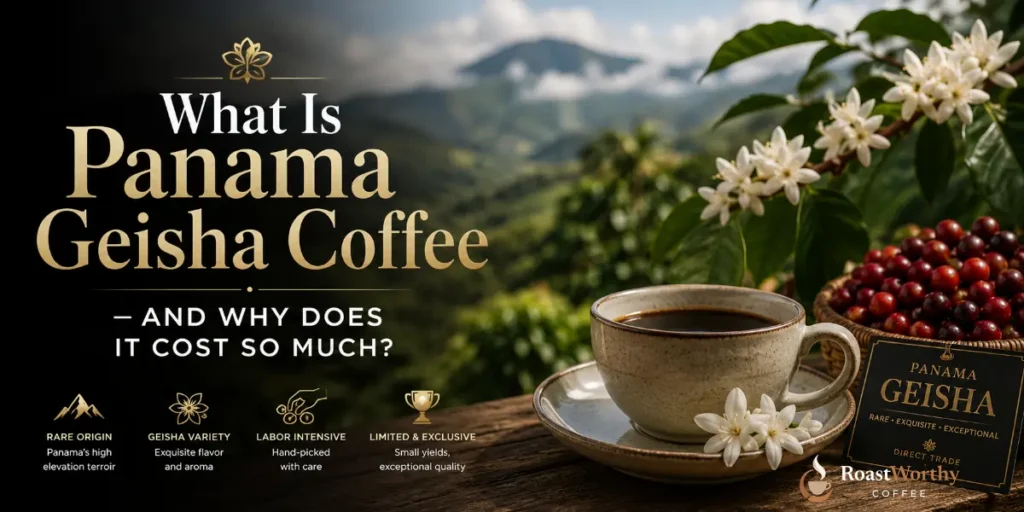
In 2004, a small Panamanian farm entered a coffee competition almost as an experiment.
The judges stopped mid-cup. Nobody had tasted anything like it. Hacienda La Esmeralda's Geisha didn't just win — it broke the scoring system people were using.
That was the moment Panama Geisha coffee changed the specialty world. It hasn't looked back since.
Panama Geisha Coffee: A Variety, Not Just a Name
Panama Geisha coffee is a specific genetic variety — Coffea arabica var. Geisha. It is not a processing style or a brand.
The name comes from the Gesha region of southwestern Ethiopia, where the variety was first collected in the 1930s. Spelling drifted over decades of documentation. Today both “Geisha” and “Gesha” are used — sometimes interchangeably, sometimes to signal slightly different genetic lineages.
The variety made its way through Costa Rica's CATIE research institute before landing in Panama in the 1960s. Farmers initially dismissed it. Low yield. Disease-resistant but not exciting. It sat mostly unnoticed on hillside lots at Hacienda La Esmeralda for decades.
Then someone cupped it separately. The terroir is doing something here that nobody expected.
What Panama Geisha Actually Tastes Like
Forget menu-speak. Here's what's actually in the cup.
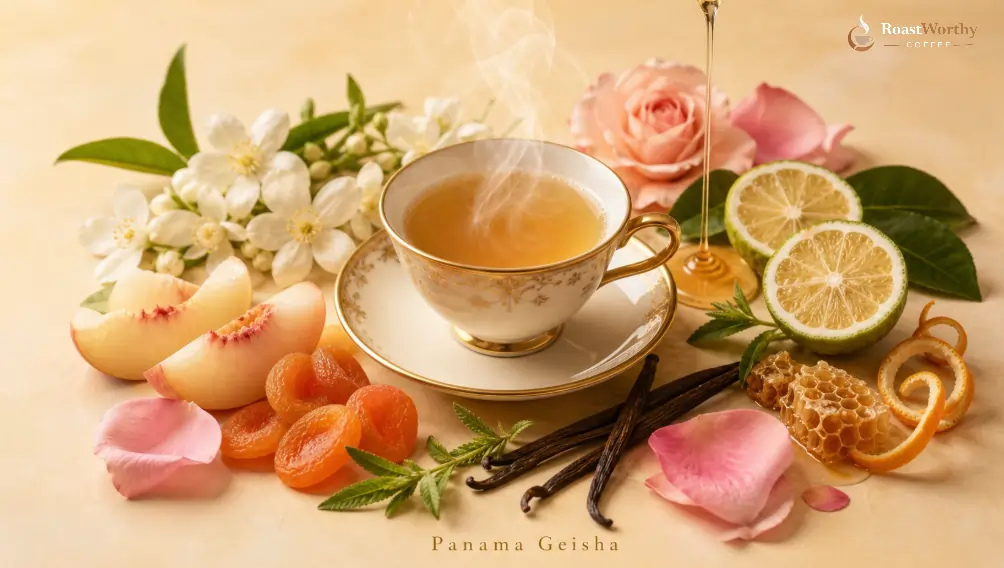
A well-prepared Panama Geisha — washed process, light roast — tastes like jasmine tea steeped in bergamot water, with a citrus brightness that lifts clean through the finish. There's a floral intensity that is genuinely unlike any other coffee variety.
Depending on the farm, the lot, and the process, you might also get:
The texture is light. Almost tea-like. That surprises people expecting body.
Natural-processed Geisha reads differently — more fruit-forward, sometimes slightly fermented, closer to a floral stone fruit than a jasmine tea. Both are exceptional. They are not the same experience.
The cupping score on top-tier lots regularly lands at 94–97 points. That is rare at any price. At that consistency, it's almost unheard of.
☕ There's a whole story in this cup — and the flavour is only part of it.
Why It Comes From Panama Specifically
Ethiopia has Geisha genetics. So do farms in Colombia, Costa Rica, and Japan. But Panama Geisha commands a different market tier. Why?
Altitude and microclimate.
The Boquete region of Chiriquí Province sits at 1,500–1,800 metres above sea level. Volcanic soil. High humidity from the cloud forest. Cool nights that slow cherry development dramatically. Slow development means more time for sugars and organic acids to accumulate inside the bean.
The result: a flavour complexity that farms at lower altitudes or different latitudes simply cannot replicate with the same variety.
This is not marketing. It's measurable in cup quality and auction results. The terroir is doing something here that soil chemistry and sensory science both confirm.
Other origins grow Geisha. Panama grows this Geisha.
Hacienda La Esmeralda: The Farm That Started It All
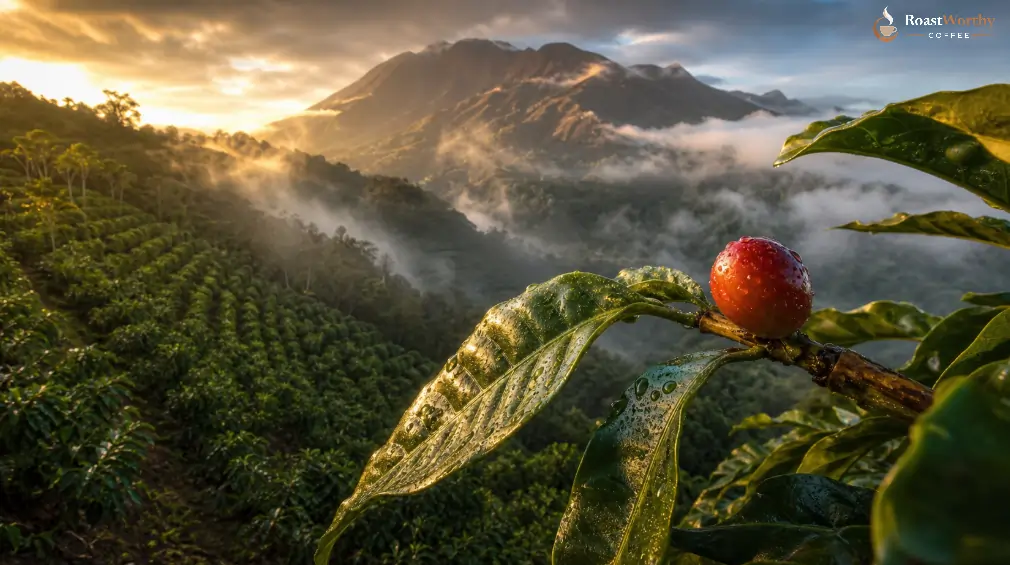
You cannot talk about Panama Geisha coffee without naming the Petersons.
The Peterson family has owned Hacienda La Esmeralda since 1967. It was Daniel Peterson's decision to isolate those Geisha trees on the Jaramillo plot and cup them separately in 2004.
Since that competition win, Esmeralda has auctioned its Geisha lots through its own Best of Panama invite-only auction. The results have been extraordinary:
These are not retail prices. They are auction prices for micro-lots — sometimes 10 to 50 kilograms total. The numbers are real.
Esmeralda is not the only producer. Lamastus Family Estates, Elida Estate, and Carmen Estate all produce world-class Panama Geisha. But Esmeralda remains the reference point. The name that made the variety famous. The people who grew this deserve credit.
Why Panama Geisha Coffee Is So Expensive
🌿 The price isn't hype. It's the result of six compounding factors.
1. Tiny yields per tree
Geisha trees produce significantly less fruit per hectare than commercial varieties like Catuai or Caturra. Farmers are choosing quality over volume every season.
2. Extreme altitude and difficulty of harvest
High-altitude farms are harder to work. Harvesting steep volcanic hillsides by hand — selectively picking only ripe cherries — is slow, skilled labour. Multiple passes per tree, per season.
3. Microclimate specificity
Only a few thousand hectares in Panama have the precise conditions to grow Geisha at competition quality. That land is finite.
4. Processing precision
Top producers use meticulous washed or natural processing with temperature-controlled fermentation and raised drying beds. The margin for error is zero at this price point.
5. Auction market dynamics
When roasters in Tokyo, Seoul, New York, and Copenhagen compete for 30-kilogram lots, auction prices detach from any normal cost-of-production calculation. Scarcity times desire equals this number.
6. Cupping score consistency
At 94–97 points, this variety scores where almost nothing else does — repeatedly, year over year. The market prices certainty of excellence.
A bag of Panama Geisha coffee at specialty retail typically costs $60–$150 per 100 grams. At auction, the same variety sells for hundreds or thousands per pound. Both prices are, in their context, rational.
How to Actually Brew Panama Geisha at Home
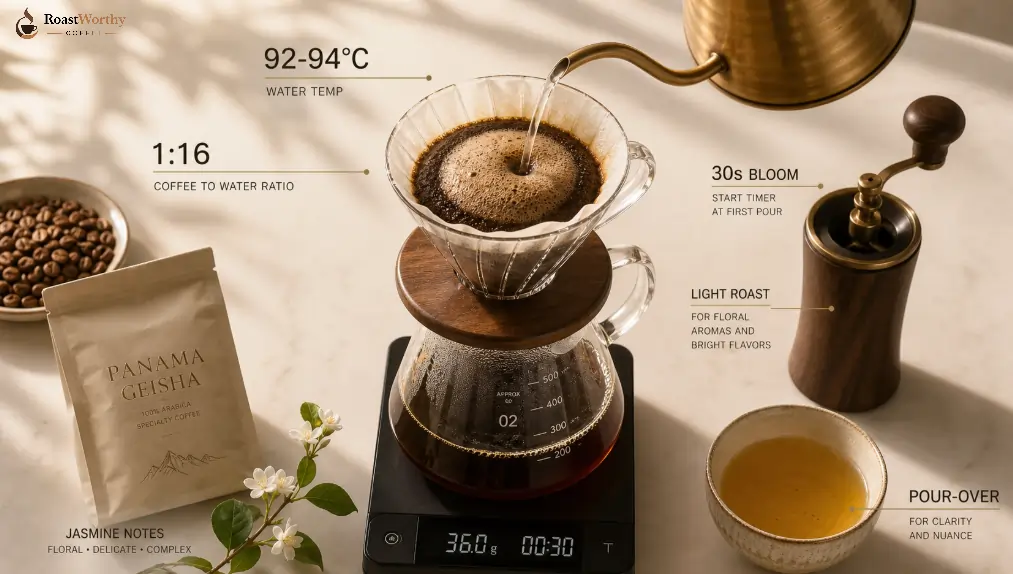
You paid for it. Don't waste it.
Roast level: always light. Medium roast will flatten the jasmine. Dark roast is simply a mistake at this price. You want a light roast, off the roaster within 7–21 days, before the volatile aromatics fade. 🌡️
Brew method: pour-over or Chemex. The tea-like body and floral top notes show best through a paper filter. Espresso is possible — but the delicacy translates poorly under pressure for most palates.
Grind: medium-fine, fresh. Grind immediately before brewing. Geisha's aromatics are volatile. Pre-ground Geisha is a waste of money.
Water temperature: 92–94°C. Slightly cooler than standard pour-over to protect the floral compounds from extraction distortion.
Ratio: 1:16 (1 gram coffee to 16 grams water). Some go 1:15 for slightly more body.
Bloom for 30–45 seconds. Pour slowly. This is not a coffee you rush.
Taste it. Write it down. Roast it again — if you can afford to.
Frequently Asked Questions
What is Panama Geisha coffee?
Panama Geisha (also spelled Gesha) is an Arabica coffee variety originally from Ethiopia's Gesha region, now grown primarily in Panama's Boquete highlands. It's known for its intense jasmine, bergamot, and citrus flavour, and for consistently achieving the highest cupping scores in the specialty coffee world.
Why is Panama Geisha coffee so expensive?
Low yields, high-altitude hand harvesting, limited microclimate conditions, precision processing, and fierce global auction competition all drive the price. Top lots from Hacienda La Esmeralda and other Panama farms sell for hundreds to thousands of dollars per pound at auction.
What does Panama Geisha coffee taste like?
A washed Panama Geisha tastes like jasmine tea with bergamot, white peach, and citrus. The body is light and clean. Natural-processed versions lean more toward stone fruit and floral fermentation. Both are distinct from any other coffee variety.
What is the best way to brew Panama Geisha?
Pour-over or Chemex, light roast, water at 92–94°C, 1:16 ratio, freshly ground immediately before brewing. Never use pre-ground Geisha. Never dark roast it.
What is Hacienda La Esmeralda?
It's a Panamanian farm owned by the Peterson family in the Boquete region of Chiriquí Province. They were first to isolate and compete the Geisha variety in 2004, winning the Best of Panama competition and triggering a global specialty coffee revaluation of the variety.
Is Panama Geisha coffee the most expensive coffee in the world?
By auction price per lot, yes — it regularly holds the record. Retail availability at $60–$150+ per 100 grams makes it one of the highest-priced coffees accessible to consumers. Kopi Luwak is expensive by gimmick. Geisha is expensive because it earns it.
Is Panama Geisha Coffee Actually Worth It?
Let's be honest. Spending $80 on 100 grams of coffee requires a real answer, not a dodge.
If you are a coffee professional — a roaster, a cupper, a serious enthusiast building your palate — yes. Panama Geisha is not hyperbole. It is a genuine sensory reference point. There is nothing else that delivers this particular combination of jasmine, bergamot, and citrus clarity with this level of precision. Tasting it recalibrates what you think coffee can do.
If you are a casual drinker who adds oat milk and a pump of vanilla syrup — no. Buy a great Colombian instead. You will enjoy it more. This is not a slight; it is honest pairing advice.
The people who say Geisha is overpriced have usually had a poorly sourced lot, an over-roasted bag, or bad brew technique. The variety is expensive and unforgiving of those three failures simultaneously.
Find a roaster who sources it carefully, roasts it light, and ships it fresh. That experience will answer the question for you better than any article can.
Start with the origin, not the price tag.
More Recommendations from RoastWorthy Coffee