Purity vs Natural Force Coffee 2026: Which Is the Cleanest?

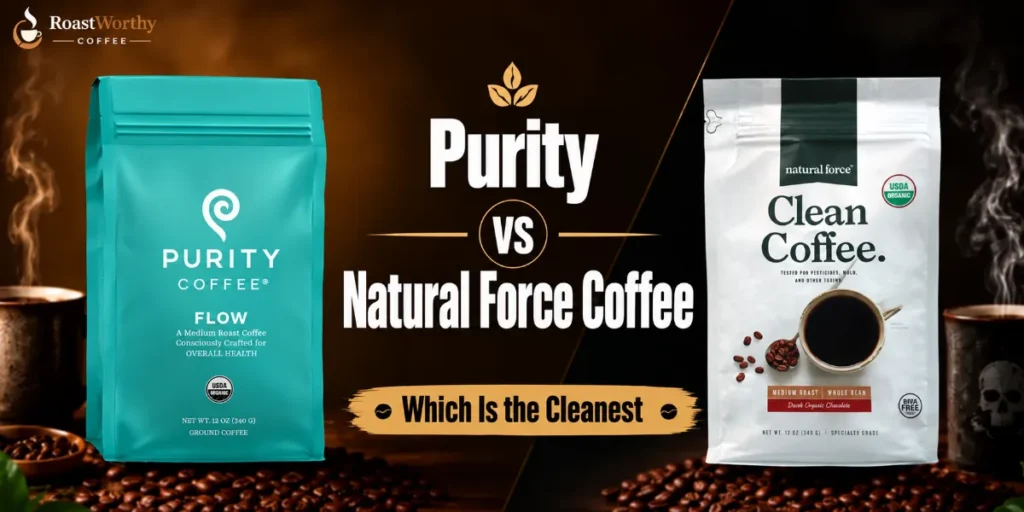
Two brands. Two big “clean coffee” claims. One question that actually matters.
Purity vs Natural Force Coffee comes down to a single test: who shows you the receipts?
Both sell themselves as mold free coffee. Both test for mycotoxins. Both talk a good game about being the cleanest cup you can drink. But “we test” and “here’s the published COA” are not the same sentence… and that gap is where this comparison gets interesting.
Let’s be honest. Most clean coffee marketing is vibes. Testing claims with no numbers attached. This one’s different — because both of these brands have real data behind them. The question is how much, how current, and how easy it is to actually read.
Here’s the head-to-head.
Quick Verdict Box
Winner on published transparency (2026): Natural Force Clean Coffee. It publicly links a downloadable third-party COA from Eurofins, an ISO 17025 lab, covering mold, yeast, 12+ mycotoxins, gluten, acrylamide, heavy metals, and 150+ pesticides.
Winner on depth of testing history + antioxidants: Purity Coffee. Its testing program is broader and more scientific — but much of the published data traces back to a 2016–2018 survey, with current SKU-level numbers living on individual product pages.
Two different philosophies. Neither is fake. Keep reading — the details change the picture.
What “Cleanest Coffee” Actually Means
Before we crown anyone, define the word.
A “clean” or mold free coffee is one verified — usually by third-party lab — to carry mycotoxins below the detection limit of the test. That’s it. Not sterile. Not magic. Just proven low on the toxic compounds certain molds produce.
The four things that actually matter in a clean coffee comparison:
Organic certification, for the record, does not cover any of this. Organic is a cultivation-input rule. It governs what the farmer sprays. It says nothing about mold that grows during drying, transport, or storage.
That distinction is the whole ballgame. A low acid organic coffee can still be moldy. Testing is the only proof.
Here’s the part most brands hope you skip. A 2015 study in Food Control found multiple mycotoxin classes across 103 commercial coffee samples. An earlier study found ochratoxin A in 56% of coffee beans analyzed. So “mold free coffee” isn’t a made-up worry. It’s a real, measurable differentiator… when a brand can actually prove it.
For more on how roasting affects clean coffee chemistry, our guide to roast level and coffee acidity is worth a read.
The Contenders: Purity vs Natural Force Coffee
Purity Coffee — The Science Project
Purity built its brand on one idea: the healthiest coffee that science allows.
They’re a certified B Corp. They roast to a specific Agtron window — around 59 — deliberately chosen to preserve antioxidants while keeping acrylamide down. They hold Smithsonian Bird Friendly and Demeter certifications on select coffees. They’re chasing regenerative organic certification on their own Colombian farm.
Their original testing survey was serious. 178 coffees. 65 brands. Three separate universities and a commercial lab. Tested for mold, yeast, ochratoxin, aflatoxins, pesticides, lead, cadmium, copper, acrylamide, chlorogenic acids, trigonelline, and caffeine.
That’s not marketing. That’s a research program.
The labs were legit too — Silliker-Mérieux in Illinois, the Federal University of Rio de Janeiro, and the University of Porto. Blind samples. Random three-digit codes. Q Grader cupping at an SCA-certified lab. This is the most academically rigorous clean-coffee testing I’ve seen from any consumer brand.
The catch? Much of that published data is from 2016–2018. Purity now directs you to each product’s “About” tab for current numbers, with more available on request.
Natural Force — The Receipt Keeper
Natural Force is a broader wellness brand. Coffee is one line among supplements.
But their Clean Coffee does something most of the category won’t: it links a downloadable third-party COA right from their support desk. Two of them, actually — one for green coffee, one for roasted.
The lab is Eurofins. ISO/IEC 17025 accredited. Global gold standard for food analytics.
The panel is broad: mold and yeast, mycotoxins, gluten, acrylamide, heavy metals (mercury, lead, arsenic, cadmium), pesticides, and glyphosate. Single-origin, high-altitude, specialty-grade arabica, USDA Organic, nitrogen-flushed packaging, and low acid by design.
They test per crop — annually, and whenever a new lot is selected. That’s a quality system, not a one-off.
One detail I respect: they don’t edit the reports. What Eurofins sends is what you see, raw technical document and all. They even publish a legend explaining the units — cfu/g for mold, µg/kg for acrylamide, and what a “<” symbol means. Most brands wouldn’t bother. It signals they expect you to actually read it.
Head-to-Head Comparison
| Factor | Purity Coffee | Natural Force Clean Coffee |
|---|---|---|
| Published COA (downloadable) | Partial — annual mold/mycotoxin data per SKU; older survey compiled as charts | Yes — direct link, green + roasted certificates |
| Testing lab | Silliker-Mérieux, Univ. Rio, Univ. Porto (historical) | Eurofins (ISO 17025) |
| Mycotoxin panel | OTA + aflatoxins (B1/B2/G1/G2) | 12+ mycotoxins |
| Mold / yeast tested | Yes | Yes |
| Acrylamide tested | Yes (~196 µg/kg, Agtron 59) | Yes (minimized) |
| Heavy metals | Lead, cadmium, copper | Mercury, lead, arsenic, cadmium |
| Pesticides / glyphosate | 310-chemical composite | 150+ pesticides incl. glyphosate |
| Organic | USDA Organic | USDA Organic |
| Low acid | pH ~4.95–5.05 (balanced) | Yes, marketed low acid |
| Certifications | B Corp, Bird Friendly, Demeter (select) | B Corp |
| Antioxidant data | Yes — CGAs + trigonelline published | No |
| Testing cadence | Ongoing + historical survey | Per crop / annual |
| Approx. per-cup (retail) | ~$1.19 | ~$1.15 |
The flavour doesn’t lie, but neither does a table. Read it twice.
Mold Free & Mycotoxin Free: Who Proves It Better?
This is the heart of the fight. So let’s actually look at numbers.
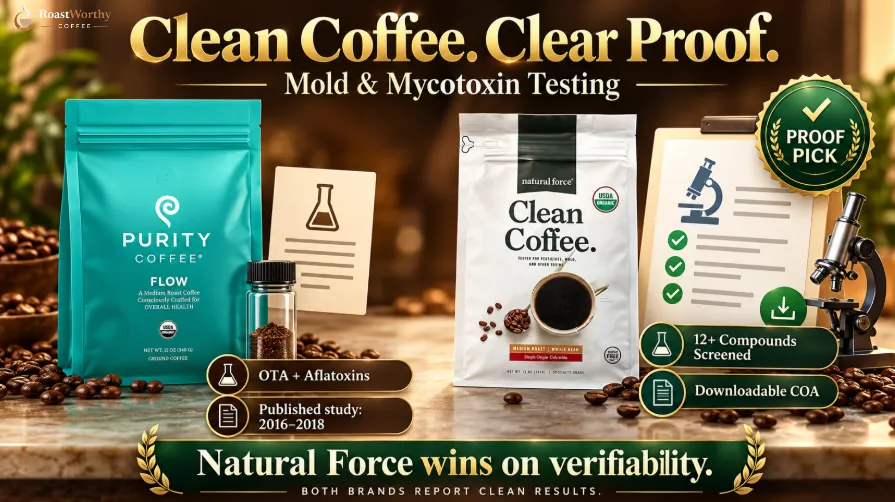
Purity’s own roasted coffee in their survey: mold <10 colonies, yeast <10, ochratoxin A <0.2 µg/kg, aflatoxins undetected. Genuinely clean results. They also refuse to buy any green coffee that shows any ochratoxin. Strong policy.
But here’s the honest bit… those specific published figures are from the 2016–2018 program. Current per-crop data exists, it’s just scattered across product pages rather than sitting in one linked certificate.
Natural Force hands you the certificate directly. Their reporting convention is clear too — a “<” symbol means the result was below the lab’s detection sensitivity. Functionally, none detected.
On mycotoxin panel breadth, Natural Force is wider on paper: 12+ compounds versus Purity’s OTA-plus-aflatoxins focus. More compounds screened means fewer blind spots. That matters, because aflatoxins and OTA aren’t the only mold metabolites that can ride along in shared processing facilities.
Now, a fair counterpoint. Breadth isn’t everything. Purity’s refusal to accept any detectable OTA at the green stage is arguably a stricter gatekeeping standard than a broad panel with generous limits. One brand screens for more things. The other draws a harder line on the thing that’s actually regulated. Both are defensible.
So who’s the more mycotoxin free coffee?
Verdict on this round: Natural Force. Not because Purity’s coffee is dirtier — the data suggests both are genuinely clean — but because a broad, current, downloadable COA beats an excellent historical study you have to reassemble yourself. In a clean coffee comparison, verifiability is the product.
Acrylamide: The Roasting Question
Acrylamide isn’t a mold problem. It’s a heat problem. It forms during roasting, and it climbs with darker, longer, sloppier roasts.
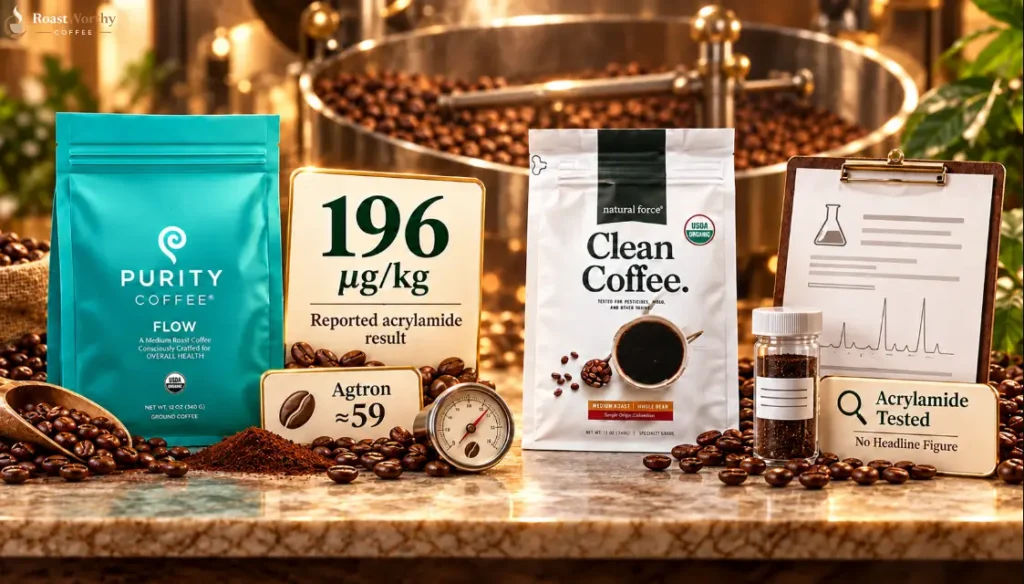
Purity is unusually specific here. They roast to Agtron ~59 partly to keep acrylamide down — their tested roasted coffee came in around 196 µg/kg. For context, they clocked competitor coffees as high as 1,053 µg/kg. And a fast-food fry portion runs far higher than any of them.
That’s the useful frame, honestly. Coffee is a minor acrylamide source next to fried and baked foods. But if you’re already optimizing, a fivefold difference between the best and worst coffees isn’t nothing.
Natural Force tests for acrylamide too, through Eurofins, with the stated goal of minimizing it. They don’t publish a headline number the way Purity does.
Verdict on acrylamide: Purity. They’ve turned roast chemistry into a spec, and they show the figure. That’s rare, and it earns credit. ☕
Low Acid, Organic & Taste
Both are USDA Organic. Both position as low acid. This is closer than the testing gap suggests.
Purity targets a pH of roughly 4.95–5.05 — deliberately balanced, not aggressively de-acidified. Their flagship cups around 85 on the Q scale. Specialty grade, no asterisk. It tastes like a clean, rounded medium — cocoa, gentle stone fruit, low bitterness. Well built. Not thrilling, but that’s the point. It’s engineered for consistency and health, not for wowing a cupping table.
Natural Force is single-origin, high-altitude arabica, marketed as smooth and low acid for sensitive stomachs. It’s a comfortable everyday cup. Less about origin character, more about being easy on the gut.
A word on “low acid,” because the term gets abused. Neither of these is chemically stripped of acidity like some canned low-acid brands. Both are naturally smoother through bean selection, altitude, and roast — not through processing that flattens the cup into cardboard. That’s the right way to do low acid. Credit to both.
Neither is going to embarrass a great single-origin from Onyx or Sey. That’s not the assignment. These are health-first cups that happen to taste fine — and both clear that bar.
Verdict on taste: narrow edge to Purity, on cupping score and roast precision. But it’s close, and your stomach may vote differently.
The Antioxidant Wildcard
Here’s where Purity pulls genuinely ahead on something Natural Force doesn’t even play.
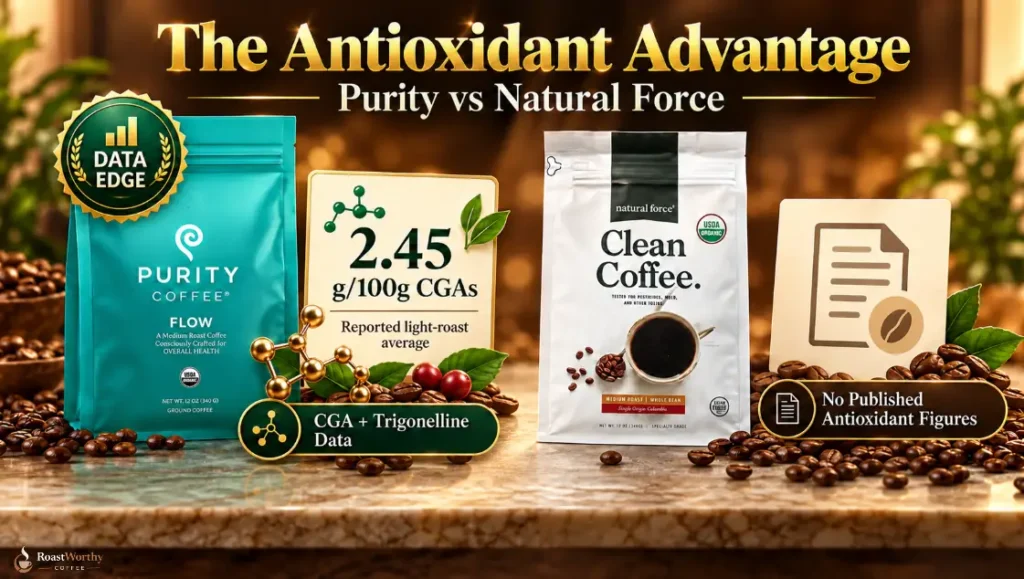
Purity publishes chlorogenic acid (CGA) and trigonelline data — the antioxidant compounds coffee is prized for. Their light-roast-averaged CGAs hit 2.45 g/100g. Over-roasting destroys these, so Purity’s controlled roast is doing real work.
They’ve also claimed antioxidant levels averaging around 65% higher than other organic brands they tested. Take any brand’s own comparison with a pinch of salt — but the underlying logic holds. A lighter, more controlled roast preserves more CGAs. The chemistry backs the claim even if the exact percentage is theirs to defend.
Natural Force doesn’t publish antioxidant numbers. Different focus.
If “cleanest” to you also means “most nutritionally optimized,” this tips things back toward Purity. If “cleanest” means “prove the toxins are absent,” it doesn’t.
Define your own word. Then choose. ✒️
FAQ's
Is Purity or Natural Force coffee actually mold free?
Both test below detection limits for mold and mycotoxins in their published data. “Mold free” means verified low on mycotoxins, not sterile. Natural Force publishes a linkable Eurofins COA; Purity publishes an extensive testing history plus per-product data. Both back the claim.
Which coffee publishes a real COA?
Natural Force links a downloadable third-party certificate of analysis from Eurofins directly on its support site, covering green and roasted coffee. Purity publishes a large historical testing survey and current data on individual product pages, but not as one single downloadable certificate.
Are both coffees low acid and organic?
Yes. Both are USDA Organic and marketed as low acid. Purity targets a balanced pH around 4.95–5.05; Natural Force uses single-origin high-altitude arabica for a naturally smoother, low-acid cup.
What about acrylamide?
Both test for acrylamide. Purity is more transparent, publishing a figure near 196 µg/kg at its Agtron 59 roast and roasting specifically to keep it low. Natural Force tests through Eurofins to minimize it but doesn’t publish a headline number.
Does organic certification mean a coffee is mold free?
No. Organic governs farming inputs — no synthetic pesticides or GMOs. It requires zero mycotoxin testing. Mold can form after the farmer’s job is done, during drying, transport, or storage. Only lab testing verifies a mold free coffee.
Which is the cleanest coffee overall in 2026?
It depends on your definition. For verifiable, downloadable proof of low toxins, Natural Force edges ahead. For the deepest testing science plus published antioxidant data, Purity leads. Both scored 8.5/10 in our clean coffee comparison.
So… Which Is the Cleanest?
Let’s not waffle. A verdict is mandatory.
If you want proof you can hold in your hand — buy Natural Force. The publicly linked Eurofins COA, the 12+ mycotoxin panel, the heavy-metal and glyphosate coverage, the per-crop cadence… that’s the strongest verifiable clean coffee case here. For most people asking “which is best,” transparency you can click on wins.
docked half a point because coffee is a side line, not the core focus, and roast variety is thin.
If you want the deepest science and antioxidant optimization — buy Purity. The testing history is broader and more rigorous, the acrylamide control is a published spec, the CGA and trigonelline data is unmatched, and the coffee cups higher. The only real knock is that the headline lab data leans historical, so you’re trusting the current product pages more than one master certificate.
same score, different reasons. Fix the “one clear current COA” problem and it’s a 9.
Two eights-and-a-half. Genuinely. This is one of the rare comparisons where I won’t pretend there’s a landslide.
My personal pick? If you’d forced me to spend my own money this morning, I’d have grabbed Natural Force — purely because I could read the certificate before checkout. But I’d keep a bag of Purity for the days I want the higher-scoring cup. Both live in my cupboard. That’s the most honest verdict I can give you.
Pick your definition of clean. Both deliver on it — they just deliver on different halves.
Want a third option to weigh against these two? See our full Purity Coffee review.
More Recommendations from RoastWorthy Coffee